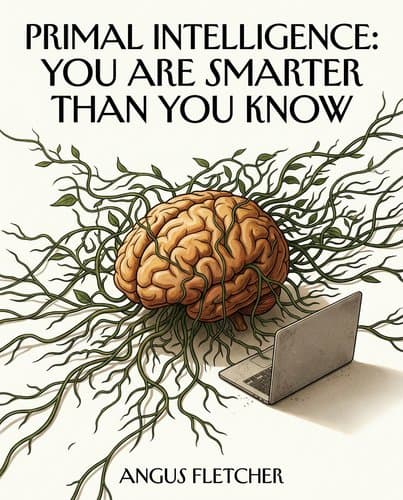
221754320_primal-intelligence
by Angus Fletcher
Your brain's most powerful capabilities—intuition, emotion, imagination—aren't flaws to suppress but ancient tools to reclaim. Fletcher shows how thinking in…
In Brief
Your brain's most powerful capabilities—intuition, emotion, imagination—aren't flaws to suppress but ancient tools to reclaim. Fletcher shows how thinking in stories instead of data unlocks the primal intelligence that algorithms can't replicate and formal education systematically trains out of us.
Key Ideas
Fear reveals what plan is missing
When you feel fear, don't fight it — ask what plan is missing. Fear is a signal that you've reached the edge of your current strategy, not evidence that you're weak or irrational.
Single objective beats dual conflicts
Design every plan with one non-negotiable goal and multiple routes. Having two primary objectives isn't disciplined — it's a guarantee of paralysis when they conflict under pressure.
Hunt exceptions for real intelligence
Train your intuition by hunting for exceptions rather than patterns. When studying a problem, look for what violates the rules, not what confirms them — that's where the usable intelligence lives.
Now plus one beats future modeling
Use the 'Now + 1' filter for uncertainty: don't model outcomes ten steps ahead. Identify only the immediate next move, then reassess. This is how Simons unplugged failing algorithms and how Armstrong landed on the moon.
Deliberate failure raises expertise ceiling
To grow as an expert, deliberately hand control to someone less experienced and let them chain mistakes until recovery is impossible. The solution you invent in that moment is your new ceiling.
Integrate setbacks into forward momentum
When you feel stuck after a setback, look for the fortunate plot twist in your own history — a moment when something good came from something bad. Your brain cannot build forward momentum on an unintegrated past.
Study dismissed anomalies for innovation
Before innovating, ask not 'what's the best existing solution?' but 'what's the exception that everyone else is discarding?' Einstein's law of relativity and van Gogh's RGB color wheel both started as anomalies that experts dismissed.
Who Should Read This
Curious readers interested in Neuroscience and Cognitive Psychology and the science of how the mind actually works.
Primal Intelligence: You Are Smarter Than You Know
By Angus Fletcher
14 min read
Why does it matter? Because the intelligence you were told to trust is the one that fails you most.
The U.S. Army spent decades selecting for the sharpest minds it could find—and then watched those minds crack under pressure. High test scores, brittle results. The recruits could solve equations but not crises. They were, in the truest sense, too educated for their own good. What went wrong isn't a mystery once you understand what modern schooling actually does: it trains human beings to imitate machines, then wonders why they lose to machines. The intelligence that carried our ancestors through genuine uncertainty—not ambiguity they'd been briefed on, but the kind that has no map—was never destroyed. It was just systematically ignored. Your instincts aren't noise corrupting your thinking. Your emotions aren't irrationality to be managed. Your gut sense that something is off, or possible, or worth risking—that's a biological system older and more sophisticated than any algorithm built to replace it. This book is about learning to trust that system again: the felt sense, the instinct, the knowledge your body registers before your brain catches up.
You Were Trained to Be a Worse Version of Your Own Laptop
Here is the uncomfortable truth about the education you received: it trained you to think like a computer, and computers do it better. Every institution that has ever assessed your intelligence — standardized tests, university admissions, performance reviews — has been measuring the same thing: logic. The mechanical operations Aristotle catalogued two thousand years ago, the same ones that now run artificial intelligence, arithmetic, data analytics, and behavioral economics. Logic is the official definition of smart, according to the U.S. Department of Education, Google, and the Nobel Prize committee alike. So you spent years drilling it. Which means you spent years optimizing for the one cognitive skill your laptop already beats you at.
The Army noticed the damage before most. By the early 2020s, Special Operations was recruiting candidates who scored at the ceiling of every IQ measure — elite by any conventional standard — yet fell apart in dynamic situations. Under pressure, they made poor decisions, erupted in anger, collapsed into addiction. One observer summarized the problem: they could solve math problems, but not life problems. The reason is structural. Logic requires stable data. Feed it incomplete information, ambiguity, or a situation that's never happened before, and it stalls. Real life is almost entirely that situation.
So if the brain isn't running logic when data runs out, what is it running? Fletcher argues it evolved four distinct powers precisely for that condition: intuition, which makes you sprint toward a sound before you've decided to move; imagination, which lets you rehearse a conversation that hasn't happened yet; emotion, which rewires your priorities after failure or loss; and commonsense, which gets you to a workable answer when the facts are missing. Ancient thinkers didn't invent these — they named them only after noticing what human intelligence already did naturally. They run on chemistry, not circuits, which is why AI consistently underperforms humans wherever data is thin.
The school system didn't just neglect these powers. It trained you to distrust them.
The Thing Van Gogh Saw That Scientists Wouldn't Discover for a Century
In May 1889, Vincent van Gogh picked up a brush inside a psychiatric asylum in Saint-Rémy and painted something his contemporaries found simply strange: a bush where the leaves and flowers clashed so violently they seemed to vibrate. He called it Lilac Bush. The colors — intense green against deep purple — violated the accepted rules of his era, a logical system called the RYB color wheel that French academics had formalized in the 1820s. According to RYB, the most powerful color pairings were red-green, yellow-purple, and blue-orange. Green-purple wasn't on the list. It wasn't supposed to work.
Van Gogh painted it anyway, because he had noticed something in the murals of Eugène Delacroix: the green-purple combination didn't just work — it hit harder than the sanctioned pairings. That observation led him to a second exception. Yellow and blue, he found, intensified each other beyond what the established wheel predicted, which is how The Starry Night got its electric sky the following month. Then he pushed further: what was red's true opposite? Not green, as RYB specified, but aquamarine — cyan. In his final self-portrait, painted in September of that same year, he colored his beard red and his jacket cyan. His peers were baffled. Cyan wasn't even considered a primary color.
Modern science later discovered why those choices hit so hard. Red cones make up nearly two-thirds of color receptors in the human eye, giving red roughly thirty times the visual punch of blue or purple. Placing red against cyan maximizes that biological intensity — it's the most chromatically vivid pairing the visual cortex can process. What van Gogh had effectively mapped, working from a single noticed exception, was the red-green-blue color wheel: RGB. The same system that powers every screen you're reading this on.
Fletcher uses van Gogh to dismantle a widely held assumption — that intuition is pattern recognition, a faster, fuzzier version of the same logic that experts use. But van Gogh wasn't recognizing patterns. He was detecting where the pattern broke. The exception — green-purple where yellow-purple should have been — was the data point that mattered. The rule existed precisely to make that anomaly invisible to everyone following the rule.
There's something worth sitting with here. Your attention snagging on the outlier wasn't distraction. It was the same capacity that kept van Gogh painting through the asylum walls — the refusal to unsee what the rules said wasn't there.
The Best Plan Has One Goal and Infinite Routes
Think of a mountain guide who has one instruction for every client: reach the summit. She has no preferred route. Ice on the north face? Take the west ridge. Rockfall on the west ridge? Find the couloir nobody's used in a decade. The destination is fixed; the path is permanently in negotiation. Most people planning a major life or business move do the opposite: they name half a dozen summits and commit obsessively to a single trail.
Fletcher encountered this in a simulation run at Cape Fear, North Carolina, where a bomb detonates without warning during a diplomatic meeting with a tribal chieftain. Ordinary people — even smart, capable ones — tend to freeze, fight back, or reach for a radio. The Special Operators in the scenario do something different. Each one improvises a completely distinct response, yet every response bends toward the same objective: restore trust with the chieftain. One Operator cracks a dark joke. Another offers medical help. A third moves physically closer rather than away. The tactics look nothing alike. The goal is identical. Fletcher calls this defined strategy, unlimited tactics — one fixed destination, every possible trail.
When he tested this model against how real leaders actually plan, the gap was jarring. One Fortune 50 CEO listed fifteen things he considered primary objectives. Not aspirations, not nice-to-haves — primary. The moment resources thinned or pressures hit, those fifteen things would pull in fifteen directions, guaranteeing hesitation and half-measures.
This, Fletcher argues, is the default failure mode of ambitious people: they spread goals wide to feel thorough, then narrow tactics to one cherished plan because committing to alternatives feels like doubting themselves. The brain cannot imaginatively plan around multiple simultaneous goals. Fix a single destination and the mind naturally generates branching paths toward it — because with the summit fixed, every obstacle becomes a routing problem. Multiply the summits and every obstacle becomes a crisis. Which raises a harder question: what happens when even a single-summit strategy hits something the map didn't show?
Fear Doesn't Mean Danger. It Means You Have No Plan.
Most of us, when fear arrives, try to override it — push it down, perform calm, get through the moment without showing the crack. That trained response costs us exactly the information we need most.
Here is what fear is actually reporting: you have no plan. Not that the situation is deadly, not that you're weak — that you're operating at the edge of your map, past the last reliable landmark. Fletcher traces how the brain responds to that condition. Without a plan, it can't think forward, so it does the next best thing: it makes you receptive. The more afraid you are, the more willing your brain becomes to follow someone else's direction, absorbing their plan as a substitute for your own. That mechanism is why genuinely frightened people follow con artists, join stampedes, and defer to whoever sounds most confident in a crisis. Fear isn't irrational. It's a backup strategy — your brain solving the problem of no plan by outsourcing the planning.
The Operators at Cape Fear were trained to recognize that signal and respond to it differently. When fear hits in combat, peripheral vision collapses until you can see only the crisis directly in front of you — a tightening box with no exit. The trained response is physical and deliberate: push your gaze to the horizon. Look past the immediate threat to the furthest point you can see. That single act expands the visible future, breaks the contracting walls of the box, and lets the brain do what it does when it has a plan — generate paths forward.
The civilian version works the same way. When work or home emergencies pile up faster than you can process them, the stress box forms identically. So does the exit: pull your attention back to your long-range objective, the single summit from the last section. That's not avoidance. It's reminding your brain that a strategy exists, which releases it from the backup mode that fear triggered.
What you were taught to treat as a cognitive flaw — the anxiety spike, the trembling attention — turns out to be a precisely calibrated instrument telling you something specific and true. You don't need to silence it. You need to read it.
A Child Knows Something ChatGPT Cannot Learn
What does your laptop actually lack? Most people assume the answer is processing power, or maybe richer data — that AI will close whatever remaining gap exists once the hardware catches up. But Fletcher points to something structural, something no amount of compute can fix: AI cannot know what it doesn't know.
Here is how he makes that visible. Put a child in an unfamiliar house and she hesitates at the threshold. She isn't running a risk calculation. She's registering something simpler: I have no map for this room. That recognition — the detection of novelty, the sense of standing at the edge of your own knowledge — is the root of commonsense. Now ask ChatGPT a question that falls outside its training. It doesn't hesitate. It answers fluently, building a response from whatever pattern sits closest to the gap, fabricating not out of any intent to deceive but because it genuinely cannot sense where its knowledge ends. It exists, as Fletcher puts it, in a mathematical present — a state in which its current knowledge is all the knowledge there is. The boundary between what it knows and what it doesn't is invisible to it.
Human commonsense is specifically a mechanism for seeing that boundary. It works through the same story-based architecture behind intuition, imagination, and emotion. When your brain can't construct a stable why for what it's observing — when imagined futures start contradicting each other — it recognizes that it has hit the edge of its reliable map. That recognition surfaces as a familiar feeling: something here is volatile, and the rules that worked yesterday may not apply. Fletcher calls this the detection of unknown unknowns, and it's a capacity that logic cannot develop. Logic handles known unknowns well; it can calculate around a clearly labeled gap. But it is constitutionally blind to the gaps it hasn't been told about.
The implication lands hardest in the places where things go wrong fastest. Novel crises. Ambiguous environments. Situations without precedent. These are exactly where AI stumbles — and exactly where the child at the threshold has an advantage the most powerful language model on earth doesn't: she knows she doesn't know. Jim Simons built one of the most successful quantitative trading operations in history, but when his algorithms started behaving strangely he didn't wait for the data to confirm failure. He smelled smoke and pulled the plug. That's not a calculation. That's a map-reader noticing the map has run out. You were trained to believe that was where you were weakest. The evidence says otherwise.
Innovation Isn't Random — It's the Deliberate Weaponization of the Weird
Most people assume innovation is a kind of organized lottery: generate enough ideas through brainstorming, iteration, and happy accidents, and eventually something brilliant will collide into existence. Fletcher's evidence says otherwise. Real innovation is precise. It starts with a single anomaly and ends only when that anomaly has rewritten the rules everyone else was playing by.
Einstein's path to relativity makes this concrete. Physicists in the late 1800s had noticed something strange about light: unlike every other moving thing, its speed didn't change depending on where the observer stood. That should have been impossible under the accepted laws of motion, so the field treated it as an inconvenient footnote — a measurement error to be explained away. Einstein did the opposite. He stopped trying to reconcile the exception with the rule and instead asked what the world would look like if the exception were the rule. If light's speed is the one constant, then time itself must be local — clocks don't all tick at the same rate, they tick according to the conditions around them. In 1905, that single act of doubling down produced the law of relativity. Not by synthesizing existing data into a better average, but by refusing to let one anomaly stay invisible.
The move is the same whether you're a physicist or a dramatist: when everyone else is looking for confirmation, you fixate on the thing that doesn't fit, then push on it until it cracks the frame open.
This is the gap AI cannot cross. Feed a machine a problem and it searches for the best-performing historical pattern. It cannot detect the exception as an exception — cannot feel the nagging wrongness that signals an anomaly worth escalating. In military war games, human Special Operations teams consistently defeat AI opponents running far greater computational power, for exactly this reason: the AI recycles known strategies faster, while the humans find the crack in the enemy's logic and build something new from it. The machine is brute-forcing the familiar. The humans are doing the thing machines can't: weaponizing the weird.
Trauma Doesn't Build Resilience. Plot Twists Do.
A therapist at a rehabilitation clinic noticed something strange in one patient's journal. He'd asked a group of trauma survivors to write about their experiences, and most delivered what you'd expect — flat accounts that circled the same wounds, the same damage, without going anywhere. One patient's journal was different. It contained a fortunate plot twist: a moment when something genuinely good had arrived at the worst point in his life. That single narrative ingredient set his recovery apart from everyone else in the group.
Fletcher's explanation for why hinges on the difference between surprise and persuasion. Positive thinking asks your brain to believe something it hasn't earned — to override its own evidence with a more cheerful conclusion. The brain knows it's being managed, and it resists. A plot twist works through a different door entirely. Surprise is involuntary. When something good arrives from a place the brain had filed as only painful, the brain can't rationalize it away. It has to revise. The category "this was only bad" cracks open, and the brain has to construct a new account of that same history — one where devastation and something worth keeping managed to coexist. Fletcher calls this wonder, and it does something positive thinking never can: it integrates the past. The bad becomes evidence of capacity rather than proof of damage.
The implication for resilience is structural. Toughness — enduring pain by force of will — leaves the past walled off, a territory you manage by not visiting. Wonder works from the inside, using the brain's own recorded experience. You don't need to rewrite what happened. You need to find the one moment where the story surprised you, and let your brain do what it does with genuine surprise: update its model of what's possible. Not therapy-speak. The brain discovering, from evidence it already holds, that good can follow from bad — which is the only belief that actually sticks.
The Man Who Trusted His Gut Over His Own Dashboard — and Lived
On May 6, 1968, Neil Armstrong was five minutes into a routine practice session at Ellington Air Force Base when the Lunar Landing Research Vehicle flipped into a half backflip. Armstrong checked his instrument panel. The gauges read normal. Everything the data said told him to hold course — just as it had on twenty-one previous flights. Seconds later, the helium system failed completely, fuel cut out, and the machine hit the ground in a fireball. Armstrong was already gone. A split second before the instruments could tell him anything useful, something else had. He'd ejected to safety on nothing but the felt sense that the rules had changed.
That faculty — call it commonsense — is the ability to detect when your reliable map has run out. Not a vague instinct, not emotion, but the brain's recognition that the current situation contains something no prior training accounts for. Armstrong's dashboard wasn't lying; it was doing exactly what it was built to do. The problem was that it was built for conditions that no longer existed. His commonsense saw past the instruments to the underlying reality.
The optimization trap works like this: the more rigorously you train for stable conditions, the more you learn to trust the tools those conditions validate — procedures, data, expertise. That trust is earned and appropriate, right up until the moment conditions shift — at which point the better your training, the harder your brain resists the signal that the old rules no longer apply.
A year after the crash, Armstrong carried that lesson to the moon. The Apollo 11 lander was flying a perfect automated descent — smoother than any simulator had managed — when he spotted an unexpected boulder field directly below. He took manual control, invented a new flight path in real time, and touched down with seconds of fuel to spare. He'd switched because commonsense told him something novel had appeared that no pre-programmed system could have anticipated.
The insight here isn't to distrust expertise. It's to understand what expertise is for. Training and data are tools for known conditions. Commonsense is the faculty that recognizes when you've left known conditions behind — and that recognition is precisely what no amount of optimization can produce, because the optimized system, by design, treats every situation as a version of a situation it has already seen. That gap between Armstrong's instruments and reality is a small one. On a boulder-strewn lunar surface, it's the whole ballgame. Which is why, in a moment, we turn to a Shakespeare professor in a fluorescent-lit conference room at Quantico — a considerably less cinematic setting, but the same gap.
The Shakespeare Professor Who Almost Lost His Foot — and What That Proves
At Quantico Marine Corps Officer Candidate School, Angus Fletcher tried to hide a pair of broken glasses. The logic was clean: show weakness, get cut. So he said nothing, and for weeks he trained functionally blind — drills, navigation exercises, live-fire sequences — unable to see what was directly in front of him. His foot developed cellulitis. He nearly lost it. The man writing a book about superior human intelligence had outsmarted himself with pure IQ logic, reasoning his way directly into a hospital bed.
He tells this story not to confess but to prove something. The exact skill set that had gotten him into Yale, carried him through a neurophysiology PhD, and won him consulting contracts with Fortune 500 CEOs was completely useless the moment conditions turned novel and high-stakes. IQ isn't a partial version of what you need in a crisis. It's a different instrument entirely — built for stable, data-rich environments, catastrophically overconfident in everything else.
What the brain actually runs in those conditions is older by half a billion years. During the Cambrian Explosion, the ocean filled with creatures that needed two things: to eat, and to avoid being eaten. Eating produced logic — neurons firing in on-off patterns, detecting food-shaped outlines in the water, operating exactly like transistors. Avoiding predators produced something else. A fish being chased doesn't calculate escape vectors; it reads the predator's body tilt, anticipates the feint, and moves before the attack arrives. That required neurons that didn't just recognize patterns but initiated original movement, chained actions into fluid sequences, and modeled another creature's intention in real time. Fletcher calls this mechanism moto, and it runs on synapses — chemical junctions that don't calculate A equals B but generate A leads to B. Action, not correlation. Narrative, not data.
AI is built entirely on the first system. Every large language model runs on transistor logic, the pattern-recognition side of that ancient split. Which means the intelligence described across this book — intuition, imagination, emotional navigation, commonsense — isn't a collection of soft skills layered on top of real cognition. It's the other half of the brain, the half that evolved to handle the things logic structurally cannot. You've had it since before language existed. The question isn't whether it's there. It's whether you've been trained to ignore it.
What You Already Knew Before Anyone Taught You Otherwise
The Army's elite recruits weren't broken. They were over-polished in one direction — trained to trust only what could be measured and ranked and scored, until everything else felt like interference. The recovery wasn't a new program. It was permission to use what was already there.
You've felt that gut-check before a bad decision. The dread that arrived before you could explain it. You probably learned to override those signals, or at least apologize for them, because nothing in your education told you they were data. They were. They are.
The instincts this book describes aren't waiting to be built. The work isn't acquisition. It's recognition. You were never without this intelligence. You were just taught to call it something else.
Notable Quotes
“A good plan has two features,”
“First, a single long-term goal. Second, many possible paths. Or, like I say it: You can target only one mountaintop. But you can take different routes up.”
“But nobody does it. If you do, you’re the exception. Or else we trained you.”
Frequently Asked Questions
- What is Primal Intelligence about?
- Primal Intelligence: You Are Smarter Than You Know argues that intuition, emotion, and imagination were never inferior to analytical thinking—they were systematically suppressed by modern education. Drawing on neuroscience and narrative theory, the book offers practical tools for reclaiming these instincts. Fletcher helps readers make better decisions under uncertainty by learning to think in stories rather than data. The work challenges the false hierarchy between rational and intuitive thinking, demonstrating that accessing primal intelligence is essential for navigating complex, unpredictable scenarios effectively.
- What does Primal Intelligence say about handling fear?
- Primal Intelligence teaches that fear should be interpreted as information about gaps in your planning, not as evidence of weakness. Fletcher explains: "When you feel fear, don't fight it — ask what plan is missing. Fear is a signal that you've reached the edge of your current strategy, not evidence that you're weak or irrational." Rather than suppressing or fighting fear, you should examine what aspects of your strategy are incomplete. This perspective transforms fear into practical intelligence that guides you toward more robust decision-making and helps you navigate uncertainty more effectively.
- What is the 'Now + 1' filter for uncertainty?
- The 'Now + 1' filter is a technique for making decisions under uncertainty that focuses on immediate action rather than long-term prediction. As Primal Intelligence states: "Use the 'Now + 1' filter for uncertainty: don't model outcomes ten steps ahead. Identify only the immediate next move, then reassess. This is how Simons unplugged failing algorithms and how Armstrong landed on the moon." Instead of attempting to predict multiple steps ahead, you identify your single best next action, execute it, then reassess based on new information. This adaptive approach proved effective in both algorithm design and space exploration.
- How does Primal Intelligence recommend approaching expert development?
- Primal Intelligence recommends a counterintuitive approach to developing expertise: intentionally give control to someone less experienced and permit them to make compounding errors. Fletcher teaches: "To grow as an expert, deliberately hand control to someone less experienced and let them chain mistakes until recovery is impossible. The solution you invent in that moment is your new ceiling." This strategy forces you to innovate beyond your current capabilities because you're solving a problem that normal caution would have prevented. By managing failure at the edge of disaster, you develop novel expertise that exceeds what safe, incremental learning alone could produce.
Related Book Summaries

Read the full summary of 221754320_primal-intelligence on InShort