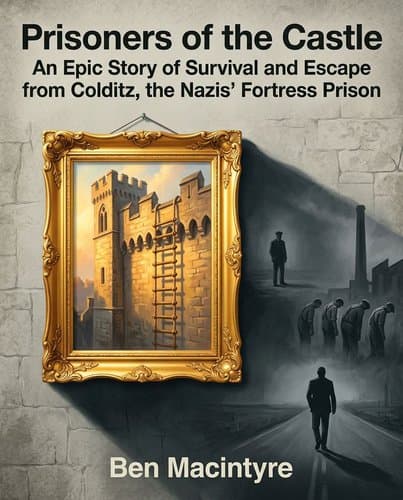
59883560_prisoners-of-the-castle
by Ben Macintyre
The famous Colditz escape legend was real—but carefully curated, erasing an Indian doctor, invisible orderlies, and 700 Jewish slaves next door.
In Brief
The famous Colditz escape legend was real—but carefully curated, erasing an Indian doctor, invisible orderlies, and 700 Jewish slaves next door. Ben Macintyre reveals that what made these men heroes wasn't just courage, but who got to decide whose courage counted.
Key Ideas
Selection builds historical narratives
Heroic narratives are made by selection, not invention. The Colditz escape legend was built from real events — but its staying power came from consistently centering the same cast (white, male, Allied officers) while leaving orderlies, a lone Indian doctor, and 700 Jewish slave laborers outside the frame. You don't need to fabricate a myth; you only need to decide who counts.
Captivity intensifies social hierarchies
Captivity doesn't dissolve social hierarchy — it concentrates it. Birendranath Mazumdar was left without Red Cross parcels, suspected of espionage, and excluded from escape planning by the men he shared a courtyard with. The same forces that would have marginalized him in London operated more intensely, not less, behind barbed wire.
Moral integrity rarer than physical courage
Moral consistency under pressure is rarer than physical courage. Mazumdar refused Nazi recruitment three times, survived 16 days of hunger strike, and endured Gestapo beatings without naming a single French civilian. His reward was an MI5 surveillance file labeled 'Indian Subversion.' The book raises the question of whether it was worth it — and deliberately refuses to answer.
Enemy humanity reveals moral blindness
The enemy's humanity is the most uncomfortable fact in any war story. Eggers's tribute to Sinclair — invoking Valhalla for the man he spent years trying to catch — is one of the book's most moving passages. It appears in the same chapters that raise the question of what a man that perceptive allowed himself not to see about the HASAG camp 300 yards from his office.
Publication decisions create historical myths
Myths are made afterward, in the choices about what gets published and broadcast. Pat Reid shaped the Colditz legend into a story of gentlemanly British heroism that averaged seven million viewers a week. The people who complicate that frame were always in the archive — in tape recordings, diaries, and MI5 files. They just needed someone to look.
Who Should Read This
History readers interested in Military History and World History who want a deeper understanding of how we got here.
Prisoners of the Castle: An Epic Story of Survival and Escape from Colditz, the Nazis' Fortress Prison
By Ben Macintyre
10 min read
Why does it matter? Because the Colditz you've heard about was the version someone chose to tell.
The Colditz story most people know came from one man: Pat Reid, civil engineer turned escape officer, who wrote the books, sold the film rights, and licensed a board game. Reid decided what mattered. What he decided was: plucky British officers, a Gothic castle, escape as a form of combat. A great story. Also an edit. Cut out: the Indian doctor who refused a Nazi recruitment pitch and starved himself toward freedom instead. Cut out: the labor camp three hundred yards from the gate and what the SS did there the morning the Americans arrived. Cut out: the German security officer who spent twice as long in a Soviet labor camp as any British prisoner spent in Colditz, and who eulogized his most relentless adversary by invoking Valhalla. Ben Macintyre restores the cut — and what it reveals isn't just about Colditz.
Four Months of Genius, Destroyed by the Wrong Color of Ink
On a warm September night in 1943, a German sergeant major appeared on the castle terrace for his usual midnight inspection — ginger-gray whiskers, an Iron Cross at his chest, a pistol at his hip. The sentries snapped to and obeyed his orders to leave their posts. Only when the man reached the barbed-wire gate and handed over an exit pass did anything go wrong. The sentry stared at the document and slowly raised his rifle. The pass was gray. It was supposed to be yellow.
The sergeant major was Michael Sinclair, a British lieutenant who had spent four months building this disguise from whatever the castle provided. The mustache and mutton-chop whiskers were disassembled shaving brushes, dyed ginger-gray with watercolor paint and glued to his face. The Iron Cross was cast from zinc stripped off the roof. The pistol butt was a painted piece of wood; the holster was polished cardboard. His two escorts carried rifles with wooden barrels buffed with pencil lead, triggers cut from kitchen cutlery. Thirty-five more officers waited in the darkness above, bars already sawn through, carrying forged papers stamped with an eagle carved from a shoe heel.
One wrong shade of ink erased four months of that work.
Sinclair really did spend four months studying one man's gait and accent. You already knew the Colditz story was impressive. Macintyre agrees — and then shows you what that impressiveness was covering.
Escaping Was Every Officer's Sworn Duty — Unless You Were a Servant or the Wrong Race
Pat Reid's conviction that escaping was "the sworn duty of all officers" was technically accurate — if you read the second word carefully. Officers. Not orderlies.
Every British officer in Colditz had a personal servant, a batman from the enlisted ranks, who polished boots, swept floors, and carried steaming jugs of ersatz coffee across the cobblestones each morning while the men he served sat upstairs plotting the next tunnel. Sidney Goldman, batman to Colonel German, the Senior British Officer, was celebrated around the camp as the "ace amongst the orderlies" — impudent, quick, devoted to his colonel, and completely trapped. The Geneva Convention guaranteed Colonel German a servant. It did not guarantee Goldman a way out. Recaptured officers were returned to Colditz for a spell in the solitary cells. Recaptured orderlies risked being shot. Goldman was excluded from escape planning for reasons that had nothing to do with nerve or ability. Under the conventions that governed this war, an officer's liberty was worth more than a private soldier's: an officer who made it home could fight again; a batman could not. So Goldman carried the coffee, the officers schemed, and nobody in the castle seemed to feel this required justification. The sworn duty belonged to officers. It had never been Goldman's to hold. The same logic would apply, more visibly, to the one man in the castle who didn't look like the men around him.
The Prisoner With the Cleanest Record Was the One They Left Without Food
In the summer of 1942, Birendranath Mazumdar sat across a lunch table from Subhas Chandra Bose in a Berlin apartment, a white-gloved waiter refilling their glasses, the two men speaking Bengali — the first time in years he'd spoken his mother tongue. Bose was everything Mazumdar had admired since childhood: the great Indian nationalist, the man who had escaped British house arrest in Calcutta disguised as an Afghan insurance salesman, the charismatic leader now raising his Indian National Army to expel the British from India. Hitler had offered Bose a U-boat to reach Southeast Asia. Now Bose was offering Mazumdar a way out — not just from Colditz, but from the racial prejudice that compounded every day of his captivity. "Join my Legion," Bose said. "Come and fight for the freedom of India, our Motherland."
Mazumdar said no. He had taken an oath to the King, and a gentleman's word was his bond. Whatever his political convictions, the oath held. He returned to Colditz in third class. In the courtyard: "Didn't he want you after all?"
This is the part of Macintyre's book that doesn't fit the poster. The British officers in Colditz were brave, endlessly resourceful, and genuinely funny — and they left Mazumdar, the only Indian among them, without Red Cross food parcels while eating theirs. They called him "Jumbo," after an African circus elephant that apparently sufficed as their working model for all dark-skinned people. When the Senior British Officer warned him not to "fraternize with the Germans," the implication was plain: a man who opposed the British Empire could not be trusted inside a British prison. When Mazumdar asked to be considered for escape attempts, the SBO replied: "You? Escaping from here? With your brown skin?" He was later warned by a French officer that British officers were calling him a spy. The French offered this as a kindness. It landed as what it was.
Mazumdar's response, when he finally ran out of patience, was characteristically precise. He went on hunger strike: sixteen days on water, a little salt, and nothing else, while British officers walked past his room making "Jumbo is doing a Gandhi" jokes. On day sixteen, the German army blinked. Berlin sent word: release him. The men who had left him without food for months immediately announced they had always liked him, and piled his plate high. He walked out of the castle gates to loud cheers.
He then escaped from a transit train by levering out a window while it was moving, walked nine hundred kilometers across Nazi-occupied France with a giant Sikh cavalryman, was beaten by the Gestapo twice, and refused under repeated torture to name the French civilians who had sheltered him. London's reward was an MI5 file labeled "Indian Subversion," a fabricated embezzlement charge, and a tip that he was "ruining his chances of getting a medal."
"Do you think I escaped and went through all these things just to get a bloody medal?" he said, and walked out of that room too. The Gestapo had tried harder.
The Most Principled German in Colditz Was Also the One Who Claimed Not to Know
What would it take for a German prison guard to reach into Norse mythology to honor the enemy he spent years chasing?
On September 25, 1944, Michael Sinclair put on a pair of thick black gloves, stepped over the tripwire, and hauled himself up the perimeter fence while guards shouted at him to halt. He was crumpling into the autumn leaves before the machine gun fell silent — a single bullet off his elbow, into his heart. Among his folded belongings: a note. "I take full responsibility. Safe home to you, all you good chaps."
Reinhold Eggers had spent years trying to stop Sinclair — the prisoners called him the Red Fox — studying his routes, unraveling his disguises, sealing the exits he opened. The relationship was adversarial, prolonged, and personal. When Sinclair died, Eggers reached into Viking myth for something adequate: "If there is indeed a Valhalla for the heroes of whatever nation, if the men who go there are men of courage and daring... in our own German tradition, Valhalla is the resting place of Lieutenant Mike Sinclair."
An enemy's tribute means more than a comrade's. Here, Eggers stops being backdrop: he is the book's most morally complicated figure, a man who opposed violence against prisoners on principle, fought both World Wars without becoming a fascist, and still wrote that sentence about his adversary.
And then the ground shifts again. Three hundred yards from his office was a labor camp Eggers filed as an SS matter, "practically no contact." Macintyre doesn't argue. "People are skilled at seeing, and remembering, what they want to."
After the war, the Soviets sentenced Eggers to ten years' hard labor at Sachsenhausen. He emerged in 1955 at 50 kilograms — twice as long imprisoned as any man he'd guarded.
The question still doesn't close.
Three Hundred Yards Away, Seven Hundred People Were Being Worked to Death
The liberation of Colditz reads like a moral settlement. Four GIs cross a bridge over a dead German boy, accept a neatly typed surrender, and Private Frank Giegnas Jr. shatters a portrait of Hitler across his knee while men cheer from every window. The right people are freed; the wrong people are in cells. The account closes. But the frame was always too small.
Three hundred yards from that courtyard, in Colditz's old Steingutfabrik (once the largest china factory in Germany), approximately 700 Hungarian Jews had been assembling weapons for the Reich under the SS-contracted arms company HASAG. The governing policy was "Vernichtung durch Arbeit": extermination through work. Life expectancy ran to about three and a half months. The morning ration was ersatz coffee so revolting that some prisoners washed with it rather than drank it, before reporting for twelve-hour shifts building ammunition and rocket launchers. Regular selections removed those no longer fit to work. The dead were left where they fell.
Most had come from Hungary in the summer of 1944, when Germany occupied the country and the deportations began. Nearly half a million people were taken from provincial towns in eight weeks. The ones who reached Colditz had been selected at Auschwitz for labor: still useful, for a time. They had been teachers, shopkeepers, and farmers. People with names, addresses, children. The HASAG system was not designed to care what they had been. It was designed to extract what remained of them and discard the rest, which is what a life expectancy of three and a half months actually means.
As the Americans advanced on Colditz on April 14, 1945, the SS guards at the Steingutfabrik began executing the surviving prisoners in groups of five. The shooting stopped just before daybreak — just before the four GIs sprinted across the bridge, just before the cheering began in the courtyard above.
Macintyre is careful here. He doesn't prosecute Eggers for claiming ignorance, doesn't argue with the townsfolk who said they saw nothing. He just notes that a great deal has been written about Colditz and almost nothing about the factory a few hundred yards away where Jews were being worked to death. That disproportion, he implies, was not accidental. The legend the escape stories built has a particular shape — heroic officers, the wrong color of ink — and that shape required a frame. You follow the men inside it and feel the liberation arriving. Everything outside becomes background noise that the cheering, when it finally starts, conveniently drowns out.
The Version Seven Million People Watched Left Out Everything Complicated
Julius Green — the camp dentist, and by Macintyre's accounting the most prolific intelligence channel out of Colditz — walked alone through Piccadilly on the night of his liberation, flinching whenever a passerby came too close. Five years of captivity had compressed his sense of space; the suddenly limitless city felt disorienting rather than free. He found a corner table off Regent Street and ordered the meal he'd been composing in his head for four years: smoked salmon, minestrone, roast beef, pineapple and kirsch, coffee, good brandy. His first night back in England, he sat alone and ate.
Green's liberation never made the legend. The one that did was Pat Reid's: three bestselling books, a film with John Mills, a BBC series averaging seven million viewers per week. By 1973, a Gibsons board game "devised by Major P. R. Reid, M.B.E. M.C." was reportedly outselling Monopoly. Reid endorsed a Galaxy Ripple chocolate campaign using a Colditz escape map and conducted lecture tours with a model of the castle. He made a fortune. Macintyre calls the account "highly subjective, and partly inaccurate." Airey Neave — the actual first British officer to successfully escape Colditz — was furious his achievement was eclipsed by the author's.
Reid didn't invent anything. He chose what stayed inside the frame. Inside: officer courage, schoolboy ingenuity, the wrong color of ink. Outside: Goldman carrying coffee to officers planning escapes he was barred from joining; Eggers emerging from a Soviet labor camp in 1955; seven hundred Hungarian Jews worked to death three hundred yards from where the prisoners cheered their liberation.
And Birendranath Mazumdar: who had refused Nazi recruitment, endured racism from his own side, survived torture, walked nine hundred kilometers across occupied France, and returned to Britain labeled "Z/240" in an MI5 file marked "Indian Subversion." When his interrogator warned him he was ruining his chances of a medal, Mazumdar said, "Do you think I escaped and went through all these things just to get a bloody medal?" and walked out.
The British Empire had claimed his loyalty against his every conviction. He'd honored it, because a gentleman's word held. What it gave him back was a surveillance file. Same injustice, different paperwork.
The Questions the Legend Never Got Around to Asking
The people Macintyre finds were never lost. Mazumdar's voice is on tape. Eggers kept a diary. HASAG survivors gave testimony, and Julius Green left a record of exactly what he ordered at that corner table off Regent Street — alone, the night London didn't know what to do with him. The archive held everything. Seven hundred Jewish laborers were shot in groups of five, three hundred yards away, as the cheering started. Mazumdar came home to a surveillance file. The question Macintyre leaves you with isn't which version is true. It's simpler than that, and harder: who decided, for eighty years, that you'd only hear one of them?
Notable Quotes
“were murdered. The Third Reich was HASAG's only customer: the company paid the SS for each laborer, and the Nazi regime paid HASAG handsomely for its products. HASAG was singled out as an”
“They were in the charge of an SS unit, with whom we in the castle had practically no contact at all,”
“This was an SS matter.”
Frequently Asked Questions
- What does Prisoners of the Castle reveal about the Colditz escape myth?
- The book exposes how the famous Colditz escape legend was selectively constructed. "Heroic narratives are made by selection, not invention. The Colditz escape legend was built from real events — but its staying power came from consistently centering the same cast (white, male, Allied officers) while leaving orderlies, a lone Indian doctor, and 700 Jewish slave laborers outside the frame." Macintyre shows myths aren't fabricated—they're constructed through silence. "You don't need to fabricate a myth; you only need to decide who counts." The book recovers overlooked figures whose stories were always present but systematically excluded from the dominant narrative.
- Who was excluded from the traditional Colditz story?
- The traditional Colditz narrative centered on white male Allied officers while systematically erasing other captives. Ben Macintyre recovers three overlooked groups: non-officer orderlies, Birendranath Mazumdar (an Indian doctor), and 700 Jewish slave laborers from the nearby HASAG camp. Mazumdar's experience was particularly stark. "Birendranath Mazumdar was left without Red Cross parcels, suspected of espionage, and excluded from escape planning by the men he shared a courtyard with." His story reveals that "Captivity doesn't dissolve social hierarchy — it concentrates it." These figures weren't absent from history; they were absent from the myth that Pat Reid shaped into a gentlemanly British heroism narrative reaching millions weekly.
- What was Birendranath Mazumdar's story in Colditz?
- Mazumdar was an Indian doctor who endured systematic discrimination and isolation despite sharing a prison with fellow captives. His resistance to Nazi coercion came at extraordinary personal cost: "Mazumdar refused Nazi recruitment three times, survived 16 days of hunger strike, and endured Gestapo beatings without naming a single French civilian." Yet this moral steadfastness brought no recognition. "His reward was an MI5 surveillance file labeled 'Indian Subversion.'" The book raises a haunting question about whether such sacrifice was worthwhile and deliberately refuses to answer. Mazumdar's story challenges assumptions about heroism and exposes how captivity concentrated rather than dissolved social prejudice.
- How does Prisoners of the Castle change our understanding of heroic narratives?
- The book reveals that myths are made through deliberate selection rather than discovery or fabrication. "Myths are made afterward, in the choices about what gets published and broadcast. Pat Reid shaped the Colditz legend into a story of gentlemanly British heroism that averaged seven million viewers a week." Crucially, "The people who complicate that frame were always in the archive — in tape recordings, diaries, and MI5 files. They just needed someone to look." This exposes how collective memory is constructed through editorial choices, challenging readers to examine which stories survive, which voices we amplify, and whose complexity we simplify into mythology.
Related Book Summaries


Read the full summary of 59883560_prisoners-of-the-castle on InShort