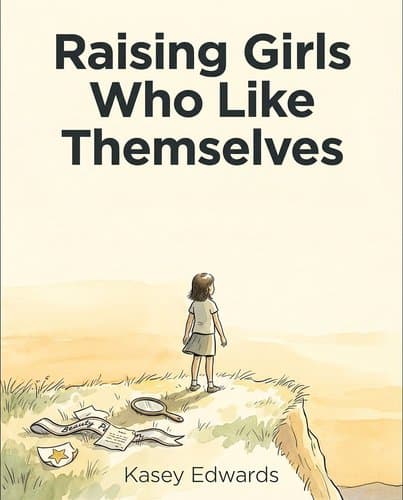
56291695_raising-girls-who-like-themselves
by Kasey Edwards
The instincts that feel most loving—complimenting her looks, rescuing her from failure, urging a hug for grandma—are quietly eroding your daughter's self-worth.
In Brief
Raising Girls Who Like Themselves (2021) argues that a daughter's self-liking is built or eroded through ordinary daily interactions — not personality and not luck. Drawing on psychology and behavioral research, it gives parents concrete tools to protect body autonomy, replace rescue with mastery, audit appearance-focused language, and build the internal sense of worth that drives lifelong wellbeing.
Key Ideas
Dilute, redirect, and model appearance
Apply the DRM framework to appearance comments: Dilute (add non-appearance qualities when you do comment), Redirect (shift from how she looks to what her body can do), and Model (stop discussing anyone's weight or appearance — yours, hers, or strangers' — in front of her).
Bodily consent trumps social comfort
Never force affection. When someone requests a kiss or hug from your daughter, offer her a menu of alternatives — high five, handshake, wave, blown kiss — and back her unconditionally if she declines, even when it causes social awkwardness. Her body autonomy is worth the discomfort.
Let her build her own competence
Apply the rule 'only do for her what she can't yet do for herself' to everyday tasks — tying shoelaces, carrying a bag, finishing a painting, speaking for herself in a conversation. Mastery, not rescue, is what builds the self-esteem that praise alone cannot transfer.
Build wellbeing through reflective gratitude
Teach the 'What Went Well and why' exercise: three things that went well today and the causal role she played in making them happen. Martin Seligman's research shows doing this for one week produces measurable wellbeing gains at six months.
Foster internal over external validation
Audit your own language for external-locus phrases: 'What will people think?', 'Stop because people are looking', 'Don't make a scene.' These train daughters to locate their worth in others' assessments. Replace with questions about what she thinks and feels.
Teach her whose voice counts
Teach her to name whose opinion counts by writing six names on a card — filtered by: do they show up, do they have your best interests at heart, do you respect them? Any criticism from someone not on the card does not require a response.
Never discuss weight with her
Stop all weight-focused conversation directed at your daughter. The evidence is unambiguous: a 2015 study of 99,791 obese women found the annual probability of reaching normal body weight was 1 in 124. Weight-focused parenting is statistically setting a child up for a defined lifetime of failure, and is the primary clinical pathway to eating disorders.
Interrupt trained patterns of selflessness
Watch for Good Girl self-denial — your daughter reflexively declining offered food, compliments, money, or help — and name it explicitly. Teach her that accepting something she wants is not greedy or rude; declining out of trained selflessness is a habit worth breaking.
Name her energizing spark often
Identify her 'spark' — the activity that energizes rather than merely skills her — and name it often. Research shows disparaging words hit at least three times harder than praise; positive identification of genuine strengths is how you counteract that asymmetry.
Build trusted mentorship before crisis
Establish a trusted adult outside the family — a friend who shares your values — make the role official, and grant that adult permission to keep secrets from you if your daughter requests it. Do this before the stakes are high, not after.
Who Should Read This
People working on personal growth in Child Development and Family, especially those tired of generic motivational advice.
Raising Girls Who Like Themselves
By Kasey Edwards & Christopher Scanlon
10 min read
Why does it matter? Because the parenting moves that feel most loving are often the ones doing the damage.
In a café, a stranger asks your daughter for a kiss. You say nothing. That moment — well-meaning, quickly forgotten — is how the damage starts.
Your daughter is outperforming boys in school, following climate activists her own age, growing up with more female role models than any generation before her. By the visible metrics, she is winning. Now look at the hidden report card: depression, self-harm, and body shame that set in before she leaves primary school.
The source is closer than Instagram or diet culture, and harder to name. The beauty compliment from a well-meaning relative. The rescue from a struggle that felt too painful to watch. The silence in that café. Those ordinary, loving interactions are where the damage accumulates, one small decision at a time. This book shows you exactly how, and what to do instead.
The Girls Driving Social Movements Are Failing the Report Card No One Publishes
The girls leading global climate strikes and defying the Taliban for education rights are, statistically, also the girls who hate what they see in the mirror.
That's the central paradox Kasey Edwards and Christopher Scanlon (journalists, researchers, and parents of daughters) found after more than a decade of research: this generation is outperforming boys academically and driving movements that reshape governments, yet enormous numbers of them are quietly falling apart. The achievements are real. So is the suffering. Both are happening at once.
Edwards and Scanlon assembled what they call a Girls' Report Card, and every category receives an F. One in five girls aged 16 to 17 meets the clinical criteria for depression. A quarter of girls that age have deliberately hurt themselves. More than half of Australian girls aged eight and nine are already dissatisfied with their bodies.
That last number is worth stopping on. Those eight and nine-year-olds are barely out of preschool, dreading the school day because they think they look fat in their uniforms.
The culture around girls tells them publicly they're powerful while privately measuring their worth by appearance and flawlessness. When they fall short of those impossible standards — and they always do — entire industries step in to sell a fix for a gap they helped manufacture.
Parents are best positioned to interrupt this before it takes hold. That's the argument the book makes.
Every Beauty Compliment You Give Her Is Teaching Her What Actually Matters
Violet was four years old, still buzzing from Santa's express train, when an elf led her family into the grotto. What followed had nothing to do with Rudolph. Santa commented on every item of clothing she was wearing — including her socks — declared her the most beautiful person in the department store, and suggested this preschooler might want to become a model.
A friend's four-year-old son visited the same Santa that season. Santa talked to him about Rudolph. Violet loved Rudolph every bit as much as any boy; she knew the whole reindeer pack. Santa could have bonded with her over flying reindeer, or non-flying ones, or anything. He chose instead to focus on three things: how Violet looked, how she compared to other females in the store, and whether she might want to build a career around being evaluated for her appearance.
The authors put it plainly: we speak to boys like people and girls like dolls.
Santa meant no harm. That's what makes this worth examining. The adults who love your daughter most are making the same move: every time she walks through a door, every time a relative notices her eyelashes, every card that calls her beautiful before asking how she's doing. Psychologist Dr. Renee Engeln, who studies beauty culture, found that every appearance comment, however warm, sends one underlying message to a girl: this is what matters about you. Repeated often enough, she starts to hear something more precise — she is of value to others when she looks a certain way, and not otherwise. This is why telling your daughter she's beautiful tends to backfire. It doesn't reduce the importance of beauty; it confirms it. A girl who builds her self-worth on that foundation is permanently at the mercy of whoever happens to be looking.
The counter-move is redirection. When someone praises your daughter's dress, add: it's good for climbing trees. When a stranger notices her eyes, follow with something she did. If a relative's first question is always about her hair, redirect before it lands — ask your daughter about the book she's reading while the relative is still talking. Stop discussing anyone's appearance in front of her, positive or negative, because the lesson she absorbs isn't about the person being discussed. It's about what the adults around her have decided is worth noticing.
The Forced Kiss for Grandma Is Where the Problem Starts
A man behind a coffee counter looks down at five-year-old Violet and says, "Give us a kiss." Kasey Edwards is standing right there. Her immediate, internal reaction is: don't ask my daughter to kiss you. She says nothing. Violet hesitates, flinches, and then leans in.
Edwards later describes what she did in that moment as a straightforward act of cowardice — the people-pleasing instinct she'd spent years trying to teach her daughter to resist. She didn't want to cause a scene. She didn't want to offend the man. So she chose social harmony over her five-year-old's comfort, and in doing so, delivered a lesson she hadn't intended: it's fine to say no, unless saying no makes someone else uncomfortable.
Children don't do nuance. They absorb absolutes. What Violet learned in that moment wasn't a complicated social grace. It was a rule: when an adult wants something from your body, you provide it.
Edwards and Scanlon's response, which they call the high-five policy, is practical: when someone demands affection from a child, offer her a menu. A high five, a handshake, a wave, a blown kiss. She picks. The person gets acknowledged. She stays in charge. The policy generated enough controversy to make international headlines. One woman told the authors that under this standard, she'd never be able to kiss her grandchild. A US television poll found a third of respondents sided against the advice. The objection is almost always framed as a concern about rudeness. What the objection actually defends is the right of adults to receive physical affection from children on demand.
In a study of nearly 500 girls aged twelve to eighteen who had sent explicit photos of themselves, only 8 percent had actually wanted to. The other 92 percent sent those photos to please someone, to avoid conflict, or to comply with pressure. One fourteen-year-old described being pressured for hours, then threatened with blackmail if she didn't send more: "The stuff I have to do is unbelievable." Not chose, not agreed — have to. A complete absence of perceived agency.
The authors argue that absence was built across years, one small moment at a time. Body ownership isn't a switch that flips at sixteen. It's a capacity built in hundreds of low-stakes moments, most of them in rooms with people who love her.
Fifty Years of 'You Are Amazing' Parenting Has Produced the Opposite of What It Promised
Five-year-old Elly and her twelve-year-old cousin Jessica are painting portraits of Elly's Emma Wiggle doll, the one with the huge sparkly eyes and the yellow and black outfit. Ten minutes in, Jessica's portrait captures the doll's likeness with real competence. Elly's looks like roadkill in the same color palette. She compares them and her shoulders drop: "Mine is bad. I'm stupid."
Her dad, raised in the 1980s self-esteem movement, knows exactly what to do. "Your painting is so good it should be in a gallery," he tells her. "You are a great artist."
Elly scrunches the painting into a ball. "Mine looks like a poo." She can see both paintings. She's five, not blind.
Dad, undeterred, paints Emma Wiggle himself, not brilliantly but well enough. He feels good about this. Elly does not.
What went wrong is worth being precise about. The gallery comment didn't reassure Elly; it told her that her dad either couldn't see the obvious or was willing to lie about it. Either way, her own assessment — that the painting was bad — was confirmed as the truth adults wouldn't say out loud. Then dad painted it for her, which confirmed something additional: the painting really was too bad for her to be trusted with it. Two moves intended as kindness, both landing as evidence that Elly's judgment about herself was correct.
The mistake at the root of fifty years of "You are awesome!" parenting is that it reverses cause and effect. The adults who designed it noticed that successful, capable people tend to have high self-esteem, then concluded that installing it first would produce the capability. It doesn't work that way. Seligman's research made the answer plain: self-esteem grows from doing things and finding out you can. It is a side effect of mastering challenges and working through frustration, not something words can install in advance.
The rule that follows is simple: only do for a daughter what she cannot do for herself. Not grand achievements — tying shoelaces, carrying her own bag, pouring flour into a bowl, speaking to the doctor herself rather than watching her parent do it. Primary school principal Simon Millar found that, by age four, children allowed to speak for themselves during school interviews were running 12 to 18 months ahead of children who weren't, not because speaking made them smarter, but because the same conditions that gave them permission to speak also gave them permission to try things and fail at them.
When Elly's dad took the brush and finished the painting, he didn't rescue her from failure. He handed her the conclusion that failure was something she needed rescuing from, and that he was the one equipped to do it. The painting she could have made, badly, and learned from, was gone.
Her Emotional Response to Events Is Not Fixed — It Is a Skill You Can Teach
Focus on the grime of a flyscreen door and that's all you see: the rust, the dead insects, the barrier. Shift your gaze and the world outside snaps into focus; the screen disappears. Same door, same room, entirely different experience. Edwards and Scanlon open with this image to make a claim that sounds obvious until you follow it to its conclusion: what your daughter feels about an event is not delivered by the event. There is always a step between the trigger and the emotion — a thought — and that step is where you actually do your parenting.
The birthday story makes this concrete. Ivy accidentally destroys Violet's present minutes after she unwraps it. Tears, understandably. The authors' first instinct is to replace the toy, removing the distress by removing its cause. They don't. Instead, they give Violet the problem framed as a choice: spend the rest of the birthday focused on the broken present, or focus on the party, the other gifts, the people who showed up. The event is fixed. The broken toy is broken. What isn't fixed is what Violet decides to look at, and therefore what she feels. Replacing the toy would have resolved her distress and taught her, in the same moment, that it can only be fixed from the outside.
What separates resilient girls from fragile ones isn't circumstances. It's what they believe their own resources can do with those circumstances. Girls who believe their internal resources can handle what life delivers become adults who are measurably more resilient, more persistent, and physically healthier. Girls who believe external forces determine their lives tend toward depression, underachievement, and anxiety. Both have the same capabilities. What differs is what each believes those capabilities can do. And unlike most of the variables that shape a daughter's future, this one is directly teachable — not by lecturing, but by refusing to rescue.
This reframes your job as a parent. You are not managing circumstances. You are training a response.
Screen Time Is Not Your Daughter's Enemy — Your Schedule Is
How much of your daughter's schedule exists to keep her away from screens?
If the answer is "a lot," you've organized her life around a fear the evidence doesn't support. The WHO issues strict screen-time limits: no more than one hour daily for young children. Those guidelines carry the kind of authority that produces parental guilt the moment an iPad appears. What the WHO buries in the same report is a confession: those guidelines are, in its own words, "strong recommendations based on very low-quality evidence."
Dr. Amy Orben at Oxford's Department of Experimental Psychology puts a number on it: children need more than eleven hours of daily screen use before any measurable wellbeing drop appears. To show the scale, she reaches for a comparison: wearing glasses correlates more negatively with teenage wellbeing than social media use does, and nobody is campaigning to limit glasses.
The threat the research actually supports is the one parents are building in response to the imagined screen danger: the packed schedule, the chronically tired child, the family that hasn't had an unplanned afternoon in months. A 2013 survey of 1,400 Australian children found that 43 percent hadn't done anything spontaneous in the prior month, and 89 percent of children aged six to eleven wished they had more time with their families.
Your daughter isn't drowning in screens. She's drowning in your calendar. The counter-move is the one that looks, from the outside, like failure: an afternoon with nothing planned, no enrichment, no outcome. That blank space is, as it turns out, the schedule.
The Most Dangerous Thing You Can Raise Her to Be Is a Good Girl
The most dangerous thing you can raise is a girl who is always agreeable.
When Violet was six, a neighbor offered her some coins toward her savings box — a small, thoughtful gesture. Violet wanted those coins. She was actively saving for a book she cared about. She said, "Oh, it's okay," and walked away empty-handed.
Her parents asked afterward if she'd actually wanted the money. Of course. Did she know why she'd declined? She shrugged.
Her parents did. She had watched every woman in her family reflexively turn down whatever was offered (food, help, gifts, money) as though accepting made you a burden rather than a person with legitimate wants. Violet was six and already fluent in the language of self-erasure.
Rachel Simmons, who researched the phenomenon in The Curse of the Good Girl, argues that this conditioning begins early and extends across a woman's life, quietly stunting her ability to ask for what she needs in friendships, relationships, and careers. The Good Girl (the one who smiles when sad, drops hints instead of asking, says "it's fine" through gritted teeth) is not actually good. She is compliant. And that compliance comes at the cost of her interior life, built through thousands of small moments exactly like declining coins she actually wanted.
The antidote the authors landed on isn't complicated: they explicitly taught Violet that saying yes was allowed. The next time the neighbor offered coins, Violet looked her in the eye and accepted — and walked away beaming, savings box heavier, sense of worth intact.
You don't need to overhaul your parenting to interrupt this. You need to notice when your daughter turns down things she actually wants to seem like less of a burden, and say clearly: you're allowed to want things.
The Battlefield Is Smaller Than You Think — and You're Already On It
The real ask isn't that you parent perfectly. It's that you stay awake — to the cafe, to the coins, to the broken present — because she is already watching how you move through the world, and drawing her conclusions about what she's allowed to want from it.
You will not get every moment right. Some will land wrong, and you will only realize it later. That is not a disqualifying fact; it is the normal condition of parenting. What Edwards and Scanlon offer is not a checklist for flawless execution. It is a compass: something that tells you which way each small moment votes. Once you have that, you start catching things you would have let pass. And that attention — compounding across years of ordinary mornings — is where the odds actually shift.
Notable Quotes
“No thanks, Grandma, let's have a hug instead.”
Frequently Asked Questions
- What is Raising Girls Who Like Themselves about?
- Raising Girls Who Like Themselves argues that a daughter's self-liking is built or eroded through ordinary daily interactions — not personality and not luck. The 2021 book by Kasey Edwards and Christopher Scanlon draws on psychology and behavioral research to provide parents with concrete tools. Key strategies include protecting body autonomy, replacing rescue with mastery, auditing appearance-focused language, and building internal worth. The authors emphasize that self-liking develops through everyday parenting practices rather than innate traits, offering evidence-based frameworks like the DRM approach for managing appearance comments and the "What Went Well and why" exercise for building wellbeing.
- What are the main strategies to protect girls' body autonomy?
- Never force affection is the central principle for protecting body autonomy in Raising Girls Who Like Themselves. When someone requests a kiss or hug from your daughter, offer a menu of alternatives — high five, handshake, wave, or blown kiss — and support her unconditionally if she declines, regardless of social awkwardness. The authors emphasize that her body autonomy is worth the discomfort. This approach teaches daughters that their bodies belong to them and they can refuse physical contact without guilt. Early establishment of body autonomy boundaries creates foundations for lifelong confidence and consent awareness, protecting against future coercion.
- How can parents stop appearance-focused language?
- The book recommends applying the DRM framework to all appearance comments: Dilute (add non-appearance qualities when commenting), Redirect (shift from how she looks to what her body can do), and Model (stop discussing anyone's weight or appearance — yours, hers, or strangers' — in front of her). This systematic approach reduces emphasis on appearance while building competence-based confidence. Crucially, stop all weight-focused conversation directed at your daughter entirely, citing evidence that weight-focused parenting is "the primary clinical pathway to eating disorders." This evidence-based stance eliminates weight discussion completely rather than managing it, protecting daughters' long-term physical and mental health.
- What role does mastery play in building girls' self-esteem?
- Apply the rule "only do for her what she can't yet do for herself" to everyday tasks like tying shoelaces, carrying bags, finishing paintings, or speaking in conversations. The authors emphasize that "mastery, not rescue, is what builds the self-esteem that praise alone cannot transfer." Rather than protecting daughters through parental intervention, allowing them to struggle and succeed develops genuine self-worth. Mastery experiences create internal attributions for success, teaching girls they caused positive outcomes through their own effort. This foundation proves stronger than external praise or parental rescue in building lasting confidence.
Related Book Summaries

Read the full summary of 56291695_raising-girls-who-like-themselves on InShort