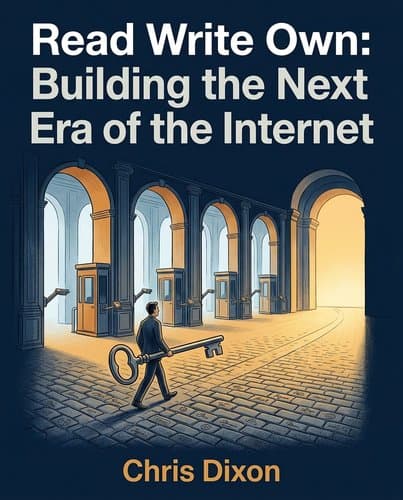
178628338_read-write-own
by Chris Dixon
Corporate platforms don't betray creators by accident—their profit logic makes it inevitable. Dixon reveals how blockchains create mathematically enforceable…
In Brief
Read Write Own: Building the Next Era of the Internet (2024) argues that corporate platforms structurally betray their users through an attract-then-extract cycle, and that blockchain networks offer a mathematically enforceable alternative.
Key Ideas
Attract-Extract Cycles Make Betrayals Predictable
Every corporate network follows the attract-extract cycle by structural necessity, not by choice — once you understand this, platform 'betrayals' become predictable rather than surprising, and you can make platform decisions accordingly.
Domain Ownership Beats Platform Handle Illusions
The difference between owning a domain name (cdixon.org) and owning a social handle (@cdixon) is the difference between real and illusory digital property — the first lets you move your entire network overnight, the second means your audience belongs to the platform.
Code Replaces Trust in Blockchain Governance
Blockchain's defining feature isn't currency — it's the ability to make binding commitments in code that no CEO can override, shifting the governance model from 'trust management' to 'read the contract.'
Token Incentives Solve Bootstrap Problems
Token incentives solve the cold-start bootstrap problem that has killed every previous attempt at grassroots networks — Helium's nationwide wireless coverage versus the graveyard of MIT Roofnet, Fon, and NYC Mesh illustrates this empirically.
Immutable Code Locks Low Platform Rates
Low blockchain take rates (0–2.5%) aren't charity or temporary subsidies — they're enforced by immutable code, community voting, fork threats, and portable assets, making the structure fundamentally different from a corporate network that could raise rates tomorrow.
Ten Percent Fees Enable True Fans
The creator economy's failure to deliver Kevin Kelly's '1,000 True Fans' was an architectural problem, not a motivation problem — the math only works when the platform takes 10% instead of 99%.
Token Design Separates Utility From Speculation
Casino culture (FTX, memecoins, leverage trading) and computer culture (infrastructure, composability, ownership networks) use the same token mechanism — distinguishing them requires looking at whether token design ties value to network utility or pure speculation.
Who Should Read This
Business operators, founders, and managers interested in Artificial Intelligence and Futurism who want frameworks they can apply this week.
Read Write Own: Building the Next Era of the Internet
By Chris Dixon
12 min read
Why does it matter? Because every platform you've built on is designed to eventually betray you.
You built the audience. You wrote the posts, shipped the integrations, cultivated the community — and then one Tuesday, the algorithm changed, the API closed, or the take rate doubled, and you learned that none of it was yours. You probably blamed bad management, or greed, or the wrong person in the room. But Chris Dixon wants you to understand something more unsettling.
Nobody betrayed you. The platform simply matured.
Profit optimization, run correctly, always produces the same result — extract value from the people who created it. That's not a bug in corporate networks; it's the logical endpoint of their architecture. Dixon's argument isn't that we need better platform ethics or smarter regulation. It's that the structure itself guarantees the outcome. The only way out isn't a pledge — it's a different kind of network, one where the rules aren't promises but code.
The Bait-and-Switch Is Not a Conspiracy — It's a Business Model
Andrew Stone had built a thriving Twitter app called Twittelator. Then, in 2010, Twitter acquired a competing app, rebranded it as its official iPhone client, and quietly closed off the API features that third-party developers had relied on. Stone watched his product suffocate and told a reporter that Twitter was behaving like the mythological Titan Cronos — eating its own children as they were born.
Stone assumed this was Twitter being unusually ruthless. He was wrong. It was Twitter being rational.
Here is the structural logic that explains every version of this story. Early in a network's life, it needs creators and developers desperately — they produce the content and tools that attract users, and users are what make the network valuable. So the network subsidizes them: free hosting, open APIs, generous algorithmic reach. This is the attract phase, and it feels like a partnership. Then the network climbs high enough on its growth curve that the math changes. Adding more creators increases the platform's value only modestly, but those same creators are now economically dependent — they've built audiences, workflows, and livelihoods on top of the platform. That dependency is leverage. So the network throttles organic reach and charges creators for sponsored posts to reach the followers they already earned. The extract phase has begun. What felt like betrayal is actually just profit optimization completing its arc.
The numbers make the extraction concrete. Meta and TikTok capture nearly 100 percent of the advertising revenue their platforms generate, passing almost nothing back to the creators whose content draws the audience. Apple charges app developers a 30 percent cut on payments — more than ten times what the payment industry charges anywhere else. These aren't negotiating positions. They're what monopoly leverage looks like once the attract phase is over and creators have no viable alternative platform to move to.
Chris Dixon calls this the attract-extract cycle, and his key point is that it isn't the product of malicious executives or cultural rot. A corporate network that skips extraction gets outcompeted by one that doesn't. Only the networks that maximize revenue from their most dependent complements survive long enough to dominate. The cycle isn't a bug; it's the selection pressure that produces every platform you've ever used.
We Had the Answer in 1983 — and Quietly Lost It
The open internet encoded genuine ownership long before anyone called it that. In 1983, a computer scientist named Paul Mockapetris built DNS — the domain name system — and buried inside its design was a property rights framework that kept corporate power in check for decades. We abandoned it so gradually that most people don't know what we lost.
Here is what it actually meant to own a domain name. If you registered cdixon.org and hosted it on Amazon's servers, you controlled the mapping between that name and the physical machine serving your site. Amazon could raise prices, throttle your traffic, or make your life difficult — but it couldn't take your name, and it couldn't sever your connections to the rest of the internet. You'd simply redirect cdixon.org to a different host, overnight, and every link pointing to your site would still work. Every email address at your domain would still function. Amazon knew this, which meant Amazon had to compete on the merits. The architecture enforced the constraint. For about ten dollars a year, paid to a registry rather than a platform, you owned something in the same enforceable sense that you own physical property.
Contrast that with what Twitter offers. When you build a following under a handle like @cdixon, Twitter owns the name. You can download an archive of your posts, but the followers stay behind — they followed the account, and the account belongs to Twitter. The export button gestures toward freedom without providing it. You get a ZIP file. You lose the network.
The architectural difference is this: DNS decoupled names from the services built around them. Corporate networks recoupled them, by design, because the coupling is where the leverage lives. RSS showed what that recoupling cost. RSS was a protocol that let you subscribe to any website or creator without handing your subscription list to any single company — your feeds belonged to you, not to a platform. Millions of people used it. Then Twitter stopped supporting it in 2013 and Google shut down Google Reader. The users hadn't abandoned RSS. The corporations had simply found it easier to own the relationship than to participate in a system where nobody owned it, and so the protocol collapsed.
We didn't lose the open internet because the dream was naive. We lost it because a specific architectural choice — decoupled names, no platform intermediary — got replaced by a different choice that concentrated leverage at the center. That substitution wasn't inevitable. It was a decision. The next section is about whether a different architecture can make a different decision stick.
A Blockchain Is Not a Currency — It's a Computer That Can Make Promises
The 1983 architecture meant that whoever owned the hardware held the power. Blockchains are the first design that breaks that equation.
Imagine you ask a bank to engrave a promise onto a coin: 'This institution will never issue more than twenty-one million of these.' The engraving is decorative. The board can vote tomorrow to mint a billion more, update the terms of service, or shut the program down entirely. The promise lives on metal; the power lives with people — and people change their minds.
This is the problem Bitcoin solved, and it has almost nothing to do with currency speculation. It has everything to do with computers.
A blockchain is a virtual computer running across a distributed network of machines that no single entity controls. It stores information and executes programs, just like any computer. What makes it categorically different is that the software is in charge, not the hardware owners. When Satoshi Nakamoto encoded Bitcoin's cap of twenty-one million coins, that limit wasn't a policy written into a terms-of-service document that lawyers could revise. It was baked into the consensus rules that every node on the network independently enforces. Changing it would require persuading a majority of validators to agree — a coordination problem so costly it functions, in practice, as an absolute constraint.
Compare that to Dixon's GoogleCoins thought experiment. If Google launched a digital currency on its own servers and promised a hard supply cap, nothing would actually bind the company to that commitment. Their legal obligation to make money for shareholders would always outrank a pledge to users. The promise evaporates the moment keeping it becomes inconvenient.
That gap is what Dixon means by 'strong commitments,' and it's the architecture that makes blockchains a genuinely new class of computer rather than a faster database. The code sets the rules, validators enforce them collectively, and no single owner can override the result. Token holders vote on rule changes — in 2023, Uniswap's community used exactly this mechanism to decide how protocol fees would be distributed — rather than leaving the call to management.
On a corporate server, you trust the CEO. On a well-designed blockchain, you read the code. One of those commitments survives a leadership change, an acquisition, or a bad quarter. The other doesn't.
Tokens Solve the Problem Every Grassroots Network Has Always Died From
Why have so many grassroots network projects failed at exactly the same moment — not in the long run, not after years of slow decline, but right at the beginning, before they had a chance to matter? The answer is structural. Networks become valuable only when enough people are already using them. Until you reach that threshold, they're useless, and uselessness repels the very users who would make them useful. Every grassroots alternative to a corporate network hits this wall and slides back down.
For decades, technologists dreamed of building a community-owned wireless network — users installing routers in their homes and offices, collectively displacing the AT&T-and-Verizon model. A neighborhood coalition in New York called NYC Mesh tried it. Coverage required enough access points to be useful, but nobody installs an access point for a network that barely exists yet. The cold start kills you before you can warm up.
Helium broke this pattern by changing the economics of being early. The blockchain network paid people in tokens for every access point they installed and operated. The reward was real — tokens with market value — and it arrived immediately, before the network had proven itself useful to anyone. That's the structural move: instead of asking people to donate effort to a speculative public good, tokens let a network compensate contributors in proportion to their early risk. People who install hardware when coverage is thin are taking a larger gamble than those who join later, and token rewards reflect that. Helium reached nationwide coverage in a few years, further than any prior attempt had managed.
Token skeptics tend to miss what this actually demonstrates. The objection — that token rewards are just speculation dressed up as economics — assumes the tokens are the point. They're not. They're the mechanism for solving a problem that has killed every grassroots network before it: how do you pay people to build something that isn't valuable yet? Corporate networks solved this with subsidies — YouTube once absorbed bandwidth costs to get creators posting — but subsidies run out, and more importantly, they create dependency that the platform later exploits. Token rewards do something different. They distribute ownership. The people who installed Helium's access points aren't employees waiting to be extracted from; they're partial owners of the network they built. Their incentive to see it succeed doesn't expire when the subsidy does.
Squeezing the Middle: Why Low Take Rates Are Structural, Not Charitable
Start with what 'low' actually means. Ethereum and Uniswap take between zero and 2.5 percent of the value flowing through them. YouTube, the most generous major social platform, takes 45 percent. Meta and TikTok take roughly 99 percent of ad revenue and return almost nothing to creators. Four interlocking structural constraints hold blockchain take rates at that floor — and corporate networks are architecturally incapable of replicating any of them.
First, take rates are encoded at launch into the software itself — they can't be raised unilaterally by a CEO or board. Second, any change requires a community vote, meaning the people who would be harmed by a fee increase are the same people who have to approve it. Third, because all blockchain code is open source, a competing network can copy and redeploy it with lower fees the moment any network turns extractive; the fork threat functions like a permanent price ceiling. Fourth, users own their names, social graphs, and digital assets on the blockchain itself, not inside any application. When OpenSea raised its fees, Blur entered the NFT marketplace with lower rates and users left — taking their wallets, their collections, and their transaction histories with them. OpenSea responded by cutting its fees. That's the opposite of what happens on corporate platforms, where downward price competition is essentially unheard of.
The deeper argument is about where the profit balloon gets squeezed. Google made Android free not out of generosity but to make sure Apple couldn't use iPhone ownership to push Google out of mobile search — give Apple no toll booth to operate, and Google's search revenue stays safe. Blockchains apply the same logic to the network layer itself, forcing it to be a thin utility, like a road or an email protocol, so that creators, developers, and entrepreneurs capture the value on top. Corporate networks squeeze the edges. Blockchain squeezes the middle. That inversion is the whole mechanism.
The Casino Is Real — and It's Discrediting the People Actually Building
The casino is real, the damage is real, and it has made the actual infrastructure story almost impossible to tell. When FTX collapsed — a Bahamas-based exchange running leveraged derivatives on customer funds it didn't actually hold — it cost ordinary people billions of dollars and handed every skeptic a canonical example. Think of someone like Maria Implied, a nurse in Ohio who put $40,000 into FTX because it looked like a legitimate exchange, not a Ponzi with a PR budget. She lost most of it. Her story is the story critics tell, and they're right to tell it. The problem is that FTX became the only story, and behind it, thousands of developers quietly building composable financial protocols and decentralized networks became invisible.
The entanglement is genuine and worth sitting with honestly: the same token mechanism that lets a blockchain network bootstrap contributors and distribute ownership also enables pure speculation. You cannot separate them architecturally. Tradeable tokens are how Helium paid people to install wireless access points before the network was useful; they're also how memecoin promoters manufactured hype and exited before retail investors noticed. The bootstrap incentive and the speculation engine are the same instrument, played by different hands.
This produces a regulatory environment that punishes the wrong people. Because most of the casino operates offshore and outside US law, regulators turn to the nearest available target: ethical American entrepreneurs trying to build. The result is a specific catch-22. Every blockchain project starts centralized — a small founding team, concentrated early ownership — and must eventually become decentralized enough that its token is treated as a commodity rather than a security. But the SEC has called Ethereum's token a security while the Commodity Futures Trading Commission has called it a commodity. When the regulators themselves can't agree on the test, the rational response for a good-faith builder is to hire expensive lawyers or move to Zug. Scammers, already operating outside US jurisdiction, ignore the question entirely and move faster. The regulatory fog is a competitive advantage for bad actors and a tax on honest ones.
The longer view looks like this: rising prices attract developers, the crash filters out speculators, and the builders who remain create the infrastructure that triggers the next wave. The dot-com crash bankrupted Pets.com and wiped out $5 trillion in market value — and left behind the fiber-optic cables, the payment rails, and the engineering talent that Google and Amazon were built on. Crypto cycles follow the same pattern. The media covers the crash. The building happens in the silence after.
What Ownership Actually Changes for Creators, Musicians, and the AI Economy
Nine million musicians have uploaded their work to Spotify. Fewer than eighteen thousand of them — about two tenths of one percent — earned more than fifty thousand dollars last year. The rest effectively subsidized a platform that captured the overwhelming majority of the revenue their music generated. Kevin Kelly once argued that a creator needs only a thousand devoted paying fans to sustain a career. Web2 delivered the fans and swallowed the money.
The math is straightforward and brutal. The five largest social platforms generate roughly a hundred and fifty billion dollars annually and return about twenty billion to creators, with YouTube responsible for almost all of that. Meta, TikTok, Instagram, Twitter — they pay out nearly nothing. If those platforms charged ten percent instead, the way Substack charges newsletter writers, an extra hundred and fifteen billion dollars would flow to the edges of the network each year. At an average American salary, that funds two million careers. The scale suggests this isn't a rounding error in the creator economy; it's the creator economy.
Artificial intelligence makes the timeline more urgent. Google built its dominance on an implicit deal: crawl creator content, index it, send traffic back. Generative AI threatens to dissolve that arrangement entirely — answering queries with synthesized summaries that require no click-through, no attribution, no revenue share. Dixon calls this one-boxing the internet: the model answers the question directly so users never need to visit the original source. Individual creators opting out of AI training face the same problem every individual creator faces when opting out just means someone else fills the gap. Blockchains function here as collective bargaining infrastructure — a place where creators set shared terms for training data use and receive automated micropayments when their work contributes to a model's output, enforced by code rather than negotiation. The alternative is content farms run by machines, optimized for machine consumption.
What blockchains actually change is where the rules live. A musician uploading to Spotify hands her terms to the platform, which can revise them during a bad quarter or pass them to an acquirer. An NFT works differently: she writes a rule into the token specifying that any remix earns her a cut automatically, that a remix of that remix splits revenue three ways, and that these terms travel with the music permanently — no lawyer, no label, no platform's goodwill required. The contract is the code. It's enforced the same way a blockchain enforces a supply cap: not by trusting an institution, but by making deviation computationally expensive. Her terms don't live on a server someone else controls. They live in the token, and the token goes wherever the music goes.
These Are the Good Old Days — If You're Building, Not Watching
Every platform that mattered looked like a toy or a joke while the important work was happening. The people who took the PC seriously in 1977, or the web seriously in 1993, or mobile seriously in 2007 — they looked credulous at the time and prescient in retrospect. The window when something is still dismissible is exactly the window when the architecture gets set. Consider what happened in 1993: the decisions made about HTTP and HTML were not technical footnotes — they were choices about who could publish, who could link, who had to ask permission. We are still living inside those choices. After that, you're renting space inside someone else's decisions. What Dixon is describing isn't a speculative bet on tokens — it's a structural argument about where the rules live. Networks designed for ownership rather than extraction would mean a musician's terms travel with her music, a gamer's assets outlast any single studio, a creator's relationship with her audience belongs to her rather than to a platform's quarterly targets. The internet was built by people who believed architecture was a moral choice. It was. These are the good old days for anyone willing to build so that users own what they make, keep what they earn, and leave when they want to.
Notable Quotes
“download your data and delete your account”
“law of conservation of attractive profits.”
Frequently Asked Questions
- Why do platforms inevitably turn against their users?
- Corporate platforms follow an attract-then-extract cycle "by structural necessity, not by choice." Once platforms accumulate critical mass, they raise fees and reduce quality to maximize shareholder returns—not from malice, but from venture-backed incentives. Understanding this cycle makes platform "betrayals" predictable. When you recognize that every successful platform eventually faces pressure to extract maximum value, you can make smarter decisions about which platforms deserve your long-term commitment. This structural understanding transforms platform strategy from surprise to calculation.
- Do I really own my social media account?
- "The difference between owning a domain name (cdixon.org) and owning a social handle (@cdixon) is the difference between real and illusory digital property." A domain gives you true ownership—you can move your entire audience overnight. A social handle belongs to the platform, which controls access. Real ownership means controlling your relationships with your community. Blockchain networks emphasizing true digital ownership and portability address this core problem by giving creators genuine control rather than dependent access to platforms.
- How do token incentives solve the cold-start problem?
- Token incentives solve the cold-start bootstrap problem by aligning early participants' financial interests with network growth. Helium built nationwide wireless coverage by rewarding early contributors with tokens tied to real utility. Previous grassroots networks like MIT Roofnet and Fon failed because they relied purely on altruism. "Token incentives solve the cold-start bootstrap problem that has killed every previous attempt at grassroots networks" by creating proof-based incentives that attract capital when networks are most vulnerable. This explains Helium's success.
- What makes a token casino culture versus computer culture?
- "Casino culture (FTX, memecoins, leverage trading) and computer culture (infrastructure, composability, ownership networks) use the same token mechanism." The difference lies in design and purpose: casino tokens tie value to pure speculation and leverage, while computer tokens incentivize infrastructure building and measurable network utility. Examine whether token adoption correlates with actual usage or hype. Computer culture tokens create composable systems with real utility; casino tokens create extractive bets divorced from functionality.
Related Book Summaries
Read the full summary of 178628338_read-write-own on InShort