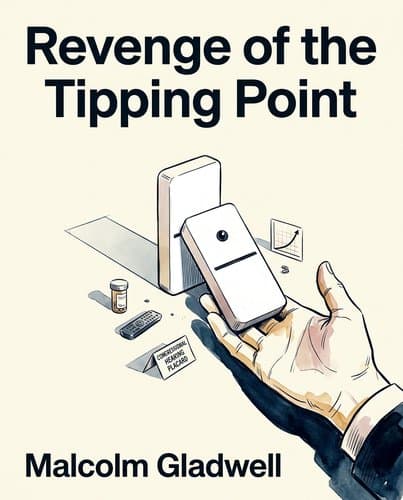
216857785_revenge-of-the-tipping-point
by Malcolm Gladwell
The same viral mechanics that spread ideas and movements are being weaponized against us—and Gladwell reverse-engineers the forensics of manipulation to reveal…
In Brief
Revenge of the Tipping Point (Octo) revisits the viral mechanics of social change — superspreaders, overstories, and group thresholds — and examines how they can be deliberately weaponized to cause harm. Gladwell forensically deconstructs real-world epidemics of behavior, from opioid overprescribing to institutional discrimination, giving readers a framework for identifying who is engineering contagion and why.
Key Ideas
Small-area variation reveals hidden social narratives
Look for 'small-area variation' — when a neighborhood, school, or profession behaves differently from its neighbors despite identical demographics, you're looking at an overstory, an ambient social narrative that shapes behavior outside conscious awareness. Identifying it is the first step to changing it.
Social change reaches tipping point at 25%
Social change doesn't accumulate gradually — it hits a cliff edge. Damon Centola's research shows nothing happens below 25% dissent, then everything happens. If you're working for change and feel like you're making no progress, you may be one or two people away from a cascade.
Target the few who drive disproportionate harm
The most efficient interventions target the Few, not the many. Whether it's air pollution, infectious disease, or opioid prescribing, a small fraction of the population drives a disproportionate share of the harm. Broad solutions often miss the actual mechanism.
Homogeneity removes immune system against contagion
Monocultures — communities, institutions, or systems built around a single dominant type — are structurally fragile. The very homogeneity that makes them high-performing removes the subcultural diversity that acts as an immune system against social contagion.
Subjective criteria mask objective enrollment boundaries
When an institution starts using 'subjective criteria' — character, fit, intangibles — ask what objective threshold it's trying to prevent someone from crossing. Harvard invented holistic admissions the moment Jewish enrollment approached 28%. The criteria and the target are worth examining together.
Social mechanics are neutral, intention is moral
The toolkit for spreading good and the toolkit for spreading harm are identical. Overstories, superspreaders, and group proportions are neutral mechanics. The moral question is always: who is doing the engineering, and for whose benefit?
Who Should Read This
Curious readers interested in Behavioral Psychology and Social Psychology and the science of how the mind actually works.
Revenge of the Tipping Point
By Malcolm Gladwell
15 min read
Why does it matter? Because the tools that change the world for good are already being used against you.
A woman testifies before Congress and uses the passive voice to avoid saying her family's drug killed people. That grammatical sidestep — "has been associated with" — turns out to be a blueprint, not a slip. Malcolm Gladwell spent twenty-five years mapping how ideas spread, how behaviors tip, how small pushes move whole populations. The people doing the damage were studying the same maps. The same mechanics he celebrated — the right messenger, the right environment, the right threshold — have been quietly weaponized. The opioid epidemic wasn't chaos. Suicide clusters aren't mysterious. Vaccine hesitancy doesn't just happen. Each one has architecture. Each one has a leverage point someone found first. This book runs the same tools in reverse — forensically, looking for reasons, culprits, and leverage points. This book is Gladwell running the same tools in reverse — not to explain how to change the world, but to show you exactly who already did, and how, and why they were so confident you wouldn't notice.
The Passive Voice Was the Confession
A young heir to a pharmaceutical dynasty is sitting in front of a bookcase, unmuted at last, telling a congressional committee that his family's painkiller 'has been associated with abuse and addiction.' A politician stops him mid-sentence. Not to challenge the facts — to challenge the grammar. The passive voice, the politician points out, erases the subject. It implies the family simply watched from a distance as something unfortunate unfolded nearby, rather than engineering the conditions that killed roughly half a million Americans.
That two-word grammatical catch is where Malcolm Gladwell opens his sequel to The Tipping Point, and the choice tells you everything about what kind of book you're holding. Twenty-five years ago, Gladwell argued that the world was secretly malleable: find the right lever, apply the right pressure, and a positive idea could spread like a virus. The framing was exhilarating. Change was close. The slightest push in the right place could tip everything.
Gladwell hasn't abandoned that insight. He's prosecuting it. If social epidemics respond to deliberate pressure, then whoever understands that mechanism wields real power — and the question becomes what they do with it. This book reframes the original promise as a warning. The tools that can lower crime rates or spread literacy can also be used to flood a country with addictive opioids, and the people who use them that way will later sit before Congress describing the carnage in the passive voice, as though the epidemic arrived on its own, associated itself with suffering, and left no fingerprints. Gladwell calls what he's doing forensic: a search for reasons, culprits, and consequences. The optimism of the original Tipping Point isn't gone — it's Exhibit A for the prosecution.
Why Los Angeles Had a Bank Robbery Epidemic and New York Didn't
Why did Los Angeles produce a bank-robbery epidemic while New York — home to the legendary Willie Sutton, who turned bank heists into performance art and stole the equivalent of $20 million over his career — produced almost nothing? Sutton should have been the spark. He robbed with such theatrical confidence that one of his maxims, 'that's where the money is,' is still quoted in medical schools. And yet the criminal classes of New York looked at Slick Willie and mostly shrugged.
Gladwell's answer begins in Vermont in 1967, where a young physician named John Wennberg was hired to map medical quality across the state's thirteen hospital districts. He expected to find that poorer communities got less care. What he found was variation so extreme it looked like a data error. In the town of Stowe, 70 percent of children had their tonsils removed before age fifteen. Ten miles down the road in Waterbury, the number was 20 percent. The demographics were identical. The patients weren't asking for different things. The difference lived entirely inside the local medical culture — a contagious set of assumptions doctors in each community had absorbed from one another, invisible as weather, powerful as gravity. Wennberg called it small-area variation, and he found it everywhere: surgery rates tripling across county lines, end-of-life doctor visits running three times higher in Los Angeles than in Minneapolis, with no patient preference explaining the gap.
The implications snap into focus the moment you map this onto crime. Los Angeles didn't have more bank robberies because it had more desperate people. It had a specific social architecture — a gang ecosystem, a culture of carjacking that made getaway cars easy to acquire, and one extraordinary operator named Robert Brown, street name Casper — that allowed the behavior to scale. Casper recruited teenagers during their school lunch breaks, supervised from a parked car down the street, and once commandeered a school bus to ferry his crew to safety. He personally orchestrated 175 robberies. He was not a random criminal. He was the overstory: the high canopy of assumptions and permissions under which everyone else moved.
That's the concept Gladwell lands here, borrowed from forest ecology. An overstory is the uppermost layer of a forest canopy — you barely notice it, but it governs the light, the moisture, and the growth of every living thing below. Social epidemics work the same way. They don't spread everywhere. They spread to the edges of the overstory and stop. Which means they can be mapped, and sometimes, dismantled.
The Perfect Town That Engineered Its Own Tragedy
Imagine a forest where every tree is genetically identical. A single blight finds one tree, and because every other tree shares the same vulnerability, the whole forest falls. That is what biologists mean by a monoculture — and it is, with eerie precision, what the parents of Poplar Grove built for their children.
Poplar Grove is a pseudonym for a real American suburb: waterfront properties, 121 state sports championships since the late 1970s, houses that sell to doctors and lawyers fleeing cities with 'deplorable' public schools. The real-estate agent who knew it best chose to raise his own daughters in the neighboring, less prestigious town next door. 'The parents are outta their f—ing mind,' said the principal of Poplar Grove High. She meant the pressure. Four or five AP classes simultaneously. Sports captaincies. Grade-point averages tracked with the anxiety of a stock portfolio. What made this unusual wasn't the ambition itself — plenty of wealthy suburbs push hard — but the absence of any alternative. Sociologists Seth Abrutyn and Anna Mueller, who spent years studying the town, found that even the students who identified themselves as rebels were fully captured by the culture. One self-described nonconformist, a kid named Scott, caught himself mid-thought believing that if he failed a test, he would end up homeless. He recognized the absurdity. He couldn't shake it. Deviation from Poplar Grove's norm was, as Abrutyn and Mueller put it, so slight you would need an MRI to detect it.
Monocultures cost you resilience. A typical high school contains multitudes: jocks who hate class, goths who are secretly shy, kids for whom the whole enterprise is a performance in indifference. Each subculture carries its own way of measuring worth. An epidemic of despair spreading through one group hits a firewall at the border of another. Poplar Grove had no such borders. When a girl named Alice jumped from a bridge and survived, it was shocking. When her teammate Zoe jumped from the same bridge six months later and did not survive, it became a pattern. When classmate Steven died by gun, and then more deaths followed, and then more after that — eighteen suicides between 2005 and 2016 in a school of two thousand students — the logic of contagion had run its course through a community with nothing to stop it. The deaths clustered disproportionately among the high-status students, the ones who most perfectly embodied the Poplar Grove ideal. Which sent a message to everyone below them on the hierarchy: if the best among us couldn't survive this, what chance do the rest of us have?
Gladwell gives this a clinical name: iatrogenesis — harm caused by the healer. The parents of Poplar Grove didn't want their children to suffer. They built the safest, most achieving, most cohesive community they could imagine. In doing so, they removed every off-ramp.
One Extra Person Changes Everything: The Math Behind Social Revolutions
Social change feels gradual until the moment it doesn't. You track the polls, count the court victories, measure each incremental gain — and then overnight, something that seemed immovable for decades just collapses. The reason this keeps catching us off guard isn't inattention. It's that we're watching the wrong indicators. Change doesn't climb a slope. It goes off a cliff.
The clearest demonstration comes from experiments run by University of Pennsylvania sociologist Damon Centola. He built an online naming game: groups of participants, paired and re-paired at random, each trying to agree on a name for the face in a photograph. Nobody could see what anyone else was typing. Within roughly fifteen rounds, the whole group converged on a single name — call it Jeff. The consensus hardened fast and, once established, became self-reinforcing. Everyone had learned that Jeff works, so everyone kept typing Jeff.
Then Centola introduced dissidents: graduate students instructed to push a different name — say, Pedro — regardless of what everyone else typed. He wanted to know how many it would take to flip the group. At 18 percent dissidents, nothing happened. At 20 percent, still nothing. In a version with exactly twenty participants, four dissidents produced zero movement. He added one more person. Five dissidents — 25 percent of the group — and the entire room flipped to Pedro, almost instantly. One person was the difference between total failure and total victory.
The activists fighting for marriage equality in 2004 were living inside that gap without knowing it. After George W. Bush called for a constitutional amendment and state after state wrote bans into law, the movement's leaders gathered in Jersey City and drafted a slow, cautious, decades-long plan. Asked how long it would take, one veteran activist answered without hesitation: twenty to twenty-five years. Maybe forty. What none of them could see was that the cultural canopy governing what ordinary people considered normal and possible was already shifting, one Thursday night at a time.
Will & Grace had been on NBC since 1998. Critics called it ordinary. Some gay activists dismissed it as toothless. What it was doing, quietly, was breaking every unspoken rule that had governed how television depicted gay life: a gay man at the center of his own story, defined not by his sexuality as a crisis but by his friendships and his competence and his humor. Normal, and incidentally gay. When Maine reversed its vote on same-sex marriage in 2012, researchers asked the people who'd changed their minds where they'd been thinking about the question most. The number-one answer was television.
The activists felt like they were losing right up until they won. That's not a failure of nerve. That's what it feels like to be at 24 percent.
Harvard Has Been Running a Wealth Filter Since the 1920s
Six people watched on YouTube as the Harvard women's rugby team beat Princeton 61–5 in the rain. Six. And yet to field that team, Harvard had recruited internationally — players from Scotland, Australia, Hong Kong, Germany, Honduras — and was actively building relationships with coaches in New Zealand and England. For a sport that barely registers in American high schools, with a YouTube audience you could seat at a kitchen table, the investment seems baffling. Until you look at what those thirty-three roster spots actually do.
To understand that, you have to go back to the 1920s, when Harvard's president Abbott Lawrence Lowell looked at his incoming freshman class and saw catastrophe. Jewish enrollment had climbed from 10 percent when he took office in 1909 to 27.6 percent by 1925 — dangerously close to the threshold where a minority group stops being a curiosity and starts reshaping the culture around it. So Lowell did something extraordinary: he built a classification system. J1 meant an applicant was conclusively Jewish. J2 meant the evidence was probable. J3 meant possible. Then he dismantled the objective admissions process that had let Jewish students in on merit, replacing it with character interviews, letters of recommendation, and personal essays — tools that rewarded the kind of polish that came from country clubs and boarding schools rather than immigrant families in the Bronx. The goal, stated plainly in his correspondence, was to hold Jewish enrollment at around 15 percent: high enough to appear tolerant, low enough to stay safely in skewed territory.
That structure never left. It just changed targets. Compare Caltech's Asian enrollment to Harvard's across the same decades and the management becomes visible. Caltech uses a straightforward meritocratic process and doesn't try to govern its proportions — so its Asian enrollment climbed from 25 percent in the early 1990s to over 42 percent by 2013, with the numbers moving freely each year. Harvard's Asian enrollment across the same period barely moved at all: 17 percent, 18 percent, 16 percent, back to 17 percent, year after year, like a thermostat set to a specific temperature.
Rugby and squash and lightweight rowing are the thermostat. Varsity athletes are admitted at near-universal rates regardless of academic scores, and the sports that get varsity status at Harvard happen to be ones that require country clubs, private coaching, and families with six-figure training budgets. The roster that rainy afternoon at Princeton came from Shaker Heights, Marin County, exclusive boarding schools in British Columbia. Gladwell has a name for the version of this that operates at extreme scale: the Law of the Very, Very, Very Few. Lowell's lesson has held for a century: if you want to control who gets in, control the definition of merit. His successors just swapped J1 classifications for recruiting trips to New Zealand.
86% of the Virus Came From Two People
Most people carry a reasonable assumption into any public-health crisis: the threat is roughly distributed across the population, so the solution should be too. Masks for everyone. Distance from everyone. Testing for everyone. Gladwell's chapter on the Biogen outbreak destroys that assumption with one number.
In a British challenge study, researchers infected thirty-six young, healthy volunteers with identical doses of COVID under identical conditions, quarantined them, and measured everything. Eighty-six percent of all detected virus particles came from two people. Not the sickest people — just two people who happened to exhale an order of magnitude more aerosol than anyone else. Aerosol scientists call them superemitters: individuals whose saliva is unusually viscous, or whose upper airways are too dry to trap particles before they escape. Dehydration makes it worse, and dehydration tracks with age and body mass, which is why a long transatlantic flight on recycled air and an empty stomach matters enormously to what happens next. Gladwell calls the governing principle the Law of the Very, Very, Very Few.
The pattern looks exactly like what chemist Donald Stedman found on Denver's highways: five percent of vehicles caused fifty-five percent of automobile pollution. He built a roadside scanner that could spot the outliers in real time. The efficient fix was obvious — target those cars. Colorado still makes virtually everyone queue up for a smog check every year. Singling out the few is politically uncomfortable, so society absorbs the cost spread across everyone instead.
The Biogen strain entered Boston through one person — a speaker in a crowded hotel ballroom, probably dehydrated and jet-lagged, talking loudly in a poorly ventilated room. Of the 120 separate COVID strains that reached Boston in those early months, 119 mostly stopped. That one caused an estimated 300,000 infections across twenty-nine states and multiple countries. One person. The problem isn't that we lack the tools to find that person in advance. The problem is that we haven't decided what we'd do if we could.
The Word 'Holocaust' Was Invented by an NBC Marketing Department
Why did it take thirty years for Americans to reckon with what happened in the Nazi camps — and what finally broke the silence? The answer isn't grassroots activism or scholarly courage. It's a television executive who didn't like the title of a script.
The silence was measurable. In 1961, a Harvard historian named H. Stuart Hughes published a 524-page account of European history from 1914 through the late 1950s. He mentioned the concentration camps exactly three times. He gave more pages to Arnold Schoenberg's twelve-tone scale. This wasn't denial — it was something more disorienting. Hughes simply didn't have the cultural framework to treat the genocide as central to the story he was telling. That same year, survivors in Los Angeles were depositing their prisoner uniforms and family photographs into a borrowed closet on Wilshire Boulevard because they couldn't bear to keep the items at home but didn't know what else to do with them. The overstory above everyone — scholars, survivors, ordinary Americans — said: look forward, not back.
In the spring of 1978, NBC aired a nine-and-a-half-hour miniseries dramatizing the fate of a prosperous Jewish family through the years of Nazi rule. It reached 120 million Americans across four consecutive nights — roughly half the country. In West Germany, where it aired on a minor regional network, 15 million viewers watched anyway, some in tears, calling their local stations at midnight. The German parliament had been on the verge of letting the statute of limitations for war crimes expire. After the broadcast, legislators reversed course and abolished it entirely.
The show had been titled 'The Family Weiss.' The head of NBC read the scripts, decided that name would sink the project, and called the producer with a one-word fix: call it the Holocaust. That single instruction is why the word exists as a proper noun. Before 1978, it appears almost nowhere. After April of that year, it goes vertical on every usage chart, and every memorial museum built afterward adopted it into their name.
The overstory that had held for three decades — that Jewish strength meant silence about Jewish suffering — was rewritten not by historians or survivors, but by the people who controlled the broadcast channel. Whoever writes the songs doesn't need to write the laws.
McKinsey Taught Purdue Pharma How to Engineer a Drug Epidemic
In 2013, a McKinsey consultant joined an OxyContin sales rep for a day of calls around Worcester, Massachusetts, and filed a report that reads like a comedy of failure. Hospitals had stopped letting reps walk the floors. Doctors refused to schedule meetings. One administrator sent a formal letter after the rep tried introducing himself to an office secretary in a reception line. McKinsey's verdict: Purdue was playing what they called the 'pinball wizard' model — bouncing from doctor to doctor hoping to catch someone receptive — and it wasn't working.
What McKinsey proposed instead was a map. Pull every OxyContin prescription written in the first half of 2013 — over six million — rank the prescribing doctors from bottom to top, and look at where the math lives. The bottom decile, roughly 100,000 physicians, averaged one prescription in six months. The top 358 averaged 247 each. That's not a different quantity of the same behavior. It's a different category of person. McKinsey called them Core and Super Core, and told Purdue to stop spending money on everyone else.
Then they found the tipping point. Purdue ran the numbers on how Super Core doctors responded to sales visits at different frequencies. At eight visits a year, twelve, sixteen — prescription counts still fell. At twenty-four visits a year, twice a month, the numbers jumped. Wined and dined on that rhythm, the Super Core became reliably productive.
Michael Rhodes, a pain clinic operator outside Nashville, is where the theory becomes a controlled experiment. In 2007 he wrote 297 OxyContin prescriptions — Core territory. Purdue sales reps started visiting, taking him to dinner, bringing gifts. His license was placed on probation. Purdue visited him 31 more times after that. Before his license was revoked entirely, reps had documented at least 126 in-person meetings. His annual prescription count climbed to 1,082, then 1,204, then 1,307. When the Tennessee attorney general filed its complaint, the tab read 319,560 tablets over nine years. One doctor, methodically cultivated.
The economist Mathew Kiang later calculated that one percent of all American doctors wrote 49 percent of opioid doses. Purdue built an epidemic on a few hundred people like Rhodes, concentrated in states where the triplicate prescription laws had never taken hold.
The passive voice David Sackler deployed before Congress — OxyContin 'has been associated with' abuse — wasn't a rhetorical stumble. It was the culmination of a strategy. The mechanics were McKinsey's. The application was Purdue's. The tools were the same ones Gladwell spent the original Tipping Point celebrating: find the superspreaders, identify the tipping point, apply pressure precisely. The only new element was the target.
The Grammar of Accountability
David Sackler's testimony before Congress. Return to that sentence. 'Has been associated with abuse and addiction.' Now run it through everything you've just read. A company identified the superspreaders — the top 358 doctors writing 247 prescriptions each. It calculated the exact visit frequency that flipped their behavior. It sent representatives to one doctor 126 times after his license was placed on probation and watched his annual count climb past a thousand. These are not the components of a tragedy. They are the components of a case study. The passive voice wasn't a stumble under pressure — it was load-bearing. Strip it away and what remains is a sentence no legal team would permit: we found the tipping points, we applied the pressure, and we knew what would spread. The mechanism is on the record now. You can grieve a tragedy. You cannot un-name a method.
Notable Quotes
“Look at the world around you,”
“It may seem like an immovable, implacable place. It is not. With the slightest push—in just the right place—it can be tipped.”
“More than 50% of OxyContin primary calls are to low-decile (0-4) prescribers.”
Frequently Asked Questions
- What is Revenge of the Tipping Point about?
- Revenge of the Tipping Point examines how viral mechanics of social change — superspreaders, overstories, and group thresholds — can be deliberately weaponized to cause harm. The book forensically deconstructs real-world epidemics of behavior, from opioid overprescribing to institutional discrimination. Gladwell provides readers with a framework for identifying who is engineering contagion and why. Rather than simply celebrating tipping points as forces for good, this work explores how the same mechanisms that spread positive change can spread destructive behavior across communities and institutions.
- What is an overstory and why does it matter in understanding social change?
- Look for 'small-area variation' — when a neighborhood, school, or profession behaves differently from its neighbors despite identical demographics, you're looking at an overstory, an ambient social narrative that shapes behavior outside conscious awareness. Finding and identifying these hidden narratives is crucial because they drive behavior at the subconscious level. Gladwell emphasizes that "identifying the overstory is the first step to changing it." Overstories explain why entire communities or institutions can exhibit radically different outcomes from statistically similar peers—the invisible cultural scripts that guide decision-making at scale.
- At what point does social change actually happen according to the book?
- Social change doesn't accumulate gradually — it hits a cliff edge. Damon Centola's research prominently featured in the book shows that "nothing happens below 25% dissent, then everything happens." This explains why activists and change-makers often feel stuck for years before sudden breakthroughs occur. The insight is highly practical: if you're struggling to create change, "you may be one or two people away from a cascade." Understanding this threshold principle fundamentally transforms how we approach social problems and design strategic interventions.
- Why does the book focus on small groups rather than broad populations?
- The most efficient interventions target the Few, not the many. Whether it's air pollution, infectious disease, or opioid prescribing, a small fraction of the population drives a disproportionate share of the harm. This insight challenges conventional thinking about social problems and policy design. Broad solutions based on mass behavior often miss the actual contagion mechanism entirely. By concentrating resources on superspreaders, high-prescribing doctors, and key institutional decision-makers instead, organizations can achieve far greater impact and efficiency than attempting population-wide interventions.
Related Book Summaries

Read the full summary of 216857785_revenge-of-the-tipping-point on InShort