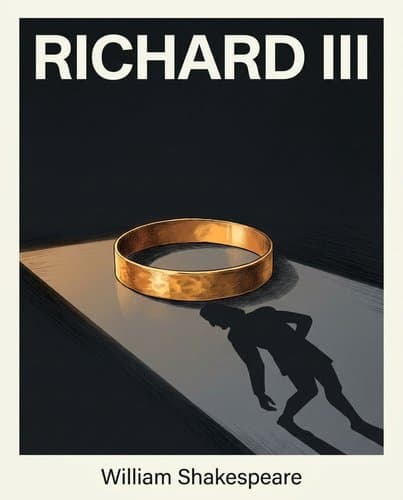
42058_richard-iii
by William Shakespeare
Power sustained by performance always leaves a receipt. Shakespeare's Richard narrates his own villainy with chilling clarity—making you his…
In Brief
Power sustained by performance always leaves a receipt. Shakespeare's Richard narrates his own villainy with chilling clarity—making you his co-conspirator—while proving that charm weaponized as anesthetic, coalitions built on fear, and institutions hollowed into theater all collapse the moment vulnerability appears.
Key Ideas
Villainous confession recruits co-conspirators
Villainy announced openly is still villainy — and often more effective. Richard's radical transparency with the audience makes us feel like co-conspirators, which is itself a form of manipulation. Watch for people who are this candid about their own ruthlessness; the confession is part of the performance.
Warmth disarms targets better than aggression
Warmth is a weapon when deployed before violence. The strawberry request isn't a pleasantry — it's anesthetic. Charm, social ease, and domestic warmth used instrumentally are more disabling than open aggression because they prevent the target from recognizing the threat.
Legal legitimacy is manufactured theater
Institutional form can be emptied of institutional substance. The Scrivener's indictment shows how legal legitimacy is manufactured to ratify decisions already made. The fraud is visible; the mechanism is the silence that surrounds it, not the document itself.
Fear-based coalitions collapse instantly
Fear-based coalitions are structurally self-destructing. Every alliance Richard builds is purchased through fear or coercion — and the moment weakness appears, the whole structure inverts. Buckingham was made a king-maker and dismissed in the same scene; Stanley withheld his army until the last possible moment. Power built on fear cannot survive the first sign of vulnerability.
Self-awareness without agency imprisons
Self-knowledge without the will to change is its own prison. Richard sees every manipulation he performs with total clarity, narrates his own villainy to the audience, and still cannot stop. At Bosworth, this lucidity turns against him: the conscience he suppressed all play simply recites his own confessions back at him. Knowing what you are doing wrong is not the same as being able to stop.
Legitimacy requires constant performance
The performance of legitimacy requires constant maintenance. Richard's seizure of power is a theatrical production — the prayer book, the two bishops, the reluctant capitulation — and it works precisely once. The moment he stops performing and starts dismissing allies, the audience (citizens, nobles, eventually the audience itself) stops believing the role.
Who Should Read This
Readers interested in Classics and Classic Authors, looking for practical insights they can apply to their own lives.
Richard III
By William Shakespeare & John Jowett
12 min read
Why does it matter? Because the most dangerous villain in English literature announced his plan on page one — and we cheered anyway.
We assume we'd spot the villain. We assume that if someone told us directly — looked us in the eye and confessed their plots, their contempt, their murders — we'd recoil. Then Richard III opens his mouth in the first sixty seconds and addresses us personally. He tells us everything: the plots, the brother he'll have killed, the widow he'll seduce over her husband's bleeding corpse. And something uncomfortable happens. We lean in. We want him to succeed.
Shakespeare understood that villainy doesn't sneak past us — it recruits us. Richard doesn't hide his manipulation; he performs it for our benefit, and that performance is the trap.
The Most Dangerous Villain Is the One Who Tells You Exactly What He's Doing
Most villains derive their power from concealment. Richard III derives his from announcement.
Before the play is two minutes old, Richard, Duke of Gloucester — younger brother to King Edward IV, physically malformed, politically sidelined now that the wars are over — has already told us everything. The kingdom is celebrating; Richard cannot stand it. He was shoved into the world unfinished, so misshapen that dogs bark when he limps past. His conclusion arrives with the calm logic of a man who has genuinely thought it through: since he cannot be a lover, he has decided to be a villain.
Not stumbled into it. Decided.
The calm is what's startling. He hasn't confessed a weakness — he's outlined a strategy. The plots are already running: forged prophecies have convinced King Edward that a man whose name begins with "G" will murder the royal heirs. Edward's brother is named George. The arrest warrant is as good as written. We're hearing the after-action briefing.
Then Clarence himself walks in, under armed escort bound for the Tower, and Richard plays the horrified brother with total conviction — furious on Clarence's behalf, promising to fight for his release. The moment Clarence is gone, Richard turns to us: Simple, plain Clarence — I do love thee so, that I will shortly send thy soul to heaven.
That line is aimed at us, not Clarence. We are the only ones who hear it. And that's the trap. Richard has made us his confidants, his audience within the audience. From the first scene, we're his accomplices. The discomfort isn't that he's deceiving Clarence. It's that he's already got us.
Standing Over a Corpse, With Nothing But Words, He Won
Lady Anne is walking behind the coffin of King Henry VI when Richard of Gloucester steps into the road and stops the procession. She is the widow of Henry's son, a prince Richard killed three months earlier at Tewkesbury. Henry himself, also Richard's victim, lies in the box before her. She calls Richard a "dreadful minister of hell," a devil, a lump of deformity. He calls her a divine perfection of woman.
It is the play's proof that Richard's method has no floor.
What follows is a rhetorical demolition carried out at close range. Richard admits every charge (yes, he killed her husband, yes he killed Henry) but each admission is instantly redirected. The murders were acts of love. Her beauty drove him to it. The reframes are so brazen they work partly by velocity: Anne can't attack a position he keeps abandoning and replacing.
The peak is the sword gambit. Richard kneels, offers her his sword hilt-first, and bares his chest to the blade. He names his crimes out loud and tells her to strike. He won't resist.
Anne raises the sword. She holds it there. She cannot bring it down.
He interprets her hesitation as permission, slips a ring on her finger, and sends her to his house to wait for him.
The gambit works because Richard has read her precisely. Anne is not weak — she arrived at this funeral armed with curses, pouring them over Henry's body. But her mercy and her rage are not separate; they run on the same circuit. Richard has spent the whole scene running a slow conversion, shifting her hatred into something that must at least listen, then into something that cannot quite act. When the sword appears, he doesn't give her a target; he gives her a choice between being a murderer and being a listener. She makes the only choice a person with mercy can make.
After Anne leaves, Richard steps aside and delivers a victory speech to the empty stage. He catalogs every disadvantage: the dead husband she loved, God and conscience arrayed against him, his own deformity. He marvels. He decides to buy a mirror to see what a man capable of this looks like.
The speech isn't gloating — it's something stranger. Richard is genuinely delighted, the way a craftsman is delighted by a piece of work that exceeded his own expectations. Which is the scene's final discomfort: he pulled it off, and you've been enjoying every second of it.
The Prayer Book, the Strawberries, and the Severed Head: How Theater Kills
A sword requires a victim who cannot fight back. A performance requires one who will not — who has been given every reason to believe what they're seeing is real.
This is what Shakespeare builds toward: not murder, but theater. He lets you watch the rehearsal before the show.
The council meets in the Tower. Richard enters late, apologizes warmly, and then, in what reads like idle small talk, asks the Bishop of Ely if he might send for strawberries from his garden in Holborn. The request is so domestic, so warmly specific, that it makes the room feel safe. The Bishop leaves. The moment he's gone, Richard tells Buckingham that Hastings must die.
He returns raging. His arm is withered, he declares: witchcraft, Shore's wife and Hastings behind it. Hastings, who has been sleeping with Shore's wife, hedges: if they have done this thing, they deserve death. That if, barely a hesitation, costs him his head. Richard calls it treason. Within the hour, Hastings is executed; his head comes back into the chamber as a prop, evidence of a discovered plot, proof of Richard's vigilance. The strawberries are never mentioned again. They were set decoration.
Before the Lord Mayor arrives at Baynard's Castle, Buckingham gives Richard his stage directions with a director's precision. Be difficult to reach. Hold a prayer book. Stand flanked by two clergymen. When the petition comes, he must "play the maid's part": refuse the crown once, refuse it twice, let them press it on him, so that when he finally yields it reads as reluctant duty. Buckingham will handle the applause.
Richard appears above, between two bishops, prayer book in hand, looking exactly like a man who had to be torn from evening prayer to deal with affairs of state. Buckingham, below with the Mayor and citizens, contrasts him to Edward IV, who spent his days on a lewd day-bed with courtesans. The crowd watches a projection of holiness and begins to believe what it sees.
The Mayor certifies it himself: "God bless your grace! we see it, and will say it."
We see it, and will say it. The Mayor hasn't merely been deceived — he's agreed to become the deception's guarantor, to carry the performance home as eyewitness. Theater, ratified, becomes history.
The instant the citizens leave, Richard says: "Come, let us to our holy task again." The prayer book returns. He's not breaking character. There's nothing beneath the performance to break.
Everyone Saw Through It. No One Would Say So Aloud.
Then Shakespeare pulls us backstage, to a man who was conscripted into the performance before he knew what it was.
A professional copyist walks onstage alone, holding a single sheet of paper. He has just spent eleven hours transcribing a legal indictment in the careful formal hand required for public reading: Hastings', to be proclaimed at St. Paul's Cathedral that morning. Catesby brought him the original draft the previous night; the original had taken equally long to prepare. Which means the document was composed and being professionally copied while Hastings was still alive and uncharged — untainted, unexamined, free. The paperwork preceded the pretext by hours.
He lays out the arithmetic with quiet precision, then asks two questions. Who is so dull they cannot see through this obvious scheme? And yet — who is so blind as to openly say they see it? The questions cancel each other into paralysis. Everyone perceives the fraud; no one will name it aloud. The Scrivener knows this because he is doing it himself: he delivers fourteen lines of moral clarity, exits without naming Richard, without naming Catesby, without naming anyone. "Bad is the world," he says, and leaves.
That exit is the point. The Scrivener sees everything; Richard has not deceived him. The engine is complicity: that indictment, drafted before Hastings was even charged, still functions as legal authority because everyone, the Scrivener included, agrees to handle it like one. He cannot point a finger without becoming the next indictment. So he does what people do under political terror: he speaks in the passive voice, gestures at the universe, and goes home.
Margaret's Curses Aren't Witchcraft — They're a Receipt
The Scrivener tracks the machinery from inside it, naming the trap to himself and walking into it anyway. Margaret tracks it from outside, from the beginning, before most of these men knew what they were helping build. Her curses aren't dramatic atmosphere. They're a ledger, and the play collects on every entry.
When she appears early, a discarded Lancastrian queen ranting at the men who destroyed her family, she reads as theatrical excess. She calls down ruin on Buckingham, Rivers, Hastings, Richard himself. Buckingham waves her off as a bitter, deluded old woman. Rivers and Grey treat her words as noise. Her prophecies feel like the ravings of grief rather than the operations of fate.
Then the play begins cashing them in, one by one.
The reckoning crystallizes near the end, on All-Souls' Day (the Catholic feast for the dead), when Buckingham walks to the scaffold Richard has ordered for him. He recites a catalog of Richard's victims: Hastings, Edward's children, Rivers, Grey, old King Henry, his son. These are people Buckingham helped condemn. And then, dying, he quotes Margaret. She had told him exactly this: that when the grief came, he would remember she had seen it coming. He does. That's almost his final statement — a man who dismissed her as a bitter hag, repeating her words as the blade descends.
Shakespeare refuses to resolve what this means. Is it divine justice, providence moving through time to punish each man in sequence? Or is it the mechanical logic of a terror regime, which always produces enough violated loyalties and accumulated enemies to eventually devour its own architects? Both readings fit. The play doesn't choose between them. What it insists on is the accuracy: Margaret was right, and the accounting was exact. The curses weren't prophecy in any supernatural sense. They were a receipt. Payment eventually arrived.
The Throne Was the Peak, and Also the Beginning of the Fall
What brings Richard down? The obvious answer is Richmond—the challenger gathering forces across the Channel, the coalition assembling against him. But watch the timing. Richard hasn't been on the throne for thirty lines when his power starts leaking.
Watch what happens in the first scene after the coronation. Richard, newly crowned, floats a hint to Buckingham, the man who engineered his kingship, about the princes still living in the Tower. He expects Buckingham to complete the thought. Buckingham doesn't. He asks for time to consider, then exits. Richard's diagnosis is immediate: "High-reaching Buckingham grows circumspect." No mourning for the partnership.
When Buckingham returns to claim the earldom of Hereford (Richard's explicit promise, his reward for placing him on the throne), Richard speaks about prophecies, about a castle he once visited, about the time of day. Buckingham presses three times. "I am not in the giving vein to-day," Richard says, and leaves.
Buckingham's five-line exit is the scene's real verdict. He doesn't curse Richard; he thinks of Hastings, killed by Richard months earlier for a far smaller offense, and runs for his life. That's the logic completing its circuit: the same cold efficiency Richard used to discard everyone else has now processed his closest partner. Richmond hasn't raised a sword yet. The coalition is already gone.
The Night Richard Could Not Outrun Himself
Richard wakes in the dark calling for a horse and ordering someone to bind his wounds. A beat passes before he catches himself: he was dreaming. It is the night before Bosworth Field, and for the first time in the play, Richard has lost control of his own interior.
Both commanders have pitched tents on opposite sides of the coming battle. Richmond prays, draws up plans, and sleeps soundly. Richard skips supper, obsessively checks his armor, threatens to execute a hostage if reinforcements don't arrive by dawn, then tells a lieutenant what he can't say to the troops: he's not himself. The usual sharpness isn't there. Something is already wrong before the ghosts arrive.
What visits Richard in the dark is his own ledger, made visible. Every person he has killed appears in sequence: the prince stabbed at Tewkesbury, the king murdered in the Tower, the brother drowned in wine, the courtiers executed at Pomfret, the children smothered in their beds, the wife who never slept a quiet hour beside him, the ally sent to the scaffold. Each delivers the same double verdict: to Richard, despair and die; to Richmond, live and flourish. The entire murder account, itemized in a single night.
Then he wakes, and the soliloquy begins. It is nothing like anything else in the play.
For five acts Richard has addressed us from a position of control: reporting schemes, savoring victories, explaining what everyone else is too slow to see. Now the sentences come in short, colliding bursts. He asks what he fears, answers "myself," then immediately tries to argue his way out of it. He cycles through the logic of self-love, asks whether he loves himself, asks why, decides there's no reason: he has done nothing for himself worth loving. "Is there a murderer here? No. Yes, I am: / Then fly. What, from myself?" The argument keeps collapsing under itself. He calls himself a villain, takes it back, calls himself a fool for taking it back. Conscience, he concludes, speaks in a thousand tongues, and every one reaches the same verdict.
The devastating thing is that Richard hasn't suddenly become someone different. He has always known this about himself — it's what made him dangerous. That self-knowledge let him see every weakness in the room and exploit it; he named his own monstrousness in the opening scene without flinching. Now that same faculty has nowhere left to redirect. The man who could talk his way out of any corner can't negotiate with the part of himself that simply knows the account and won't stop reading it aloud. He has set his life upon a cast, he tells his officers, and he will stand the hazard of the die.
He goes to battle. On foot, his horse killed under him, he cuts through the field hunting Richmond personally, and refuses every chance to withdraw. Shakespeare gives him no death speech — the villain who never stopped talking vanishes mid-action. His last words are a king offering his entire kingdom for a horse: the whole architecture of his ambition compressed, finally, into a single animal want.
The Kingdom for a Horse
Here is what Shakespeare finally does with you: he makes you complicit, then presents the bill. For five acts you watched Richard narrate his own crimes with a connoisseur's precision, and some part of you enjoyed it. That enjoyment was never incidental — it was the mechanism. His power over the court worked exactly the same way it worked over the audience: not through fear alone, but through the pleasure of being let in. At Bosworth, when the conscience he had suppressed for a lifetime finally speaks at full volume and he cannot answer it, what collapses isn't just a tyrant — it's the performance you were watching. The man who trusted his intelligence above everything meets the one argument his intelligence already knows by heart and cannot dismiss. The villain who never stopped talking goes silent. You're left holding whatever it was you felt while watching him work.
Frequently Asked Questions
- What does Richard III show about fear-based power systems?
- Power built on fear cannot survive the first sign of vulnerability. Every alliance Richard constructs is purchased through fear or coercion rather than genuine loyalty. When weakness appears, the structure inverts: Buckingham becomes a threat after becoming king-maker, and Stanley withholds his army until the last moment. This reveals a fundamental weakness—fear-based systems depend entirely on perceived strength. While fear can secure short-term compliance, it provides no stable foundation for lasting rule. When Richard's power wavers, his coalition dissolves, leaving him isolated. The play demonstrates that intimidation cannot substitute for genuine authority and that rulers depending on fear are structurally vulnerable.
- How does Richard manipulate others through charm in Richard III?
- Richard uses warmth and charm as strategic weapons more disabling than open aggression. The 'strawberry request' serves as anesthetic rather than pleasantry, lowering victims' defenses by creating intimacy and normalcy. This instrumental use of social ease prevents targets from recognizing threats until too late. Charm works as camouflage because it triggers trust before violence strikes. People are more vulnerable to calculated warmth than direct hostility; once they recognize the threat, they're already emotionally compromised. The play reveals that charm is a superior manipulative tool because it operates before rational thought engages. Weaponized affection proves more effective than threats at disabling resistance to attack.
- What causes the collapse of Richard's manufactured legitimacy?
- Richard's seizure of power is a theatrical production requiring constant performance to sustain legitimacy. The staged performance includes the prayer book, two bishops, and reluctant capitulation—suggesting his reluctance and righteousness. This theatrical legitimacy works only once. The moment Richard stops performing and dismisses allies, his audience stops believing. His institutional form becomes emptied of substance. The Scrivener's indictment shows how legal legitimacy is manufactured to ratify predetermined decisions; the document is fraud hidden by silence. When performance lapses, so does the illusion. Authority built on theatrical form rather than genuine power cannot withstand discontinuity in performance. Manufactured legitimacy collapses the instant the performance drops.
- Why does Richard's self-awareness become a fatal weakness?
- Richard's self-knowledge becomes his greatest weakness because it doesn't prevent him from acting. He narrates his own villainy with total clarity, seeing every manipulation yet unable to stop despite this awareness. Self-knowledge without will to change becomes its own prison. At Bosworth, his suppressed conscience erupts, haunting him through recitation of his own confessions—internalized torment rather than external judgment. The play demonstrates that understanding what you are doing wrong differs fundamentally from being able to stop. Richard's lucidity traps him, turning self-awareness into suffering. His conscience emerges precisely when useless for redemption, creating an internal reckoning that defeats him. Awareness cannot substitute for the capacity to change.
Related Book Summaries

Read the full summary of 42058_richard-iii on InShort