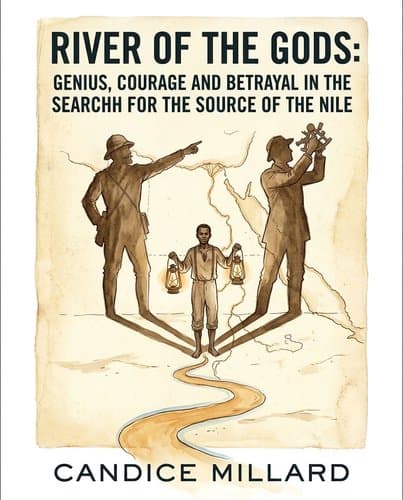
58777696_river-of-the-gods
by Candice Millard
Two explorers consumed by mutual contempt raced to claim the Nile's source — while the African man who walked 6,000 miles holding the expedition together…
In Brief
River of the Gods: Genius, Courage and Betrayal in the Search for the Source of the Nile (2022) traces the 19th-century race to find the Nile's source and the credit dispute that destroyed the Burton–Speke partnership.
Key Ideas
Visible hierarchy prevents resentment accumulation
Credit structures in any partnership create resentment when the formal hierarchy does not match actual contribution — Speke's bitterness grew from an asymmetry Burton never noticed because he was never threatened by it; make the real hierarchy visible before resentment makes it for you.
Find invisible workers before history
The person doing the navigation, translation, and negotiation is almost never the person who gets named — Bombay walked 6,000 miles, held the expedition together, and got a silver medal and no biography; find out who is actually doing that work before the history gets written.
Strategic first claims beat cautious evidence
Correct epistemics is not the same as being right — Burton's demand for evidence before accepting the Nyanza claim was scientifically valid, but Speke's unverified intuition proved true; holding out for proof can mean losing the argument to the person willing to stake a claim first.
Stored grievances explode under pressure
Resentment is architectural: stored grievances accumulate invisibly beneath a surface of loyalty and explode under stress — illness, rival success, public confrontation — with force disproportionate to any single incident, as Speke's delirium revealed years of brooding Burton never suspected.
Discoveries inherit discoverer's ideology always
A discovery's legacy is shaped as much by what its discoverers believed about the people they found as by the discovery itself — Speke was right about the Nile, and his Hamitic Myth contributed to a genocide; separating the achievement from the ideology of the person who made it is not optional.
Who Should Read This
History readers interested in World History and Resilience who want a deeper understanding of how we got here.
River of the Gods: Genius, Courage and Betrayal in the Search for the Source of the Nile
By Candice Millard
9 min read
Why does it matter? Because the names carved into history were almost never the people who found the way.
We tell the Nile story as a rivalry between two brilliant, difficult men, and leave it there. But the man who actually navigated the expedition's most dangerous moments — who retrieved a lost compass on a thirty-mile night walk, who kept two half-dead explorers alive when the supplies ran out and the porters mutinied — was sold for cloth as a child and never once invited to England. History gave him no monument. What Candice Millard has written is the story of what Victorian exploration actually cost: not in money or miles, but in friendship, credit, and the specific cruelty of building someone's greatness while knowing it will not include you. Discovery and betrayal, it turns out, rarely travel separately.
Every Explorer Is Running Toward Credit, Not Toward Discovery
Inside Islam's holiest shrine, Richard Burton was pretending to pray. Thousands of pilgrims wept around him, pressing their palms against sacred stone. Burton — disguised as an Afghan Muslim doctor, knowing that exposure meant death at the hands of the crowd — reached under his white pilgrim's cloth, pulled out a pencil, and quietly sketched a floor plan of the room.
He felt no religious awe. What he felt, he later admitted, was the thrill of accomplished pride.
Burton had spent months preparing: shaved head, darkened skin, a disguise stress-tested on Cairo's streets. He knew Islam well enough to recite a quarter of the Quran from memory. He'd crossed a desert and survived near-discovery to stand here. What carried him was the need to be the first Englishman inside Mecca and alive to say so.
The problem with credit is that it expires. Back in Cairo, the triumph curdled almost immediately. Success, Burton wrote, delivers the dreary lesson that all our achievements are shadows, not real things. He'd won. Now he had nothing. He kept wandering the hotel in his pilgrim's robes weeks later, no audience left, playing a role out of habit.
Credit is a hunger that doesn't quiet when fed — it just demands a larger prize. Burton would soon find his: the source of the Nile, the greatest unsolved geographical mystery of the century, a question that had defeated two thousand years of philosophers, emperors, and explorers. Roderick Murchison, president of the Royal Geographical Society, had already named the prize in public: whoever found the true sources of the White Nile would be "justly considered among the greatest benefactors of this age."
The Resentment Was Finished Before the Expedition Left the Port
The resentment between Burton and Speke didn't build across miles of African interior; it arrived nearly complete, baked into the partnership before they'd seen a single stretch of the Nile basin.
When Speke joined Burton's Somaliland expedition in 1854, he was a replacement for the beloved Dr. Stocks, who had just died at thirty-two. Burton accepted him out of something close to pity, signing what the political resident called "a written bond for our blood" (legal responsibility for Speke's life) while privately noting Speke had almost no qualifications beyond being "a good sportsman." That assessment, honest as it was, came from a man who had nothing to prove. Burton already had Mecca and Harar — another forbidden city, another entry that should have been fatal — behind him.
That asymmetry (Burton operating from abundance, Speke from need) made ordinary slights catastrophic. After Somaliland, Burton published First Footsteps in East Africa and included Speke's expedition diary as an appendix, standard practice for government-funded work. But he cut it from 24,000 words to 13,000, shifted it from first person to third, and gave it a title that led with failure: when Attempting to Reach the Wady Nogal. Then appended: Speke's life had been "never in real peril." To Burton, this was analysis. To Speke, it was a published verdict on his inadequacy.
By the time they reached Zanzibar to start the East African expedition, Speke was writing to his mother that Burton "never went to Mecca & Harar in the common acceptance of that word, but got artful natives to take him." He called Burton "a rotten person." The main expedition hadn't started. Burton knew none of this. He couldn't notice the jealousy directed at him — not because he was obtuse, but because he'd never needed to.
The Man Who Actually Navigated the Expedition Was Sold for Cloth as a Child
The night Speke realized he'd left his compass fifteen miles back, every man in the caravan was settling in for a rare feast of milk and meat. Speke announced he was going back. He called for volunteers. One hand went up: a slight, sharp-eyed man who had once been enslaved, named Sidi Mubarak Bombay.
They walked thirty miles through the dark, retrieved the instrument, and turned around without resting. Speke later wrote that Bombay was just as lively at mile thirty as at mile one. As they walked, Speke, who spoke neither Arabic nor any African language and was daily hardening against Burton, talked about birds and river shells. Bombay shared memories of wildlife his father had shown him before the night his village was taken. By the time they reached camp, Speke had found the one person on the expedition he could actually talk to.
Bombay's story runs underneath the whole book. He was Yao, from a village on the Tanzania-Mozambique borderlands, taken as a child when slave traders arrived armed and demanded immediate repayment of old debts no one could pay. He was marched in chains to Kilwa, packed onto a ship to Zanzibar, and sold for a few lengths of Gujarat cotton — a child exchanged for cloth, the circle of trade made whole. He spent twenty years enslaved in India. When the man who owned him died, he walked back to Africa.
By the time Burton and Speke arrived in Zanzibar, Bombay was soldiering in the sultan's army at near-starvation wages. He spoke Hindi alongside several African languages, and could do what neither explorer could: move through East Africa without getting killed. Over two expeditions, he was negotiator, translator, logistician, and emotional anchor. He deflected impossible demands from suspicious kings, found chickens when the expedition had two ears of corn left for dinner, and kept the caravan moving when the porters struck and the guides disappeared.
History gave Bombay a silver medal. No biography. No map feature.
Speke Was Nearly Blind When He Saw the Source of the Nile
What does it actually look like when an explorer reaches what he crossed a continent to find?
When Burton crested the last hill above Lake Tanganyika in February 1858, he was being carried in a hammock. His legs had gone numb months earlier, his hands could barely grip a pen, and his caravan leader had walked past him on the previous march without a word — already certain he was dying. Speke walked beside him and could see almost nothing. A fever had left deposits of black pigment across his lenses, a condition called iritis. Burton would later describe the lake in almost feverish terms: brilliant blue, foam-flecked, the most beautiful sight he had ever seen. To Speke it appeared as mist and glare.
How Speke reached that hill is the part Millard wants you to carry. A month earlier, during a violent storm on the lake's western shore, a beetle had crawled into his ear canal. Unable to go further, it began digging. He tried everything: salt, oil, melted butter poured down the canal. When nothing worked, he used his penknife. The knife punctured his ear instead of the beetle. Abscesses spread from ear to shoulder; his jaw locked so tightly he could only swallow broth; his face pulled sideways. He went permanently deaf in that ear. The beetle stayed lodged for six more months, until fragments of a wing and a leg finally came out in the wax.
The cruel twist: the inflammation accidentally drew infection away from his eyes. The same disaster that deafened him partially restored his sight — just in time to barely see the lake.
Burton's Scientific Skepticism Was Correct — Which Is Exactly Why It Destroyed Him
The morning after Speke returned from the Nyanza, Burton sat down to breakfast with him in Kazeh — two men who had carried each other through two years of illness, for one last conversation as partners.
Speke announced it immediately: he had found the source of the Nile. Burton's response was not celebration. It was a list of problems. Speke had spent three days at the lake. He had seen a fraction of its 27,000 square miles. He had taken no scientific measurements. Every piece of testimony he'd gathered had passed first through Bombay's imperfect Hindustani and then back into English, a telephone game played at the edge of endurance. Burton's verdict: the conviction was strong; the evidence was not.
He was right. That's what makes it catastrophic.
Everything Burton objected to was real. Speke hadn't circumnavigated the Nyanza, hadn't found a northern outlet. He had gut certainty and local testimony about a lake so vast that a woman born far to the north said (straightforwardly, not poetically) she was sure no way around it existed. A fisherman had thrust his arm northward, snapping his fingers, and said the lake probably stretched to the end of the world. None of it met the evidence standard the Royal Geographical Society required.
But Speke heard the skepticism as something else entirely: a commander maneuvering to claim a subordinate's discovery. He drafted a note to the Society saying he planned to go home, report it himself, and return without Burton — then crossed it out, but added three words: I was not wrong.
What Burton couldn't know was that the resentment predated the Nyanza by years. Weeks later, delirious from a disease the locals called "little irons," Speke raved every grievance he'd nursed: the diary edited without his consent, the words "don't step back" shouted at Berberah during a night attack where Burton took a javelin through the jaw, the Nyanza claim dismissed. Burton listened, stunned. "I never should have known," he wrote, "if he had not raved them out in delirium." Speke recovered apparently oblivious to what he'd revealed, and told Burton: "The knives are sheathed."
They weren't.
Speke Didn't Just Betray His Mentor — He Filed a Government Complaint to Finish the Job
By the time Burton's ship docked at Southampton, the machinery was already running. Most betrayals happen in heat. Someone says the wrong thing, a door slams, and whatever existed between two people ends in a moment. Speke's betrayal of Burton was nothing like that. It was organized in advance, routed through institutions, and sealed with paperwork.
While Burton was still at sea, Speke had visited the Royal Geographical Society, given a lecture, won the Society's president as a patron, and secured his own expedition, funded at five times the amount Burton had received four years earlier. When Burton arrived, he found himself quietly repositioned as the sick man who'd struggled to keep up, with Speke installed as the true discoverer.
Speke wasn't finished. He encouraged Captain Rigby — the incoming Zanzibar consul who already despised Burton — to file formal accusations with both the Bombay government and the Royal Geographical Society, claiming Burton had cheated the expedition's porters out of promised wages. Speke knew the full picture: the original promise had been made by the previous consul; Rigby himself had refused government funds to honor it; and Burton had personally spent over a thousand pounds of his own money getting the team home. None of that stopped the accusation. The Bombay government sided with Speke and Rigby. Burton received a formal reprimand.
The telling detail: while publicly insisting the whole affair caused him "great pain," Speke was writing to Rigby to laugh about Burton's "weak legs and rotten gut," then asking him to scrub those private letters clean, releasing only the portions that made Burton look guilty. He claimed injury and engineered the wound at the same time.
Burton, when he understood the full shape of what had happened, wrote down an Arabic couplet he'd learned years earlier: I taught him archery by day — / when his arm waxed strong, 'twas me he shot. Four lines for a relationship that had started with Burton signing a legal bond for Speke's life.
What Obsession Leaves Behind: A Genocide, a Burned Manuscript, and a Silver Medal
Speke told Bombay — the man who had navigated both expeditions through the African interior — that he was enslaved by natural law because his ancestors carried a biblical curse. He had also found the Nile's source, and he was right. The journalist-turned-explorer Henry Morton Stanley confirmed it years later, guided by Bombay: the Rusizi flowed into Tanganyika, not out of it, which ruled out Tanganyika as the Nile's source; the Nyanza was primary. But the intellectual work that echoed longest was a theory Speke wove from Genesis and racial contempt. He catalogued East African peoples by their proximity to Caucasian stock, coding the Hutu as primitive and the Tutsi as descended from superior Abyssinian blood. Victorian England found this persuasive. So did enough people across the following century that the ideology fed directly into the 1994 Rwandan genocide, in which 800,000 people died. Speke had been dead 130 years by then.
Burton's damage was different. He co-founded a polygenist society whose ritual mace was carved in the shape of an African man's head, then abandoned those views in his later years — far too late, far too quietly.
Bombay walked 6,000 miles across his own continent, helped cross it east to west for the first time, and was awarded a silver medal and a pension. The medal was posted to Zanzibar. No ceremony. No biography. His name appears in the expedition accounts as a coordinate — reliable, present, useful — never as a person with a stake in any of it.
After Burton died in 1890, Isabel locked herself in his rooms with his final manuscript, an Arabic erotic text he'd promised would fund her old age. She spent three days on the floor before the hearth, offered thousands of pounds for it, then fed it into the flames sheet by sheet. She said the thought of what she'd done would haunt her to death. It did.
That's what obsession leaves behind: one man right about geography and catastrophically wrong about humanity, a forgotten man right about everything that actually mattered, and a woman kneeling at a hearth, destroying the thing she most wanted to protect.
The Map Is Always Wrong About Who Found the Place
The image that stays with you is Isabel on the floor, feeding pages to the fire at 2 a.m., asking whether Burton would rise to curse her or bless her. She thought she was protecting him. Burton risked death to be first. Speke crossed a continent to be believed. Isabel burned everything she most wanted to keep, to save his soul. And Bombay walked 6,000 miles through the interior of his own continent, held two expeditions together through illness and mutiny and near-starvation, and got a silver medal delivered to him in Zanzibar while the men he'd guided were collecting their honors in London. The Nile got found. The maps got made and named. What you're left with, after all of it, is the smoke rising from that hearth — and the question of who paid the real price, and whether their name appears anywhere at all.
Notable Quotes
“I shall never forget his face,”
“It was full of sorrow, of yearning, and perplexity.”
“I could not but remark,”
Frequently Asked Questions
- What caused the breakdown of the Burton-Speke partnership in the Nile expedition?
- The partnership crumbled due to mismatched recognition of contributions creating resentment. Speke's bitterness grew from an asymmetry in credit distribution that Burton never noticed because he was never threatened by it. As the book explains, credit structures in any partnership create resentment when the formal hierarchy does not match actual contribution. This invisible accumulation of grievances became architectural: stored beneath a surface of loyalty, it exploded under stress—illness, rival success, and public confrontation—with force disproportionate to any single incident, as Speke's delirium revealed years of brooding Burton never suspected.
- What role did Bombay play in the Nile expedition and why is he largely forgotten?
- Bombay was the expedition's true navigator, translator, and negotiator, walking 6,000 miles and holding the expedition together. Yet he received only a silver medal and no biography while others claimed credit. Millard reveals how "the person doing the navigation, translation, and negotiation is almost never the person who gets named." This pattern shows real contributors are systematically erased from historical narratives before the history gets written. Understanding who performs critical work is essential before resentment and historical amnesia make the truth irretrievable and invisible.
- Why did Burton's scientific skepticism fail against Speke's unverified claim about the Nile source?
- Burton's insistence on verification was epistemically sound—"correct epistemics is not the same as being right." Speke's unverified intuition proved true, while Burton's higher evidentiary standard meant losing the argument to someone willing to stake a claim first. This dynamic shows how holding out for proof can paradoxically disadvantage the more rigorous thinker, who sacrifices credibility and momentum to the confident declarant. Scientific validity and rhetorical victory operate on different principles: one requires evidence, the other requires conviction and willingness to commit.
- What does River of the Gods reveal about how explorers' ideologies shaped colonial history?
- "A discovery's legacy is shaped as much by what its discoverers believed about the people they found as by the discovery itself." Speke was right about the Nile's source, yet his Hamitic Myth contributed to genocide. Millard demonstrates that separating achievement from ideology is not optional—the discoverer's beliefs became foundational to colonial policy and racial pseudoscience. Historical narratives intertwine factual correctness with moral catastrophe, forcing readers to reckon with how a verified geographic claim enabled systematic dehumanization and violence.
Related Book Summaries
Read the full summary of 58777696_river-of-the-gods on InShort