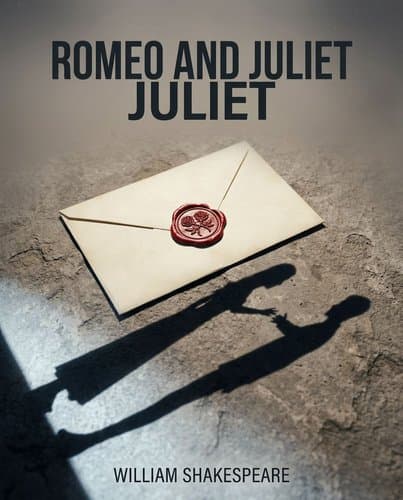
59926998_romeo-and-juliet
by William Shakespeare
No villain kills Romeo and Juliet—inherited feuds, gendered obedience, and exile laws do the lethal work without anyone intending harm.
In Brief
Romeo and Juliet (1590) examines how inherited social structures — family feuds, arranged marriage, gendered obedience, and the law of exile — make certain human outcomes inevitable without any single villain causing them.
Key Ideas
Society makes tragedy inevitable through structures
When a story announces its ending before it begins, the question shifts from 'what happens?' to 'how does a society make this outcome inevitable?' Romeo and Juliet is built entirely around that second question — and the answer is: through names, ranks, laws, and obedience demands that leave no room for the people caught inside them.
Structural violence requires no malice
No one in this play is trying to destroy Romeo and Juliet. There is no villain. The social architecture — inherited feud, arranged marriage, gendered obedience, the law of exile — does the work without anyone intending it. Structures don't need malice to be lethal.
Peacemaking accelerates harm in violent systems
Mercutio's death shows how peacemaking inside a violent system can accelerate the very harm it tries to prevent. Romeo steps between two swords and opens the gap that kills his friend. The lesson is not 'don't intervene' — it's that a system built on honor violence punishes de-escalation as much as aggression.
Helpers' self-interest shapes harmful outcomes
When the only adult helper has his own political stake in the outcome, the help is shaped by that stake. Friar Lawrence's plan in Act 4 is designed around his priorities — avoid church scandal, end the feud — as much as Juliet's survival. That misalignment is baked into every decision he makes.
Contingency, not cosmos, causes catastrophe
The catastrophe of Act 5 is not fate: it is a wedding moved one day early, a letter quarantined by plague, and a tomb reached moments too late. The play insists on 'star-cross'd' language and then demonstrates that contingency — not cosmos — does the actual work. That gap between the story's framing and its mechanics is the play's sharpest argument.
Who Should Read This
Readers interested in Classics and Literary Fiction, looking for practical insights they can apply to their own lives.
Romeo and Juliet
By William Shakespeare & Paul Werstine & Barbara A. Mowat
9 min read
Why does it matter? Because you've been reading this as a love story — it's a trap story.
Everyone knows Romeo and Juliet is a love story. Two teenagers, one doomed night, the stars lined up wrong. Fate steps in. Curtain falls.
Except Shakespeare tells you they die in the first fourteen lines. Before Act 1 opens, before Romeo has heard Juliet's name — the Chorus announces the ending. Shakespeare is not building suspense. He is removing it. The question was never whether they would die. The question is: what kind of machine produces two bodies and then blames the cosmos?
Because nothing in this play is fated. The deaths require a letter that never arrives, a wedding moved up by one day, a man who steps between two fighters at exactly the wrong second. All accidents. All avoidable. All inside a system built to make those accidents inevitable — and to charge the stars for the bill.
The Play Announces Both Deaths Before Act 1 Begins — So You're Not Watching a Love Story
Shakespeare tells you Romeo and Juliet will die before either of them has spoken a word. The Prologue isn't a mood-setter or a dramatic backdrop — it's a complete 14-line sonnet delivered by a Chorus whose only job is to announce the outcome. Two families, an ancient feud with no named cause, two lovers from those families, and then: they die. The feud ends. That's the whole play, compressed into fourteen lines before Act 1 begins.
Knowing the ending changes what you're watching. In most stories you watch for the what. Shakespeare removes that question entirely. The Chorus calls the lovers "star-cross'd" and means it at face value: the stars are working against them. That's precisely the cover story the rest of the play will expose. When the Prologue calls their love "death-mark'd," the death arrives already built in. It's a property of the love itself from the first moment, not a conclusion waiting at the end.
So the play becomes a different kind of inquiry. Not: will they survive? But: how does a society generate this outcome? What's the mechanism by which inherited hatred destroys people who have nothing to do with its origin? The children die not despite the feud but because of it — and their deaths are precisely what ends it. The Chorus frames this as a transaction you're invited to audit. Watch how the gears turn. That's the whole invitation.
They Write a Perfect Sonnet Together Before Learning Each Other's Last Names
Romeo crashes a Capulet party in disguise, still pining over a different girl, when he spots someone across the room he's never seen before. He crosses the floor. What follows is one of the strangest things Shakespeare ever staged: two strangers meet and, in fourteen lines, compose a perfect English sonnet together.
Romeo opens the first quatrain: his hand touching hers is an act of profanation, his lips two pilgrims waiting to make amends. Juliet answers with her own quatrain, correcting his metaphor — pilgrims touch palm to palm, that's the holy gesture. Romeo turns her correction into a question: then don't pilgrims have lips? She answers: lips are for prayer. He turns that into a request. She grants it, conditionally. They've written three quatrains and a couplet in real time. He kisses her. The poem is finished.
Then the Nurse appears.
The devastation turns on timing: the recognition arrives the instant the poem closes, as if the play withheld it for exactly that moment. Romeo learns first: the girl is a Capulet. He says his life is now a "foe's debt," owed to an enemy he never chose. Juliet learns separately, asking the Nurse to name the man who just kissed her. Romeo is a Montague. Her only love has sprung from her only hate — and then the sharper line, "known too late."
That phrase is the exact shape of the trap. She saw him before she knew his name, which means the love formed ahead of the information that would have stopped it. The sonnet and the surname can't now be separated. The poem is finished, and it turns out it was always going to end here.
'What's in a Name?' Is Not a Romantic Question — It's a Legal Argument
The balcony scene's most famous question is usually read as pure idealism. It isn't. What Juliet is actually doing is running a legal argument.
She's on her balcony, unaware Romeo is below, having just spoken her feelings to the night. When he steps forward, she identifies the problem immediately: his name is her enemy, not him. She dismantles it piece by piece — the name Montague belongs to no part of his body, not hand, foot, arm, or face. It's an inherited designation attached to a person who exists independently of it. Give him a different name and he's still the same man; strip the identifier, and the incompatibility disappears. Call him something else, and there is no obstacle.
The mechanism she's targeting is inherited naming — the thing that makes them enemies on sight. She's arguing it can be bypassed. If Romeo agrees to stop being Romeo, technically no Capulet is consorting with a Montague.
Romeo's response seals the trap. He doesn't say he'll try, or that names are complicated, or that he's still a Montague in the morning. He agrees on the spot: call him love, he'll be baptized anew, he will never be Romeo again. He's offering to erase himself to be loved.
The play knows what Juliet's argument can't account for: names here aren't identifiers you peel off, they're structural positions. Romeo being a Montague is the reason Tybalt will want to kill him, the reason the Prince will exile rather than execute him, the reason the friar's plan will hinge on a letter reaching him in Mantua. Juliet found a genuine logical flaw in the system. The system doesn't care.
The One Adult Who Helps Them Is Doing It for Political Reasons
Romeo takes that newly shed identity straight to Friar Lawrence. Why does the only adult in the play who helps Romeo and Juliet do it?
Friar Lawrence doesn't believe Romeo. When Romeo shows up before dawn, fresh from Juliet's balcony, announcing he's abandoned Rosaline and fallen in love with a Capulet overnight, the friar says it plainly: young men's love lives in their eyes rather than their hearts. He thinks this is infatuation. He agrees to perform the marriage anyway, and he tells Romeo exactly why. The union might end the feud between their families; his word for it, roughly, was "peace treaty." The teenagers are his instrument. Their feelings are secondary.
A political calculation dressed as pastoral care.
The same logic runs through his Act 4 plan. When Juliet threatens suicide rather than marry Paris, the friar produces a sleeping potion — a scheme that depends on a letter reaching Romeo in Mantua in time. It saves Juliet from a forced second marriage. It also protects the friar. He married her to Romeo in secret; if she now marries Paris, he performed a bigamous union. His reputation and his office ride on the plan working. Juliet's interest and the friar's interest align in this moment, but they are not the same interest.
He acts with genuine hope the plan succeeds. But the machinery of the play runs on adults acting from their own logic — the feud, family honor, the church's standing. The teenagers caught inside it have no one whose only concern is them.
Romeo Killed Mercutio by Trying to Stop the Fight
Romeo steps between Mercutio and Tybalt with his arms out, trying to stop a sword fight he helped create. Tybalt's blade finds Mercutio through the gap Romeo's body opens. The stage direction gives it plainly: Mercutio falls underneath Romeo's arm. That's the whole tragedy in four words.
What the scene actually shows: Romeo won't fight Tybalt because they are now secretly related by marriage. He can't explain why without exposing the ceremony. So he absorbs the insults and speaks in riddles about a love he can't name. Mercutio, who knows nothing of the marriage, reads this as cowardice — and draws in Romeo's place. Romeo tries to physically end the duel. That physical act is the murder weapon.
Mercutio's death speech is a systematic accounting. He appraises his own wound with a bookkeeper's calm: not catastrophic by any measure, but enough. Precisely enough. He asks Romeo directly why he stepped between them. Romeo says he thought it would help. Mercutio says nothing to that, just calls for a surgeon and curses both families three times before he's carried off. The joke and the curse arrive in the same breath. He signs off with a pun: tomorrow, he'll be grave enough, and he means it both ways. What's behind it is fury at the machinery, not at Tybalt personally.
That's where the play is pointing. Mercutio isn't a Montague or a Capulet — he stands outside the feud entirely. He dies because the feud has no outside. Romeo's intervention, meant to be the civilizing gesture, becomes the mechanism of death precisely because the feud has already compromised him: he can't fight openly, can't explain why, can only step between the swords and hope. The gap he opens kills his friend.
Capulet's Love for Juliet Was Always Conditional on Her Obedience
Capulet loves Juliet the way a merchant loves inventory.
One exchange makes it plain. He has arranged her marriage to Paris without consulting her. When she refuses, he doesn't ask why, doesn't attempt to persuade, doesn't treat her refusal as information. He tells her to go to the church or face complete abandonment: penniless, disowned, cut off without a word. Then, in the same breath, he states the logic plainly: she is his to give to his friend, or not. She is a resource being allocated. Her refusal is a malfunction, not a preference.
The anger fits the era — fathers in Verona held legal authority over daughters, and his reaction sits within period norms. What exposes him is the logic underneath it. He recites Paris's qualifications like a buyer's checklist: princely lineage, youth, noble training. He has invested himself in this match. She declined. The fury that follows belongs to a property owner who just discovered the property has opinions.
Then the Nurse speaks. Juliet has lost her cousin to Romeo's sword and her parents to ultimatum and silence, but the Nurse is the person who raised her, who carried her messages, who is the only figure in the play who has functioned as a mother. When Juliet turns to her, the Nurse recommends marrying Paris. Romeo is in exile, Paris is right there, the practical path exists. She genuinely means it as help. What Juliet hears is the last door closing. The person who existed to protect her is now advising her to commit bigamy for convenience.
In the space of one afternoon, Juliet has been stripped of every relationship she might lean on: cousin, father, Lady Capulet (who said nothing), Nurse. The sleeping-potion plan — drink a vial that mimics death, wake in the family vault, wait for Romeo to come by letter — requires trusting one friar and staking everything on a message arriving intact. It is the only option left.
A Plague Quarantine — Not the Stars — Killed Romeo and Juliet
Think about what it would take to construct a tragedy with no villain. You'd need a series of events that are each individually reasonable, each one the kind of thing that just happens, that in sequence kill two people who were trying, at every step, to survive. Shakespeare built exactly this machine, and in Act 5 you can see every gear.
The mechanism that does the actual work is Friar John's single scene. He never reached Mantua. His explanation takes about ten lines: he went to collect a fellow friar for the journey, found one, and while they were in a house together, city officials suspected plague and sealed the doors. No one could leave. The letter that would have told Romeo that Juliet was only sleeping, not dead, that he should come to the vault and wait for her to wake, never went. Friar Lawrence calls it "unhappy fortune." The phrase is technically accurate and completely insufficient.
That quarantine is the hinge of the entire play. Remove it and the letter arrives. Romeo receives it, waits, Juliet wakes, they leave for Mantua together. Every death in Act 5 — Paris, Romeo, Juliet, Lady Montague (who dies offstage of grief at Romeo's exile) — is downstream of one plague official's reasonable decision to seal a door.
The cruelty is in the cascade of near-misses that follows. Romeo drinks the poison and dies. Friar Lawrence arrives moments later. Juliet wakes, finds Romeo dead, checks his lips for poison — his lips are still warm; she is seconds behind him. She finds none, grabs his dagger, and kills herself in five lines. The watch is already approaching when she does it. Thirty seconds of different timing anywhere in this chain and both of them live.
The Chorus called them "star-cross'd" in the very first lines, and that framing does real work, because it lets the patriarchs off clean. Capulet and Montague survive, reconcile over the bodies, and pledge golden statues to each other's children. The Prince says "all are punish'd," but the people most responsible for the conditions that killed the lovers are alive and shaking hands. The stars absorb the blame. For Romeo and Juliet, that framing erases what actually killed them: a wedding moved one day early, a letter stopped by a quarantine, a vault door opened thirty seconds too late.
What the Golden Statues Actually Mean
The feud outlived everyone it killed. Two men stand over their children's bodies, making a deal: Capulet pledges a gold statue of Romeo, Montague pledges one of Juliet. Both go home. The Prince says all are punished — but the punishment falls entirely on people who had no vote in the conflict they were born into, killed not by fate but by a wedding moved one day early, a letter quarantined by plague, a tomb reached ninety seconds too late. The stars absorb the blame. That's the last piece of machinery Shakespeare builds: a story that frames its own mechanism as cosmic while showing you every gear. The settlement happens. The price is paid. The people who owed it are giving speeches over the bodies.
Frequently Asked Questions
- What is Romeo and Juliet about?
- Romeo and Juliet (1590) examines how inherited social structures—family feuds, arranged marriage, gendered obedience, and the law of exile—make certain human outcomes inevitable without any single villain causing them. The play shifts the question from "what happens?" to "how does a society make this outcome inevitable?" It answers this by showing how names, ranks, laws, and obedience demands create a system that leaves no room for the people trapped inside them. Shakespeare demonstrates that catastrophe is produced by systems, not malice.
- Is there a villain in Romeo and Juliet?
- No. Romeo and Juliet has no villain attempting to destroy the lovers. The social architecture—inherited feud, arranged marriage, gendered obedience, the law of exile—does the destructive work without anyone intending it. "Structures don't need malice to be lethal." The play insists that the double death is not caused by any character's malevolence but by the systematic constraints that everyone—parents, the Prince, the Friar—unknowingly perpetuate. This demonstrates a central tragic truth: systems can kill without requiring evil intent.
- How does Mercutio's death illustrate the play's larger argument?
- Mercutio's death reveals a critical paradox: peacemaking inside a violent system can accelerate the very harm it tries to prevent. When Romeo steps between two swords during the brawl, he opens the gap that kills his friend. The lesson is not "don't intervene" but rather that a system built on honor violence punishes de-escalation as much as aggression. His death demonstrates that within such systems, even well-intentioned actions can produce tragedy—no escape exists outside the structure itself.
- Is Romeo and Juliet really about fate?
- The play announces its ending through "star-cross'd" language, but its mechanics tell a different story. The catastrophe of Act 5 results from contingency: a wedding moved one day early, a letter quarantined by plague, and a tomb reached moments too late. "That gap between the story's framing and its mechanics is the play's sharpest argument." Shakespeare insists the cosmos is not responsible—rather, accident and timing do the actual work. Fate becomes not destiny but an accumulation of small delays.
Related Book Summaries
Read the full summary of 59926998_romeo-and-juliet on InShort