62446_the-prince-and-the-pauper
by Mark Twain
Strip away the crown and the prince vanishes — identity is just costume, gate, and trained deference. Twain's swap experiment proves that no ruler can…
In Brief
The Prince and the Pauper (1881) uses a clothes-swap between a Tudor prince and a London street boy to argue that identity is external, empathy requires lived experience, and rulers who have never suffered under their own laws cannot govern with genuine mercy.
Key Ideas
Identity exists through external performance only
Identity, in practice, is almost entirely external — costume, gate, trained deference, and context. Strip these away and even a genuine prince becomes invisible to the people who were just bowing to him. Twain's swap plot is an experiment designed to prove this.
Lived suffering teaches mercy theory cannot
Empathy for people living under a law requires experience of that law, not just knowledge of it. Secondhand information about suffering produces policy proposals; lived experience produces the kind of mercy that never forgets its source and never lets a dignitary talk you out of it.
Comfort erases suffering's memory inevitably
Comfort erodes the memory of suffering faster than suffering installs it. Tom Canty's arc — from traumatized pauper to a boy who shudders at the thought of his mother's arrival — shows this is not a failure of character but a feature of how comfort works. Twain offers no reassurance that this is unusual.
Insulated lawmakers normalize systemic cruelty
The laws and punishments that seem monstrous in historical context are often simply the normal operations of any system where lawmakers are insulated from the consequences they create. Tudor England was not the exception; it was the civilized world's standard. Connecticut's reviled Blue Laws were, by comparison, the first sweeping act of legal mercy anyone had seen.
Dignity earned through character, not rank
Real dignity, in Twain's argument via Miles Hendon, 'comes unasked from a clean hand and a right spirit' — not from inherited rank, purchased loyalty, or the formal machinery of ennoblement. The mock earldom Edward confers with a scourge on a bleeding man's back carries more weight than Hugh Hendon's stolen title.
Who Should Read This
Readers interested in Classics and Literary Fiction, looking for practical insights they can apply to their own lives.
The Prince and the Pauper
By Mark Twain & Everett Emerson
9 min read
Why does it matter? Because the king who governs mercifully is the one who has already been governed badly.
You probably think this is a sweet story about two boys who look alike, swap clothes for a laugh, and spend a week learning to appreciate each other's very different lives before everything gets sorted out. It is that. It is also a political indictment dressed as a bedtime story — one of the most uncomfortable arguments Mark Twain ever made. The argument goes like this: a king who has never been cold, never been beaten for someone else's crime, never watched a woman burn for pulling off her stockings — that king will sign the law that burns her. Not because he is cruel. Because he has never been governed. Twain believed empathy couldn't be inherited or assumed. It had to be purchased, at full price, through the skin. Everything else in this book is just the receipt.
Two Boys Born Identical and the World Immediately Makes Them Strangers
Tom Canty arrives in the world on an autumn day in sixteenth-century London, unwanted. Up a foul alley called Offal Court, off Pudding Lane, his family regards his birth as a problem rather than a gift. On the same day, in the same city, Edward Tudor arrives as Prince of Wales, and the nation loses its mind. Strangers embrace and weep in the streets. Bonfires blaze at every corner for days and nights. Banners hang from every balcony. An entire kingdom drinks and dances and cannot stop talking about the new baby. Nobody mentions Tom Canty at all.
The two boys have the same face. Everything that separates them (the silk from the rags, the palace from the straw pile, the nation's love from the nation's indifference) comes entirely from which door they happened to be born through.
Twain doesn't build to this. He puts his thesis in the first paragraph, with no ceremony: one family wanted their baby, one didn't. England adored one of them and didn't know the other existed. The infant prince, the most celebrated child in England, is wholly unaware of the celebration. Tom Canty, meanwhile, has come to trouble his family with his presence. That verb — trouble — is the entire argument. His birth isn't a gift. It's an inconvenience.
Strip Away the Clothes and the Prince Vanishes
Identity in Twain's Tudor England is not something you carry. It is something others assign, based entirely on what you are wearing.
The proof arrives in a single scene. Edward proposes the swap on impulse: a brief experiment, a few minutes in each other's clothes before anyone interrupts. They dress, stand before a large mirror, and find something unsettling: two boys with the same face, the same eyes, the same voice, the same build. Twain calls it a miracle. Neither boy can tell which reflection belongs to whom. They are, in every observable way, the same person.
Then Edward walks outside.
The soldier who had bowed to him moments earlier, who had recognized the silk and the gate and performed his trained deference, now sees only a boy in rags. He boxes Edward on the ear hard enough to spin him into the road. Edward shouts his name and title. The soldier offers a theatrical mock-salute. The crowd that had cheered Edward's name just minutes ago now surrounds him, hooting and jeering. He is the same boy. Same face, same voice, same indignant fury. The only thing that changed was the coat.
This is Twain's coldest argument: deference is not a response to persons, it is a response to signals. The soldier never bowed to Edward — he bowed to silk and jewels and the correct side of the gate. Strip those away, and the more urgently Edward insists he is the prince, the more firmly everyone concludes he has lost his mind. The insistence itself becomes evidence against him.
Twain staged the mirror as a revelation, not a trick. What it reveals is that princeship is not a quality Edward possesses — it is a condition the world imposes, sustained by clothes and gates and rehearsed deference. Take those away, and the prince ceases to exist for everyone around him. He has nothing else to offer as proof. By nightfall he's in a barn, still a prince to himself, still no one to anyone else.
Suffering Teaches Edward What Three Years of Royal Tutors Could Not
Twain tracks the conversion of experience into intention scene by scene. The first clear example is Christ's Hospital, the charity school Edward's father founded, where students set dogs on the ragged boy claiming to be their founder's son. That same night, wandering and bleeding, Edward promised himself: when he was king, the poor would have books alongside bread, because a full stomach without learning produces nothing. He drafted education policy from a ditch. Each wound closes into a specific pledge.
A ruined barn, somewhere in the woods south of London. Rain on the rotten rafters. A fire in the center of the floor lights up the worst company in England — fake blind men who have just removed their eye patches to sing, a fake cripple who shed his wooden leg to dance, knife-grinders and tinkers and women of every age, most of them drunk. When the gang chief asks who has "fared hardly," a man called Yokel stands up, strips back his rags, and begins.
His land was converted to sheep-ranges, so he lost the farm. He begged and was whipped naked through three towns. He begged again and lost an ear. Begged again, lost the other. Begged again — branded with a hot iron, the letter pressed into his cheek while his children watched. Sold into slavery. Running. His mother burned alive as a witch. His wife flogged to death for begging. His children starved while he was in the stocks. Yokel delivers each of these as a toast, raising an imaginary cup and thanking the English law for its bottomless mercy.
None of this is invention. Twain is describing the actual Vagabonds Act — the series of statutes that criminalized poverty itself and escalated punishments for the crime of being repeatedly poor. Yokel's body is a legal document: one ear, then the other, then the brand. You can read the law off his skin.
Edward, crouched in the straw at the barn's far end, cuts the speech short. He strides into the firelight and announces himself: the king of England, and the law Yokel described ends today. The gang explodes in laughter. John Canty (Tom Canty's father, a drunk who has mistaken the ragged prince for his own son) calls him his mad son. The gang chief, an outlaw with his own code of honor, actually protects Edward from Canty's fists, then offers a compromise: fine, be a king, just pick another title. A tinker shouts a mock title, something like the King of Fools, and the barn runs with it. They crown him with a tin washbasin, robe him in a torn blanket, seat him on a barrel, hand him a soldering iron for a scepter. The whole barn kneels in performed adoration, begging him to spit on them, to grace the dirt with his royal foot.
The irony lands hard on Edward: he came here to offer mercy and found that the mercy itself was the joke.
His royal tutors could have recited the Vagabonds Act chapter and verse, explained its history, traced its consequences. Edward would have listened perfectly and forgotten everything the moment power made forgetting comfortable. What makes Yokel's words stick is that Edward heard them while hungry, cold, unbelieved, and dressed in rags himself. The lesson entered through the same door as the shame.
Four Weeks of Silk and Ceremony Does to Tom What Years in Offal Court Could Not
Could four weeks of palace life actually erode what years in Offal Court built into Tom Canty? Twain's answer is yes — and the speed of it is the point.
The erosion happens in stages so gradual you almost miss it. Tom stops fearing exposure, starts enjoying ceremony, then begins expanding his power: doubling his guard of gentlemen-at-arms to a hundred, trebling his staff past four hundred. Through all of this, he remains genuinely kind, championing the oppressed and pardoning prisoners — which is precisely how Twain hides what's actually happening to him.
The real corruption runs inward. Tom's earliest palace weeks bring guilty thoughts about the true prince, and sincere wishes for his return. As weeks pass, those wishes curdle: Edward becomes an unwelcome presence who triggers shame rather than loyalty. Then Tom's family: first he misses his mother and sisters, then the thought of them arriving in their rags, embracing him, pulling him back to Offal Court, makes him shudder. Finally he reaches a state of contentment, even gladness, that their faces have faded. Not relief. Gladness. Twain holds nothing back: in those rare moments they do intrude, Tom feels more contemptible than crawling things.
Then comes coronation morning. London fills with cannon smoke and pageantry. Tom rides a war-horse through crowds screaming their love, scattering coins, watching elaborate tableaux of his alleged ancestors. At the peak of all this, he spots a pale, astounded face in the second rank of the crowd. An old reflex fires: his palm thrusts outward before he can stop it. His mother tears past the guards and seizes his leg, calling his name. An officer wrenches her away with a curse. The words already out of Tom's mouth: a denial, three words, addressed to a stranger. She turns for one last look, wounded, broken, and the crowd swallows her.
The procession continues in full splendor. Tom sees none of it. He hears only those three words looping in his chest.
The night before, at midnight, Tom lay in his palace bed, a happy boy. At that same exact hour, Edward stood outside Westminster Abbey in rags, watching workers prepare the ceremony that would crown his usurper. Twain makes no comment. He doesn't need to.
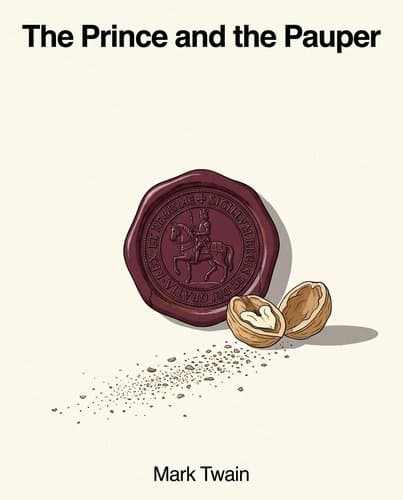
The Great Seal of England Spent Its Missing Weeks as a Nutcracker
At the exact moment the Archbishop raises the crown of England over Tom Canty's head — every peer in Westminster Abbey with their own coronets poised midair, waiting for the signal — a ragged, bareheaded boy walks up the central aisle and announces that the ceremony must stop. He is the king.
Tom Canty, still in his gold robes, steps forward before the guards can reach the boy. He falls to his knees before the beggar and becomes the first person in England to swear fealty to him. He has silk, throne, and a kingdom's adoration, and he surrenders it all without a breath of hesitation.
What Tom cannot do is prove it. The Lord Protector, the nobleman who holds power pending a young king's coronation, demands evidence only the true prince could supply: the location of the Great Seal of England, missing for weeks and baffling the entire court. Edward cannot remember. Excruciating minutes pass. Then Tom Canty, of all people, walks Edward back through the morning of the swap, detail by detail — the servants dismissed out of courtesy, the game of switching clothes, the soldier who hurt Tom's hand — until Edward's memory fires. The Seal is hidden inside an arm-piece of Milanese armor hanging on the palace wall. An envoy runs. The hall falls silent. He returns holding the Seal aloft, and the hall erupts.
Twain gives you the fairy tale completely: the vindication, the kneeling vassals, the cannon fire. Then Edward, now crowned, turns to Tom and asks the obvious question: how did you know where the Seal was when I had forgotten it myself? Tom's face goes red. He finally admits he used it to crack nuts.
The Great Seal of England, the object that nearly decided a dynasty, spent its missing weeks as a nutcracker. Twain builds the ceremony with genuine grandeur specifically so this line can deflate it. That's the argument the whole book has been making: sovereignty is theater, and the crown is whatever someone decides to do with it.
You Cannot Write Merciful Laws for Lives You Have Never Lived
Imagine a surgeon who has never been a patient — who sets bones without knowing how breaking feels, prescribes recovery without knowing what it costs. That surgeon is every Parliament that has ever signed a vagrancy law from the warm side of a bench. Twain's argument is that every legislature in history has been that surgeon.
By the time you finish The Prince and the Pauper, you've absorbed Tudor England as the villain: the branding, the executions for petty theft, the women burned for witchcraft. Twain lets you sit with that disgust. Then, in his closing notes, he turns around and points the finger at you.
Connecticut's Blue Laws — the strict Puritan moral codes that regulated everything from Sunday commerce to public behavior — have long been held up as a monument of Puritan cruelty. Twain inverts the assumption: Connecticut never executed more than fourteen offenses at once. England, within the living memory of people still walking around when Twain published in 1881, maintained 223. The monster was never Tudor England specifically. It was any system where the people writing the laws do not live under them.
The pardons Edward issues when he reclaims the throne map directly to his education on the streets. He cannot save the man hanged for killing a deer; he arrives too late. But he saves the boy who caught a stray falcon, the woman who stole a scrap of cloth, the lawyer rotting over an unjust fine. When a dignitary later protests that some law being amended causes no suffering worth minding, the king tells him plainly that he and his people know what suffering looks like, and the dignitary does not.
Twain closes by asking us to remember Edward's reign as a merciful one. The ask is small. The indictment behind it is enormous.
The Question No Crown Can Answer for You
Edward VI died at fifteen, after six years on the throne. Twain describes his reign as singularly merciful — which sounds, at first, like faint praise: a short list of pardons, a handful of amended statutes. But singular is exactly the right word. Mercy of that kind doesn't arrive from good intentions or careful tutoring. It arrives from a king who once stood at the wrong end of his own laws and could not pretend the experience away. The question Twain leaves standing (the one he never answers) is whether you can design a system that produces the same education without requiring its rulers to spend a few weeks as vagabonds and prisoners. He just notes that the one merciful king in the book was the one who had. You are left to draw your own conclusions about every ruler since.
Notable Quotes
“What dost thou make of this?”
“Ah, good your worship, require me not to answer. It is not meet that one of my degree should utter the thing.”
“Yes; but it is a slight thing, and your worship knoweth that the poor man-at-arms—”
Frequently Asked Questions
- What is The Prince and the Pauper about?
- The Prince and the Pauper (1881) uses a clothes-swap between a Tudor prince and a London street boy to explore what identity really means. The novel argues that identity is almost entirely external—costume, social context, and trained deference—rather than inherent to a person. Through this swap plot, Twain demonstrates how stripping away external markers renders even a genuine prince invisible to those who were just bowing to him. The story also shows that rulers who have never suffered under their own laws cannot govern with genuine mercy, making lived experience of injustice essential to fair governance.
- What does The Prince and the Pauper argue about empathy and the law?
- Empathy for people living under a law requires direct experience of that law, not just intellectual knowledge of it. "Secondhand information about suffering produces policy proposals; lived experience produces the kind of mercy that never forgets its source and never lets a dignitary talk you out of it." Tom Canty's transformation—from traumatized pauper to a boy shuddering at his mother's arrival—illustrates that comfort erodes the memory of suffering quickly, a feature of how comfort works rather than a character flaw. Twain offers no reassurance that this moral erosion is unusual or exceptional.
- Why does Mark Twain use a clothes-swap plot in The Prince and the Pauper?
- The clothes-swap is designed as an experiment to prove that identity is external, not internal. By having a prince and pauper exchange places and clothing, Twain reveals how entirely dependent identity is on "costume, gate, trained deference, and context." The moment external markers change, people stop recognizing the prince as royalty and treat him according to his new appearance and social position. This plot device directly challenges the assumption that rank or character are inherent qualities; instead, it demonstrates that identity, in practice, is almost entirely external and socially constructed.
- What does The Prince and the Pauper teach about real dignity?
- Real dignity, in Twain's argument via Miles Hendon, "comes unasked from a clean hand and a right spirit"—not from inherited rank, purchased loyalty, or formal ennoblement. The novel demonstrates through Edward that true dignity emerges from moral character and integrity, not from the machinery of titles and rank. The mock earldom Edward confers, despite his lack of authority, carries more weight than Hugh Hendon's stolen title. This reveals Twain's belief that authentic dignity derives from one's actions and spirit, not from external apparatus of power or inherited position.
Related Book Summaries

Read the full summary of 62446_the-prince-and-the-pauper on InShort