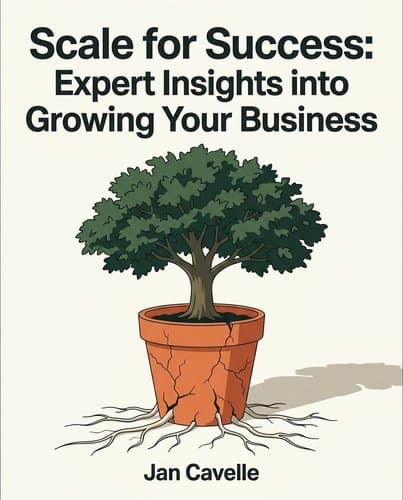
55987362_scale-for-success
by Jan Cavelle
The instincts that carried you to £1m are the same ones that will stop you going further — discover the stress tests, hiring frameworks, and investor…
In Brief
Scale for Success: Expert Insights into Growing Your Business (2023) draws on interviews with founders and investors to map the structural shift required when a business moves beyond its early growth phase.
Key Ideas
Stress Test Your Year Tomorrow
Run Bev Hurley's stress test before you scale: imagine your entire year's turnover arriving tomorrow. Write down every gap that would expose — infrastructure, working capital, management bandwidth. That list is your real scaling readiness checklist.
Hire From Two Stages Ahead
Hire for the stage ahead, not the stage you're at. At £1m, hire people who've navigated £5m businesses. Oracle applied this at £12m by hiring people who had already built £100m companies.
Two Lists Reveal Your North Star
Use Durell Coleman's two-list exercise to find your North Star: write what brings you joy; write what makes you angry. Circle five, underline three, star one from each. Set 1-, 5-, and 15-year goals. Focus on the 15-year target — it becomes your navigation system when everything else is uncertain.
Crisis Salary Test Validates Purpose
Test whether your purpose is real or aspirational with James Bartle's criterion: in a genuine crisis, would your team voluntarily forgo their salaries to keep the mission alive? If the answer is uncertain, purpose is still a message rather than a structural element.
Never Announce Remaining Funding Gap
Before fundraising, never announce how much of your round is still open. Siegel's research shows the herd factor — whether other investors are already in — outweighs all other variables in investment decisions. Momentum is the message, not the pitch.
Calculate CAC Before Scaling Sales
Calculate your customer acquisition cost before you build a sales team: total campaign spend divided by customers acquired, then crossed with revenue per customer. Volume of customers is not the metric. This ratio tells you whether your model can actually scale.
Your Calendar Reveals Your Role
Audit where your time goes right now. If your calendar is full of meetings about sales and operations, you are still an operator. The shift to owner means spending time on mergers, acquisitions, partnerships, and exit readiness — even when no exit is planned.
Find Opportunity In Ignored Customers
When identifying a new market opportunity, ask Paris Cutler's question: which customers are your competitors ignoring entirely, and why? The answer reveals the blue ocean. Netflix found that late fees were universally hated and unaddressed. That pain point destroyed Blockbuster.
Who Should Read This
Business operators, founders, and managers interested in Scaling and Business Strategy who want frameworks they can apply this week.
Scale for Success: Expert Insights into Growing Your Business
By Jan Cavelle
9 min read
Why does it matter? Because the instincts that carried you to £1m will quietly kill your company above it.
You're probably at or close to £1m, and the game feels like it's about to get easier. You've proved the model. Now you just scale — more customers, more people, run harder. Whatever got you here will get you there, only faster.
It won't. Above that first million, the instincts that built your business start dismantling it. Selling to anyone corrodes margin. Doing everything yourself creates a ceiling only you can hold up. Hiring fast to fill orders plants the toxic employee who poisons a whole team. Loving the product means ignoring the customer experience that keeps people subscribed.
Thirty entrepreneurs — people who ran headlong into these reversals, often at serious personal cost — sat down with Jan Cavelle and told her exactly what it cost them to learn it. What follows is their curriculum, delivered before you pay the same tuition.
£1m Is Not a Milestone — It's Where the Game Changes Completely
Everything you did to reach £1m is exactly what will work against you above it. The skills that built the early business — selling anything, to anyone, wherever the opportunity arose — become liabilities the moment you try to scale. Jan Cavelle, who built her own company past £1m, is direct about this: the threshold isn't a milestone. It's where the game changes.
Stephen Kelly, former CEO of Sage and Micro Focus, calls the zone between £1m and £10m "Death Valley." His point is blunt: most companies that enter it either die or shrink back into something smaller. Not because demand dries up. Because the business isn't built to carry the load. The YTKO Group found this out firsthand.
Bev Hurley's UK enterprise support business had grown to around 20 people when it doubled almost overnight, reaching 40 staff within weeks. They weren't ready. No HR infrastructure to properly bring people in. The technology couldn't support the expanded team. Management was stretched too thin to run the existing operation while onboarding 20 new colleagues. Hurley made the only sensible call: she halted all new business development for several months and rebuilt the foundations.
A year later, YTKO doubled again, from 40 to 80 people. The expansion went smoothly. Same pace of growth, completely different result: the scaffolding was already in place.
The pattern that traps founders above £1m is this: more activity feels like progress, so you keep doing more of what worked. But past a certain point, growth without structure isn't scale; it's an accelerating version of the same problems. The systems, management layers, and capital reserves you need at £5m or £10m didn't exist at £500k, and they can't be improvised mid-expansion.
Hurley's test for readiness is stark: imagine a whole year's revenue arriving tomorrow. Work through what you'd need to handle it. Working capital nearly always tops the list: you pay for new hires, equipment, and support functions before a pound of new revenue arrives. The gaps that exercise reveals are the gaps that will stop you cold when growth actually hits. Fix them first.
Fixing the infrastructure is the visible problem. The harder one is that once the scaffolding goes up, the founder is still standing in the middle of it. At that point, they're the next constraint.
The Traits That Built Your Business Are Quietly Dismantling the Next One
In the autumn of 2014, James Davidson sat across from investors and made the case for not giving up. tails.com — the personalized dog food company he'd co-founded with Graham Bosher (who had already built LoveFilm and Graze) and a vet named Joe Inglis — had launched in July. Within a few months, it was burning through what was left of £5m in seed capital. The food was genuinely excellent: each bag calculated from the dog's age, weight, breed, and exercise level by a team that included nutritionists, vets, and engineers. The subscription management was poor: customers who couldn't easily see or adjust their orders simply left. Acquisition cost had overtaken revenue.
Davidson later described the failure with unusual candor: despite all their combined experience, the team had convinced themselves that product mastery would carry everything else. Deep knowledge of dog nutrition, years in consumer goods, a genuinely novel formula — all of it had become a kind of tunnel vision that left the customer's actual experience unexamined. They rebuilt around that gap: restructured the subscription so users had real visibility and control, oriented the whole business around fast feedback loops, and within five years enrolled 200,000 dogs and sent eight million tailored meals across the UK and France every month. Afterward, Davidson changed how he hired. He asked candidates not whether they'd failed, but how: whether the failure came from risk-taking or from playing it safe. The company had nearly died because nobody was watching what he couldn't see; he wasn't going to hire the same blind spot twice.
What happened to tails.com has a name: a founder superpower pushed past its context. Jan Cavelle, who scaled her own company on pure hustle and hit the same wall, is candid about the pattern. The conviction that built the thing becomes the certainty that blinds you: load-bearing in the early days, those same instincts are exactly what close off your view at the moment you most need to see around corners. The difficult work is catching this before it costs you the company. tails.com caught it just in time.
Purpose Is the Only Thing Strong Enough to Survive What Scaling Actually Costs
James Bartle is standing in a Southeast Asian city with a rescue agency when they show him a girl for sale. She is around eleven years old. He can see she is terrified. The agency tells him there is nothing they can do.
That scene is where Outland Denim begins — not with a market gap or a business plan, but with a fact Bartle could not unfeel. He went home to Australia and spent five years figuring out how to attack the root cause: poverty. He sold sausages, leaned on his metal fabrication business, tried a non-profit and watched it fail for lack of funding, then rebuilt as a for-profit denim brand employing rescued women in Cambodia at living wages. No fashion experience. No obvious pathway. Just the image of that girl, and a version of the question he still asks when things get hard: how hard can it be?
In 2018, Meghan Markle stepped off a plane wearing Outland Denim jeans. Bartle was in Cambodia. His phone erupted. Sales spiked. He flew back immediately, hired 46 more women, and then watched the company nearly lose its culture in the chaos of rapid growth. He rebuilt it deliberately. Two years later, COVID-19 hit as the brand had just opened inside Nordstrom's New York flagship. Bartle called his Australian team together for a difficult conversation. Their response was to ask whether they could forgo their own salaries so that the Cambodian women could keep receiving theirs.
That is not what happens at a company where purpose lives on the about page.
The Australian team wasn't sacrificing for Nordstrom, or for the strategy of for-profit denim in Cambodia. They were sacrificing for the reason behind all of it — the thing Bartle traces back to an eleven-year-old girl and the fact that he couldn't stop thinking about her. That is what makes purpose load-bearing rather than decorative. What changes is who stays, who sacrifices, what the company can survive. Without purpose, scaling difficulty is existential. With it, it is temporary.
You can see this in the specific texture of how Outland Denim operates. Customers don't buy jeans; they buy into an outcome they can describe to another person. Staff don't follow a values statement; they defer a paycheck. A Cambodian seamstress who no longer lives under plastic sheeting, who bought her own house and paid to free her sister from slavery, is not a brand story. She is what the purpose actually produced.
Bartle's prediction for companies without genuine purpose is direct: they become dust within ten years. Customers drift first — they increasingly want their spending to mean something, and finding a company that lets it is not hard. When customers leave, the case for staff sacrifice disappears with them. The businesses that survive are the ones where no one inside needs purpose explained to them.
Culture Doesn't Die from Bad Hires — It Dies When Success Makes You Too Busy to Tend It
Natalie Lewis spent three years in a consultancy that was slowly dismantling her. Not through confrontation. Through repetition. Every day, someone told her she wasn't good enough. Believing it, she stayed, convinced she had nowhere else to go. By the time she left, she was close to a breakdown. A client took her to lunch, said something blunt, and six months later she had founded Dynamic HR Services. What that experience gave her wasn't just a reason to leave. It was pattern recognition: the ability to spot the conditions before they compound.
The lesson Lewis built her practice around isn't the obvious one: companies that end up like that consultancy rarely start there. Most begin with genuine warmth — people who know each other and know the mission. Culture doesn't corrode from the beginning. It corrodes from the middle, when success arrives.
The mechanism is precise. In the early stages, a founder knows everyone in the room — the work, the clients, the mood on a given Monday. Growth changes that. The founder gets pulled toward deals and investors and the problems only they can solve. The floor, where culture lives, gets left to run itself. It doesn't.
What fills the gap is what Lewis calls a "distressed recruiting disaster": someone hired quickly to fill a seat, not to fit a team. One wrong hire can fracture a cohesive group. The pattern is consistent: a high-performing employee who doesn't fit will, over time, cause more damage than their output justifies. Keeping them isn't pragmatism. It's slow erosion.
Rob Hamilton's model at Instant Offices shows what the alternative requires. Every employee held the same one-page three-year plan. It laid out three years of priorities, stated plainly enough to test any decision against them, and it came with one rule: if an action isn't on the plan, don't do it. During two difficult years after the dot-com collapse, he sat the whole team down, shared every financial figure, and told them exactly what survival required. Nobody left. Seven people eventually exercised shares worth over £1m each.
Culture isn't what you articulate at the founding. It's what you maintain, or quietly neglect, as growth makes you busier.
The Venture Capital Statistics Nobody Reads Before Taking the Meeting
Ask a VC for half the money you need and you'll probably get a no. Tell that same investor three-quarters is already committed — watch them lean forward. David Siegel spent a decade as an angel investor losing serious money before he found the statistics that explain why. The herd fallacy, he says, is several times more important than any other single factor in investment decisions. Your market, your team, your financials — all running second to one question: who else is in?
Siegel is a venture partner at Right Side Capital Management, and the numbers he dug up aren't flattering to his own industry. The average VC fund returns 1.9x over ten years against a break-even of 2.5x. Invest in 50 companies and you have a 60 percent chance of returning 1x. Invest in 300 and that climbs to 99 percent. The investors who consistently beat the market run quantitative portfolios large enough that winners surface. The pitch meeting, with its careful preparation and sharp narrative and credible team, rests on a model the data contradicts.
The pitch matters less than the signal that precedes it. Getting the first credible yes, from someone whose name carries weight in that specific investor circle, changes the character of every conversation after. The meeting you're preparing for has already been shaped by conversations you weren't in.
Which is what the next section returns to: precision over volume. Whether you're building investor signal before a pitch or selecting customers before acquiring them, where you concentrate your effort early determines outcomes more than how hard you work once you're in the room.
'Sell to Anyone' Is a Launch Strategy — Not a Scaling One
Think of a net dropped at random versus one placed where the fish you want are known to gather. Early on, casting wide makes sense — any customer proves the business is real. Past a certain revenue threshold, the indiscriminate approach starts costing more than it earns.
Matt Sweetwood built what became the largest single-location camera store in the United States, and he worked out a precise way to think about customer value that most founders skip. The starting calculation is simple: divide total marketing spend by the number of customers it produced. Most businesses stop there. The part that matters comes next — compare that cost against what each customer actually spends. Two customers at the same acquisition cost are nothing alike if one buys bubble gum and one buys whisky. Same investment, radically different return. The headcount metric flatters you. Revenue per customer tells you the truth.
That truth leads somewhere uncomfortable. A strong acquisition model should eventually let you identify customers who cost more to attract and serve than they will ever spend — and stop pursuing them. The customers who made economic sense at year one may be dragging your margin by year three. Deliberately not pursuing certain people is a growth decision, not a retreat.
Ed Molyneux at FreeAgent (accounting software he co-founded and eventually sold to Royal Bank of Scotland) drew this line explicitly. When small businesses grew large enough to outgrow the software, the team told them to move on. That refusal to expand upmarket kept the customer base coherent: freelancers and small operators who behave more like consumers than businesses, which let FreeAgent use playful language in a category full of grey corporate software. The differentiation was real because the customer exclusion was real.
Precision about who you are not selling to is what makes the selling you do effective.
What the Founders Who Made It Said Success Actually Was
Here is what nobody tells you before you start chasing the next revenue threshold: the founders in this book who built something worth having all eventually stopped optimizing for growth and started optimizing for a reason. Not a mission statement — a reason. The kind you could explain to someone at eleven years old, or at eleven at night when the round hasn't closed and the margins are wrong. Rob Hamilton wanted school runs. James Bartle couldn't unfeel a child's terror. Ed Molyneux wanted to run out of talent before he ran out of time. None of those are strategies. They are the thing underneath the strategy — the part that doesn't get renegotiated when it gets hard. You can build a company without one. Plenty of people do. The question this book puts to you is whether you'll recognize the difference before the decade is gone.
Notable Quotes
“style of management is seen as outdated and the”
“What sort of contribution do I want to make?”
“How can I utilize my company's strengths to provide something that helps society?”
Frequently Asked Questions
- What is Scale for Success: Expert Insights into Growing Your Business about?
- Scale for Success maps the structural shift required when businesses move beyond early growth through interviews with founders and investors. The book provides concrete tools—scaling readiness audits, fundraising psychology, hiring strategies, and market identification techniques—to replace founder instincts with systems and strategic clarity. Jan Cavelle combines expert frameworks with practical exercises addressing working capital readiness, finding your North Star, customer acquisition costs, and the transition from operator to owner. It equips leaders with the structural elements needed to reach the next level.
- How do I know if my business is ready to scale?
- Bev Hurley's stress test is a critical readiness check: imagine your entire year's turnover arriving tomorrow. Write down every gap that would expose—infrastructure, working capital, management bandwidth. That list is your real scaling readiness checklist. Before scaling, audit where your time goes. If your calendar is full of meetings about sales and operations, you are still an operator. The shift to owner means spending time on mergers, acquisitions, partnerships, and exit readiness—even when no exit is planned. Calculate your customer acquisition cost to verify your model can scale.
- What hiring strategy does Scale for Success recommend for growing companies?
- Hire for the stage ahead, not the stage you're at. At £1m, hire people who've navigated £5m businesses. Oracle applied this at £12m by hiring people who had already built £100m companies. This counterintuitive approach prevents bottlenecks when managers grow into their roles. By recruiting leaders with proven experience at the next scale level, you embed institutional knowledge and processes before you need them. This hiring philosophy accelerates organizational maturation and reduces the trial-and-error that founders typically experience. It's about having guides who've walked the path ahead.
- How do I find my North Star as a founder scaling a business?
- Use Durell Coleman's two-list exercise: write what brings you joy; write what makes you angry. Circle five, underline three, star one from each. Set 1-, 5-, and 15-year goals focused on the 15-year target—it becomes your navigation system when everything else is uncertain. Before scaling, test your purpose with James Bartle's criterion: in a genuine crisis, would your team voluntarily forgo their salaries to keep the mission alive? If the answer is uncertain, purpose is still a message rather than a structural element. A genuine North Star guides decisions during turbulence and attracts the team needed to sustain growth.
Related Book Summaries
Read the full summary of 55987362_scale-for-success on InShort