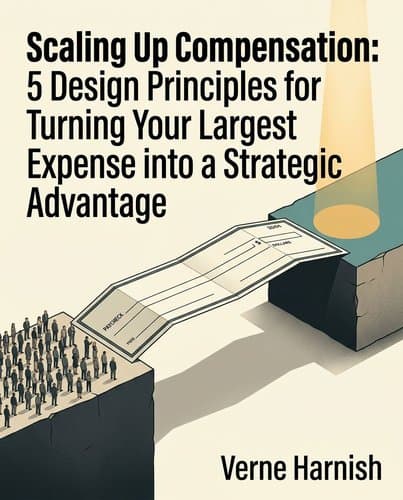
58565854_scaling-up-compensation
by Verne Harnish
Pay your best people twice the market rate and still cut your total labor cost—the math works when you hire a third as many people who produce three times the…
In Brief
Pay your best people twice the market rate and still cut your total labor cost—the math works when you hire a third as many people who produce three times the output. Five design principles reveal how to turn compensation from a budget line into the structural advantage your competitors can't copy.
Key Ideas
Premium talent reduces per-unit labor cost
Run the productivity-to-cost arithmetic before setting wages: a hire who is 3x more productive and costs 2x the industry average still reduces your total labor cost per unit of output. The Container Store built $900M in revenue on this math — but it requires the discipline to hire fewer, better people rather than staffing to industry norms.
Treat salary outliers as accumulating debt
Audit your pay structure for management debt: every informal counteroffer, off-band salary, and undocumented exception is accumulating interest. Map outlier salaries explicitly — treat them as debt with a repayment plan — rather than leaving them hidden until they infect the whole system.
Eight conditions separate working incentives from failures
Before building any individual incentive plan, test it against eight structural conditions: single-focus role, unambiguous goals, end-to-end employee control, easy measurement, gaming-resistant design, role independence, no cooperation required, meaningful and frequent payout. If any condition fails, redesign or don't build it.
Variable reinforcement schedules drive behavioral change
Replace predictable bonuses with intermittent variable rewards when the goal is behavioral change. The psychological effect of a spinning wheel outperformed a constant commission spiff by 250% at HSN — with the identical budget — because variable reinforcement schedules are neurologically more powerful than guaranteed ones.
Multi-year value-sharing creates structural retention advantage
For long-term retention of key roles, design value-sharing tied to multi-year milestones rather than annual bonuses. The mechanism isn't harder work — it's different decisions over time. Outback Steakhouse converted a six-month GM turnover problem into a ten-year structural advantage without changing how hard anyone worked.
Flat benefits contributions serve lower wage earners
Check whether your benefits package is quietly redistributive upward: 401(k) matching, performance bonuses, and equity grants often deliver nothing to employees who can't afford to participate, while concentrating rewards at the top. Heath Ceramics found this, halved its matching budget, switched to flat tenure contributions, and raised its minimum hourly wage — net cost was zero.
Who Should Read This
Business operators, founders, and managers interested in Scaling and Business Strategy who want frameworks they can apply this week.
Scaling Up Compensation: 5 Design Principles for Turning Your Largest Expense into a Strategic Advantage
By Verne Harnish & Sebastián Ross
10 min read
Why does it matter? Because the safest-looking pay decision is often the most dangerous one you can make.
Most compensation decisions start from the same place: find the market rate, land somewhere close, and move on. Pay enough to avoid losing people. Not so much that you feel like you're throwing money away. Keep things roughly consistent, avoid drama, and call it done. It's sensible. It's also how you accidentally build an organization that looks exactly like every competitor you have — because you made the same decisions they did.
The companies that are genuinely hard to beat don't tend to have compensation strategies that look smart from the outside. They look strange. Too generous. Too equal. Too structured, or weirdly unstructured. And the strangeness isn't accidental — it's the whole point. Figuring out why is what this book is for.
The Most Dangerous Pay Decision Is the One That Looks Safest: Matching the Market
In late 2011, Dan Price stepped outside for a smoke break with Jason Haley, a phone technician at Gravity Payments. Haley was making $35,000 a year. Gravity, a Seattle credit card processor, had barely survived the 2008 financial crisis, and Price had kept a lid on salaries since then — the responsible thing, the financially disciplined thing. Then Haley said: "You're ripping me off. I'm not making enough money to lead a decent life."
Price was stung. But the comment didn't leave him. Over the next two and a half years, it curdled into a question he couldn't shake: what if the responsible approach to pay was the problem?
On April 13, 2014, he announced that Gravity's minimum wage would rise to $70,000, and that he would fund part of the change by cutting his own salary from $1.1 million to $70,000. About a third of his 120 employees saw their pay double overnight. Another third got significant raises.
The $70,000 figure wasn't arbitrary. Price had read a 2010 paper by Nobel laureate Daniel Kahneman and economist Angus Deaton: emotional wellbeing improves sharply with income up to roughly $75,000 a year, then flattens. Below that threshold, money problems crowd out everything else: health, relationships, sleep. Above it, more money barely registers. Price landed on $70,000 because it was what Gravity could afford, and because that's roughly where the anxiety lifts.
What followed was hard to predict. NBC's coverage became the most-shared video in the network's history. Half a billion social media interactions. Revenue climbed from $15 million to $50 million over the next several years. Profit doubled despite the additional $2 million in payroll.
Here's the counterintuitive part: none of that is the most interesting outcome. When COVID hit, Gravity lost $1.5 million a month. Three months of runway left. Price explained the situation openly to his team. They responded by voluntarily offering pay cuts. Some gave their entire salary. Others between 5 and 50 percent. Together they contributed nearly $500,000 a month to keep the company alive. That's not what people do for employers who pay them market rate. That's what people do when they belong to something.
The principle in Price's story: there is no neutral compensation decision. Paying market rate feels safe because it's defensible. You can point to the benchmark, say you're competitive, and move on. But matching the market is its own strategy. It's a strategy for being exactly as attractive as every other company in your industry, for selecting exactly the employees everyone else is selecting, for building exactly the culture everyone else is building. The differentiation you're giving up isn't visible in a spreadsheet. Your customers feel it anyway.
The question isn't whether your pay is competitive. It's whether your compensation is doing anything: reinforcing the behaviors your business needs, attracting people who'll thrive in your culture, making clear to everyone else that this isn't the right place for them.
The Counteroffer You Kept Secret Has Already Spread Through Engineering
In a London School of Economics study, nearly half of respondents chose to earn $50,000 in a world where the median was $30,000 — over earning $100,000 where the median was $125,000. Same prices, half the money, and they still took it. Pay is a status signal more than an incentive. Frederick Herzberg had a name for this: hygiene factor. Get it wrong and people leave. Get it right and they don't particularly notice. You can't hand someone a raise and expect a performance bump. Cut someone's relative standing and you'll watch them disengage overnight.
Informal pay exceptions, the one-time "special deal" to keep someone from leaving, are more dangerous than they look.
Ben Horowitz tells the story of an engineer at a startup who gets a better offer elsewhere and prepares to leave. She's not the best engineer on the team, but she's on a critical project, and management can't afford to lose her right now. So they match the outside offer, even though it now puts her above every other engineer at the company. Everyone swears to secrecy.
Here's what actually happens. The engineer has a close friend who advised her to take the other offer. She has to explain why she didn't — or lose credibility. So she tells him, swearing him to secrecy too. He's furious: not because she got more money, but because she had to threaten to quit to get it. He tells a few other people, keeping her name out of it. Within days, everyone in engineering knows the raise formula: generate an outside offer, threaten to leave, get what you were already worth.
Nothing was contained. A policy was created — just never written down.
Horowitz calls this management debt: short-term decisions that carry compounding interest. The compounding is literal. After the word spreads, three engineers present outside offers in the same month. Each one, individually, is a defensible retention call. But management is paying interest on the first exception — every counteroffer is harder to say no to, every compensation conversation is harder to defend, and the engineers who are too loyal to play the threat game start to notice they've been subsidizing everyone else's raises.
The antidote is mundane: define pay grades clearly, apply them consistently, and run all exceptions through a formal approval process. Not because bureaucracy is virtuous, but because the alternative rewards whoever is most willing to make threats and punishes everyone too honest to do the same.
Individual Incentives Have Eight Hard Requirements — Most Plans Satisfy None of Them
Does tying individual pay to performance make people work harder?
The intuition is hard to shake: reward what you want and you get more of it. Yet Egon Zehnder International, one of the world's largest executive search firms, has never paid a performance bonus in sixty years. No commissions, no discretionary bonuses, no formal system for tracking individual office results. A partner in a money-losing office who's been at the firm a decade earns more in profit-sharing than a five-year partner who broke every billing record. This is intentional.
The logic is pure strategy. Executive search firms live on long-term client trust — the consultant who knows a client's culture after a decade of partnership is worth more than one who just closed a marquee deal. Commissions would redirect everyone's attention toward the next transaction instead of the next decade. Partner turnover at Zehnder runs at 2 percent; the industry average is 30 percent. The firm won't hire consultants who've worked under commission systems, worried the "selling attitude" is contagious.
Individual incentives aren't a neutral tool. They're a cultural signal. They select for certain personalities, redirect attention toward whatever gets measured, and reshape behavior in ways that can build or destroy what you're trying to create. The question isn't whether incentives motivate. They do. The question is whether the motivation they produce is the motivation your business actually needs.
Research has mapped eight conditions for individual incentives to work reliably. Most make intuitive sense: repetitive work, unambiguous goals, easy measurement. The counterintuitive ones are where most plans fail.
Take gaming. For incentives to work, gaming has to be practically impossible. Safelite windshield technicians can't fake an installation. The glass is in or it isn't. Most knowledge workers can hit a quarterly target without doing anything the business actually needed, and they'll find the shortcut fast. The other surprise: there's no expectation to help colleagues. Variable pay prices every decision; a rep who spends an afternoon training a teammate is spending time they're not being paid for. When cooperation matters, incentives quietly tax it.
Safelite met both conditions, and all six others. Switch technicians from hourly pay to $20 per windshield, and productivity jumps 44 percent. The work was repetitive, solo, and impossible to game.
Most knowledge work meets two or three of these conditions at best. Goals are multi-dimensional. Collaboration is constant. Output depends on teammates, timing, and variables the employee doesn't control. In those situations, a variable pay scheme motivates whatever the measurement captures, which is never quite the same as the work you actually needed done.
Individual incentives are a sharp but narrow tool. They work reliably in simple, repetitive, solo work and fall short in the complex collaborative roles where most organizational value gets created. In 2015, Bosch eliminated individual bonuses for all 378,000 employees, replacing them with group-level profit sharing. The problem they were solving: years of schemes that made each unit protect its own metrics and resist helping the next team. The incentive principle stayed; only the unit of account changed. It's the same correction Zehnder made six decades earlier, only at a different scale.
The Bingo Machine Got Better Teamwork Than Management Ever Did
Individual incentives can fix individual problems. What they rarely produce is cooperation — and most management failures are cooperation failures.
The owner of a sixty-person steel and piping firm in Boston had a straightforward problem: the warehouse team wouldn't cooperate. Not in any dramatic way. No one was sabotaging anything. They just wouldn't support each other, and years of management effort had produced nothing.
Then he gamified their bonuses.
The mechanics were simple. Each month, $5,000 went into a reward pool. Any employee who hit their individual or team goals had their name placed in a bingo-style spinning drum. Exceed those goals by a certain margin and your name went in twice. At an all-hands meeting, they'd draw names, first for small prizes like movie passes and dinners, then for a $2,000 cash grand prize.
Within a single cycle, the five-person warehouse team did something no manager had engineered: they formed a spontaneous cooperative pact. They agreed to push each other toward the goal threshold so every warehouse member got the maximum ten entries each month, and if anyone won the $2,000, they'd split it five ways.
The owner had been trying to get this for years. The bingo machine did it in a month.
The mechanism isn't money. It's psychology. A predictable bonus teaches employees to budget for it. A lottery, variable and potentially large, does something different. It creates shared stakes without any management enforcement. The warehouse team didn't cooperate because they were told to or because they liked each other more than before. They cooperated because the math favored it. Double your entries, double your odds. You can't max entries alone.
Well-designed group incentives alter the social calculus in ways direct management can't. MiniMovers, a Brisbane moving company founded by Mike O'Hagan, pools 3% of revenue as a quarterly team bonus paid only if nothing breaks. Coworkers train new hires on the spot because damage comes out of everyone's pocket. Management doesn't have to enforce standards. The incentive redesigned the social environment, and the social environment enforces itself.
Most group bonuses are just math: divide the pool, distribute the checks, repeat. The designs that change behavior give people a reason to police each other, compete, or cooperate in ways that feel natural rather than imposed. That's the difference between a bonus plan and a game. One is a transaction. The other is a social fact.
Long-Term Compensation Doesn't Motivate People — It Changes How They Think
Annual profit pools change what people earn at the end of the year. There's a harder design problem underneath: getting people to think past the year at all.
Think about renting an apartment versus owning one. Same building, same leaking faucet. The renter waits for the landlord. The owner fixes it that afternoon, because they'll still be dealing with that faucet in ten years. Nothing changed about the work. What changed was whose future is attached to the outcome.
That's the real mechanism behind long-term compensation. It doesn't make people work harder. It changes whose future they're managing.
Chris Sullivan, co-founder of Outback Steakhouse, figured this out by looking at a number the restaurant industry had simply accepted: general managers turned over, on average, every six months. Good managers got rotated to rescue failing locations. Great ones left to open their own restaurants. The company moved around the people it needed most and then lost them anyway.
Sullivan asked a different question: what if a manager stayed at the same restaurant for five to ten years? Not an improvement — a structural transformation.
His solution was counterintuitive, almost insulting. He asked young managers to invest $25,000 of their own money and commit to five years. Outback trained them for three years at competitive pay, then let them run a restaurant solo. Hit the performance milestones by year five: a $100,000 bonus, a 4x return. Commit to another five years at the same location: $100,000 as a lump sum, plus $500,000 in stock.
The design created someone who thought in five- and ten-year arcs because their financial future was tied to one restaurant's long-term performance. Not effort — time horizon. Ninety percent of "proprietors" (Sullivan's title for managers who'd made the investment) stayed five years. Eighty percent stayed ten or more. A problem measured in months became a competitive advantage measured in decades. Bloomin' Brands, Outback's parent, reached 1,450 outlets and over $4 billion in revenue.
Sullivan didn't get more work out of his managers. He got different decisions. A manager who knows they're running this kitchen in this neighborhood for the next decade makes different choices about sourcing, training, and customer relationships than someone who'll rotate out in six months. Same person, same job title — different mental model of what they're actually doing.
Every Pay Decision Is a Signal — The Question Is Whether You Intended It
Your compensation plan is already sending a message. The question is whether you wrote it deliberately or let it write itself — one counteroffer, one quiet exception, one bonus that pays out regardless of whether anyone's behavior actually changed.
Dan Price didn't raise his minimum wage to be generous. Egon Zehnder doesn't refuse commission-trained consultants out of sentiment. Outback didn't ask managers to invest $25,000 as a retention trick. Each decision was a signal: this is who we are, and what belonging here actually looks like. Some people will hear that and leave. That's the point.
The sequence is short: fix the base so money stops being the argument, point the incentives at something worth pointing at, stretch the time horizon until gaming it stops paying off.
The most dangerous compensation system isn't a badly designed bonus structure. It's one that accumulated, exception by exception, until leadership itself can no longer say what it's actually trying to say — and everyone else has already figured out what it means anyway.
Notable Quotes
“You're ripping me off. I am not making enough money to lead a decent life,”
“Philosophically, what I wanted to create at Gravity was a place where people could come to work and pretend they were volunteers,”
“I had implemented our raise policy because I didn't want my people to have to worry about money, and I also didn't want money to be the only reason they came to work.”
Frequently Asked Questions
- What is the productivity-to-cost principle in compensation design?
- The productivity-to-cost principle shows that selective hiring of higher-productivity workers reduces total labor cost per unit of output. "A hire who is 3x more productive and costs 2x the industry average still reduces your total labor cost per unit of output." The Container Store built $900M in revenue using this math by hiring fewer, better people rather than staffing to industry norms. This approach transforms compensation into a strategic advantage by combining higher wages with lower total labor costs—creating powerful competitive positioning and turning your largest expense into an asset.
- How should leaders audit pay structures for hidden compensation problems?
- Leaders should audit their pay structure for management debt by mapping outlier salaries explicitly and treating them as debt with a repayment plan. "Every informal counteroffer, off-band salary, and undocumented exception is accumulating interest." Rather than leaving exceptions hidden until they infect the whole system, document outlier salaries explicitly and develop clear strategies to address them. This systematic approach prevents compensation inequities from spreading throughout the organization and undermining effectiveness. Auditing for management debt ensures compensation remains aligned, fair, and strategically valuable by surfacing hidden liabilities before they create systemic problems.
- What eight structural conditions should incentive plans meet before implementation?
- Before building any individual incentive plan, test it against eight conditions: "single-focus role, unambiguous goals, end-to-end employee control, easy measurement, gaming-resistant design, role independence, no cooperation required, meaningful and frequent payout. If any condition fails, redesign or don't build it." These conditions ensure incentive plans reinforce desired behaviors rather than creating perverse incentives. The framework prevents misalignment by requiring that incentives address roles where employees directly control outcomes and goals are transparent. This systematic approach transforms incentive design from guesswork into strategy.
- Why do variable rewards outperform predictable bonuses for changing employee behavior?
- "The psychological effect of a spinning wheel outperformed a constant commission spiff by 250% at HSN — with the identical budget — because variable reinforcement schedules are neurologically more powerful than guaranteed ones." When the goal is behavioral change, "replace predictable bonuses with intermittent variable rewards." The unpredictability of when rewards arrive activates stronger motivational pathways in the brain than guaranteed bonuses. This achieves dramatic performance improvement without additional spending by restructuring how and when rewards are distributed, making variable schedules a cost-neutral strategic tool.
Related Book Summaries
Read the full summary of 58565854_scaling-up-compensation on InShort