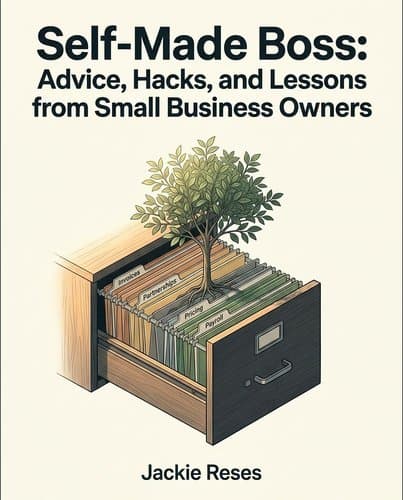
59143095_self-made-boss
by Jackie Reses
Surviving as a small business owner isn't about having the best idea—it's about mastering the unglamorous systems most entrepreneurs skip: billing before you…
In Brief
Surviving as a small business owner isn't about having the best idea—it's about mastering the unglamorous systems most entrepreneurs skip: billing before you finish, stress-testing assumptions cheaply, and locking down partner agreements before the first crisis makes those conversations impossible.
Key Ideas
Bill upfront to prevent payment delays
Bill clients before you finish their project, not after — or you go unpaid for months while you do the work.
Test assumptions cheaply before building
Before building anything, write down every assumption your business depends on, then find the cheapest way to test each one. Most business failures are predictable.
Small expenses compound into losses
Track every cost, including the ones that seem negligible. The M&Ms might be the ones losing you money.
Clarify vision, succession, and exit rights
Before signing with any partner, write down answers to three questions: What is your ten-year vision for this business? What happens when one of us dies — do shares go to heirs or back to the company? If one of us wants to sell our stake, does the other get right of first refusal?
Hire for attitude, not experience
Hire for personality and willingness to learn — not prior experience. Experience teaches people to do it the old way. Evaluate candidates on their best day at work, not their most impressive résumé line.
Turn structural obstacles into advantages
When an obstacle is structural — discrimination, a closed channel, a locked market — tactics aimed at it are wasted. Ask instead whether the obstacle can become a differentiator. Stop trying to serve everyone and find the customers who value exactly what you are.
Document processes to scale beyond yourself
Document every process in your business as if you were going to franchise it — regardless of whether you ever plan to. If the business cannot run without you, you do not have a business; you have a job with extra steps.
Who Should Read This
Business operators, founders, and managers interested in Startups and Business Strategy who want frameworks they can apply this week.
Self-Made Boss: Advice, Hacks, and Lessons from Small Business Owners
By Jackie Reses & Lauren Weinberg
9 min read
Why does it matter? Because the idea was never the problem.
The aspiring small business owner imagines losing on the big things: the wrong idea, the wrong market, a competitor who got there first. Almost nobody imagines losing on invoices. On a partnership agreement that felt too awkward to write up. On a pricing model that looked right and quietly bled them for years. But that's where most small businesses actually break — not at the dramatic inflection point but somewhere in the unglamorous machinery underneath it. The founders who survive aren't smarter or more passionate than the ones who don't. They built those systems before the first crisis made building feel impossible. This book is the collected intelligence of hundreds of operators who learned which systems matter and when — usually by getting it wrong first. Here's what they found.
The Passion That Launches a Business Can't Keep It Running
Bobby Crocker had one of the most structured careers imaginable. Drafted out of college, he played outfield for the Oakland Athletics: daily practice schedules, coaching staff, game-day routines, everything mapped out before he arrived. When a shoulder injury ended his playing days, he wanted independence. He'd watched his father run a construction company. That life appealed to him — self-reliance, building something on his own terms, not answering to anyone.
So he became a self-employed personal trainer in the Bay Area. And within his first weeks, he discovered the problem. "In baseball, the framework was provided for me," he said later. "What I gained in freedom I lost in structure."
He'd spent years inside an institution that told him exactly how to use his time. When that scaffolding disappeared, what he'd called freedom turned out to have its own demands: scheduling his week, setting rates, following up on invoices, finding clients and keeping them. No coach assigned his hours. No organization told him what to work on next. The structure baseball had always provided, he now had to build himself.
Most founders hit this in their first weeks. The idea gets you through the door. The infrastructure is yours to figure out.
The Business That Failed Was Based on Two Wrong Assumptions — Both Researchable
A Minneapolis company called Hedberg Maps built an atlas of every local sports facility in the area — soccer fields, hockey rinks, the whole grid. The logic was clean: parents shuttle kids to games constantly, they need directions, and school sports teams are always hunting for fundraising products. Two revenue channels, one product.
Both assumptions were wrong. Parents had already moved to navigation apps on their phones. And the local soccer association had quietly locked up the fundraiser sales channel before Hedberg got there. Hedberg didn't discover either until after print. They paid to have the unsold atlases destroyed.
Neither failure required bad luck to predict. A few hours watching parents at a Saturday game would have revealed the shift to navigation apps. A few calls to the soccer association would have uncovered the existing sales arrangement. The research wasn't exotic. It just didn't happen.
The most expensive cognitive habit in small business is falling in love with the solution before knowing whether anyone will pay for it. Yvonne Cariveau, who runs an entrepreneurship center at Minnesota State University, frames it this way: if you want to build a product that fixes a problem with snowshoe bindings, don't start sketching designs. Go watch people put on snowshoes first. The actual friction might be cold fingers, stiff plastic, bindings that are too short, or lack of flexibility. Each of those is a different product. You can solve the wrong version of a real problem and never notice until the atlases come back.
The pre-launch questions are specific: will people pay for this, can they find you, and does someone already own the channel you're counting on? Hedberg had a real problem — and no viable answer to any of the three.
You're Going Broke Because You're Not Getting Paid, Not Because You're Not Selling
Most businesses that fail in the first year aren't failing because the market rejected them. They're failing because the money they earned never arrived.
Lauren Weinberg had spent nearly half her career near the top of the corporate world, leading teams at a major television network and eventually becoming chief marketing officer at Square. When she went out on her own as a marketing consultant, she thought the hardest part would be building the website. She had the skills, the contacts, decades of experience.
What she hadn't figured out was billing. On her first projects, she told clients to pay after the work was finished. Projects stretched over months. During those months, she received nothing. A seasoned executive, undone by a decision she'd never had to think about inside a large organization — because someone else had always handled it.
When you work inside a company, collections, invoicing, and accounts receivable are someone else's department. When you run your own shop, they become your job, and they arrive without instructions. Most people discover this the way Weinberg did: by not getting paid and realizing they built no system to make sure they would.
The instinct when cash runs low is to look for more sales. But Karen Turnquist, who lends money to businesses against their unpaid invoices, draws a more useful distinction: every sale carries two separate risks — whether your customer can pay, and whether they will. In her experience, the second one fails far more often. The customer has the money. The invoice was vague, the follow-up never came, no one set terms before the work started. That's a collection problem, and more sales won't fix it. Turnquist's clients who stay solvent agree on payment terms before the work starts, bill on schedule rather than waiting until the end, and stop extending credit after three missed commitments. A sale is not revenue until the money is in your account.
The Partner Conversation You Skip Is the One That Destroys You
Michael Lassner and his co-founder were good together. They worked well day-to-day, got along personally, trusted each other to handle their respective responsibilities. By most measures, they had what people mean when they say a partnership is working.
What they'd never discussed was where they each wanted the company to go. Lassner, who runs Allied Steel Buildings in Fort Lauderdale, wanted scale — global operations, complex projects, a company that kept getting larger. His partner wanted something smaller and closer to home. Neither discovered the mismatch until sorting it out had gotten expensive. Lassner eventually bought him out. In retrospect, he could name exactly what they'd skipped: a shared picture of what the company was supposed to become.
Chemistry and complementary skills get you started. They don't carry you through divergent ambitions. What most founding partnerships skip — because it's uncomfortable, because the energy is high and the future feels open — is the conversation where you name the hard specifics. Jeremy Weinberg, a partnership attorney, has a pre-partnership checklist that gets at what that conversation actually requires: Where do you each see this in ten years? If a partner dies, do their shares pass to heirs or revert to the company? If one partner wants to sell their stake, does the other get first right to buy it before an outside buyer enters? These aren't edge cases to resolve later — they're the questions that determine whether a partnership survives a crisis or dissolves into one.
Most founders treat the partnership agreement as paperwork that follows the relationship. The relationship comes first, the document ratifies it, everyone moves on. That sequence is backwards. The document is where you find out whether the relationship can survive contact with reality — with divergent ambitions, with the unexpected, with the question neither person wanted to raise because things were going so well.
Hire for Personality — Experience Teaches People to Do It the Old Way
A cook Marc Bash hired for one of his New York restaurants came with strong opinions about Bolognese. One wine in the sauce, not two — that was the right way to do it. Pine nuts didn't belong in pesto, either. Bash disagreed on both counts, but more than the food, he disagreed with the disposition: this was someone who'd learned to do things a certain way and wasn't going to change. They clashed at nearly every turn until the cook walked out.
Bash owns four restaurants with his brother and has cycled through more than 250 employees over his career. He's fired eight of them. The number stays low partly because of what he screens for before anyone touches a stove. He doesn't ask about prior kitchen experience. He asks whether the person likes people — "happy-go-lucky," as Bash puts it — and whether they'll learn his way. Candidates with years of entrenched habits often can't.
The tenure tells the story. One of his managers started as a busboy who arrived without a word of English. He learned the job, worked his way through the ranks, and now, two decades later, he's Bash's closest operational partner. That trajectory doesn't happen if you're filtering for credentials — it happens when you hire for disposition and invest in the training yourself.
The instinct to require experience makes intuitive sense: shorter ramp time, someone who already knows the fundamentals. It can also mean someone who already knows they're right. Every trade accumulates orthodoxies — the accepted shortcuts, the standard moves, the conventional wisdom. An experienced hire often arrives with all of it loaded. A raw hire arrives carrying none.
When the Wall Won't Move, Stop Trying to Move It
Letitia Hanke ran her roofing company for years under initials. Not a pen name or a legal formality — a deliberate concealment. "L. R. Hanke" on every contract, because she knew what some customers would do with a first name and a face. She is a Black woman in a trade that didn't expect either.
The day that clarified things: she'd already sold the job by phone. The couple had been warm, enthusiastic. She drove to their Santa Rosa home in business attire a stylist had selected, expecting to collect signatures. The wife answered the door and offered a reluctant handshake. The husband looked at Hanke's extended hand, looked at her, looked back at the hand. He walked away. As she was leaving empty-handed, he reappeared to mention the alarm system and how loudly it would sound if anyone tried to break in. She drove around the corner and cried.
Most people facing that moment ask: how do I get around this? What framing, what presentation, what different approach? That instinct — tactical, problem-solving — is right for most business obstacles. It doesn't work here. You cannot optimize your way through someone's prejudice. The obstacle isn't a process. It's the person.
What Hanke did instead was stop treating it as a problem to solve and start treating it as information about her market. She shredded their unsigned contract and went back to the office. Then she rebuilt her marketing from scratch: her full first name, her face, everywhere. Every ad, every truck, every page of her website. Anyone looking for ARS Roofing would know exactly who ran it.
The reframe is the whole move. She stopped trying to win customers who saw her race and gender as a liability and started targeting the ones who saw those things as a reason to call. Northern California, it turned out, had plenty of those customers. The company became a multimillion-dollar business. That reframe only works when the obstacle is structural; most friction has a tactical solution, and the instinct to optimize is usually right.
Build the Business as If Someone Else Will Run It
What if you never plan to sell your business? Does any of this documentation work actually matter?
Genevieve Weeks opened Tutu School in 2008 in a single room on the edge of San Francisco's North Beach neighborhood. She was a recently retired ballet dancer, running toddler classes alone. Within a year she'd hired another teacher. Within two years she'd opened a second location in Marin, following families whose kids were aging out of her program. A year after that, she understood something: the model could work anywhere children lived. That's when she started thinking about franchising.
What franchising actually required surprised her. The hard part wasn't the legal structure — it was making the business transferable to someone who hadn't watched her do it for years. That meant replacing spreadsheets with purpose-built studio management software and writing a real curriculum instead of having new teachers shadow her. She had to put on paper what she'd been carrying in her head.
The result: 37 locations, 34 of them franchises, with more sold and reserved. Weeks is clear about why the exercise matters even if you never franchise: "There's no downside to systematizing your business, really looking at your systems and operations." She recommends doing it early — not because you're planning an exit, but because it tells you whether your model is replicable at all. In the meantime, your existing business runs more smoothly.
The same work that makes a business saleable or franchisable — clear documentation, processes that don't depend on one person carrying everything in their head, records clean enough that someone could walk in and understand the operation — is the same work that makes a business durable. There's no separate track for businesses that intend to stay small. The infrastructure either exists or it doesn't.
The Business You Could Walk Away From Is the One Worth Building
You could carry the whole operation in your head, and it might work fine for years. But at some point, planning to leave or not, the question arrives: could someone else run this? The businesses built to last are the ones where the answer was already yes.
Notable Quotes
“Define your problem very, very specifically. Observe. Ask open-ended questions,”
“Entrepreneurs fall in love with their solutions before they really understand the problem,”
“If you have a business where it costs you $100 to make an item and you can only sell it for $90, then you might as well just create an organization that gives $10 to every person you meet,”
Frequently Asked Questions
- What is Self-Made Boss about?
- Self-Made Boss draws on stories from real small business owners to reveal operational and financial fundamentals that determine business survival. Published in 2022 by Jackie Reses and Lauren Weinberg, the book provides practical guidance on cash flow, testing assumptions, hiring, partnerships, and building systems—the unglamorous infrastructure most owners neglect until a crisis forces the issue. Rather than focusing on glamorous growth strategies, it emphasizes the foundational discipline required to keep a small business operational and sustainable.
- What are the key takeaways from Self-Made Boss?
- Self-Made Boss emphasizes several critical practices: bill clients before finishing projects to ensure cash flow; document every assumption and test cheaply before building; track all costs including negligible ones; establish partnership agreements addressing succession and buyout rights; hire for personality and willingness to learn rather than experience; treat structural obstacles as potential differentiators; and document all processes as if franchising regardless of intent. The book stresses that if your business cannot run without you, you have "a job with extra steps."
- What does Self-Made Boss teach about cash flow management?
- Self-Made Boss emphasizes aggressive billing practices to protect cash flow: "Bill clients before you finish their project, not after — or you go unpaid for months while you do the work." This counter-intuitive approach prevents businesses from funding client work themselves. Beyond billing, the book stresses comprehensive cost tracking, noting that "the M&Ms might be the ones losing you money." These unglamorous financial practices form the infrastructure most owners neglect until crisis strikes, making them essential for survival.
- How does Self-Made Boss approach hiring for small businesses?
- Self-Made Boss recommends hiring for personality and willingness to learn rather than prior experience. The authors argue that "experience teaches people to do it the old way," limiting innovation. Instead, evaluate candidates "on their best day at work, not their most impressive résumé line." This approach allows small businesses to build teams motivated by growth and adaptability rather than entrenched practices. By prioritizing trainability and cultural fit, owners create teams willing to learn methods suited to their specific business context.
Related Book Summaries
Read the full summary of 59143095_self-made-boss on InShort