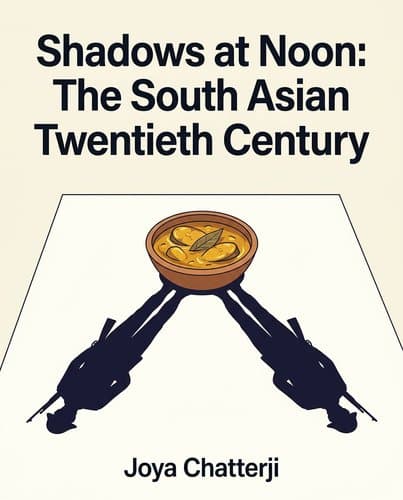
61634087_shadows-at-noon
by Joya Chatterji
The "ancient Hindu-Muslim hatred" that split South Asia was invented—by the same governments that then built nearly identical states using nearly identical…
In Brief
The "ancient Hindu-Muslim hatred" that split South Asia was invented—by the same governments that then built nearly identical states using nearly identical laws. Joya Chatterji dismantles the partition myth by showing what was actually severed: wrestling lineages, migration routes, and shared kitchens that states needed you to forget.
Key Ideas
Political choices, not theology, determined Partition
Partition was not the product of ancient Hindu-Muslim incompatibility. The Lucknow Pact of 1916 offered a working model — minority protections, weighted representation, mutual concession — that was killed by Congress hegemony and Nehru's refusal to share power, not by any underlying incompatibility.
Identical states wore opposing national identities
India and Pakistan built near-identical states simultaneously. They passed parallel citizenship legislation in the same calendar years, stripped parallel minorities of legal standing through the same legal mechanisms, and experienced parallel authoritarian lurches. The 'opposites' story was something both governments needed, not something history produced.
Weak police power, precise legal persecution
The South Asian state is both weaker and more precise than it appears. It cannot catch a leopard or disarm a dacoit in a Delhi hospital. But it can create a legal state of exception that removes an entire religious minority from civil court access — and sustain it for decades. The paper tiger has specific targets.
Elite food culture erased Dalit culinary history
The 'Indian diet' was constructed from the food practices of roughly 6% of the population (Brahmins) and universalized by British medical men. The actual diet of roughly one-seventh of the subcontinent — Dalit communities — was dung-washed grain, dead cattle, and wedding leftovers. The gap between these two food histories is also the gap between the official story of South Asia and the lived one.
Partition cut through specific human networks
Partition severed specific human networks, not abstract national identities. Wrestling training lineages that crossed Punjab, migration routes connecting Konkan villages to Bombay chawls, patronage circuits sustaining acrobatic troupes — these were the actual tissue of connection that the Radcliffe Line cut through. Many of these connections persisted anyway, underground.
Secret cooperation masked by manufactured hatred
The governments manufacturing popular enmity were conducting quiet cooperative diplomacy throughout. Within months of partition, Indian and Pakistani delegates were eating fish curry together and reaching swift agreements — while explicitly agreeing their publics must never know. Elite cooperation and popular hatred were not contradictions; the secrecy of the one sustained the effectiveness of the other.
Who Should Read This
History readers interested in World History and Geopolitics who want a deeper understanding of how we got here.
Shadows at Noon: The South Asian Twentieth Century
By Joya Chatterji
9 min read
Why does it matter? Because the hatred between India and Pakistan was a government project — built while both governments quietly cooperated.
The assumption is that South Asia's divisions are ancient: primordial, religious, inevitable. Then comes one unsettling detail: the historian who spent decades dismantling that story was herself, at age ten, taught by a government-mandated school curriculum to hate "the Britishers" and Jinnah. Not in a bigoted household. Taught. By the state. From a syllabus.
That's the gap Shadows at Noon forces open. Joya Chatterji argues that the century's central project across India, Pakistan, and Bangladesh wasn't independence — it was manufacturing enemies out of neighbors who shared the same spices, the same wrestling holds, the same monsoons. The hatred was not discovered. It was engineered. And running beneath the official hostility was a history both governments preferred not to examine.
Partition Was Not Inevitable — Someone Had to Kill the Peace
In 1916, Muhammad Ali Jinnah set about doing something improbable: persuading Punjabi and Bengali Muslims to voluntarily surrender power they already had.
Those two provinces were the only places in British India where Muslims formed majorities. Under any democratic arithmetic, their numerical weight would deliver them outsized influence in local government. Jinnah asked them to give that up, accepting fewer seats than raw demographics would have handed them, so that Muslims in minority provinces like the United Provinces could win weighted representation instead. In exchange, Hindus across the country would accept that minorities deserved more seats than their numbers alone warranted. The Congress reciprocated: in the United Provinces, Hindus gave up thirty percent of seats to Muslims who made up only thirteen percent of the population.
That was the Lucknow Pact, assembled through years of maneuvering: Jinnah shuttling between parties, extracting concessions from old allies, sitting on objections until they softened. The agreement recognized that a country built around a permanent Hindu majority would terrify its minorities into paralysis, and that the only way to make Indians govern themselves was to write protection for the outvoted into the constitutional structure itself. It was not a perfect arrangement. It was a workable one.
The man who built it is the same man history casts as Pakistan's founding father and the destroyer of Indian unity. That contradiction is where Chatterji begins.
Chatterji's argument is that Jinnah never changed. From his entry into Indian politics in 1906 until his death in Karachi in 1948, he remained a liberal constitutionalist who believed minorities needed enforceable safeguards — not sentiment, not goodwill, but law written down. As a young man in London he had watched Dadabhai Naoroji, the first Indian elected to the British Parliament, appeal to British liberal values from inside their own institutions — and took from it a method: argue in the empire's own terms, and they have no principled ground to refuse you. He absorbed On Compromise, by the Victorian Liberal politician John Morley, so completely that he was still recommending it to students decades later. Jinnah's whole career was an attempt to do what the Lucknow Pact had done: find the constitutional formula that let different communities share a country without any of them needing to trust each other entirely.
What changed was Congress. After its 1937 electoral landslide, when it won every Hindu-majority province, the party grew steadily less willing to share power. When the Muslim League asked to join Congress coalition governments in the United Provinces, Nehru refused. When senior Congressmen drafted a new constitutional framework, they did it without Jinnah in the room. What emerged stripped away the protections the Lucknow Pact had built, on the reasoning that a true nation had only one kind of citizen.
Partition wasn't the surfacing of ancient hatred. It was one party deciding, at the moment it held power, that it no longer needed to share it. Someone had to kill the Lucknow Pact. Chatterji shows you who did.
What partition couldn't separate is what Chatterji turns to next.
India and Pakistan Built the Same Country, With the Same Laws, in the Same Calendar Years
India and Pakistan passed near-identical citizenship legislation, in near-identical sequence, across fifteen years. This is not a coincidence that historians have missed — it is the structure that the official story of division requires you not to see.
Both opened with liberal intentions. Both Constituent Assemblies in 1947 began with territorial citizenship as the organizing principle: if you were born there, you belonged there. Both retreated within months, pushed not by ideology but by squatters. When partition sent millions across Punjab and Bengal, Hindu and Sikh refugees seized homes vacated by Muslims fleeing the other direction. They fought police with bricks, held fortified compounds they named "Fortress of Freedom," and refused every eviction order with the collective force of people who believed they had already earned their country. Nehru shifted his position within six weeks. The squatters had moved policy faster than any law could have.
In 1948 — the year India put its first permit system in place to control movement across the new border — Fazal Dad traveled from his village in central India, where he had lived for forty years and owned property, to Pakistan to attend a wedding. He stayed longer than intended. He came home in 1953 carrying a Pakistani passport, walking into a country that had spent five years building the machinery for exactly his case: the Evacuee Property Ordinance of 1949 had nationalized Muslim-vacated homes at a stroke; by 1955, the citizenship law explicitly excluded anyone ever domiciled on the other side. He argued that a wedding visit could not constitute emigration, that he had always been Indian, that the law could not strip a man of his country for attending a celebration. In November 1962, two judges disagreed: Pakistani citizen, petition dismissed. He had gone to a wedding and lost his country.
The timing matters. T.H. Marshall published his classic 1950 essay arguing that court access is the foundational civil right of citizenship, the thing that makes all other rights real. At that precise moment, India had stripped its Muslim citizens of access to civil courts over property entirely. The Evacuee Property Ordinance made the custodian's rulings unchallengeable. The country writing the world's most elaborate democratic constitution was simultaneously writing a legal exception that applied to one community alone. Pakistan did the same. The same laws, the same years, the same result. They didn't build opposites. They built each other.
The State That Could Not Catch a Leopard Could Strip a Muslim of His Home
The leopard arrived in Chamoli in 2006, and the District Magistrate immediately began generating paperwork.
A protected hill leopard had started stalking a Himalayan town in Uttarakhand, taking a woman first, mauling her badly, then growing bolder. Shops shut before dusk. People bolted their doors in daylight. The leopard eventually took up residence in the government compound itself, sleeping one night alongside the DM's rose bed. What the DM could not do was shoot it. Leopards are protected under Indian conservation law, which meant a hunting permit required approval from the state capital in Dehradun, which required sanction from New Delhi, which required files traveling the chain in both directions, each bearing the right signatures, noting the appropriate urgency. Weeks passed. The leopard killed a twelve-year-old boy. Residents marched to the DM's house chanting for his death. Eventually, three state-hired hunters arrived in a white jeep, dressed in camouflage and sunglasses like Bollywood action heroes, and left three weeks later having caught nothing. A local villager killed the leopard himself.
Chatterji names what ordinary South Asians understand in their bones: the state is a kaaghazi baagh, a paper tiger. It generates files. It dispatches men who look the part. It cannot catch the thing it came for.
But the paper tiger has real teeth — pointed in a specific direction.
The state's dysfunction is not evenly distributed. The DM could not protect Chamoli because the machinery had no specific target. The Evacuee Property Ordinance moved swiftly because it moved against a named population. A daaku walked into a Delhi hospital, rifle in hand, for years; nobody asked why. The policemen outside were protecting government ministers. The state looks away. Where it chooses to act, it acts with precision. The rest is waiting — and the people who wait the longest are the ones the state has decided not to see.
The 'Indian Diet' Is an Anglo-Brahmin Invention — A Seventh of the Subcontinent Subsisted on Dung-Washed Grain
Food is where this book's larger project lands with the most weight: the dismantling of manufactured official stories about South Asian civilization.
Santamai goes out to make dung cakes and comes home with dinner.
During harvest season, cattle graze the fields and pass undigested sorghum through their bodies, grains still swollen and edible, embedded in the dung. Santamai, grandmother to the Dalit writer Sharankumar Limbale, picks through the lumps with her hands, carries them to the river, washes away the dung, dries the grains in the sun, and grinds them to flour. She sings while she grinds. Her grandson cannot bring himself to eat the flatbread she makes. Santamai eats without pause. This was western India in the 1960s.
The official story of Indian food was built from a different source entirely. Colonial surgeons and administrators learned about food norms exclusively from Brahmin pandits and universalized what they heard. The saatvik/raajsik/taamsik food hierarchy, the purity rituals around the kitchen, the taboos against stale food and food touched by another's lips: these cosmologies supposedly governed a civilization. In 1901, Brahmins were 6.2 percent of British India's population.
What the pandits described governed almost nothing outside a thin stratum. Limbale's family, Dalit Mahars who stood outside caste entirely, had no ghee, no lentils, no milk, no vegetables. Their diet was sorghum flatbread, jaggery, and the dried meat of dead cattle. The Brahminical prohibition against food touched by lower-caste hands, which rendered Dalit contact contaminating even while it relied on Dalit labor, meant they spent their lives eating what the purity system had already rejected. When a landowner's cow died, men of the settlement arrived with their plates and carved shares from the carcass. Their full bellies came from what the cow-worshipping village had thrown away.
The Brahminical food system did not merely ignore the Dalits who held up its supply chain. It required their degradation to function.
At wedding feasts, Dalit children waited outside while caste guests ate inside. They could hear dishes announced between the rows — kheer, ghee, curry — until, as Limbale wrote, their stomachs became "a huge cauldron." Eventually they ate the leavings. When Limbale grew old enough to feel the humiliation and refused to go, his mother's rebuke was four words: "Too much self-respect."
Partition Did Not Divide Two Nations — It Severed One Civilization's Specific Human Networks
In 1947, Ghulam Muhammad Baksh Butt, known everywhere as Gama the Great, had spent nearly four decades undefeated in every wrestling competition he entered. He had thrown the American world champion in two straight falls at London's Holborn Empire in 1910, and no serious challenger came near him afterward. His training regime: four thousand free squats and three thousand push-ups every single day, followed by three hours of grappling. His patronage: the Maharaja of Patiala, whose territories sat at partition's fault line and who funded his training hall and his tournaments.
When the Maharaja's power evaporated in 1947, so did Gama's world. He tried running a bus business. It failed. He crossed forty miles to Lahore, where he had trained as a young man, now in Pakistan. The Pakistani government gave him land and covered his medical bills. And from across the new international border, the Indian industrialist G.D. Birla — a man who had financed Gandhi's campaigns for non-violence — sent Gama two thousand rupees a month until his death in 1960.
The money crossing that border says more about what partition actually severed than any official history does. The training hall where Gama had wrestled was not a Hindu space or a Muslim space. Muslim wrestlers, Hindu wrestlers, Sikh wrestlers, and Catholic migrants from India's western coast all grappled together as disciples of the same teacher, massaged each other's bodies every Sunday, and shared the sacred soil of the wrestling pit. What gave this world coherence was not religion — it was patronage circuits: the princes who funded the tournaments, the villages that hosted the troupes, the industrialists who showed up at ringside. Partition severed every one of those circuits at once.
Independent India never replaced the princes as wrestling's patron. The new government backed classical dance and music instead: forms that could be made to look ancient, Hindu, and unambiguously national. Wrestling was too entangled with Muslim greats like Gama, too spread across both sides of the new border, too much a sport of people who had never sorted themselves by the new political grammar. Neither country claimed it. So it survived in small neighborhood training pits with no money and no spectators, still teaching the same squats and push-ups Gama had drilled, while Birla's checks kept crossing a border that the sport itself had never recognized.
The Governments Teaching Their People to Hate Each Other Were Eating Fish Curry Together in Secret
How hostile were India and Pakistan's leaders to each other, really? Two months after the subcontinent's worst communal violence, with a war beginning over Kashmir, the answer seems obvious. But the transcript of the first India-Pakistan international conference, held in Calcutta in April 1948, tells a different story.
The meeting nearly collapsed in its opening minutes when India's Assam representative threatened to walk out over Muslim migrants. Both sides brokered a deferral and continued. What the stenographic record shows is something harder to square with the official story: delegates joking about rapacious finance ministers, swapping names of mutual acquaintances caught by the taxman, bonding over shared estates stranded on the wrong side of the border. When Pakistan's Ghulam Muhammad suggested that an Indian delegate who owned property in East Bengal deserved to be "punished" for depriving Pakistan of a man of his caliber, the room erupted in laughter. By the second evening, they had apparently forgotten they were at an international conference. Fish curry was served. Swift agreements on minority protection, property rights, and economic guarantees followed.
The stenographic record is explicit about why none of this was ever meant to surface. The delegates understood the logic of their mutual dependence. What mattered, the transcript says, was "that the pablik should not know."
South Asian statecraft has run on this logic ever since. India and Pakistan fought a total of 168 days of active combat across the entire twentieth century — fewer days, spread across five conflicts, than most sieges lasted in the Second World War — each clash brief, bounded, resolved. Between those intervals came the quiet agreements: the Indus Waters Treaty, the Tashkent Declaration, a nuclear hotline established in 2004 while both governments publicly raced toward missile delivery. Each was conducted in the same spirit as the Calcutta dinner: cordially, efficiently, away from public view. The public was taught eternal enmity. The leaders depended on each other's survival. The wars were the performance. The fish curry was the policy.
The Fish Curry at the Table You Were Never Supposed to Know About
The fish curry is the detail that stays with you. Not the Kashmir war, not the citizenship laws, not the property seizures — but two delegations sharing a bowl and agreeing, without irony, that what just happened in this room must not reach the street. Chatterji's book is the street finally finding out.
The twentieth century's great South Asian tragedy was not incompatibility. It was manufacture. The same spices, the same wrestling holds, the same fish — and two states working methodically to make a billion people forget they knew this. What Birla's checks to Gama tell you, what the Lucknow Pact tells you, what the Calcutta conference transcript tells you, is that the separation required maintenance. Enemies who need constant reminding they are enemies are not quite enemies. The fish curry, the money crossing the border, the room where they agreed to keep it from you — you are the street. You have found out.
Frequently Asked Questions
- What is Shadows at Noon: The South Asian Twentieth Century about?
- Shadows at Noon (2023) by Joya Chatterji dismantles the standard partition narrative by arguing that Hindu-Muslim incompatibility was manufactured, not inherited. Drawing on forgotten pacts, parallel legal mechanisms, and severed human networks, the book shows how nearly identical states deliberately created enmity to justify their existence. It reveals that viable alternatives existed—like the 1916 Lucknow Pact—but were rejected by Congress hegemony and Nehru's refusal to share power. The work provides a sharper, more honest account of how modern India and Pakistan were built and what that cost the region.
- What does Shadows at Noon reveal about India and Pakistan's state structures?
- Shadows at Noon reveals that India and Pakistan built near-identical states simultaneously, not as fundamentally opposed systems. Both countries passed parallel citizenship legislation in the same calendar years, stripped parallel minorities of legal standing through identical legal mechanisms, and experienced comparable authoritarian shifts. Chatterji argues that the "opposites" narrative served both governments' needs—not because history produced inherent opposition, but because manufactured enmity justified why each state excluded similar groups. This counterintuitive argument demonstrates that the supposed civilizational incompatibility disguises a shared political strategy of internal homogenization.
- What was the Lucknow Pact and how does it feature in Shadows at Noon?
- The Lucknow Pact of 1916 offered a working model for Hindu-Muslim cooperation that included minority protections, weighted representation, and mutual concession. According to Chatterji, this pact demonstrates that partition was not inevitable—a viable alternative to enmity existed but was killed by Congress hegemony and Nehru's refusal to share power. The book uses the Lucknow Pact as historical evidence that Hindu-Muslim incompatibility was not inherited but manufactured. Its rejection was a political choice, not a civilizational necessity, revealing how the standard partition narrative obscures the actual agency and decisions of political leaders.
- How did partition affect human networks in South Asia according to Shadows at Noon?
- According to Shadows at Noon, partition severed specific human networks—not abstract national identities. The book details how wrestling training lineages that crossed Punjab, migration routes connecting Konkan villages to Bombay chawls, and patronage circuits sustaining acrobatic troupes were the actual tissue of human connection that the Radcliffe Line cut through. Chatterji emphasizes that these concrete, embodied relationships—not theoretical communal identities—constituted the lived reality of South Asian connection. Remarkably, many networks persisted underground after partition, suggesting that the human bonds severed were more resilient than official histories acknowledge.
Related Book Summaries
Read the full summary of 61634087_shadows-at-noon on InShort