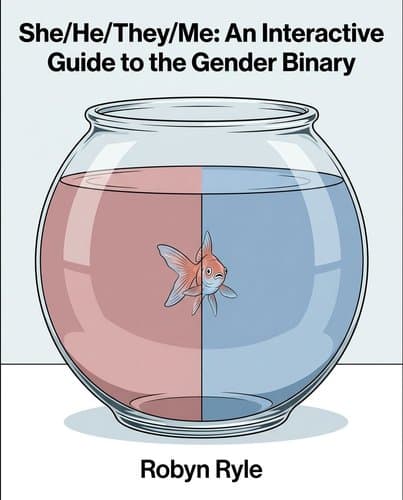
59204546_she-he-they-me
by Robyn Ryle
Gender isn't natural — it's a cultural rulebook installed in you before you could consent. Learn to see the invisible system shaping every choice you make, and…
In Brief
Gender isn't natural — it's a cultural rulebook installed in you before you could consent. Learn to see the invisible system shaping every choice you make, and discover that understanding its architecture is the first step to navigating it on your own terms.
Key Ideas
Gender rules feel natural through installation
What feels 'natural' about gender is a set of cultural rules installed before you could consent — by chromosomes, family lessons, and cultural categories you had no say in choosing.
Immersion makes gender systems invisible
Immersion in gender is what makes it invisible: the fish doesn't know it's in water. You can't examine what you've never been forced to see.
Visibility sparks both liberation and backlash
Gender's growing visibility in public life — trans rights debates, media representation, political conflict — is caused by the same forces loosening its hold. Change makes the system visible, and visible systems produce both liberation and fear-driven backlash.
Gender constraints extract material human costs
For millions of people, gender constraints aren't abstract: they cost people jobs, family relationships, physical safety, and sometimes their lives. Understanding this moves the conversation from academic exercise to ethical stakes.
Awareness reveals exits from gender constraints
Understanding that gender is socially constructed doesn't make it disappear — but it does reveal the exits. Once you can see the pond you're swimming in, you get to choose whether to stay, find a different pond, or become a gender outlaw.
Who Should Read This
Curious readers interested in Social Issues and Cultural Studies and the science of how the mind actually works.
She/He/They/Me: An Interactive Guide to the Gender Binary
By Robyn Ryle
10 min read
Why does it matter? Because the gender you think you have was assigned to you before you could object.
You know gender the way you know how to breathe: automatically, without ever thinking about it. You were born into it, shaped by it, and now you carry it everywhere, invisible as the air. That's exactly the problem.
What feels like natural fact turns out to be something closer to software — installed before you could read the license agreement, running quietly in the background of every choice you've ever made about how to dress, speak, move, or take up space. Most people never notice it's there. Not from lack of curiosity — you can't see a system from inside it.
This book hands you a window. What you see through it will be unsettling at first — the ground does fall out from under you, and that's the point. Then something else happens. You start to realize that a system you didn't choose is also one you don't have to be trapped by.
The Very Things Loosening Gender's Hold Are What Make It Feel More Urgent Than Ever
Here's a paradox worth sitting with: gender has never been more front and center in public life, and gender has never mattered less. Both are true. The question is how.
The answer is that visibility and loosening move together. When the rules around gender start to relax — when more women enter spaces once reserved for men, when transgender people gain recognition, when the old certainties about what a man or woman can do begin to soften — gender stops being invisible. For most of human history, gender worked like the smell of your own house, inescapable to everyone else, invisible to you. You don't notice what's everywhere. But the moment the rules become negotiable, the whole system surfaces. Suddenly everyone is talking about it, debating it, legislating it.
That same visibility produces two opposite reactions at once. For some people, seeing gender clearly for the first time is the beginning of freedom — proof that the boxes society handed them were always arbitrary, always changeable. For others, the same visibility reads as threat. If gender can be renegotiated, what happens to the world built on its fixed foundations? Fear produces backlash: a push to freeze things exactly as they are, to insist that the old version of gender is the only real one.
Robyn Ryle grounds this in her own backyard. She teaches in a small town in Indiana, and even there, gender is changing faster than most people can track. That's the point. This isn't a phenomenon limited to places where every café has a gender-neutral bathroom. The shift is everywhere, because the shift is structural: the force making gender more talked-about and the force making it less determinative of your life are not in competition. They're the same force, working on the same people, in the same small towns.
So the paradox dissolves into something more useful. Gender feels urgent right now because it is genuinely loosening. The urgency is the proof of the change, not evidence against it.
You Think You Understand Gender Because You've Never Had to Think About It
Think about what water means to a fish. Not philosophically — practically. The fish has never been without water. It doesn't know what dry air feels like, can't imagine what it would mean to be thirsty, has no concept of "wet" because wet is simply the condition of existence. Water isn't something the fish understands; water is something the fish is. That total immersion is what makes water invisible to it.
Gender works the same way. You've been swimming in it since before you were born — perhaps since the moment a doctor read an ultrasound and your parents painted a room pink or blue. The rules arrived before you had language to question them. Boys don't cry. Girls don't take up space. This is just how things are. You learned gender the way you learned gravity: not as a taught lesson but as the basic texture of the world. Which means most people arrive at adulthood with a confident working theory of gender that has never once been tested.
On the first day of class, Ryle asks her students what gender is. The straight, cisgender ones (those who've never had reason to push against their assigned categories) are usually the most confident. They've lived it, after all. Then the evidence starts coming in: that gender categories are not universal constants but historical inventions, and that the binary of "man" and "woman" as we know it emerged from post-Enlightenment European thinking, not from nature. That cultures have recognized third and fourth gender categories for centuries; among the Bugis of Indonesia, five distinct genders are formally documented, each with its own social role. The certainty doesn't just crack; it shatters. The students are left staring at a reflection they no longer recognize.
The fun-house mirror moment. The face is still yours, but everything familiar has become strange. That feeling is disorienting, and it's also, Ryle insists, the beginning of something better. The mirror isn't showing you something false. It's correcting for the distortion you've been living inside your whole life. Once the strangeness settles, the discomfort changes texture. Dread at the top of a roller coaster's first drop becomes exhilaration at the bottom: same motion, one second apart. The world doesn't get simpler. But it turns out to be far more interesting than the one you thought you were in.
The key move isn't learning new facts about gender. It's accepting that your prior certainty was always a product of immersion, not understanding. The fish doesn't know it's wet. Neither do most people, until someone asks them to explain the water.
Your Gender Was Measured, Assigned, and Taught Before You Could Have Any Say
A doctor leans in, and for a moment the whole delivery room waits. The question isn't whether the newborn is healthy. The question is whether a particular piece of tissue is longer or shorter than two and a half centimeters.
That measurement — clinical, precise, seemingly objective — is how gender assignment works in the contemporary United States. If the tissue clears the threshold, the newborn gets a blue hat. Below one centimeter, a pink one. In between, the situation becomes complicated in ways most delivery rooms try hard to avoid. But here is what those centimeters are actually measuring: whether the tissue is long enough, by clinical convention, to urinate while standing up and to achieve vaginal penetration. Not biology. A social judgment about function, imported into biology. The blue hat arrives because someone decided what a penis is for, and "for" turns out to mean one particular kind of heterosexual act.
This is gender assignment. You had no say in it. You weren't consulted. You hadn't yet developed the capacity to have opinions. Within minutes of your arrival, you were sorted, labeled, and handed to parents who had already been told which chromosomes you carried, which color to paint the nursery, which pronouns to use. The sorting felt like a fact of nature because it happened in a hospital, performed by someone in a white coat. It was actually a cultural decision, executed with a measuring tape.
But the measurement is only the first installation. The lessons your particular family taught you about what your gender means, what it permits, what it forbids: you didn't choose any of that either. If your parents believed boys don't cry, you were punished for crying before you had any framework for understanding that this was a rule, let alone a contestable one. If they believed girls are nurturing, you were rewarded for cradling a doll while your brother was handed a truck, and both of you learned something about yourselves from that transaction without either of you agreeing to the lesson. Ryle lists these three installations in sequence: the chromosomes you were born with, the family that did the teaching, the culture that supplied the curriculum. None required your consent, because you couldn't give it.
The book itself is structured like a choose-your-own-adventure: the reader selects which culture to be born into, which family to have, which gender to feel, which body to inhabit. It feels like agency. But Ryle is explicit: in real life, most of those choices were already made. The create-a-path format isn't offering what life actually offers. It's showing you the full shape of a system you were dropped into before you could see its edges.
The freedom here isn't the freedom to start over from scratch. You can't undo the first measurement, or the lessons that followed it, or the culture that framed both. What you can do is see the water. Once you know that the two-and-a-half-centimeter threshold was invented, that the lessons were arbitrary, that your culture chose two genders when other cultures have chosen more, you can start to distinguish between what you actually want and what the system wants you to want. That distinction is partial. But it's real. And for most people, it's the first genuinely free thing they've had access to.
For Many People, Gender Isn't an Intellectual Puzzle — It's a Matter of Survival
The same system you've been turning over intellectually (tracking its history, watching it vary across cultures, noticing how arbitrary its rules actually are) is why specific people lost specific jobs this week, lost contact with their families, ended up in emergency rooms, or didn't come home.
Sociologist Kirsten Schilt spent years tracking what happens to transgender men in American workplaces — people who transitioned from living as women to living as men, often in the same jobs. The research is a controlled experiment life ran by accident: same person, same skills, same education, different side of a gender line. What changed?
Men in female-dominated fields (nursing, teaching, administrative work) tend to advance faster than the women around them. Researchers call it the glass escalator: an invisible lift that carries men upward through workplaces women built. When Schilt followed transgender men into those environments, the escalator switched on. Informal mentoring materialized. Assumptions of authority appeared. Promotions came faster. The escalator wasn't tied to ability — the same person's ability hadn't changed. It was tied to perceived gender. When Schilt looked more closely, she found the effect didn't extend equally to men of color: race interrupted what gender alone was supposed to deliver. One sorting mechanism stacked on top of another.
You can't argue merit when the same person gets different treatment depending on how they're read.
Ryle names the consequences plainly in the book's closing pages: because of gender, people lose jobs, lose families, lose their health, lose their physical safety, and in the worst cases, their lives. Schilt's research captures the toll directly: trans women navigating similar workplaces often faced pay cuts after transition. Same résumé. Different read. Ryle places this immediately after the adventure metaphors (gender as water, gender as magical realm, gender as epic journey), and the contrast isn't accidental. The terrain was never safe. Calling it an adventure doesn't mean the hazards aren't real.
Which is why the idea of a gender outlaw, someone who refuses to follow the rules the gender system has established, isn't mainly a romantic concept. The book presents it exactly like a dictionary entry, complete with phonetic spelling, the way you'd encounter a term you're meant to carry with you. That formatting is doing something: this is a role that can be occupied, not just described. The curiosity that brought you to this material is a starting point. What you do with it next is the actual question.
Seeing the Water You're Swimming In Is the First Step to Choosing Where You Swim
Imagine learning, for the first time, that the body of water you've spent your entire life swimming in is not the only water that exists. Not even close. There are ponds of different temperatures, rivers that run in different directions, oceans no one has fully charted. That discovery changes something fundamental: the water stops being the world and becomes merely a world — one arrangement among many possible arrangements.
That's what happens when you learn how gender actually works. The first stage — learning that the binary emerged from post-Enlightenment European thinking, that delivery-room measurements encode cultural decisions rather than biological facts, that cultures across the world have organized gender in entirely different ways for centuries — can feel like a trap snapping shut. You were inside the system before you could consent to it. The rules arrived before you had language to question them. The fish doesn't choose the pond.
But Ryle's argument turns here. Knowledge doesn't just reveal the walls — it shows you the door. Once you see that the two-and-a-half-centimeter threshold was invented, that the categories are historical artifacts rather than natural constants, that the entire system is maintained through punishment and reward rather than gravity, something shifts. The pond you've been swimming in was always a choice someone made. Other choices are possible. You can pick which water you swim in, what stroke you use, how deep you go.
Ryle offers three possible endings to the book: leave gender as it is, reform it, or abolish it entirely. She doesn't name a winner. But the Conclusion is frank about what's at stake: job loss, family rupture, physical danger. Standing still, Ryle makes clear, is the one path she's least interested in. The journey doesn't end when the book does. There's always a new branch in the trail ahead.
That's the adventure she promised: not comfortable, not safe, not a puzzle with a predetermined solution. But genuinely open. The fish found out about the pond. What happens next is up to you.
What the Fish Eventually Figures Out
The book is over, but the question it leaves you with isn't. What you hold now is the map: how gender works as a system, where it came from, how it stays in place. That's not something you can unknow.
What changes is what you do next. Ryle doesn't tell you. She offers three roads — leave things as they are, reform them, or dismantle them entirely — and declines to pick. What she does insist on is that you are now a person who can see the choices. And people who can see choices are different from people who can't. You might become a gender outlaw. You might not. Either way, you're swimming with open eyes.
Notable Quotes
“How Sexually Dimorphic Are We? Review and Synthesis,”
“5 Health Risks of Being a Redhead,”
“Serena Nanda, Gender Diversity: Crosscultural Variations (Long Grove, IL: Waveland Press, Inc., 2000).”
Frequently Asked Questions
- What is She/He/They/Me: An Interactive Guide to the Gender Binary about?
- She/He/They/Me examines gender as a social system most people are too immersed in to see clearly. Through an interactive format, the 2019 book exposes the cultural rules shaping identity and reveals the real costs gender constraints impose on people's lives. Ryle equips readers to recognize the system and navigate it on their own terms. The core insight is that "what feels 'natural' about gender is a set of cultural rules installed before you could consent — by chromosomes, family lessons, and cultural categories you had no say in choosing." By making gender visible as constructed rather than inevitable, the book enables genuine choice.
- Why is gender invisible even though it shapes our identities?
- "Immersion in gender is what makes it invisible: the fish doesn't know it's in water. You can't examine what you've never been forced to see." Gender feels natural and inevitable because it's enforced before conscious awareness develops. Ryle's interactive approach addresses this by highlighting the cultural rules you didn't consent to, creating crucial distance from the system. This perspective shift enables recognition that gender is a social system rather than biological truth. Once the previously invisible becomes visible, readers can genuinely choose how to relate to gender—whether to stay within traditional roles or navigate the system differently.
- Why is gender becoming more visible in politics and society?
- "Gender's growing visibility in public life — trans rights debates, media representation, political conflict — is caused by the same forces loosening its hold. Change makes the system visible, and visible systems produce both liberation and fear-driven backlash." This means gender conflicts aren't new; rather, previously invisible systems become visible through social change. As constraints loosen, more people question traditional roles, making the taken-for-granted suddenly contested. The intense public debates signal system visibility emerging, not conflict creation. Understanding this framing explains why gender discussions feel so heated: the system was always present but becomes visible only when its grip weakens.
- What does recognizing gender as socially constructed actually change?
- "Understanding that gender is socially constructed doesn't make it disappear — but it does reveal the exits. Once you can see the pond you're swimming in, you get to choose whether to stay, find a different pond, or become a gender outlaw." This knowledge matters because "for millions of people, gender constraints aren't abstract: they cost people jobs, family relationships, physical safety, and sometimes their lives." Recognizing gender as changeable isn't merely theoretical—it's ethically urgent. By seeing the system clearly, readers move beyond treating gender as inevitable nature to understanding it as a social creation with real stakes in people's lived experiences.
Related Book Summaries



Read the full summary of 59204546_she-he-they-me on InShort