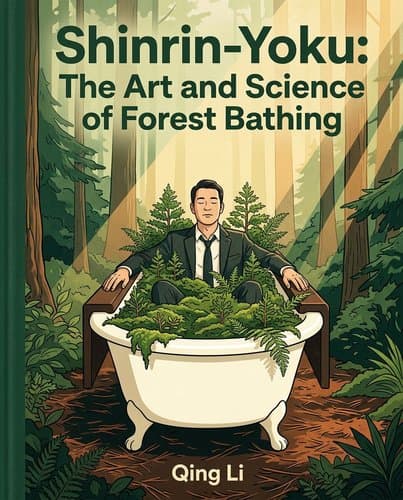
36531628_shinrin-yoku
by Qing Li
Spending 3 days among trees measurably boosts immune cells for an entire month—and even diffusing pine oil while you sleep triggers the same cellular response.
In Brief
Spending 3 days among trees measurably boosts immune cells for an entire month—and even diffusing pine oil while you sleep triggers the same cellular response. Japanese forest medicine pioneer Qing Li reveals how your body is biologically wired for nature, and exactly how much exposure it takes to undo the damage of modern life.
Key Ideas
Monthly forest trips sustain immune cell elevation
A 3-day, 2-night forest trip once a month is the minimum effective dose to sustain elevated NK cell activity for 30 days — Li's data shows the immune boost persists even when the forest visit is over, so frequency matters more than duration.
Forest oil diffusion boosts nighttime immune response
Diffuse hinoki or pine essential oil in your bedroom while you sleep — Li's hotel experiment produced measurable NK cell increases and lower stress hormones after just 3 nights, with no change to participants' daily routines.
Sensory presence, not walking distance, matters most
Engage all five senses deliberately when you are in nature: stop, close your eyes, listen for birdsong, press your palm to bark, breathe slowly through your nose. The sensory engagement is the mechanism, not the steps walked.
Workspace plants restore air ions and focus
Add at least one air-purifying plant to your primary workspace — indoor air runs 2–5× more polluted than outdoor air, and plants restore the negative ions that electronics drain, reducing afternoon headaches and respiratory irritation.
Forty-second green breaks restore mental clarity
Use a 40-second 'green micro-break' when mentally fatigued: look out a window at any vegetation, or use a nature photo as your lock screen. University of Melbourne research found this brief exposure is enough to restore focus and reduce cognitive errors.
Who Should Read This
People working on personal growth in Mental Health and Mindfulness, especially those tired of generic motivational advice.
Shinrin-Yoku: The Art and Science of Forest Bathing
By Qing Li
10 min read
Why does it matter? Because "feeling better outside" is the understatement of the century.
You already know this. You've felt it — that particular unwinding that happens when you step into trees, the way your shoulders drop, your breathing slows, and something you didn't realize was clenched just... releases. You've probably chalked it up to fresh air and a break from screens. Reasonable. Also incomplete.
What's actually happening is this: your immune system is doing its job. Your natural killer cells (the white blood cells that hunt down viruses and tumors) are surging. Anti-cancer proteins are spiking. Stress hormones are dropping. Your body isn't relaxing; it's activating. The forest is medicine, and the dose is measurable.
Qing Li spent decades in the lab confirming what your nervous system already knew. What he found was stranger and more specific than anyone expected — a measurable compound, a measurable cell, a measurable dose.
We Built a World Our Bodies Were Never Designed For
Every morning, white-gloved workers at Tokyo's busiest train stations perform a job that exists almost nowhere else on earth: they push. Their title is oshiya — "pusher" — and their work is compressing eleven million daily commuters into carriages built for roughly half that number. Passengers have developed a countermove: a practiced sideways turn into a closing door without meeting anyone's eyes, which locals call the Tokyo pirouette. The average commuter will spend three and a half years of their life underground this way, pressed against strangers in a space too tight to read.
You recognize something in that image, even if the scale is unfamiliar. The commute that grinds you down. The office that runs on artificial light. The evening that disappears into a screen. Somewhere in your body, you already know this is wrong. You've probably felt the opposite: that ease that settles over you in a park, on a trail, or just near a stand of trees. You've just never taken that feeling seriously enough to act on it. Neither had science, until recently.
The average American spends 93 percent of their time indoors, 6 percent in cars, leaving roughly half a day outside per week. Daily media consumption runs past ten and a half hours. The WHO calls stress the health epidemic of the twenty-first century; anxiety and depression cost the EU and US a combined $380 billion per year. The man perfecting his Tokyo pirouette lives inside a system that has a word for its worst case: karoshi, death from overwork. Japan officially records around 200 such deaths a year, in a country where nearly a quarter of companies report employees working more than 80 hours of overtime per month.
The standard prescription is better personal habits: more sleep, more exercise, less screen time. Qing Li, a forest medicine researcher at Nippon Medical School in Tokyo, locates the problem deeper. Humans evolved over hundreds of thousands of years surrounded by trees, soil, and the volatile chemical compounds that plants release into the air. Our immune systems developed inside that world. Our nervous systems were calibrated to it. When biologist E.O. Wilson described biophilia in 1984 (the idea that humans carry a genetic drive to connect with the living world), he was identifying something written into our DNA, not a lifestyle preference.
The modern city relocated us and removed the inputs our biology depends on. The ease you feel stepping into a forest is recognition: your body finding the conditions it was built to run on. The exhaustion you carry out of the subway is biological mismatch, the predictable result of an organism in the wrong environment. Once you see it that way, you don't need a better routine. You need the forest.
The Forest Is Running a Pharmacy Inside Your Blood
When you step into a forest and feel something shift in your chest, that isn't your imagination loosening. It's your immune system waking up.
In 2005, Li brought twelve middle-aged Tokyo businessmen to the forests of Iiyama in Nagano Prefecture and tracked their blood over three days and two nights. Natural killer cells, the white blood cells your immune system deploys against viruses and tumors, rose from 17.3 percent activity to 26.5 percent: a 53.2 percent increase. The anti-cancer proteins those cells use to breach and destroy infected cells (perforin, granulysin, granzyme A and B) all climbed between 28 and 48 percent. Li tracked participants for a full month after they returned to Tokyo. The elevation held for thirty days. One trip to the forest per month is the minimum effective dose to sustain your immune system at that higher baseline.
The numbers are striking, but the more important question is how. Li suspected the key was smell. Forest air carries phytoncides, volatile compounds trees release as their own chemical defense against bacteria and fungi. A Japanese cypress exhales terpenes: alpha-pinene with its sharp piney freshness, D-limonene with its citrus edge. These aren't incidental perfumes. They're compounds your immune system knows how to use, encoded before we had words for any of it.
To prove it, Li designed an experiment that stripped away every variable except the smell. He took twelve healthy men and put them in a Tokyo hotel: no forest, no elevated exercise, no fresh air. Just a humidifier diffusing hinoki cypress oil through the night while they slept and worked ordinary days. The results tracked almost exactly with the forest study. NK cell counts and activity rose. Stress hormones fell. Anxiety and hostility scores dropped. The forest's immune effect, reproduced in a city hotel room with no trees in sight.
The Tokyo hotel experiment changes the category of the thing. You're not talking about mood, or atmosphere, or the vague restoring power of a walk somewhere green. You're talking about a specific airborne compound interacting with a specific class of immune cell in a way precise enough to isolate under controlled conditions. Li, characteristically, diffuses hinoki oil in his own bedroom every winter. "For my health," he says simply.
The forest does this to you whether you pay attention or not. The phytoncides pass through your lungs, the NK cells climb, the anti-cancer proteins accumulate in your bloodstream, and none of it requires that you know the mechanism or even notice the smell. Two hours in a forest is enough to register measurable changes in stress hormones and immune markers. A monthly trip is enough to keep your immune function running at a higher level than you'd otherwise maintain.
What you felt in that park — that settling, that ease — was your body recognizing a compound it knows how to use. The feeling wasn't a sign that something relaxing was happening. It was a biological side effect. The forest has always been running a pharmacy. You just needed someone to run the blood tests.
When Trees Die, People Die — and We Can Count the Bodies
What would you call it if removing something from your neighborhood statistically killed your neighbors? Not a metaphor — an epidemiological finding with bodies attached.
That's what happened when a small green beetle called the emerald ash borer arrived in the American Midwest in the early 2000s, probably hitching a ride in wooden packing crates from China. The beetle attacked ash trees, a dominant species in American public spaces that accounted for roughly a quarter of trees on city streets. As infestation spread, once-shaded neighborhoods went treeless. The effect on trees was visible. The effect on people took a decade to count.
When researchers tracked mortality rates across fifteen US counties from 1990 to 2007, following the beetle's spread, they found 15,080 additional cardiovascular deaths. Another 6,113 people died of lower respiratory disease. The more trees a county lost, the higher the death toll climbed. No change in poverty, no change in healthcare access — just fewer trees, and thousands more deaths from the two conditions trees are now known to defend against: stress on the heart, stress on the lungs.
The ash borer study cuts deepest for a simple reason: it didn't ask people how they felt. It counted deaths. And what it found is that tree cover is less like scenery and more like a water treatment plant or a power grid. Its failure produces measurable casualties.
The mechanism isn't mysterious. Trees absorb air pollutants that damage cardiovascular and pulmonary tissue. They lower ambient temperatures that strain hearts. They reduce cortisol and blood pressure in people who simply live near them, the same way a single two-hour forest walk does in a controlled study. Remove the trees, and every one of these functions disappears at once.
Toronto researchers quantified the other direction: adding ten trees to a city block produces well-being gains equivalent to earning $10,000 more per year, or being seven years younger. A shaded street is a measurable health intervention, as real as a prescription.
We have spent decades treating trees as an amenity, something cities add when they can afford it and remove when they need the space. The ash borer experiment shows that framing is wrong in the same way treating smoking as a personal preference was wrong before we counted the lung cancer deaths. Trees are health infrastructure. The people who lose them don't just lose shade. They lose years.
Shinrin-Yoku Is Not a Walk — It's a Sensory Protocol
The hard part isn't finding a forest.
Think of the difference between glancing at a painting as you walk past a gallery and standing in front of it long enough for your eyes to actually take in what's there. The painting hasn't changed. What changes is you — different circuitry fires when you attend rather than merely observe. Shinrin-yoku works on that same distinction: the same forest, inhabited with full sensory attention instead of passive presence, triggers biological responses that a brisk walk through the same trees would miss entirely.
The instructions Li gives resemble a calibration exercise for each sense in sequence. Leave your phone behind, not for tranquility's sake but because divided attention is lost attention. Walk slowly enough that your nose registers what shifts between one stand of trees and the next. Listen past what you'd normally filter out. Touch the bark.
That last instruction is where the protocol turns specific in a way that's easy to dismiss — until you understand what pressing your nose to the right tree actually delivers. The ponderosa pine, which grows across the Rocky Mountains and Black Hills of the American West, transforms at around 120 years old: its black bark peels away to expose a yellow underlayer that smells unmistakably of cinnamon, butterscotch, and vanilla. The tree is releasing volatile compounds — the same chemical family as the hinoki phytoncides that elevated NK cell counts in the Tokyo businessmen Li studied. You don't need Japan, and you don't need to know the chemistry. Stop, press your nose to the bark, and your lungs receive the compounds regardless.
Li's certified forest-therapy bases in Japan are useful: trails tested, therapists on hand, walking plans tailored to each visitor. But the sensory engagement they're designed to produce doesn't belong only to them, any more than meditation belongs only to a monastery. Physicist Richard Taylor measured what happens when you look at trees: their branching geometries are fractals, the same pattern repeating at every scale, and they cut stress response by up to 60%, tracked via skin conductance. The human visual system evolved to process exactly these shapes. They appear in every tree in every park. The attention is the practice. The forest is available to you.
Li takes his third-year medical students to Shinjuku Gyoen (a city park in central Tokyo, not a certified therapy base) every Monday. The point he keeps making is the simplest one: wherever there are trees, the protocol works.
A 40-Second Glance Out the Window Counts as a Medical Intervention
The biological chain reaction you've been reading about doesn't require a Japanese cedar forest or a certified therapy trail. Forty seconds is enough to start it.
University of Melbourne researchers gave fatigued workers a brief break from a sustained attention task and divided them: some looked at a plain city rooftop, others at a rooftop covered in flowering plants. Forty seconds. That was the entire exposure. The workers who saw the green roof returned to their task with measurably restored focus and significantly fewer errors — the same cognitive rescue that longer forest walks produce, compressed into less than a minute of passive looking.
The mechanism is the same one Li isolated in the Tokyo NK cell experiments: your visual system evolved reading the fractal geometry of plants, your nervous system down-regulates in their presence, and neither process requires that you know it's happening or be anywhere near a forest. When you glance at a plant for forty seconds before returning to a difficult problem, you're borrowing from the same biological inheritance the Tokyo businessmen tapped by walking among cypress trees for a weekend.
Smell reaches further still. When two nurses at Vanderbilt's emergency department began diffusing essential oils through their unit, they weren't planning an experiment. What they got was one anyway: the share of staff who said work stress hit them "very often" fell from 41 percent to 3 percent. Those who felt equipped to handle the pressure climbed from 13 percent to 58 percent. These are the same compounds Li isolated in the Tokyo hotel study — airborne, absorbed through the lungs, interacting with the nervous system without any visual nature required. The emergency department wasn't calmer because the staff had gone outside. It was calmer because the forest came in.
The practical picture this leaves you with is a dose-response curve with a very low floor. A plant filters your air continuously. A diffuser running while you sleep replicates what Li's hotel study produced. Forty seconds of looking at something green restores your attention before your next meeting. None of this replaces an actual forest — but the forest was never a single place. It's a set of biological inputs, and you can introduce them one at a time, wherever you are.
The Same Logic That Makes Forests Medicine Makes Their Loss a Health Emergency
Set the numbers beside each other: the 53 percent NK cell increase, the fifteen thousand cardiovascular deaths that followed a beetle through the Midwest, ten trees on a city block worth seven years of youth. The science that explains why a forest heals you is the same science that explains why losing one kills people. These are not separate arguments. They are the same argument spoken in two registers, and you can begin acting on it today — in how you walk through a park, in what you plant, in what you let your children love enough to one day protect. If you understood this as personal medicine, you have already understood it as something larger.
Frequently Asked Questions
- What is shinrin-yoku and how does it affect immune function?
- Shinrin-yoku is Japan's practice of immersive nature exposure that measurably boosts immune function, lowers stress hormones, and restores mental focus. According to immunologist Qing Li's clinical research, time among trees produces specific physiological changes through deliberate sensory engagement—listening for birdsong, pressing your palm to bark, and breathing slowly through your nose. These interactions trigger measurable improvements in NK cell activity (immune cells fighting disease) and reduce cortisol, the primary stress hormone. Li's research demonstrates that forest exposure creates lasting improvements extending weeks beyond the actual forest visit, with benefits persisting for 30 days after a single trip.
- What is the minimum effective dose for forest bathing to sustain immune benefits?
- A 3-day, 2-night forest trip once a month is the minimum effective dose to sustain elevated NK cell activity for 30 days, according to Qing Li's data. The immune boost persists even when the forest visit is over, so frequency matters more than duration. This means monthly visits of relatively short duration provide more sustained benefits than occasional longer retreats. The key finding is that consistency creates a cumulative effect on immune function throughout the month following exposure. This practical guideline shows readers don't need extended vacations to gain forest bathing's health benefits.
- Can you get forest bathing benefits without visiting a forest regularly?
- Yes, Qing Li provides evidence-based alternatives for those unable to visit forests monthly. Diffusing hinoki or pine essential oil in your bedroom while sleeping produces measurable NK cell increases and lower stress hormones after just 3 nights, with no change to participants' daily routines. Adding air-purifying plants to your primary workspace restores negative ions that electronics drain, reducing afternoon headaches and respiratory irritation. A 40-second 'green micro-break'—looking at vegetation through a window or using nature photos as a lock screen—restores focus and reduces cognitive errors. These accessible alternatives maintain the sensory engagement mechanism driving forest bathing's health benefits.
- What role does sensory engagement play in forest bathing's health effects?
- Sensory engagement is the critical mechanism behind forest bathing's benefits, not physical distance walked or time spent hiking. Qing Li emphasizes deliberately engaging all five senses: stop, close your eyes, listen for birdsong, press your palm to bark, breathe slowly through your nose. This intentional practice triggers the physiological changes that boost immunity and reduce stress. The research distinguishes between passive presence in nature and active sensory engagement, showing that mindful attention to natural stimuli—sounds, textures, scents, and sensations—activates the immune system's response. This insight reveals that forest bathing's benefits come from quality of engagement rather than quantity of exposure time.
Related Book Summaries



Read the full summary of 36531628_shinrin-yoku on InShort