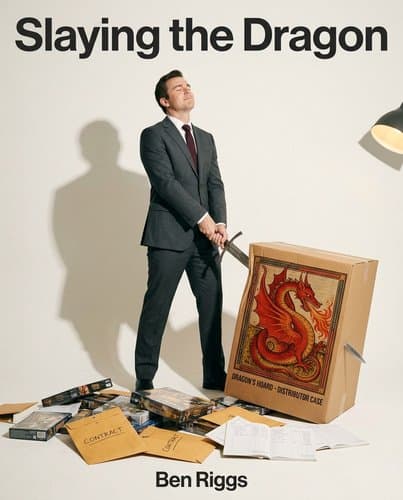
58724805_slaying-the-dragon
by Ben Riggs
TSR invented Dungeons & Dragons and an entire cultural phenomenon—then systematically dismantled itself by treating the creative geniuses behind it as…
In Brief
TSR invented Dungeons & Dragons and an entire cultural phenomenon—then systematically dismantled itself by treating the creative geniuses behind it as replaceable cogs. A cautionary autopsy of how mistaking brand for talent destroys the very thing that made you great.
Key Ideas
Creative Talent Cannot Be Commodified
Creative talent is the actual product: when you treat creators as interchangeable parts, you degrade the thing you're selling — not just the morale of the people making it.
Transparency Enables Creative Excellence
Financial secrecy from the people doing the work prevents them from improving: TSR designers who never saw sales data couldn't learn from failures or double down on successes.
Product Expansion Cannibalizes Existing Markets
Brand proliferation cannibalizes existing customers instead of growing new ones: each new franchise, setting, or product line tends to steal from your own base — test this assumption before scaling.
Lost Talent Strengthens Your Competitors
The talent you lose defines your competitor: nearly every departure from TSR enriched someone else, from Weis and Hickman to Salvatore to Brom to the artists who built Dark Sun.
Financial Contracts Create Decades-Long Liabilities
Structural financial mechanisms — contracts, distribution deals, accounting arrangements — can doom a company decades after they're set up. By the time the Random House contract became a crisis, no one who signed it was still in the building.
Align Products With True Customer Value
If you discover what your business is actually selling (the unified customer, not the branded sub-product), act immediately: Wizards cut supported D&D settings from twelve to two and never looked back.
Who Should Read This
History readers interested in Business Strategy and Company Culture who want a deeper understanding of how we got here.
Slaying the Dragon
By Ben Riggs
9 min read
Why does it matter? Because the company that invented Dungeons & Dragons didn't die from competition — it died from a repeatable mistake every creative business makes.
The conventional story is clean: Magic: The Gathering arrived, D&D couldn't compete, TSR died. Satisfying. Wrong. What actually killed TSR was a repeatable failure hidden inside the company's own records — sales figures management kept from designers, contracts that rewarded shipping product nobody wanted, decades of extraordinary talent underpaid and walked out the door. 1,885,419 units of D&D sold in 1983. 397,961 by 1986. Management's explanation: market saturation. The actual explanation: a company that confused the dragon painted on the box for the thing that made the box worth buying. Ben Riggs spent years tracking down the artists, editors, writers, and executives who built something genuinely remarkable — and then watched it dismantled, one preventable decision at a time, by the people who believed they owned it.
By the Time Magic Arrived, TSR Had Already Spent a Decade Destroying Itself
The story you probably know goes like this: TSR built Dungeons & Dragons into a $40 million empire, then Wizards of the Coast invented Magic: The Gathering, and the faster, cheaper, addictive card game sucked the oxygen out of the room. TSR fell. Wizards bought the ruins. Market forces at work.
The problem with that story is the numbers. In 1983, TSR sold 1,885,419 units of D&D products. By 1986, that figure was 397,961 — a collapse of 79 percent. Magic: The Gathering wasn't published until 1993. The game that supposedly killed TSR appeared seven years after the killing was already done.
Jim Ward, VP of production, tells the conventional story most clearly. He's not lying — Magic genuinely did drain money and hours from the hobby game market. But Ward was an executive during the collapse years, inside a management culture that had already borrowed $4 million from a bank (contingent on mass layoffs), purchased a needlepoint company owned by a Blume cousin, attempted to raise a shipwreck from the bottom of a lake, and cycled through four rounds of firings between 1983 and 1985. When a convenient external cause is available, people use it.
The real story, as author Ben Riggs assembled it from court records, contracts, and interviews with survivors, is that TSR spent a decade sabotaging itself before a better game ever arrived.
The People Who Built D&D Were Doing Something Closer to Building a Religion
Mary Kirchoff is standing in a TSR hallway in 1987, already late for a sales meeting with the marketing team, when she realizes she needs a sidekick for a barbarian hero in an upcoming Forgotten Realms novel — right now, before she walks through that door. She calls Bob Salvatore, a Massachusetts man who'd spent years writing fantasy in whatever hours his factory job left him. She needs an answer immediately.
Salvatore panics and says the first thing that comes to his head: a drow. A dark elf. An evil subterranean spider-worshipper that the rest of the world would hate on sight.
Long pause.
He keeps going: a drow ranger, fighting with two swords.
Kirchoff pushes back. Nobody's tried this for a reason. He talks her around. She asks for a name.
What came out was Drizzt Do'Urden of Menzoberranzan. She asked if he could spell it. He could not.
Drizzt Do'Urden went on to headline thirty-one novels. The character invented in thirty seconds, meant to be a sidekick, became one of the defining figures in fantasy fiction for a generation of readers. Salvatore's first three books sold over 1.5 million copies combined.
This is what TSR actually was. The company paid its designers $100 a week and ran its first operations from a sheet of plywood on two sawhorses in Gary Gygax's own basement, lit by a single bulb. Its downtown offices occupied a converted hotel where designers jumped between ceiling rafters and occasionally fell through (people would point at holes in the acoustic tile and argue about which colleague had made which one), and where the FBI once arrived to investigate an assassination plot written on company stationery, only to be told it was a scenario from a tabletop roleplaying game.
These people were poorly paid, working in a collapsing building, falling through ceilings. They were also building worlds that millions of people would live in for the next forty years.
That's what makes what comes next so hard to read.
Gary Gygax Lost His Own Company — Then Rewrote the History
Who took Dungeons & Dragons from its creator?
The standard answer is Lorraine Williams, a non-gamer who quietly purchased majority control of TSR and removed Gygax as CEO at a board meeting he himself chaired in October 1985. It's a compelling villain story: the suits stealing the artist's work.
But the Wall Street Journal got there first.
In November 1983, the paper ran a piece headlined "AFTER SUCCESS OF DUNGEONS & DRAGONS, TSR FIGHTS POOR MANAGEMENT, UNEVEN GROWTH." It catalogued the needlepoint company, purchased with TSR funds and owned by the Blumes' cousin; the shipwreck the company paid to raise from a lake, receiving only a boiler that rusted behind the building for years; the romance novel line for teenagers; the 2001: A Space Odyssey tabletop game; the hiring sprees stocked with relatives. The piece ran with a photograph of Gary Gygax, smiling, bespectacled, in a suit.
That man later claimed he had known nothing of these decisions while in California.
When Gygax defended the needlepoint purchase ("crafts is a larger field than hobbies"), he was president of the company. When he claimed years later to have been powerless, only discovering the Blumes' incompetence upon his dramatic return in 1985, he was asking people to ignore a published record. The harder Williams pursued him afterward, the easier it became to remember Gygax only as the man she wronged — not the man who also helped run the company into the ground.
TSR's Pattern Was Always the Same: Find the Genius, Extract the Value, Drive Them Away
TSR didn't lose its best people to market forces. It expelled them, repeatedly and for the same reasons, through a management philosophy that treated creative talent as interchangeable — writers as machines producing words, replaceable whenever they became inconvenient.
The clearest version of the math is Margaret Weis. She was a New York Times bestselling author whose Dragonlance novels had kept the company solvent through its worst years. TSR was paying her less than $30,000 a year, wages that would have suited a freight handler. When she and co-author Tracy Hickman proposed a new trilogy, the company passed. Bantam Books took it. Their agent called: Bantam wanted all three books at $30,000 each. Weis's first reaction was "thirty thousand for three books." Her agent corrected her: "No, no, no. That's for each book." She called Hickman. They decided to leave TSR that afternoon. An author who had spent years keeping the company afloat was earning less annually than what a New York publisher would pay her per novel.
The logic that made this repeatable had a name: "a theory of interchangeable creativity." Audiences bought brands, not people. A Dragonlance novel would sell whoever wrote it. So when Weis and Hickman left, TSR's question wasn't why its bestselling authors had walked. It was who would replace them. The lesson management took from losing Weis wasn't to stop losing people — it was to find better leverage over the ones who remained.
That logic, applied with coercion, is Brian Thomsen. Hired in the early 1990s to run the Book Department, he inherited the same philosophy and upgraded its tactics. Bob Salvatore had invented TSR's most iconic character in a panicked thirty-second phone call and produced its first hardcover to crack the Times bestseller list. Thomsen wanted nine novels from him on top of a three-book deal Salvatore had already signed elsewhere. When Salvatore said he couldn't write three books a year without breaking himself, Thomsen's answer was "I don't care, this is what we need." His leverage: he would hand Drizzt Do'Urden to a different writer. Salvatore signed on Friday under financial pressure, couldn't sleep through the weekend, and called Monday morning to refuse. TSR had wanted six books; it ended up with none. Thomsen was later promoted.
TSR Figured Out How to Print Money Without Making Sales — Until the Bill Came Due
Picture a restaurant where the food supplier pays the owner every time a delivery truck backs up to the loading dock. Not when a dish sells, not when a customer pays. Just when the crates arrive. More deliveries, more money. If the food spoils unsold, the debt comes due with interest.
That was TSR's deal with book distributor Random House, signed in 1979 and running for fifteen years in near-total secrecy. The contract paid TSR 27.3 percent of retail price the moment Random House received a shipment, technically a loan at Chase Manhattan prime rate, repayable when products sold or were returned. Staff who knew about it called the arrangement "El Banco." Of the dozens of writers, designers, and editors the author interviewed, not one knew the contract existed until he told them.
The mechanism explains something that otherwise looks like stupidity. When DragonStrike, a 1993 board game aimed at eight-year-olds, had 50,000 copies on order, designer Bruce Nesmith advised printing 50,000 more. Management printed 150,000. Fifty thousand filled existing orders. One hundred thousand sat in a warehouse. When sales director Jim Fallone later paused an overshipment because the numbers made no sense, VP Rick Behling screamed at him over the phone; the product shipped before quarter close. Demand was irrelevant. What mattered was the loan payment that arrived when Random House accepted delivery.
TSR was borrowing money to pay itself. Every overprinted box and manufactured shipment added to a debt accumulating quietly in New York for years. By June 1995, the total owed was $11.8 million. Random House wanted it back. The company had papered over every bad decision, every unsold setting, every alienated genius with borrowed cash — and now the paper was dissolving.
El Banco explains the debt. It doesn't explain the product decisions that made the debt unpayable — those were happening in parallel, in the design studios and conference rooms, for the same fifteen years. Both stories end at the same place.
TSR's Greatest Creative Work Was Also the Mechanism of Its Destruction
What if TSR's settings — Ravenloft, Dark Sun, Planescape — weren't what the company produced despite its business failures, but what caused them? The El Banco debt was one drain on the company. Lisa Stevens found another.
When Wizards of the Coast acquired TSR in 1997, they handed financial analyst Lisa Stevens a mountain of the company's records. She was mid-MBA at the time. Her finding was precise and devastating: an enormous number of TSR's setting products were priced at a point where they could never recoup their design, art, editing, and printing costs. Entire lines had never turned a profit. She checked Planescape, widely considered the finest setting TSR ever produced. Ryan Dancey, who was leading Wizards' post-acquisition catalog review, was blunt: nothing in that line had ever broken even.
Stevens asked a simple question: why? She traced the drop in per-product profitability directly to the proliferation of settings. The company hadn't been building D&D fans. It had been building Forgotten Realms fans, Dark Sun fans, Greyhawk fans. Fans of one setting refused to buy products from another. Stevens had seen it herself. Greyhawk devotees would look at a Forgotten Realms release and declare it tainted, unfit to touch. Every new setting TSR launched didn't recruit new players; it cannibalized existing ones, requiring TSR to produce two products to keep the same number of customers.
Wizards tested the hypothesis directly. Two identical adventures were scheduled for release. One carried the Forgotten Realms logo; the other went out under the generic AD&D second edition banner. The generic version sold three times as many copies.
The fans TSR had built were loyal to the containers (specific worlds, specific aesthetics, specific logos), not to D&D itself. Each setting had been designed to grow the game. Instead, it split the audience.
The Only Way to Save D&D Was to Understand What D&D Actually Was
On one of his first days owning TSR, Peter Adkison, the Wizards of the Coast founder who had just completed the acquisition, unlocked a second-floor room in the former Q-tip factory Wizards had converted into its Seattle headquarters and waved a group of artists inside. The room held years of original paintings: cover art, interior illustrations, the visual language of Dungeons & Dragons. He told them to take whatever they had made. No forms, no negotiations.
This looks like generosity. It was also a precise diagnosis.
For over a decade, TSR had operated on the premise that audiences bought brands, not people. A Dragonlance novel would sell whoever wrote it. Original artwork in a company storeroom had value because TSR owned it, not because a specific person had made it. When writers left — or were pushed out — management's question was always who would replace them, never what had been lost.
Adkison understood the premise was wrong. The exiles weren't replaceable. They were the product. So he worked through the casualty list. Jim Lowder, a former editor locked in a legal standoff over a manuscript TSR refused to publish or release, got a phone call: rights restored, unpaid royalties delivered, legal fees reimbursed. Dave Arneson and Gary Gygax — D&D's own creators, who had spent decades in litigation with the company they'd built — each received checks in the low six figures. The legal conflict dissolved in a few phone calls.
The point wasn't charity. TSR had confused its packaging for its content (the settings, the logos, the brand architecture) and kept trying to preserve the packaging while discarding the people who had given it meaning. Adkison bought the wreckage, then called the people who built D&D, because without them, what he'd purchased was only a name.
Lisa Stevens spent weeks combing through TSR's financial records trying to understand how the company had ended up $30 million in debt. Her verdict on the whole saga: "Don't do stupid shit."
What TSR Thought It Was Selling
The controlled experiment is the thing that stays with you. Same adventure, printed twice — once under the Forgotten Realms banner, once as a plain D&D release. The generic version sold three times as many copies. TSR had spent fifteen years building fans so devoted they would refuse to buy something with the wrong logo on the spine. That isn't loyalty. It's a cage the company built around its own customers, then mistook for a business.
Every departure, every unpaid royalty, every warehouse overflowing with a setting nobody asked for — it all traces back to the same error. This wasn't fate. It wasn't Magic: The Gathering. It was a company that never understood what it was actually selling, rescued at the last moment by someone who did.
Notable Quotes
“Peter, I know there's a company you've always wanted to buy, and you can't seem to buy it. But I'm going to buy it.”
“What are you talking about?”
“I'm going to show you the letterhead, and I'm going to show you the signature on this letter, and you're going to have to trust me that the rest of what I'm about to tell you is true. I signed a letter of intent to buy TSR.”
Frequently Asked Questions
- What is Slaying the Dragon about?
- Slaying the Dragon chronicles the rise and self-inflicted collapse of TSR, the company that created Dungeons & Dragons. Drawing on internal records and interviews, Ben Riggs examines how mismanaging creative talent, hiding financial data from designers, and over-extending the brand destroyed a cultural institution. The book serves as a comprehensive case study for creative businesses, revealing the specific failures in leadership and strategy that led to TSR's downfall and its eventual loss of market dominance to Wizards of the Coast.
- Why did TSR lose its creative talent to competitors?
- TSR lost creative talent through systematic mismanagement that treated creators as interchangeable parts rather than irreplaceable assets, degrading both morale and product quality. Financial secrecy prevented designers from accessing sales data, so they couldn't learn from failures or build on successes. These poor practices drove departures of major talents including Weis and Hickman, R.A. Salvatore, Brom, and key artists—each enriching competitors. The loss of this talent directly strengthened Wizards of the Coast, which eventually became the market leader.
- What are the key business lessons from Slaying the Dragon?
- Key lessons include: creative talent is the actual product, not a commodity cost. Financial transparency with your team enables continuous improvement rather than repeating mistakes. Brand proliferation often cannibalizes existing customers instead of attracting new ones. Structural financial mechanisms like contracts and distribution deals can undermine a company for decades after they're signed. Most critically, once you identify what your business actually sells—in Wizards' case, the unified D&D customer rather than sub-branded products—act decisively to align strategy, as Wizards did by cutting supported settings from twelve to two.
- Is Slaying the Dragon worth reading?
- Yes, especially for anyone building or managing creative businesses. The book combines compelling D&D history with rigorous business analysis, demonstrating that TSR's collapse wasn't inevitable but resulted from learnable mistakes in specific areas: talent management, financial transparency, brand strategy, and how structural decisions made decades earlier can create unforeseen crises. For entrepreneurs, creative leaders, and investors, it offers invaluable case studies in what not to do. It's both historically important and practically instructive for avoiding similar pitfalls.
Related Book Summaries
Read the full summary of 58724805_slaying-the-dragon on InShort