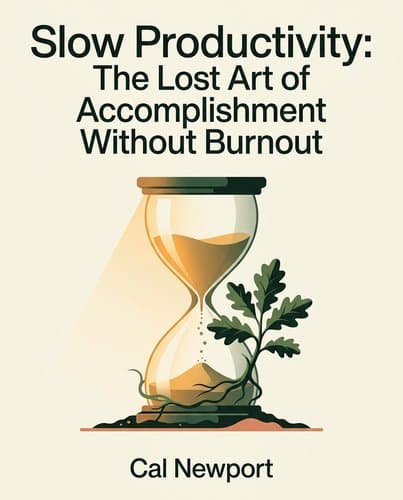
197773418_slow-productivity
by Cal Newport
Pseudo-productivity—staying busy, responding fast, juggling everything—is quietly destroying knowledge workers while producing mediocre output.
In Brief
Slow Productivity: The Lost Art of Accomplishment Without Burnout (2024) challenges the modern obsession with busyness, arguing that doing fewer things at a slower pace produces better, more sustainable results.
Key Ideas
Commitment overhead compounds more than effort
Audit your commitments for overhead tax, not just effort: every project you accept generates ongoing emails, meetings, and coordination costs that compound — eliminating two medium commitments often frees more time than working two extra hours a day
Fewer obligations cure overwhelm better than planning
When you feel overwhelmed, the default fix is better time management, but the actual fix is fewer active obligations — aim to hold no more than three significant projects in active status at once
Double timelines for all creative work
Double your estimated timeline for any creative or intellectual project: history's most productive minds (Copernicus, Newton, Miranda) routinely took years where we'd plan months, and the planning fallacy is real
Mastery gives you power to decline
Use quality as leverage, not just aspiration: becoming genuinely exceptional at a narrow thing is what earns you the credibility to decline work, set slower timelines, and control your calendar — Jewel's artistry was a negotiating strategy, not just a personal value
Rituals signal work is serious
Design environmental rituals that signal to your brain the work is serious: a specific place, time, or physical object (a particular notebook, a hotel room, a plywood board) can shift cognitive gears in ways that no digital productivity system replicates
Thinking time is the actual work
When building toward a large creative goal, protect the 'invisible' thinking time: McPhee's two weeks on a picnic table and Wiles's years of secret attic work were not delays — they were the actual work
Who Should Read This
People working on personal growth in Work-Life Balance and Time Management, especially those tired of generic motivational advice.
Slow Productivity: The Lost Art of Accomplishment Without Burnout
By Cal Newport
11 min read
Why does it matter? Because your busyness isn't a productivity problem — it's a measurement problem.
You're working harder than ever and somehow always behind. The inbox is a treadmill. The calendar is a hostage situation. And underneath the grind sits a quiet, damning suspicion: none of this is actually the point. Here's the uncomfortable truth Cal Newport surfaces — knowledge work has never had a real productivity metric. Not once. So sometime around the mid-twentieth century, without anyone quite deciding it, we defaulted to the worst possible substitute: whoever looks busiest must be doing the most. Visible motion became the currency of professional worth. Newport calls this pseudo-productivity, and he argues it's less a work philosophy than a measurement failure dressed up as one. What actually works looks nothing like a full inbox. It looks like Isaac Newton fleeing the plague to think undisturbed, and a homeless folk singer turning down a million dollars to protect her craft. What follows isn't just a framework — it's permission to stop performing.
The Invisible Con: How 'Looking Busy' Replaced Actually Working
It's 3:30 on a Friday afternoon in 1995, and Leslie Moonves is walking the halls of CBS's Television City headquarters. The place is three-quarters empty, and he is furious. He fires off a memo to his staff: we're in third place in the ratings, ABC and NBC are still working right now, this will no longer be tolerated. More hours. More visible effort. That's how you fix a struggling network.
Moonves was doing what any manager would do — the only thing he knew how to do — because knowledge work had quietly painted itself into a corner with no way out. In farming, productivity is simple: bushels per acre. In manufacturing, Henry Ford tracked labor-hours per car, and when he switched Highland Park to an assembly line in 1913, that number dropped from 12.5 hours to 1.5. The metric told you, precisely, whether you were improving. Knowledge work never developed anything like it. When Cal Newport surveyed nearly seven hundred knowledge workers and asked them to define productivity, they described their job duties — attending meetings, writing sermons, running lab experiments — rather than any measurable outcome. Management theorists spent careers circling the problem and moving on. Babson professor Tom Davenport wrote an entire book on the subject; it was the worst-selling of his twenty-five titles.
Without a real metric, organizations needed a substitute. They found one in visibility. If your manager can watch you typing, you must be contributing. If your email replies arrive fast and often, you must be engaged. Busyness became the stand-in for output — not because anyone decided this was a good idea, but because it was the only thing left to measure.
Then networked computers arrived in the mid-1990s, right around when Moonves was policing Friday attendance, and the substitution became catastrophic. Email and messaging tools let workers signal busyness with almost zero effort, so that's what they optimized for. One analysis tracking over ten thousand workers found they checked their inbox every six minutes on average. The system had arrived at its natural conclusion: a permanent, frantic performance of effort that crowds out the actual work.
Here's what that means for you personally: the guilt you feel when you close your laptop at 4 p.m., the anxiety of leaving a Slack message unanswered overnight, the sense that a quiet afternoon means you're falling behind — none of that reflects your actual value or output. It reflects a management workaround invented to fill a measurement gap. And once you see that, the performance starts to look exactly like what it is.
History's Most Productive Minds Looked Like Slackers by Modern Standards
The pace we treat as career suicide — the long pause, the wandering summer, the years between drafts — was the actual operating tempo of the minds who changed history most durably.
Copernicus spent forty-four years between first reading the planetary theory that excited him and publishing the work that repositioned Earth from the center of the universe. By any modern performance review, chronically behind schedule. By any other measure, one of the most consequential documents in human intellectual history.
Marie Curie's version of this is almost comic in how sharply it contradicts everything we believe about peak performance. In the summer of 1896, she had just coined the term "radioactivity" and was closing in on an undiscovered element hiding inside pitchblende. A Nobel-worthy find was within reach. At this exact moment — when any modern productivity culture would demand she lock in and push through — she shuttered the Paris flat, gathered her husband and newborn daughter, and spent the season in the French countryside climbing hills and bathing in rivers. She won her first Nobel Prize seven years later. The vacation did not cost her the prize. It was simply part of how the work got done.
This is the cognitive dissonance Newport wants you to sit with: the workers you most admire, the ones whose output actually reshaped the world, operated at a pace that would get them flagged today for quiet quitting. Their timelines looked uneven from the scale of a week or a month. Viewed across a career, the unevenness resolves into something undeniably fruitful. The problem isn't that we've gotten lazier than Curie or Copernicus. The problem is that we've adopted a definition of productivity — visible, constant, measurable in real time — that would have looked to them like a good way to produce nothing of lasting value.
Every Commitment You Accept Is Secretly Two Jobs
Imagine you hire a contractor to build a deck. One deck, one job. But the moment you sign the contract, you've actually created two jobs: the building itself, and all the coordination wrapped around it — the phone calls to confirm materials, the emails rescheduling around rain, the questions about permits, the texts asking whether you meant cedar or pine. The second job doesn't appear on any invoice, but it consumes real hours. Now imagine signing five contracts simultaneously.
Every commitment you accept generates not just its core work but a continuous stream of administrative friction — messages to clarify, meetings to synchronize, mental space occupied by the open loop. Newport calls this the overhead tax. At modest workloads, it's annoying background noise. But the tax scales with your list. At some point the coordination costs of maintaining everything you've committed to consume so much of your day that you can't finish old work fast enough to absorb new work. The spiral takes over.
What makes this mechanism so insidious is how little it takes to trigger the collapse. When office workers shifted to remote work in early 2020, they didn't suddenly receive twice as many assignments. The actual work arriving on their desks barely changed. What changed was the cost of coordination: a quick hallway question became a thirty-minute Zoom, and ad-hoc alignment that once happened naturally now required scheduling. That modest increase in friction — not an extraordinary workload, just slightly more expensive collaboration — was enough to push workers already operating at the edge of sustainable overhead into full breakdown. Jonathan Frostick, an HSBC program manager, had a heart attack and posted about it from his hospital bed. His first resolution wasn't to find more meaningful work or spend more time with family. It was to stop spending all day on video calls. He wasn't describing an unusual situation. He was describing the overhead spiral reaching its inevitable conclusion.
The fix Newport offers isn't a better calendar system or a smarter to-do app. Those tools optimize the management of your existing commitments; they don't change the number of overhead taxes you're paying. The actual lever is the size of your list. Fewer commitments means less total administrative drag, which means more of your hours reach the work that matters — and the hours that do reach it are less fractured, more cognitively available.
The People Who Do Less Are Usually the Ones Who Accomplish More
Franklin didn't stumble into a slower pace — he engineered one deliberately.
In 1748, he handed his printing partner David Hall a full partnership and accepted, in exchange, a permanent reduction in his income. He gave up not just half his annual profits but all the upside that would have come from staying engaged as a businessman, pushing into new markets, dreaming up new schemes. By any rational calculation, he made himself poorer. What he got in return was mastery of his own time. Within two years, freed from the administrative machinery of running a business, he had popularized an efficient wood-burning stove, organized a citizen militia, founded the American Philosophical Society, and begun the electrical experiments that would produce the lightning rod and make him famous across two continents. The business, run competently by Hall, continued generating revenue. Franklin just stopped supervising the details — and the space that opened up was where his actual contributions to history lived.
The assumption most ambitious people carry is that reduction is a retreat. Franklin's story inverts it. He didn't slow down; he redirected. By cutting his commitment to the work that was merely profitable, he freed himself for the work that was irreplaceable. The overhead tax he'd been paying — the questions, the negotiations, the daily decisions of running a complex printing enterprise — had been consuming the exact cognitive bandwidth that serious thinking requires. Remove the tax, and the thinking becomes possible.
Quality works the same way in reverse. When you become genuinely excellent at something rare and useful, you earn what Newport calls leverage — the ability to set your own terms rather than accept everyone else's. Most people see growing expertise as an invitation to take on more. Franklin saw it as permission to take on less. Depth, pursued seriously, eventually gives you the standing to say no credibly — not as an excuse, but as an honest accounting of what your time is actually worth.
'Hardwood Grows Slowly': Why Refusing a Million Dollars Was the Smartest Career Move
Somewhere in San Diego, probably around 1993, a nineteen-year-old sleeping in her car walked into a public library and taught herself music business law. Jewel had just watched record executives arriving in limousines to see her Thursday-night sets at the Inner Change Coffeehouse, and now the offers were getting serious — including a million-dollar signing bonus from Atlantic Records. Most people in her position would have cried and signed. Instead, she read far enough to discover that signing bonuses aren't gifts. They're loans, repayable out of future royalties. To earn that million dollars back, the label would need her to move enormous numbers of records almost immediately — as a folk singer, in 1993, when Nirvana owned the radio. She did the math and turned the money down.
The logic behind the refusal is what matters here. Jewel wasn't performing artistic virtue or signaling that she was above commerce. She was solving a specific problem: how do you buy enough time to get genuinely good at something before the industry forces you to cash out early? Her answer was to make herself cheap. An artist who costs the label almost nothing is an artist the label can afford to be patient with. So she took the deal without the advance, rejected all twenty producers Atlantic suggested, listened instead to the warmth of Neil Young's Harvest Moon until she found the producer she actually wanted, and spent weeks recording at Young's ranch with his band. She gave herself a motto to hold the strategy in place: hardwood grows slowly.
The album bombed. Radio programmers were openly contemptuous — grunge was everywhere, and here was this acoustic folk act playing songs about feelings. What saved her was exactly what she'd engineered: she was too inexpensive to drop. So instead of being cut loose, she toured relentlessly in a rental car with no band and no tour manager, building an audience one campus at a time. Eventually that slow accumulation tipped into something unstoppable, and the album went from a few thousand copies sold in its first year to nearly a million copies a month.
Obsessing over quality isn't a personality trait or an artistic temperament — it's a strategic position. When you become genuinely difficult to replace, you gain the leverage to resist the pressure that produces busyness. Jewel's version of all three fit on an index card: stay cheap, work on the craft, don't let the label's urgency become yours. The trick, as McPhee would recognize, is that none of it works without a repeatable system for doing the actual work.
The Plywood Sheet That Built a Pulitzer Career
Picture John McPhee standing in his office next to a sheet of plywood propped between two sawhorses. Spread across it are thirty-odd index cards, each labeled with a different component of the story he's trying to write. He moves them around. Leaves them. Comes back the next day and moves them again. He cannot write a single sentence until the order of those cards feels right.
This was not a quirk or a ritual. It was the back end of a system he'd spent years building from scratch — the same system that eventually produced twenty-nine books, a Pulitzer Prize, and five decades of landmark journalism for The New Yorker.
The system started at the typewriter. After every reporting trip, McPhee would retype his entire archive — notebooks and recorded interviews alike — onto fresh pages by hand, using an Underwood 5 manual typewriter. This retyping phase could stretch for weeks. But the slowness was the point: running raw material back through his fingers forced it back through his mind. Then he'd label each discrete chunk of notes in the margin with its story component — a typical long article had thirty or more — photocopy the pages, and use scissors to cut every chunk into its own paper sliver. Each sliver went into a manila folder organized by topic. The plywood sheet came next, the index cards, the physical rearranging until the architecture clicked. Only then did he sit down to write, pulling one folder at a time, laying its slivers out on a card table beside the typewriter, working through the material for that component and nothing else. When he finally bought a personal computer in the 1980s, he called it a five-thousand-dollar pair of scissors — a deadpan acknowledgment that the machine was just a faster version of the same analog logic.
Late in his career, McPhee told an interviewer that people who called him prolific were looking at geological time while thinking in human time. His experience of the work was simply putting one drop in a bucket every day.
That's the whole argument, made concrete. Not a theory about sustainable work rhythms, but a plywood sheet and a pair of scissors. The path from the ash tree in the backyard — where the book opened, McPhee paralyzed and staring at leaves — to the Pulitzer was not a faster system or a more disciplined schedule. It was a repeatable, unhurried process that made space for the actual thinking to happen. You don't need to outrun the work. You need a system that lets you stay with it.
One Drop at a Time
The arithmetic is worth doing once. McPhee published twenty-nine books over roughly fifty years — not by working harder than everyone else, but by filling the bucket one drop at a time, every day, without drama. That's the whole secret, and it fits on an index card. The plywood sheet and the scissors weren't productivity theater. They were the answer to a question most of us have forgotten we're allowed to ask — what does serious work actually require? Turns out: less frenzy, more patience, and a place to think.
Notable Quotes
“I lay down on it for nearly two weeks, staring up into branches and leaves, fighting fear and panic,”
“enough material to fill a silo.”
“To lack confidence at the outset seems rational to me,”
Frequently Asked Questions
- What is Slow Productivity about?
- Slow Productivity: The Lost Art of Accomplishment Without Burnout (2024) challenges the modern obsession with busyness, arguing that doing fewer things at a slower pace produces better, more sustainable results. Drawing on the working habits of history's most accomplished figures, it provides knowledge workers a concrete framework for reducing obligations, extending timelines, and obsessing over quality. Rather than better time management when overwhelmed, the book argues the actual fix is fewer active obligations. It teaches readers to audit commitments for hidden overhead costs and design environmental rituals that support sustained deep work.
- What does Slow Productivity teach about workload management?
- Slow Productivity prioritizes reducing active commitments over improving time management. When overwhelmed, the actual fix is fewer active obligations rather than better scheduling. Specifically, you should 'aim to hold no more than three significant projects in active status at once.' This principle recognizes that 'every project you accept generates ongoing emails, meetings, and coordination costs that compound.' Rather than working longer hours, the book shows that 'eliminating two medium commitments often frees more time than working two extra hours a day.' By limiting to three active projects, you reduce overhead, extend realistic timelines, and focus on quality over busyness.
- What timeline should I plan for creative projects in Slow Productivity?
- Slow Productivity recommends you 'double your estimated timeline for any creative or intellectual project.' This principle is grounded in observing that 'history's most productive minds (Copernicus, Newton, Miranda) routinely took years where we'd plan months' and 'the planning fallacy is real.' By doubling your timeline upfront, you create space for the invisible thinking time that characterizes genuine intellectual work. This isn't procrastination; it's building in realistic time for deep consideration, iteration, and cognitive work that produces exceptional rather than merely adequate results. Protecting this thinking time is where the actual work happens.
- What role does quality play in Slow Productivity?
- In Slow Productivity, quality functions as a negotiating strategy, not just a personal value. 'Becoming genuinely exceptional at a narrow thing is what earns you the credibility to decline work, set slower timelines, and control your calendar.' Newport illustrates this with the example that 'Jewel's artistry was a negotiating strategy, not just a personal value.' When you develop genuine excellence in a specific domain, you gain the authority to be selective about commitments and set realistic timelines. This excellence becomes the foundation for sustainable productivity—it allows you to produce better work while avoiding burnout and maintaining control over your obligations.
Related Book Summaries
Read the full summary of 197773418_slow-productivity on InShort