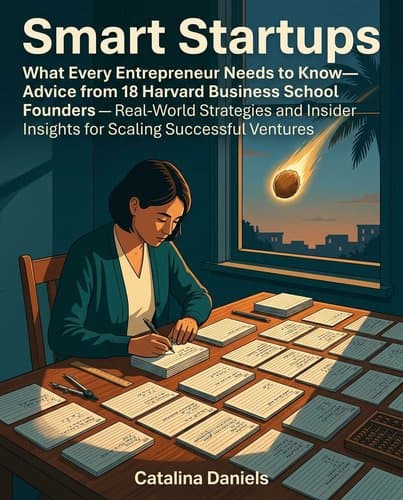
75668298_smart-startups
by Catalina Daniels
Forget the lone-genius myth—18 Harvard-trained founders reveal that startup success comes from rigorous uncertainty reduction: evaluating 100 ideas before…
In Brief
Forget the lone-genius myth—18 Harvard-trained founders reveal that startup success comes from rigorous uncertainty reduction: evaluating 100 ideas before committing to one, testing all three legs of the Ideation Triangle, and getting signal from strangers who have no reason to lie to you.
Key Ideas
Run ideation across 30-100 options
Run a deliberate ideation process before committing to any idea. Evaluate 30–100 options using 'shallow dives' — quick checks on market size, business model viability, and transportability — before narrowing to a final candidate. Expect it to take months.
Opportunity-skills-passion triangle validation
Test all three legs of the Ideation Triangle: a large opportunity you can size specifically (not just 'a big market'), relevant skills (analytical and operational — not necessarily industry knowledge), and genuine passion. A weak leg collapses the structure.
Problem, timing, model, unit economics
Before investing serious resources, run the four shallow dives: Is there a meaningful problem people will pay to solve? Why now — are you early on a wave? Do the business model building blocks exist (reimbursable by insurers, shippable by mail, manufacturable at cost)? Will the unit economics hold at scale?
Test demand with paying strangers
Test demand with strangers, not friends. Yumble got signal from a Facebook mommy group. Plated tested with customers paying $60–80 before launch. Set your signal threshold in advance: 'good feedback' means nothing. Only overwhelming, unsolicited enthusiasm clears the bar.
Identify stakeholders before demand testing
Identify every stakeholder in your model before testing demand. SkyMD tested with doctors and patients but missed the insurance companies whose reimbursement decisions controlled whether patients would use the product at all.
Founder credibility wins early sales
Do your own early sales. Only the founder has the credibility, passion, and freedom to improvise unconventional moves — Justin Joffe's $500 gala ticket to sit next to Delta Dental's CMO cannot be replicated by an early sales hire.
Keep 3-4x revenue valuation
Raise at valuations you can grow into. Keep your multiple in the 3–4x revenue range if you want a corporate sale to remain viable. The higher your late-stage valuation, the narrower your exit options become — a $2B+ Series D effectively makes the IPO the only exit.
Participating preferred can dominate exit
Before signing any priced term sheet, understand liquidation preferences. 'Participating preferred' means the investor collects their preference AND participates pro-rata on remaining proceeds — a 25% stake can take the majority of exit value at a modest sale price. Get a lawyer who specializes in this.
Board composition shapes strategic incentives
Shape your board proactively from the start. Keep empty seats you control through early rounds. A board member incentivized to push top-line growth regardless of margins is a structural risk, not an advisor.
Nurture M&A relationships years ahead
Build M&A relationships years before you need them. Josh Hix cold-approached Whole Foods' CEO at SXSW in 2013. Four years later, that relationship made the Albertsons deal possible. If you open exit conversations after you run out of runway, you have no leverage.
Who Should Read This
Business operators, founders, and managers interested in Startups and Business Strategy who want frameworks they can apply this week.
Smart Startups: What Every Entrepreneur Needs to Know―Advice from 18 Harvard Business School Founders – Real-World Strategies and Insider Insights for Scaling Successful Ventures
By Catalina Daniels & James H. Sherman
10 min read
Why does it matter? Because the mythology of entrepreneurial genius is what stops you from thinking clearly.
The startup mythology runs on a specific fantasy: the founder who saw what nobody else could see, who raised a monster round on sheer conviction, who pivoted brilliantly when the market said no. It's a compelling story. It also describes almost none of the actual founders who build durable companies.
Eighteen Harvard Business School alumni — between them, $1.7 billion raised, three unicorns, two IPOs — told the authors of this book what actually happened. Not one reported a spontaneous revelation. Not one cited money as their reason for starting. They named a specific problem, or a specific gap they were positioned to close. What they described instead was methodical, unglamorous, and replicable: a series of specific decisions made in a specific order, each one designed to eliminate a different way a company can die.
The romantic shortcuts are active traps. This book names them one by one.
There Is No Aha Moment — Successful Founders Run a Process
Morgan Hermand-Waiche had narrowed his list of startup ideas from a hundred down to fifty when his girlfriend interrupted the process entirely. He wasn't thinking about lingerie. He was looking at shoes.
She complained, offhandedly, that Victoria's Secret was expensive and the quality was poor. Morgan looked up from his list. He knew nothing about women's underwear, had no personal connection to the category, no industry contacts, no relevant experience. He pivoted anyway. Adore Me raised $58 million; in 2022, Victoria's Secret acquired it for $400 million.
Smart Startups keeps telling this founding story in different forms: not the flash of inspiration, but the grind that sets you up to recognize the opening when it appears.
The authors interviewed 18 Harvard Business School entrepreneurs and asked every one of them how they found their idea. Not one said it arrived whole. Half ran what the book calls deliberate ideation — a systematic process of evaluating multiple options, sometimes dozens, sometimes over a hundred. Morgan ranked his hundred candidates by market size and personal fit; his girlfriend's complaint cleared the rest. Josh Hix and his cofounder spent six months at forty to sixty hours a week examining problems before landing on meal-kit delivery: twelve person-months on one question.
The other half got there through organic accumulation — a single problem developing slowly from lived experience until starting a company was the only answer.
Neither path is passive. Deliberate ideation is exhausting on purpose. Organic ideation requires staying open and attentive for years. Justin Joffe, who evaluated thirty ideas before settling on mobile dentistry, put it plainly: the coconut does not fall from the tree and hit you on the head. You have to figure it out.
A Big Market Is Not Enough: The Three-Leg Test That Actually Filters Ideas
A large market is a bad reason to pursue an idea. The three-leg test that actually works (the book calls it the Ideation Triangle) asks something harder: do you have a specific problem within that market, the right skills to execute, and enough passion to survive the grind? Miss any one leg and the structure collapses.
Justin Joffe's process for evaluating mobile dental clinics shows what the "large opportunity" leg actually requires. The U.S. dental industry clears $125 billion annually: every adult has teeth, half of Americans carry dental insurance, most of that flows through employers. That's the market. The opportunity was different: 40% of people with employer dental coverage hadn't seen a dentist in over a year. Joffe designed a model to close that gap. Mobile clinics park outside office buildings; employees get seen in 45 minutes, pay nothing out of pocket; employers pay nothing; insurers show utilization on their books. Three parties, three different incentives, all served by one structural change to how the service gets delivered. The $125 billion number mattered only because Joffe had found a specific hole in it.
The contrast is Eric Price's SkyMD. He did the math correctly: 100 million dermatology visits annually, clinical evidence that 75% could be handled through a smartphone photo. The market math checked out. What he didn't verify was whether dermatologists would actually tell their patients to download the app. They wouldn't. Market size was sound; the adoption assumption was not.
The second leg — relevant skills — is where the authors push hardest against conventional wisdom. Morgan Hermand-Waiche of Adore Me had no background in women's lingerie, fashion, or e-commerce. He had two years at McKinsey and a computer science degree. His argument: industry knowledge is not a skill; analytical thinking and people skills are. Jenny Fleiss makes the same point from the outside: she believes Rent the Runway couldn't have come from someone inside fashion, because insiders had too many good reasons why it wouldn't work. Diane von Furstenberg told them to abandon the concept. They raised $450 million.
Once the Ideation Triangle holds, the book prescribes four cheap checks before committing. First: talk to people across the full bell curve, meaning the average potential customer, not just early enthusiasts who will validate almost anything. The enthusiasts tell you what you want to hear; the average customer tells you whether you have a business. Second: ask why now. What changed recently that makes this viable today? Founders who skip this question can be right about the problem but two years early, which is functionally the same as being wrong. Third: confirm the business model can actually be constructed. Who pays, how much, and why. Fourth: sketch whether the unit economics can work. Does one transaction generate enough margin to build a company on, or does every customer cost more to serve than they're worth? These aren't deep analyses. They're cheap disqualifiers. The goal, as Joffe puts it, is to qualify ideas out faster than you qualify them in.
Good Feedback Is Noise. Only Overwhelming Feedback Is Signal.
Think of the difference between a restaurant where you tell the waiter "great" on the way out — and a restaurant you describe to a friend, unprompted, the next morning. You used the word "great" in both cases. The meals were not comparable. Smart Startups makes the same distinction about early customer feedback: positive reactions are noise. The only signal worth acting on is the response that surprises even the founder.
Matt Salzberg founded two companies before learning this. His first, Petridish, crowdfunded science research. Teachers and donors called it great. He concluded it would be too hard to grow, shut it down, and started Blue Apron. After the first meal-kit deliveries, customers did not call it great. One sent an unprompted twenty-minute account of a steak dish: the herbs, the technique, what they would have done differently. Others described it as potentially life-changing. "Diatribes," Salzberg called them. Same entrepreneur, same instinct for reading people, entirely different signal.
Getting that signal requires giving customers something real enough to react to. Faking the infrastructure to deliver a genuine experience is the correct method. When RubiconMD wanted to test whether physicians would use a platform connecting primary care doctors to specialists, co-founder Carlos Reines copied an HTML form into a website. Doctors saw an automated healthcare platform. They were not seeing one. Every submitted case triggered an email to Reines, who forwarded it by hand to a few specialists he had recruited by walking into hospitals. He processed consults from his laptop during Harvard Business School classes. On that infrastructure — a form, an inbox, a forwarded email — they established that half of all in-person specialist referrals were unnecessary. That finding survived five years of clinical validation.
The instinct to build the back end first (the logistics, the operations, the actual system) feels like due diligence. You are stalling. The illusion earns its place because it eliminates everything except the core question: will people actually use this, and does it change something for them? The illusion is how you buy that answer. Everything else can wait.
The Competitive Moat You'll Build Is Nothing Like the One You Planned
Justin Joffe paid $500 out of pocket to attend a black-tie gala he had no reason to attend. His target was Delta Dental. He'd identified them as his key insurance partner, needed their distribution network before he could justify buying his first mobile dental truck, and couldn't get a meeting through normal channels. So he bought a ticket to the Summit Medical Group gala, found out where the Delta Dental table was, and made sure he sat there. He ended up next to their CMO and VP of Sales. Two months later he signed a distribution deal covering 50 million members nationwide.
No sales hire would spend $500 of their own money to engineer a coincidence. The founder is the only person whose belief is intense enough to absorb that kind of improvisation. Whatever your structural deadlock is — a marketplace with no buyers and no sellers, a B2B pitch with no references, a subscription product no one will try on faith — the unconventional move that breaks it requires you to be the one making it.
Breaking structural deadlocks is specifically a founder's job. No hired salesperson carries that conviction. What almost no one anticipates is the corollary: the competitive advantage that eventually makes a company hard to replicate rarely traces back to the original idea. The moat gets built in the grind, from operational problems no one planned to solve.
Rent the Runway launched expecting their moat to be relationships with fashion designers. As they scaled, logistics mattered more. Then, unexpectedly, dry cleaning. They'd assumed they would outsource it. Instead they brought it in-house and became one of the world's largest dry-cleaning operations. Jenn Hyman described what no technology could replace: the physical inspection of each garment — checking the zipper, stretching the fabric, looking for holes — and, specifically, the smell test. An algorithm cannot tell you a dress needs another pass through the machine.
Reid Hoffman frames this as founders needing to "master the business behind your business." The moat isn't the original idea. It's whatever operational capability the grind forced you to develop, and it will almost certainly not be the one you planned for. When you can name that capability, you also have something worth taking into a fundraising room.
The Startup That Raises Less Usually Exits Better
Raising more money at a higher valuation is how founders lose exits, not how they secure them.
Josh Hix built Plated, a meal-kit delivery company, raising $56 million across all rounds while deliberately keeping every valuation in the 3-to-4x revenue range. His reasoning was precise: if you raise at 10x revenue but acquirers value your sector at 3x, every employee who joins in that window can only profit if the company first grows past the 10x threshold, a bar most companies never clear. By matching valuations to what an acquirer would realistically pay, Hix preserved what he called optionality: the ability to exit at a price that made founders, employees, and investors whole simultaneously. Plated sold to Albertsons for over $200 million. Every investor from seed to late stage made money.
Blue Apron ran the same business under a different philosophy. They raised nearly $200 million, with a final private round that placed the company's implied value above $2 billion. At that level, a trade sale was structurally impossible: no grocery company was positioned to write a $2 billion check for a business still generating losses. The IPO became the only exit door, and it priced at $10 per share, below the $13.33 effective price of the final private round. The investors who committed latest, and believed most, were immediately underwater.
The dilution math starts earlier than most founders realize, before the first term sheet, at the cofounder stage. Matt Salzberg, who built Blue Apron, noted that a 50/50 cofounder split is the single largest equity event most founders will ever experience. By Series B, the average founder holds less than 30% of the company. The cofounder decision isn't a social question — who do you trust, who shares your vision. It's a financial one, with consequences that land on the same schedule as a term sheet.
You Will Lose Control of Your Company Before You Realize It
What does it mean to control a company you founded? Most founders would say: majority ownership, a favorable board, investors who trust you. The chapters on fundraising and governance reveal something more uncomfortable — you can have all three and still discover at the exit table that the proceeds belong to someone else.
The mechanism is the liquidation preference, and it is invisible until it matters. When an investor takes preferred shares in a priced round, they receive the right to be paid back their investment before any common shareholder — including the founder — sees a dollar. A standard 1x preference is defensible: if the company sells cheaply, investors at least recover their capital. The trap is "participating preferred." Under this structure, the investor collects their full preference and then participates pro-rata on the remaining proceeds alongside everyone else. A 25% stake can capture the majority of the exit check at a modest sale price. Anna Auerbach, who built Werk, discovered this post-signing: preferred shareholders had far more control over her exit than she had understood when she agreed to terms. Her summary: "Control of the board is not control of a transaction."
Most founders do the liquidation math for the first time the day an acquisition offer arrives. The terms were set years earlier.
The board-level version runs on a different schedule. Beri Meric at Ivy had a VC board member who pushed a single mandate: double revenue year over year, margins irrelevant. Meric was a first-time founder; the directive felt authoritative. He built fixed costs around top-line targets and watched the company nearly unravel when growth stalled. The board member wasn't wrong by VC logic: they optimize for the home run. Meric absorbed the downside.
The terms you sign feel abstract. The board dynamics feel manageable. Both become very concrete when someone else decides what your exit is worth.
Timing Is the Biggest Variable, and It Is Not Yours to Control
In June 2017, Matt Salzberg stood before public market investors to pitch Blue Apron, the meal-kit company he had spent five years building toward a $3.2 billion valuation. The IPO priced at $10 — against a final private round that had implied $13.33 per share. That morning, Amazon had announced it was acquiring Whole Foods.
The timing wasn't malice. It was worse: the two events had nothing to do with each other. Investors sitting across conference tables from Salzberg had just absorbed a shock to everything they thought they knew about grocery and food delivery. Late investors were immediately underwater.
Josh Hix was watching the same news break. Plated had raised $56 million at modest multiples (conservative by meal-kit standards), specifically to preserve the option of a trade sale. Now Blue Apron was trading as a public negative comparable at 0.3x revenue, against the 3x multiples at which Plated had been raising. No new round was possible.
The same event that killed Plated's financing prospects terrified Albertsons. Traditional grocers had just watched Amazon buy the country's most prestigious supermarket chain, and they had no answer. Albertsons needed a technology partner. Plated, which Nick Taranto had been quietly cultivating since cold-approaching Whole Foods' CEO at a 2013 conference, was already in the building. Plated sold for $200 million plus $100 million in earn-outs. Every investor made money.
Neither founder controlled the timing. Salzberg did nothing wrong; Hix did nothing wrong. The market moved, and one was positioned to weather it while the other wasn't. What preparation does is keep your options open long enough for luck to run in your direction. The groundwork has to be laid before you need it — not because it guarantees the exit, but because without it, bad timing has nowhere to go but down.
The Part No Framework Can Solve
Three weeks in the summer of 2017 separated two companies that had built the same product and raised in the same market. Blue Apron went public at $10 while Amazon absorbed Whole Foods. Plated sold to Albertsons for $200 million. Neither outcome came from a mistake either team made — the variable that separated their fates was one neither had touched.
That is the book's quiet argument. The founders who prepared obsessively — who tested with strangers before building, raised at multiples they could grow into, built M&A relationships before they needed leverage — didn't outperform because preparation beats luck. They outperformed because when luck moved against them, they still had room. The honest version of this advice isn't "do this and you'll succeed." It's simpler and harder: you don't get to choose when the market shifts. You only get to choose how exposed you are when it does.
Notable Quotes
“Okay, there is a need that exists. There are consumers that want to buy these [designer] products but who cannot afford these prices.”
“Oh yeah, this is great.”
“Oh my God, let me tell you for twenty minutes about the steak dish you helped me make. It was the best thing I've ever eaten. I think maybe if you had just done this differently with the herbs, it would have been even better.”
Frequently Asked Questions
- What is the ideation process recommended in Smart Startups?
- Smart Startups recommends a disciplined ideation process before committing to any idea. The framework involves running 'shallow dives' — quick checks on market size, business model viability, and transportability — to evaluate 30–100 options before narrowing to a final candidate. The book emphasizes that this process is systematic and takes months to complete. Entrepreneurs should test all three legs of the Ideation Triangle: a large opportunity you can size specifically, relevant skills (analytical and operational), and genuine passion. A weak leg collapses the structure, making it essential that all three components are strong before proceeding with resource investment.
- How does Smart Startups recommend testing demand for new products?
- Smart Startups emphasizes testing demand with strangers, not friends, to get accurate market signals. Test demand with customers paying $60–80 before launch rather than relying on 'good feedback,' which means nothing. The book features examples like Yumble, which got signal from a Facebook mommy group, and Plated, which tested with paying customers. Before testing demand, identify every stakeholder in your business model—SkyMD tested with doctors and patients but missed insurance companies whose reimbursement decisions controlled whether patients would use the product. Set your signal threshold in advance: only overwhelming, unsolicited enthusiasm clears the bar for proceeding.
- What is the fundraising strategy in Smart Startups?
- Smart Startups advises raising at valuations you can grow into, keeping your multiple in the 3–4x revenue range if you want a corporate sale to remain viable. The higher your late-stage valuation, the narrower your exit options become—a $2B+ Series D effectively makes the IPO the only exit. Before signing any priced term sheet, understand liquidation preferences. 'Participating preferred' means the investor collects their preference AND participates pro-rata on remaining proceeds—a 25% stake can take the majority of exit value at a modest sale price. The book recommends getting a lawyer who specializes in this complex area.
- How should entrepreneurs prepare for M&A and exit according to Smart Startups?
- Smart Startups recommends shaping your board proactively from the start and keeping empty seats you control through early rounds. A board member incentivized to push top-line growth regardless of margins is a structural risk, not an advisor. The book also emphasizes building M&A relationships years before you need them. Josh Hix cold-approached Whole Foods' CEO at SXSW in 2013, and four years later, that relationship made the Albertsons deal possible. If you open exit conversations after you run out of runway, you have no leverage. Building strategic relationships early is essential for successful exits.
Related Book Summaries
Read the full summary of 75668298_smart-startups on InShort