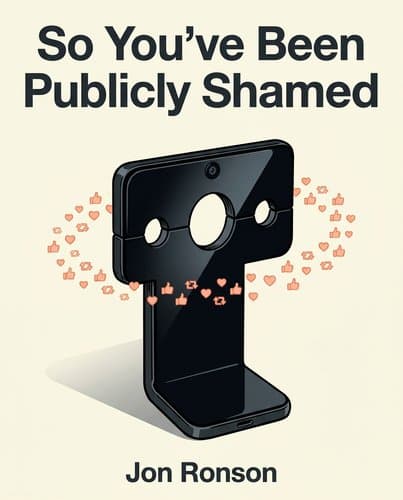
22571552_so-you-ve-been-publicly-shamed
by Jon Ronson
Online outrage feels like justice, but Jon Ronson reveals it's closer to mob violence—deliberately chosen, counterproductive, and capable of destroying lives…
In Brief
Online outrage feels like justice, but Jon Ronson reveals it's closer to mob violence—deliberately chosen, counterproductive, and capable of destroying lives over minor transgressions while leaving the shamers feeling righteous. A forensic examination of who really pays the price when we weaponize public humiliation.
Key Ideas
Justice differs from moral community feeling
Before joining an online pile-on, ask whether you're responding to the actual transgression or to the feedback — the likes, retweets, and sense of moral community — that condemnation produces. The feeling of justice and the reality of it are two different things.
Shamers act from conviction, not pressure
The 'mob mentality made me do it' excuse is scientifically dubious: the best evidence suggests shamers act deliberately, motivated by a genuine belief they're doing something good. That means the responsibility is fully yours.
Intense shame defeats behavioral change goals
Shame at high intensity doesn't produce reflection — it produces numbness. If the goal of public shaming is to change behavior, the mechanism is counterproductive; it's more likely to produce the defended, deadened state James Gilligan observed in violent criminals.
Reputation recovery demands surrendering authenticity
Recovery from public shaming is possible but comes at a cost: Reputation.com can bury your results, but only if you agree to replace your actual personality with blandness. The machine punishes complexity and rewards safe conformity.
Shame punishment rarely matches offense severity
The 'shifting sands of shameworthiness' are neither consistent nor fair — consensual sex scandals ruin women and barely touch men, while minor speech acts can destroy careers. Before amplifying outrage, ask who bears the cost and whether the punishment fits what actually happened.
Who Should Read This
Curious readers interested in Social Issues and Social Psychology and the science of how the mind actually works.
So You've Been Publicly Shamed
By Jon Ronson
8 min read
Why does it matter? Because the righteous rush you feel online isn't moral clarity — it's a machine.
You log onto Twitter, you see the name, you read the tweet, and something clicks into place — a clean, righteous certainty. This person deserves what's coming. You add your voice to the chorus. It feels like participation. It feels, honestly, like justice.
Jon Ronson felt that too. Then he started following the people on the receiving end — the ones who lost their jobs, their sleep, sometimes their sense of self — and he noticed something that wouldn't leave him alone: the mob always believed it was doing something good. That belief wasn't incidental. It was the engine. In So You've Been Publicly Shamed, Ronson traces how social media resurrected a punishment society abolished because it was considered too cruel, rewrapped it in the language of accountability, and handed it to the rest of us as a virtue. The question he can't shake — and by the end, neither will you — is whether the feeling of justice and the fact of it are ever the same thing.
We Were Braveheart — And It Felt Amazing
Jon Ronson is sitting in a rented room in Central London, watching three academics squirm. They built a Twitter bot using his name and identity — an 'infomorph,' they insisted, not a spambot — and when he asked them to take it down they told him he was merely trying to protect his 'brand.' So Ronson uploaded the video of their meeting to YouTube and let the internet do what it wanted. Death threats arrived. Mocking comments piled up in the hundreds. The academics, who had seemed so certain and superior in that rented room, caved almost immediately. Ronson felt something he described as giddy joy — the sensation of leading an army, of Braveheart with a broadband connection.
What's worth sitting with is how recognizable that feeling is. The pleasure wasn't incidental to the outcome; it was the point. Righteous cause plus collective momentum equals Braveheart — the sense that the crowd has become an instrument of justice, that the previously powerless have briefly seized the narrative. And in that moment, the violence of the response (actual threats of violence, directed at academics over a Twitter bot) registers not as a warning sign but as proof the cause was worthy.
Ronson was about to discover that this feeling scales. On December 20, 2013, a PR executive named Justine Sacco boarded a plane from London to Cape Town with 170 Twitter followers. She posted a joke about AIDS and white privilege, then went offline for eleven hours. By the time her plane landed, she was the number-one trending topic on earth. A hundred thousand tweets. A hashtag — #HasJustineLandedYet — that functioned as a countdown clock. Someone drove to the Cape Town airport specifically to photograph her expression at the moment she turned her phone on.
The Moment the Hunt Stops Being Fun
Michael Moynihan is standing on Flatbush Avenue, arms flailing, shouting into his phone. He has been chasing a fabricated Bob Dylan quote through a bestselling book called Imagine for weeks, and now he has its author, Jonah Lehrer, cornered. He runs into a drugstore, buys a Hello Kitty notebook, and in twenty-five seconds captures Lehrer's confession on paper. Total writing time for the resulting exposé: forty minutes. Total payment: $2,200. What Lehrer loses: his vocation.
That asymmetry is what the book keeps pressing on. Moynihan describes the moment the dynamic shifted using a hunting metaphor — you're in the woods and the chase feels righteous, and then you shoot the animal and it's twitching on the ground and you realize you're the one who has to finish it. He had watched twenty-four, twenty-five missed calls accumulate on his phone in a single night, Lehrer's voice going flat and repetitive at the end, like a child's toy running out of batteries. At a certain point, Moynihan said, it stopped being journalism and started feeling like something he didn't want a name for.
Lehrer spent seven months on the canyon trails of Los Angeles, drenched in shame by his own description, before accepting an invitation to apologize publicly at a journalism foundation luncheon in Miami. What he didn't know until he walked to the lectern was that the organizers had erected a giant screen directly behind his head, wired to display live tweets about his speech in real time — and positioned a second screen within his eyeline so he couldn't look away. As he tried to explain his failures, the words 'Jonah Lehrer is a friggin' sociopath' appeared in enormous letters next to his face. The crowd in the room gave polite applause. The crowd online did not. Then someone asked whether he'd been paid for the appearance. He had: twenty thousand dollars. The foundation apologized before the day was out.
The Science We Used to Explain the Mob Was Wrong — or Faked
Here is the excuse we reach for when we watch a pile-on: something about crowds overrides individual judgment, people get infected, they lose themselves in the swarm. It's a comforting explanation because it means nobody really chose anything. It turns out to be wrong.
We reach for a specific theory when we need that explanation. Gustave Le Bon gave it to us in 1895: inside a mob, individuals regress to a barbaric animal state, surrendering their moral agency to a kind of social contagion. Philip Zimbardo's 1971 Stanford Prison Experiment seemed to put the science behind it — ordinary college students assigned to play guards became genuinely sadistic within days, as if the role had possessed them. It became the go-to evidence that good people placed in bad environments will inevitably do bad things. Except the most notorious guard in that experiment, Dave Eshelman, wasn't possessed by anything. He was performing.
Eshelman is now a home loans businessman in California. When Ronson tracked him down, he said the first night of the experiment was simply boring — everyone was sitting around, nothing was happening. He'd recently seen Cool Hand Luke, in which a drawling Southern prison warden brutalizes Paul Newman's character, and he decided to channel that warden. He adopted the accent on purpose. He mapped out his escalating cruelties in advance. 'Someone is spending a lot of money,' he recalled thinking, 'and they're not getting any results.' His sadism wasn't a psychological transformation — it was a production decision. 'It was completely deliberate,' he told Ronson. 'I thought I was doing something good at the time.'
That last sentence is the one that matters. Crowd psychologists Steve Reicher and Alex Haslam, when Ronson shared the transcript with them, zeroed in on it immediately. Mobs don't act mindlessly, they argued — they act on shared moral identity. The people who piled onto Justine Sacco weren't infected with contempt; they were performing what they understood to be a public service, identifying a racist and making her answer for it. The logic of contagion lets everyone off the hook. The actual explanation is more uncomfortable: we chose it, consciously, because we believed we were the heroes of the story.
Shame Doesn't Just Hurt — It Kills the Soul
James Gilligan spent decades inside Massachusetts' maximum-security prisons after a federal judge sent him in to explain why men were blinding themselves, castrating themselves, murdering each other at the rate of roughly one per month in a single facility. He expected psychopaths — people born broken. What he found instead were men who described themselves as already dead. Not numb from boredom but numb the way a corpse is numb, as if something essential had been switched off years before they arrived. Some cut themselves not out of guilt but out of curiosity, to see whether they could still feel anything at all.
After decades of interviews, Gilligan arrived at a finding he called universal: every serious act of violence he encountered had been preceded by an experience of humiliation. Not one or two cases — every single one. The men who had been shot, beaten, prostituted, and degraded as children grew up treating violence as the only available currency for self-respect. One inmate explained it plainly: you wouldn't believe the respect you get when you have a gun in someone's face. For people raised on a steady diet of contempt, that transaction made perfect sense, even if it cost them their freedom or their lives.
This is where the etymology matters. When we say we were mortified, we mean embarrassed. But mortification literally means the death of the soul — and that, Gilligan argued, is what chronic shame actually produces. Not wounded pride. Not a lesson learned. A deadening. Dante put the lowest circle of hell not in flames but in ice, and Gilligan thought that was exactly right: at sufficient intensity, shame stops being a feeling and becomes the absence of one.
That's what the pile-on delivers. The mechanism we're using when we shame someone online isn't a side effect of justice. It is the instrument. And at the doses we're now capable of delivering, it doesn't correct people. It hollows them out.
Survival Requires Becoming Someone Blander Than You
Lindsey Stone is on a conference call, trying to approve a blog post she would never write in a million years. The post is about her excitement for Lady Gaga's jazz album. Lindsey doesn't care about Lady Gaga's jazz album. She doesn't care about Disneyland's birthday either, but that's the next one. What she is, or was, is sharp and impudent — the kind of person who takes a photo giving the finger next to a 'Silence and Respect' sign because she finds rules that take themselves too seriously faintly ridiculous. That quality got her fired, buried under death threats, and locked in her house for a year. Now it's the thing she has to suppress to survive.
The company handling her digital rehabilitation, Reputation.com, calls its method flooding the algorithm. You build out LinkedIn profiles, Tumblr pages, WordPress blogs, Instagram accounts — all indexed on platforms Google already trusts, all saturated with pleasant, unchallenging content, until the shaming material sinks to page two, the place most users never reach. The strategy has a name internally: Shock and Awe. The irony is that the content has to be so carefully inoffensive — cats, ice cream, chart music — that Google won't read it as manipulation. Anything with too much personality looks suspicious to the algorithm. So Lindsey, whose personality was the whole problem, has to sand it down until she's safe.
Michael Fertik, who runs Reputation.com, described what this produces as a culture straight out of East Germany's secret police files — surveillance so total that people stop being themselves preemptively, before anyone's even watching. His comparison: more frightening than the NSA, because at least government surveillance is looking for actual threats. The internet is just enjoying itself.
The uncomfortable math is that Lindsey's rehabilitation works, in the end. The photo disappears from her search results, replaced by a competitive swimmer named Lindsey Stone. She gets her name back. But the woman who earned it is buried under Lady Gaga posts. The shaming wins twice: once when the crowd comes for you, and again when survival demands you stop being the person the crowd decided to come for.
The System Isn't Broken — It's Working Exactly as Designed
Who actually benefits when a pile-on happens? Not a rhetorical question — a financial one. Ronson did the math. During the weekend Justine Sacco's name became the top trending topic on earth, approximately 1.2 million people searched for her. Google's average ad revenue runs around $0.38 per search. That's roughly $120,000 flowing into a corporation's accounts while a woman's life was being taken apart. The people doing the taking apart received nothing — except the feeling.
That feeling is the mechanism. Ronson found the explanation not in psychology but in a traffic-calming scheme from California. An inventor named Scott Kelley developed signs that display your current speed back at you in real time — no camera, no officer, no consequence attached. Just information. In test after test, drivers slowed down by an average of 14 percent and stayed slowed for miles afterward. Kelley, being an engineer, had no idea why it worked. The answer social psychologists eventually settled on: feedback loops. You behave a certain way, you get immediate data about that behavior, you adjust, you get immediate data about the adjustment. The loop is self-reinforcing.
Social media runs the same architecture. You condemn Justine Sacco. Likes and retweets arrive instantly, telling you that you're correct, that you're one of the good ones, that you're Rosa Parks for clicking a button. The loop closes. You stay inside it. Documentary maker Adam Curtis put it plainly in an email to Ronson: the tech-utopians describe this as a new democracy, but it's the precise opposite.
The result is a conformity machine operating at industrial scale. The corporations running the platforms collect the revenue. The users collect the validation. The boundaries of acceptable behavior narrow a little further each time the loop completes — sealing people inside the beliefs they already held, making other viewpoints feel marginal and strange — until Ronson's journalist friends describe moving through social media the way you'd move through a room with an unstable, angry stranger.
The Steak and the Slaughterhouse
Ronson ends somewhere quieter than you might expect — not with a verdict but with an appetite he can no longer trust. He misses the feeling. The communal rush, the sense that the crowd briefly became something larger and more righteous than any of its members — he misses it the way you miss a food you've given up. But he's seen enough of the machinery now — the hollowed-out people, the corporate ad revenue, the rehabilitation industry selling blandness as recovery — that he can't get back to innocent enjoyment of it. So he's out. Because he's no longer certain the feeling of justice and the fact of it are the same thing. That's the question the book deposits in your lap: you know how the slaughterhouse works now. What you do with the craving is yours to figure out.
Notable Quotes
“There is only one Jon Ronson,”
“I don’t want to be the person to do this. This is fucking horrible.”
“If you publish this you’re going to ruin a guy’s life. Do you think this is a big enough deal to ruin a guy’s life?”
Frequently Asked Questions
- What is 'So You've Been Publicly Shamed' about?
- This book investigates the resurgence of public shaming as a social force through interviews with shamers and the shamed. Ronson reveals how online pile-ons operate and why well-intentioned people participate in collective condemnation. The work examines the consequences for individuals caught in these digital storms. Crucially, Ronson asks whether "the feeling of justice and the reality of it are two different things," questioning whether our participation actually serves justice or merely satisfies our desire for moral community through likes, retweets, and social validation. The book provides readers with a framework for evaluating their own role in online outrage and collective condemnation.
- Does public shaming actually change people's behavior?
- No—"shame at high intensity doesn't produce reflection — it produces numbness." If the goal of public shaming is to change behavior, the mechanism is counterproductive. High-intensity shame creates a defended, deadened state rather than motivating self-reflection or genuine change. Instead of encouraging accountability, intense public shaming triggers protective psychological shutdown. The person being shamed becomes emotionally numb rather than motivated to improve. This creates a fundamental disconnect: while shamers believe they're promoting accountability, they're actually triggering defensive reactions that prevent behavioral change. Understanding this psychological reality challenges the effectiveness of public shaming as a tool for social correction or justice.
- Are people who participate in public shaming just following the mob?
- No—"the 'mob mentality made me do it' excuse is scientifically dubious." Research suggests shamers typically act deliberately, motivated by a genuine belief they're doing something good. Online shamers exercise agency and consciously choose to participate in pile-ons, believing their participation serves justice. Rather than being swept along by anonymous crowd dynamics, individuals actively decide to amplify outrage. Ronson's investigation reveals that people are aware of what they're doing and why. This conclusion is crucial: responsibility for online shaming falls squarely on individual participants, not on impersonal mob forces. Each person who joins a pile-on bears full responsibility for their actions and choices.
- Is it possible to recover from public shaming?
- Recovery from public shaming is possible but requires profound compromise. Services like Reputation.com can bury negative search results, but only if you agree that "the machine punishes complexity and rewards safe conformity." You must adopt a sanitized, inoffensive persona to achieve reputation rehabilitation. While technically you can escape the digital record of your shaming, the cost is your genuine self-expression. You sacrifice the complexity and individuality that makes you human. This presents a troubling trade-off: while your shaming may fade from public consciousness, you must become more carefully curated and less authentically yourself. True recovery demands this uncomfortable bargain with conformity.
Related Book Summaries


Read the full summary of 22571552_so-you-ve-been-publicly-shamed on InShort