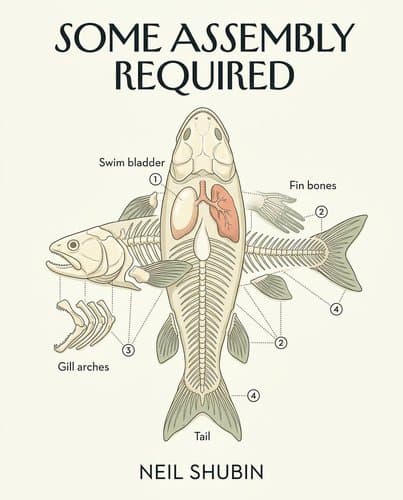
51199750_some-assembly-required
by Neil Shubin
Evolution never invents—it repurposes. Every revolutionary leap in life's history was built from ancient parts already doing something else, and your genome…
In Brief
Some Assembly Required (Marc) reveals that evolution never invents from scratch — every major biological innovation repurposed existing structures that were already doing something entirely different.
Key Ideas
Ancient precursors predate evolutionary transitions
When you encounter a major biological innovation, look for its precursor doing something unrelated millions of years earlier — the organ or feature almost certainly existed before the transition it supposedly enabled
Regulatory switches drive species differences
Most differences between species live in regulatory switches, not in the genes themselves; the same gene can produce completely different outcomes depending on where and when its switch fires, and that switch can sit nearly a million DNA letters from the gene it controls
Single genes trigger coordinated genomic change
Coordinated change across hundreds of genes doesn't require hundreds of simultaneous independent mutations — a single jumping gene that copies and distributes itself across the genome can install the same regulatory switch near hundreds of other genes in a few generations
Constraints shape convergent evolutionary solutions
Convergent evolution (the same complex solution appearing independently in unrelated lineages) is reliable evidence that developmental and genetic architecture is constraining what's possible — replaying the tape of evolution would produce recognizably similar outcomes, not random ones
Ancient viruses shaped human genome
At least 10% of the human genome consists of ancient viral DNA, and traits as fundamental as memory consolidation and mammalian pregnancy trace directly to domesticated viral infections — your genome is less a blueprint than a palimpsest of ancient invasions
Symbiosis creates major complexity jumps
The largest jumps in biological complexity consistently arrived through mergers between distinct organisms — mitochondria were free-living bacteria, chloroplasts were free-living algae — not through the gradual refinement of a single lineage
Who Should Read This
Science-curious readers interested in Evolution and Biology who want to go beyond the headlines.
Some Assembly Required
By Neil Shubin
10 min read
Why does it matter? Because the story you've been told about how evolution's greatest innovations arose is exactly backwards.
You already know the story: fish grew lungs to breathe on land, dinosaurs grew feathers to take flight, apes grew nimble hands to use tools. Need arose, evolution provided. It's a clean narrative, almost satisfying in its logic. The problem is that Neil Shubin has spent forty years digging up the actual evidence, and it keeps saying the opposite. Lungs predate land animals by hundreds of millions of years. Feathers covered ground-dwelling predators long before anything flew. The genes that build human hands were already shaping fish fins. Evolution, it turns out, is not an inventor — it's a scavenger, repurposing ancient parts through copying, timing shifts, viral invasions, and cellular mergers in ways that make purposeful design look embarrassingly inefficient. What Shubin offers instead is something stranger and more satisfying: the real mechanism, and once you see it, you'll find it operating everywhere.
Lungs Existed in Fish for Hundreds of Millions of Years Before Any Animal Crawled onto Land
Bashford Dean walked Manhattan's streets in medieval armor he had designed himself. He held dual curatorships at the Metropolitan Museum of Art and the American Museum of Natural History — one collection for battle armor, one for fossil fish — the only person in history to do so. What absorbed him most, though, wasn't on display in either building. It was fish embryos.
Peering at developing fish in early-twentieth-century anatomy labs, Dean noticed something that should have been absurd: fish swim bladders and human lungs look nearly identical in the earliest stages of development. Both organs bud from the gut tube as air sacs. He concluded they were the same organ with different careers depending on the animal. Cornell researchers later confirmed this at the genetic level: the exact same genes build swim bladders in fish and lungs in both fish and people.
Virtually every fish carries the machinery for breathing air. Some use their air sacs for buoyancy; others, including lungfish in the Amazon and Australia, gulp surface air when the water runs low on oxygen. Lungs weren't waiting to be invented when vertebrates first crawled ashore. They already existed in fish that never left the water, doing a different job, for hundreds of millions of years.
Darwin anticipated exactly this kind of finding in a response to St. George Mivart, his sharpest Victorian critic. Mivart argued in 1871 that gradual evolution couldn't produce major transitions. What use is two percent of a wing? Major innovations require whole suites of features to change at once; you couldn't get there step by step.
Darwin's answer, added to the sixth edition of On the Origin of Species, came down to five words: "accompanied by a change of function." Fish air sacs evolved for buoyancy; when water turned oxygen-poor, some fish started using the same sacs to gulp surface air; and by the time vertebrates reached land, those sacs were already hundreds of millions of years into their respiratory career. Feathers covered ground-running, prey-chasing dinosaurs for tens of millions of years before any creature became airborne. They kept animals warm. They signaled to rivals and mates. Flight arrived later and found the equipment already in place.
The Same Genetic Program That Segments a Fly's Body Is Also Building Your Fingers
Late one night in Neil Shubin's Chicago laboratory, a graduate student named Andrew Gehrke was tracking which genes were active in a fish fin. His colleague Tetsuya Nakamura had already shown that deleting a specific set of genes caused fish to lose their fin rays entirely. Now Gehrke wanted to see exactly where these genes were working. He stained the fin tissue, peered through the microscope, and took a photograph. The picture ran on the front page of the New York Times.
What he had captured: the genes known to build the wrists and fingers of mice were lighting up at the very tip of the fish fin — not somewhere in the middle, but in the terminal bones, precisely where a hand would sit in a land vertebrate.
These genes belong to a family called Hox genes: a sequence of master regulators arranged along the chromosome, each controlling a different body segment, in the same order as the body itself. The gene governing the head sits at one end of the sequence, the gene for the tail at the other. Fruit flies have this sequence. Mice have it. You have it. Four complete copies, spread across four separate chromosomes.
Humans and roundworms have roughly the same number of genes, about twenty thousand. Rice has nearly twice as many as either. What separates a human body from a nematode body isn't gene count. It's how an ancient shared recipe gets deployed.
Gehrke's photograph makes this concrete. The genes required to build human wrists and fingers were present in fish all along, already running at the tip of the fin, already marking the same terminal region. Evolution didn't invent new genetic machinery for the hand. It redirected an existing program — the same one running right now in a developing fish fin. What the photograph doesn't explain is what controls when and where those genes switch on. That's where the next discovery gets strange.
Evolution Doesn't Rewrite Genes — It Repositions the Switches That Control Them
Imagine discovering that the switch controlling a light in your living room is located not on any nearby wall, but in a garage miles away. That's an engineering absurdity, and exactly what a team at the University of Edinburgh found buried in the human genome.
The gene in question, Sonic hedgehog, directs digit formation during embryonic development. High concentrations push cells toward a pinky; low concentrations make a thumb; intermediate levels produce everything in between. Geneticist Robert Hill and his colleague Laura Lettice were investigating why some people and some cats are born with extra fingers. They gathered six-fingered patients in Holland, a child in Japan, and Hemingway's famous polydactylous cats at his Key West estate, descended from a kitten given to him by a sea captain. Every case pointed to the same patch of DNA: roughly fifteen hundred letters long, conserved across vertebrates from sharks to people, and sitting nearly one million bases away from the Sonic hedgehog gene itself.
The gene was untouched. The protein identical. Only the remote switch had changed.
Sonic hedgehog also governs heart development, brain formation, and spinal cord construction. A mutation in the gene would compromise all of them simultaneously. But each tissue runs on its own dedicated switch. A mutation in the limb switch leaves everything else alone. Snakes carry fully functional Sonic hedgehog genes — healthy hearts, intact brains — but the switches that deploy the gene in developing limbs have been silenced. The protein still works. The animal just never gets the signal to grow legs. That's the deeper point: silencing one switch lets evolution change one body part while keeping every other use of the gene intact.
Evolution didn't give snakes different genes from yours. It gave them different instructions for when to use the same ones. The same logic, it turns out, operates at a scale you can see with the naked eye.
When a Complex Organ Evolves Identically Three Separate Times, Chance Has Nothing to Do With It
David Wake spent nearly a decade building the most complete salamander family tree ever assembled, comparing DNA sequences from tissue samples collected from nearly every known species. When the results came back, he was stunned by something that should have been impossible.
Some salamanders feed by firing their own skeleton at their prey. Rather than lunging, they launch the small bones of the gill apparatus like a projectile, squeezed out by constrictor muscles the way a finger pops a watermelon seed. The bones travel half a body length in under two milliseconds, faster than any muscle in the animal's body can contract. A sticky pad at the tip catches the insect; belly muscles fused into a single strap running from pelvis to gill bones snap the whole apparatus back in.
Building this required a coordinated set of changes. The genioglossus — the muscle you use to speak, the same one surgeons tighten as a remedy for snoring — had to be eliminated entirely, since it would block the shot. The gill bones had to be freed from the skull and tapered into rods. The abdominal muscles had to be rewired into a recoil spring. At least half a dozen anatomical overhauls, all working together.
Wake's family tree showed that the salamanders carrying this apparatus were not closely related. They had different ancestors, lived on different continents, and had been diverging for tens of millions of years. The projectile tongue had appeared independently at least three times. In every case, the identical suite of changes had occurred. The same muscle lost. The same bones repurposed. The same spring assembled.
What looks like miraculous coincidence is constraint made visible. Every lineage that evolved projectile tongues had, earlier in its history, lost both its lungs and its aquatic larval stage, which meant the gill apparatus was no longer competing to serve those earlier functions. Once those claims on the bones disappeared, only one good option remained: slender, lightweight gill bones freed from their anchorage are already projectiles, and the surrounding musculature has just one arrangement capable of launching them fast enough to catch anything. The developmental recipe, working with the same freed raw material, converged on the same answer every time. The dice look thrown randomly. They aren't. They were loaded long before the game began.
Anatomy, it turns out, isn't freely variable. Developmental constraints channel it toward a small set of viable outcomes, which is why the same solution appears three times, on three continents, from independent starting points. The same principle operates at the genetic level. The mechanism there, though, turns out to be considerably stranger than anyone expected.
A Single Rogue Gene Rewrote Hundreds of Others in Lockstep — And Invented Mammalian Pregnancy
How do you evolve something that requires hundreds of genetic changes at once? Mammalian pregnancy is the hardest version of that question.
The cells that make it possible, decidual stromal cells lining the uterus, simultaneously buffer the mother's immune response to fetal proteins, channel nutrients to the embryo, and build the tissue environment that holds a pregnancy together. When Vinny Lynch, a University of Chicago biologist with a river ecosystem tattooed across his arms and legs, probed exactly which genes create these cells, the answer was daunting. Transforming a regular fibroblast into a decidual stromal cell requires hundreds of genes to switch on together when progesterone arrives — not one or two master controllers, but hundreds firing in unison.
The standard implication: pregnancy demanded hundreds of independent mutations arising across the genome simultaneously. The odds are like needing to flip hundreds of separate coins and have every one land heads. There's no shortcut in that math. Just an event so improbable it shouldn't have happened at all.
What Lynch found was a single event that solved it all.
Nearly every one of those hundreds of genes shared something: an identical progesterone-responsive switch sitting right beside it. When Lynch ran that switch sequence through genomic databases, the signature was unmistakable. It came from a jumping gene, the class of mobile elements Barbara McClintock had discovered in corn in the 1940s, dismissed as noise for decades before earning her a Nobel Prize. Jumping genes are self-replicating parasites of the genome: they copy themselves and insert those copies throughout the DNA, again and again.
Here's where the apparent impossibility collapses. A single mutation had converted one jumping gene into a progesterone-activated switch. That gene then did what jumping genes do: it duplicated and scattered itself across the genome, landing beside hundreds of different genes along the way. Each landing installed the switch. What looked like hundreds of independently coordinated mutations was one mutation, broadcast to hundreds of addresses by a replication mechanism the genome already contained.
The genome had even domesticated it. The DNA machinery that normally hunts and silences jumping genes had stripped these particular elements of their mobility while leaving the switch intact — turning an intruder into a permanent fixture doing useful work. One mutation. Hundreds of genes rewired. A new cell type. Mammalian pregnancy.
The Protein Your Brain Uses to Consolidate Memories Is Structurally Identical to an HIV Capsule
That wasn't the last time a viral invasion became a permanent fixture in the genome.
Jason Shepherd's protein purification columns kept clogging. He was isolating Arc, a protein active in the spaces between neurons and critical for memory — mice lacking it solve mazes perfectly but wake the next morning with no recollection of having done so. Purification pulls the target protein through a gel-packed column; contaminants stick, the protein flows through. Shepherd's Arc wouldn't flow. Fresh columns, new gel batches — still clogged.
His lab technician suspected the clog was structural, not contamination. They took the fluid to an electron microscope, and Shepherd saw something that stopped him: Arc was forming hollow spheres, large enough to jam a gel filter, and built exactly like the protein capsules HIV uses to carry its genetic cargo from cell to cell. The molecular architecture matched down to a structural quirk called a zinc knuckle, a fold that appears only in viral capsid proteins. When Shepherd walked the images to an HIV lab across the building, the virologists couldn't find a meaningful difference between what Arc was making and what an actual virus makes.
The function matched the structure. HIV capsules carry genetic material between cells; Arc capsules do the same thing between neurons, which is how new experiences solidify into lasting memory.
The origin story buried in the genome databases is the part that rewires how you think about cognition. Arc is present in every land-dwelling vertebrate and absent in fish. That gap places the original viral infection at roughly 375 million years ago, right at the fish-to-land transition — probably in an ancestor close to Tiktaalik, the fish with limb-like fins that Shubin's own team pulled from the Canadian Arctic. A virus entered that genome carrying a protein built to shuttle genetic cargo from cell to cell. But where this particular virus landed, the protein became active in neurons instead, and the result was better memory consolidation. The individuals who inherited it were cognitively better for it. The virus was neutered, stripped of its infectious machinery, and kept on permanently as a neural tool. Your ability to remember what you've read today runs on code that entered vertebrate genomes before anything with a backbone had ever set foot on land.
Your Cells Run on Captured Bacteria — And Your Genome Is 10% Dead Viruses
Every complex cell in your body is a merger. The mitochondria powering your neurons right now were, roughly two billion years ago, free-living bacteria with their own membranes and their own ring-shaped DNA. One was absorbed by a larger cell and never left. Lynn Margulis proposed this in the 1960s, when she was a young scientist at Berkeley. Fifteen journals rejected the paper. The idea that you could gain complexity by absorbing a foreign organism rather than refining your own struck most biologists as something close to mysticism. It found a home, eventually, in an obscure theoretical biology publication.
Vindication arrived in the 1980s, when DNA sequencing let scientists compare organelle genes to nuclear genes. Chloroplasts turned out to be genetically closer to free-living blue-green algae than to anything else inside the plant cell housing them. Mitochondria descend from oxygen-consuming bacteria, unrelated to the host cell's own nucleus. Every complex cell contains two distinct lineages, two organisms fused into something neither could have become alone.
Bacteria became organelles, organelles enabled complex cells, complex cells assembled into multicellular bodies, each new level of complexity arriving through merger rather than internal invention. The pattern holds at every scale.
The genome-editing tools that have transformed biology since 2012 — CRISPR — are a theft from a bacterial immune system. Francisco Mojica, working in a Spanish salt marsh in the 1990s with almost no funding, found palindromic sequences embedded in bacterial DNA. He eventually worked out that the bacteria were storing fragments of past viral invaders as molecular mug shots, then cutting any new virus that matched. Scientists repurposed that mechanism to edit any genome on earth. The trick is four billion years old. Life moves the way rivers do when they braid — separate channels merging, splitting, and merging again, each new lineage built from currents that ran alone for eons before they joined.
What the Arrow Between a Fish and an Amphibian Gets Wrong
The simple arrow Shubin draws when he explains evolution — fish on the left, land animal on the right, one line between — looks naïve now. It implies invention on demand: the lung appearing when land beckoned, the hand materializing for grasping. None of it worked that way. The lung existed for millions of years before any fish had reason to leave the water. The hand was already sketched in fin-tip genes. The memory protein was a viral passenger. The power plants were captured bacteria. Nothing in four billion years of evolution has ever been built from scratch — and once you see that, the question changes.
The braided river is the only way complexity gets made: through merger, repurposing, and the long second careers of things that started as something else entirely. The logic holds well beyond biology. The alphabet you're reading now descends, through Phoenician merchants and Egyptian scribes, from marks made to count livestock four thousand years ago. Writing was repurposed accounting notation. When you encounter something that looks like a brand-new invention, the better question is always: what was it before?
Notable Quotes
“We both nearly rolled down the slope in our rush to the spot,”
“). In his later scientific monograph, buried in the normally standard dry prose of the form, he described Deinonychus as being”
“I literally got weak in the knees when I first saw photos. The apparent covering on this dinosaur is unlike anything we have seen anywhere in the world before.”
Frequently Asked Questions
- What does 'Some Assembly Required' reveal about how evolution creates major innovations?
- The book reveals that evolution never invents from scratch — every major biological innovation repurposed existing structures that were already doing something entirely different. When encountering a major biological innovation, look for its precursor doing something unrelated millions of years earlier; the organ or feature almost certainly existed before the transition it supposedly enabled. This framework, drawn from genetics, paleontology, and developmental biology, transforms understanding of where biological complexity actually comes from by showing evolution works with available materials rather than creating entirely new biological systems from scratch.
- Why are regulatory switches more important than genes themselves in explaining differences between species?
- Most differences between species live in regulatory switches, not in the genes themselves. The same gene can produce completely different outcomes depending on where and when its switch fires, and that switch can sit nearly a million DNA letters from the gene it controls. A single jumping gene can copy and distribute itself across the genome, installing the same regulatory switch near hundreds of other genes in a few generations—enabling coordinated change across hundreds of genes without requiring hundreds of simultaneous independent mutations.
- What does convergent evolution reveal about biological possibility and the repeatability of evolution?
- Convergent evolution—the same complex solution appearing independently in unrelated lineages—is reliable evidence that developmental and genetic architecture is constraining what's possible. This demonstrates that replaying the tape of evolution would produce recognizably similar outcomes, not random ones. Rather than evolution producing unlimited random results each time, biological innovation is deeply constrained by underlying genetic and developmental structure. These constraints predictably channel evolution toward particular solutions, suggesting that if life's history restarted, we'd see many of the same forms and innovations emerge again.
- How have viral infections and organismal mergers shaped human biology according to 'Some Assembly Required'?
- At least 10% of the human genome consists of ancient viral DNA, and traits as fundamental as memory consolidation and mammalian pregnancy trace directly to domesticated viral infections—your genome is less a blueprint than a palimpsest of ancient invasions. The largest jumps in biological complexity consistently arrived through mergers between distinct organisms; mitochondria were free-living bacteria and chloroplasts were free-living algae, not products of gradual refinement within a single lineage. These acquisitions represent major innovations that couldn't have evolved through traditional step-by-step processes.
Related Book Summaries
Read the full summary of 51199750_some-assembly-required on InShort