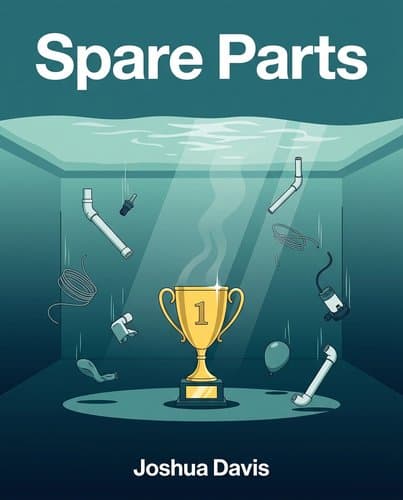
20518979_spare-parts
by Joshua Davis
Four undocumented teenagers built a homemade underwater robot on $900 and beat MIT's fully-funded team—exposing the contradiction between America's celebrated…
In Brief
Spare Parts (Dece) tells the true story of four undocumented teenagers from Phoenix who built an underwater robot on a $900 budget and beat college teams from across the country — including MIT.
Key Ideas
Scarcity Forces Superior Design Creativity
Constraint forces creativity in ways that abundance doesn't: the Carl Hayden team's $900 budget produced engineering solutions — a balloon for fluid sampling, tampons to seal a leak — that judges with NASA experience called conceptually superior to what $10,000 bought. When resources are scarce, simplicity becomes a design philosophy rather than a compromise.
Recognition Without Access Rings Hollow
Being recognized as brilliant and being given a path forward are entirely different things. The same system that couldn't provide undocumented students with in-state tuition could offer them a trophy — and the book insists you hold both of those facts at the same time.
Mentorship Requires Structural Institutional Support
Individual mentorship can be transformative and insufficient simultaneously. Teachers Fredi Lajvardi and Allan Cameron created the conditions for an extraordinary achievement; Proposition 300 undid years of that work with a single policy vote. Inspiring teaching is necessary but not sufficient without structural support.
Narrative Power Determines Whose Story Matters
The stories a society tells about who belongs shape which achievements become visible. A news crew came to cover a brawl and ignored a homemade robot driving circles around their camera. One journalist nearly deleted a misspelled email. The underdog story only exists because of a series of near-misses that most such stories don't survive.
Who Should Read This
Science-curious readers interested in Innovation and Mentorship who want to go beyond the headlines.
Spare Parts
By Joshua Davis
9 min read
Why does it matter? Because the kids who built a robot from PVC scraps and tampons are exactly who America says it wants — and exactly who the system worked hardest to discard.
The smell hits you first — Red Hot Blue Glue and PVC shavings in a high school closet in Phoenix. Then the moment the announcer pauses before saying "Carl Hayden," and four undocumented teenagers from a broke public school realize they've just beaten MIT. You've seen the movie. You felt good. The credits rolled.
Here's what the credits skip: what happens when the trophy has no legal address. When the country that just watched you out-engineer its elite universities won't let you enroll in them. When winning proves exactly what you're worth — and that proof changes nothing about your status.
Joshua Davis's Spare Parts is the underdog story, yes. But underneath it runs a colder current: these four boys didn't just build a robot from whatever was available. They built it the way they built their entire lives in America — ingeniously, invisibly, from the spare parts a system left behind after it decided they didn't belong.
The Robot Built in a Closet Shouldn't Have Existed — and Neither Should Its Builders
On June 25, 2004, a Navy weapons developer named Tom Swean sat behind a table at UC Santa Barbara, facing four teenagers from one of the poorest schools in Arizona. Swean ran the Office of Naval Research's underwater robotics program and normally dealt with million-dollar autonomous machines built for Navy SEALs. What stood before him instead was a garishly painted plastic robot held together with scrap parts and glue so toxic it had made the boys dizzy during assembly. When Swean asked how their laser range-finder worked, Cristian Arcega — five foot two, living in a plywood box the size of a large bathroom attached to the side of a trailer — answered without hesitation, explaining the helium-neon laser, the CCD camera readout, and the manual thirty-percent correction they'd calculated to account for the index of refraction. When Swean asked why they hadn't brought a PowerPoint presentation, Cristian told him PowerPoint is what people use when they don't know what to say.
For the length of that technical evaluation, the judges were assessing the boys purely on what they knew. And the boys kept knowing it. Luis Aranda, a six-foot, 250-pound short-order cook who'd joined the team partly because he was the only one strong enough to lift the robot, fielded a pointed question about pulse-width modulation and delivered a textbook answer without blinking.
Oscar Vazquez, the team's de facto leader and the most decorated cadet in Carl Hayden's ROTC program, had devoted four years to preparing for military service. He could recite the Preamble to the Constitution from memory and believed it described his own life. Then he learned that his parents had carried him across the border from Mexico when he was twelve, and the Army he'd shaped himself to serve wouldn't take him. Outside that UC Santa Barbara building, he was a fugitive. Inside it, the Navy was asking him about signal interference — and nodding at his answers.
A $900 Budget Forces Better Engineering Than a $10,000 Grant
MIT arrived at UC Santa Barbara with a $10,000 ExxonMobil grant, a team of ocean engineering majors, and a machined-metal robot built in a real lab. Carl Hayden arrived with a PVC frame, a secondhand briefcase for a control housing, and a total budget of $900 — raised partly by Luis handing his boss at a diner a robotics brochure and coming back with a hundred-dollar check, and partly by Oscar walking into the mattress factory where his father assembled box frames and persuading the owner that West Phoenix deserved a shot. The resource gap was real and it was not small.
But the constraint forced a discipline that the well-funded teams didn't have to practice. Consider Lorenzo's fluid-sampling solution. The competition required robots to extract five hundred milliliters of liquid from a barrel — a task worth twelve points that MIT judged too difficult and didn't attempt. Lorenzo, assigned the problem partly because his teammates assumed it was impossible and didn't want to waste their own time on it, solved it with a thirty-five-dollar bilge pump, two dollars' worth of copper tubing, and a balloon. The balloon cost essentially nothing and had one advantage no rigid container could match: it carried zero air when deflated, so it added no unwanted buoyancy. He stabilized it inside a halved gallon milk jug he pulled from the trash. The whole system weighed almost nothing, cost almost nothing, and worked. During the competition it extracted the sample in under twenty seconds.
The NASA judge who evaluated the robots afterward said Carl Hayden's designs were "conceptually similar" to what she encountered in her actual work — not despite the simplicity, but because of it.
The contest wasn't fair, though. The boys building the simpler, more elegant machine were also the ones who had assembled it in a chemical haze — Lorenzo warned "we're gonna get high" as Red Hot Blue Glue vapors filled the closet, and Oscar named the robot Stinky afterward. The team with the ocean engineering degrees didn't spend an all-nighter resoldering sixty-four hair-thin wires by hand after a leak appeared in their control housing the night before competition. The resource gap that forced better thinking also meant that every mistake cost more, every fix was physical, and the margin for error was always thinner than the other team's.
The Night Before the Championship, They Fixed a Leak With Tampons and Resoldered 64 Wires by Hand
The night before the competition, Oscar unzipped the briefcase housing and found water inside. Not a lot — but enough. If it reached the electronics, Stinky was done.
Lorenzo walked to a nearby grocery store and came back with a box of o.b. ultra-absorbency tampons. The logic was direct: maximum absorption, minimum space. He packed them around the electronics to soak up what had gotten in, then he and Oscar sat down to figure out where the water came from. The answer was a broken seal around the wire bundle entering the case. The wires themselves — sixty-four of them, each about the diameter of a human hair — had been soldered by hand months earlier in a school closet. Now they had to be resoldered. All of them. Tonight.
They worked through most of the night. When they finished, the seal held.
This is the part that reframes the competition. MIT's robot was machined metal, purpose-built, backed by a ten-thousand-dollar grant. Carl Hayden's was PVC pipe and a secondhand briefcase. The reasonable assumption going in is that more resources produce more reliability — that the team least likely to have a crisis the night before is the one with ocean-engineering majors and a real machine shop. But reliability under pressure isn't a function of budget. It's a function of whether the people holding the soldering iron have done it before, know what they're fixing, and refuse to quit. Oscar and Lorenzo had done all three.
Fredi, watching his team the next morning, ran his own kind of field test. He walked the boys to a pedestrian bridge on campus and told them to explain their robot to strangers passing by. Regular people — not judges, not engineers. The boys resisted at first. Then Oscar started talking to someone, explaining the PVC frame and why it worked, and the stranger actually leaned in. Then Cristian. Then Lorenzo. By the end, the boys weren't rehearsing answers for a panel. They were describing something they understood completely and had fixed with their own hands the night before.
What changed on that bridge was the story they were telling themselves about who they were. Four undocumented teenagers had spent the night resoldering sixty-four wires and walked out the other side as engineers — and Fredi needed them to know it before they walked into the judging room. The tampons and the soldering were already done. This was the last repair.
When Carl Hayden Beat MIT, the Judges Said Stinky Was 'Conceptually Similar to NASA Machines'
Third place: Cape Fear Community College. Applause. The MIT team shifts in their seats, calculating the margin. Then second place: MIT. The room takes a breath. And then, into a silence that had no business existing in a room where these particular teenagers were present, the announcer said Carl Hayden.
The design award had already cracked the logic of the day open. When the judges gave Carl Hayden the Design Elegance prize, Lorenzo was genuinely baffled — there was nothing elegant about Stinky by any conventional measure, nothing polished or precise. But Lisa Spence, the NASA flight lead who'd spent seventeen years working with advanced underwater vehicles, explained what the award actually meant: the boys had chosen the simplest workable solution to every problem they faced. The balloon, the milk jug, the tape measure threaded to a camera. No redundancy, no overengineering. Stinky's approach, she said, was conceptually similar to the machines she worked with professionally — not despite the improvisation, but because improvisation had forced a kind of rigor that money often obscures. Complex solutions are usually symptoms of unclear thinking. Stinky had no budget for unclear thinking.
So the win was real, and it was earned, and the room knew it.
But the story doesn't let you rest. Oscar Vazquez walked off that stage with a first-place trophy and turned back into a person whose eighteenth birthday was approaching like a closing door. Winning a robotics competition doesn't amend an immigration file. It doesn't convert four years of ROTC service into legal residency. The judges had seen what Oscar could do. The law hadn't changed its mind about who he was allowed to be. The trophy was genuine. The morning after was still the same country.
Winning First Place Didn't Change Anyone's Immigration Status
What did the competition actually change? For a sealed thirty-minute window in a UC Santa Barbara pool, these four teenagers occupied a world where the only thing that mattered was whether their robot worked. Then the window closed.
Oscar Vazquez's story answers the question most precisely. He had done everything the system asked — led Carl Hayden's ROTC program, helped his team beat MIT, spent four years shaping himself into someone who believed the Preamble to the Constitution described his own life. When he learned the Army still wouldn't take him, he tried the one move left: he would do it correctly, from the beginning. In September 2009, he voluntarily walked across the bridge into Juárez — at the time the most dangerous city in the world — and presented himself to the consulate. He received a ten-year ban.
His former competitors had different mornings. Jordan Stanway, the MIT team leader, went to the Monterey Bay Aquarium Research Institute. Thaddeus Stefanov-Wagner, who had rebuilt MIT's melted control system in a week, went to Bluefin Robotics. Those are the expected trajectories for people who finish second in a national engineering competition. Cristian Arcega, who had dismissed PowerPoint in front of a Navy judge and solved the index-of-refraction problem in his head, ended up at Home Depot waving a flag for forklifts. Arizona's Proposition 300, passed with 71 percent of the vote, quadrupled tuition for undocumented students, making college mathematically impossible. Luis Aranda, who had fielded questions about pulse-width modulation without blinking, buffed floors at night in the federal courthouse. Lorenzo became a line cook.
The design elegance award. The technical writing prize. The first-place trophy that made a room full of MIT undergraduates rise to their feet. None of it constituted legal presence. None of it amended a file. The competition had briefly revealed what these four people could do when assessed only on what they knew — and then the assessment ended, and the country went back to treating them as what their paperwork said they were.
Oscar Told the Truth and Got a Ten-Year Ban. Then He Enlisted Anyway.
A clerk at the U.S. consulate in Juárez asked Oscar Vazquez a simple question: had he previously entered the United States illegally? Oscar said yes. He'd explained to himself beforehand that he didn't want his citizenship built on a lie — he wanted America to actually choose him, eyes open. The clerk told him his application was denied before Oscar finished the sentence. For telling the truth about the very thing he'd crossed into the most dangerous city in the world to confess, he received the maximum penalty: a ten-year ban.
Karla found him months later at a bus station, nearly unrecognizable: boots made from tire rubber, jeans caked in mud, an ASU cap pulled low after months picking beans for $3.80 a day while gunfire ran outside his window.
Senator Dick Durbin put Oscar's story on the Senate floor as the face of the DREAM Act. The bill was filibustered. Oscar eventually received a waiver, returned, and enlisted as a specialist — the same Army that had rejected him at eighteen — intending to earn citizenship through a deployment to Afghanistan.
You can read that arc as vindication. It's also something harder. The competition had briefly created a world where Oscar was assessed only on what he could do: design a robot, solve an engineering problem, answer a Navy judge's technical questions without flinching. Then the window closed, and the country went back to treating him according to his paperwork. He did everything right by every standard the culture claims to respect — demonstrated ability, honesty under pressure, willingness to serve. The book doesn't tell you those qualities were rewarded. It tells you they were punished first, then survived, then forced to spend years proving themselves again in a system that had already seen the proof.
The question that stays with you isn't whether Oscar deserved to be here. That was settled in a pool at UC Santa Barbara in 2004. The question is what it means that the answer wasn't enough.
What 'Stinky' Actually Proved
The name stuck because it was accurate. Red Hot Blue Glue in a school closet, four teenagers getting lightheaded over PVC pipe and borrowed parts — and what came out the other side smelled like exactly what it was. Not a robot built to impress. A robot built to work. That gap is where the book lives.
Here's the thing you can't un-see once you've seen it: Cristian, Oscar, Lorenzo, Luis are precisely the people the country's founding story was written to celebrate. Ingenuity under pressure. Honesty at personal cost. Competence proved in front of experts who weren't expecting it. The system didn't fail to notice them — it noticed them, gave them a trophy, and then worked methodically to ensure their gifts went somewhere smaller than they deserved. That's not a bug you can blame on paperwork. Cristian ended up waving a flag for forklifts at Home Depot. Oscar went back to work in boots soled with tire rubber.
Notable Quotes
“the first- or second-most notorious staging site for aliens in the world.”
“clothing consistent with that of illegal entrant aliens”
“a strong body odor common to illegal aliens.”
Frequently Asked Questions
- What is Spare Parts by Joshua Davis about?
- Spare Parts tells the true story of four undocumented teenagers from Phoenix who built an underwater robot on a $900 budget and beat college teams from across the country — including MIT. The book examines how constraint drives innovation, how mentorship meets its limits against policy, and what American achievement actually looks like when the system isn't designed for you. Davis explores the engineering solutions the team created, including a balloon for fluid sampling and tampons to seal leaks, and the systemic barriers that nearly prevented their story from ever being told.
- What are the key takeaways from Spare Parts?
- The book reveals that constraint forces creativity in ways abundance doesn't—the team's $900 budget produced engineering solutions judges with NASA experience called conceptually superior to what $10,000 bought. Davis emphasizes that being recognized as brilliant and being given a path forward are entirely different things, and that individual mentorship can be transformative and insufficient simultaneously. Finally, he argues that the stories a society tells about who belongs shape which achievements become visible, showing how one journalist nearly deleted their story with a misspelled email.
- What does Spare Parts reveal about innovation and constraint?
- Spare Parts demonstrates that constraint forces creativity in ways that abundance doesn't. The Carl Hayden team's $900 budget produced engineering solutions that judges with NASA experience called conceptually superior to what $10,000 bought. When resources are scarce, simplicity becomes a design philosophy rather than a compromise. The book uses this story to challenge conventional assumptions about what drives innovation, showing that limited resources can produce superior results compared to well-funded competitors like MIT and other major institutions.
- How does Spare Parts address systemic barriers to opportunity?
- The book insists readers hold two contradictory facts simultaneously: the same system that couldn't provide undocumented students with in-state tuition could offer them a trophy. Davis illustrates how individual mentorship, while transformative, is insufficient without structural support—Proposition 300 undid years of work by teachers Fredi Lajvardi and Allan Cameron with a single policy vote. This argument reframes the achievement beyond an inspiring underdog story, revealing it as a near-miracle that depended on a series of chance encounters most similar stories never survive.
Related Book Summaries
Read the full summary of 20518979_spare-parts on InShort