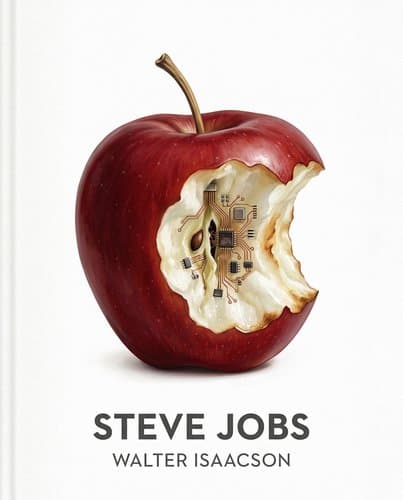
11084145_steve-jobs
by Walter Isaacson
Steve Jobs's obsessive need for total control—over pixels, people, and perception—was both the engine of the iPhone and the source of genuine cruelty, making…
In Brief
Steve Jobs (Octo) is Walter Isaacson's definitive biography of Apple's co-founder, drawn from over forty interviews with Jobs and hundreds more with colleagues, family, and rivals.
Key Ideas
Excellence requires serving users, not ego
The most productive version of perfectionism is tightly coupled to a product people can actually buy — the signed circuit board was integrity; the NeXT cube was self-indulgence. The difference is whether the obsession serves the user or the maker's ego.
Vertical integration demands long-term survival
End-to-end control of the user experience — hardware, software, content — produces higher quality but requires surviving long enough to be vindicated. Jobs's model lost to Microsoft in 1985, nearly bankrupted Apple in 1997, and then produced the iPhone. The lesson isn't that closed beats open; it's that the model only works if you're still standing when the market catches up to your vision.
Intensity without counterweight becomes delusion
The Reality Distortion Field works on yourself as much as on others — which means the same conviction that lets you demand the impossible from engineers will also let you convince yourself you can cure cancer with carrot juice. Intensity without a trusted counterweight is a liability disguised as a strength.
Founder personality can't survive succession
Building a company around a single person's taste and force of will produces extraordinary products but fragile institutions. Jobs knew this and said so explicitly: once product people are replaced by salespeople, the innovation stops. His failure to fully solve the succession problem is the most honest part of his legacy.
Early abandonment shapes control obsession
The 'abandoned child becomes the abandoner' pattern suggests that our deepest wounds don't disappear with success — they find new arenas. Jobs's need for control over products, people, and perception traces directly to his earliest experience of having no control at all. Understanding why someone is the way they are doesn't excuse the damage, but it does explain the architecture.
Who Should Read This
Readers interested in Business Leaders and Innovation, looking for practical insights they can apply to their own lives.
Steve Jobs
By Walter Isaacson
9 min read
Why does it matter? Because the traits we call dysfunction in everyone else were the source code for the most consequential products of the twentieth century.
Here's the instinct most people bring to Steve Jobs: separate the genius from the cruelty, credit the former, excuse the latter, move on. It's a comfortable arrangement. Walter Isaacson's biography systematically destroys it. Because the same psychological engine that made Jobs sign the Macintosh circuit board — insisting on beauty no customer would ever see — is the one that made him offer his closest friend exactly zero stock options, and spend nine months treating pancreatic cancer with carrot juice. It's not that a brilliant man had flaws. It's that the flaw and the brilliance were the same thing: an absolute, compulsive refusal to accept reality as others defined it — in a meeting room, in a maternity ward, in a hospital. Sometimes that refusal produced the iPhone. Sometimes it produced a child he denied for years. This book won't let you look away from the fact that you genuinely cannot have one without the other.
He Was Abandoned Once — Then He Did It to Everyone Else
A six-year-old girl on a lawn in Mountain View asked Steve Jobs a simple question: if he was adopted, did that mean his real parents didn't want him? Jobs ran inside crying. His parents sat him down and said, slowly, emphasizing every word: we specifically picked you out. Abandoned. Chosen. Special. The tension between those three words drove everything that followed — the brilliant and the brutal alike.
Here's where it gets dark. At twenty-three, Jobs was exactly the age his biological father had been when he'd walked away from a pregnant girlfriend. Jobs knew the broad outlines of his own origin story. And yet, when his girlfriend Chrisann Brennan became pregnant that same year, he deployed what people around him would come to recognize as his reality distortion field — not on an audience or a product team, but on the plain facts of his own life. He told a journalist he probably wasn't the father. A DNA test eventually put the probability at 94.41 percent. He responded by arguing, absurdly, that a third of all American men could theoretically match. Chrisann ended up on welfare. Jobs, meanwhile, was weeks away from becoming extraordinarily wealthy.
The pattern wasn't incidental. His closest early friend, Daniel Kottke, had traveled with him to India, shared a rental house with him, and worked in the original Apple garage. When the company went public and made Jobs worth $256 million at twenty-five, Kottke was still an hourly technician — technically ineligible for options, but not for the founder's stock Jobs could have given him as a friend. Engineer Rod Holt, watching this unfold, told Jobs he'd personally match whatever Jobs chose to give Kottke. Jobs said: okay, I'll give him zero. Kottke eventually got into Jobs's office to plead his case and simply broke down crying. 'Our friendship was all gone,' he said.
The abandoned child became the abandoner — not occasionally, not under pressure, but structurally, across every domain of his life. Jobs's cruelty and his genius weren't opposites struggling for control of the same person. They were the same impulse: the same drive that made him insist his name go on the circuit board made him sign zero on Kottke's options.
The Reality Distortion Field Wasn't a Trick — It Was a Tool That Could Kill You
The Reality Distortion Field was a total operating system for reality, and Jobs applied it to himself with exactly the same force he applied it to everyone else. That's what made it so dangerous.
The clearest demonstration: engineer Larry Kenyon was working on the Macintosh boot sequence when Jobs informed him that if a million people used the machine daily and it booted 28 seconds faster, the cumulative time saved would equal roughly 100 human lives per year. The math was absurd — lives don't work that way — but Jobs wasn't being metaphorical. He had genuinely converted a software optimization problem into a moral emergency, and Kenyon went back and shaved the 28 seconds. The impossible became real because Jobs couldn't perceive the boundary between what he wanted and what was true. That's not manipulation. A manipulator knows where the truth is and chooses to obscure it. Jobs had fused the two.
The same mechanism, applied in reverse, nearly killed him. In October 2003, doctors found a tumor in his pancreas — one of the rare operable kinds. Jobs spent the next nine months eating vegan food, drinking carrot juice, consulting a psychic, and cycling through herbal regimens he found on the internet. Art Levinson, a board member with a biology PhD, pleaded with him every single day. Jobs's reality simply did not include the tumor in any actionable sense. The same filtering ability that let him hear 'this boot time is a matter of life and death' and treat it as literal truth also let him hear 'you have cancer' and treat it as negotiable. By the time he finally had surgery, the cancer had spread.
That's the thing about the RDF: it didn't distinguish between obstacles and diagnoses. It compressed whatever it touched. Which brings you to what it felt like to work inside it. Designer Bill Atkinson described it plainly: you were either a god or a shithead, and even the gods knew they were one bad day from the other category. The anxiety that created was enormous — and also, perversely, productive. The RDF wasn't a charm offensive. It was a pressure system. It compressed reality until reality gave.
He Stole the TV Set First — and Then Called It Vision
Think of it this way: if you broke into a neighbor's house, stole their television, and then sold it at a premium in a custom cabinet you'd built yourself — at what point does the theft become a product? That's roughly the question Bill Gates posed to Steve Jobs's face in a Cupertino conference room in 1983, after Jobs accused Microsoft of copying the Macintosh's graphical interface. Gates's version: they both had a rich neighbor named Xerox, and Jobs had already cleaned out the living room before Gates got there.
He wasn't wrong. In 1979, Jobs had traded 100,000 Apple shares for a full demonstration of Xerox's Alto computer at their Palo Alto research lab. Adele Goldberg, one of the engineers, called it completely nuts to hand over the crown jewels — but corporate overrode her. What Jobs saw that day was bitmapping, windows, folders, a mouse: the entire visual grammar of modern computing, sitting unused in a research facility while Xerox's executives remained fixated on copiers. Jobs understood it immediately. He also executed it better than Xerox ever had: Apple's engineers invented overlapping windows, something Xerox hadn't managed, and Jobs demanded a single-button mouse manufacturable for fifteen dollars rather than Xerox's three-button, three-hundred-dollar version.
So Gates was right that Jobs stole the television. What Gates couldn't dent was Jobs's certainty that he'd built something better with it — which made the closed, controlled ecosystem he wrapped around it feel not just natural but necessary. No slots for expansion cards. Proprietary screws so hobbyists couldn't open the case. No cursor keys, forcing users toward the mouse whether they liked it or not. Jobs described this 'whole widget' philosophy — hardware and software locked together — as the difference between art and mere engineering, the same way you wouldn't let a stranger add brushstrokes to a Picasso. That framing was genuinely felt. But it also produced a machine priced at $2,495 when Jobs had wanted $999, and when Sculley held the price to protect margins, Jobs's own verdict twenty-five years later was unsparing: that price was the main reason Macintosh lost the market to Microsoft. The man who raided Xerox's house and built something beautiful in the living room ended up charging rent nobody could afford.
The Back of the Cabinet Nobody Sees — Where Integrity Becomes Pathology
Paul Jobs taught his son a rule: a great carpenter uses beautiful wood on the back of a cabinet even when it faces the wall, because the carpenter knows it's there. Jobs absorbed this so completely that when he first saw the Macintosh's internal circuit board, he ordered it redesigned — not because it didn't work, but because the memory chips were ugly and the lines between them were too close together. No user would ever see it. That didn't matter. When the board was finally right, he held a ceremony where all forty-five team members signed a sheet of paper, and those signatures were engraved inside every machine Apple shipped. The closed ecosystem that frustrated Gates had this as its foundation: caring about the thing itself, not the credit for it.
Then Jobs left Apple and started NeXT (this was 1985 — the board vote was still ahead of him), and you can watch the same principle consume itself in real time. He decreed the computer had to be a perfect twelve-inch cube — every angle exactly ninety degrees, no draft angles that would make manufacturing easier. The molds alone cost $650,000. He flew to a die-casting shop in Chicago to demand they start over after noticing a microscopic line where two mold faces met. He bought a $150,000 sanding machine to erase it. Then he had the inside of the magnesium case painted matte black — the part only a repair technician would ever see — because the principle demanded it. The factory was built to produce ten thousand units a month. It sold four hundred.
The signed circuit board and the NeXT cube are mirror images. One is the principle working: discipline in service of a product people could actually buy, beauty internalized by a team rather than performed for its own sake. The other is what happens when the same impulse runs free of any constraint — commercial, collaborative, or practical. Jobs needed the NeXT years precisely because he needed to feel the principle fail. He had to build the perfect cube, watch it sell nothing, and sit with that. Integrity that has never cost you anything is just aesthetic preference. He couldn't return to Apple and understand the difference until he'd learned it the expensive way.
The Boardroom Vote: What It Looks Like When the Field Stops Working
Bill Campbell's voice broke slightly when he said it. Not much — just enough that you could tell he didn't want to. He'd been one of Jobs's people, genuinely fond of him, and he said so before finishing his sentence: he was voting for Sculley. Then he sat back down. Jobs had already watched Del Yocam and Al Eisenstat do the same thing, one by one, each man prefacing his vote with something warm about Steve before arriving at the same conclusion. When you've built a career on bending reality through sheer force of will, you don't have a move for a democratic poll. These men were exhausted from believing.
Jobs said, 'I guess I know where things stand,' and left. Nobody followed.
The man who had seduced Sculley off the executive ladder at Pepsi with a single sentence — do you want to spend your life selling sugared water? — now sat in his unfurnished Woodside mansion on a mattress on the floor, listening to Bob Dylan records. The counterculture hero, undone by a vote. It would have been clean tragedy if the story ended there.
It didn't. The closed, controlling, end-to-end model that the boardroom effectively punished Jobs for — the one his own marketing director had warned would never become an industry standard, the one that let Microsoft swallow the PC market whole — turned out to be the only architecture that could produce the iPhone twenty years later. The board saw a difficult man making products too expensive and too closed to win. They were right about 1985. They couldn't see 2007. Jobs left the room shattered, but he left carrying the only idea that would eventually matter.
He Was Wrong About Almost Everything — Until He Was Right About Everything
What if the people who said Jobs was wrong were correct — just twenty years too early?
When Apple was ninety days from bankruptcy in 1997 — stock at fourteen dollars, losing over a billion annually — Jobs walked into a product review, watched thirty people shuffle in with PowerPoint decks for machines nobody wanted, and asked one question: which one do I tell my friends to buy? Nobody could answer. So he drew a two-by-two grid on a whiteboard: Consumer and Pro across the top, Desktop and Portable down the side. Four boxes. One great product per box. Kill everything else. Seventy percent of Apple's product line disappeared. Within a year, Jobs announced a forty-five million dollar profit.
But the real test came a decade later. When Jobs told Corning's CEO Wendell Weeks he needed as much of a discontinued, never-commercially-manufactured glass as Corning could produce — in six months, starting from zero capacity — Weeks explained patiently that this was physically impossible. Jobs stared at him and said: don't be afraid. Yes, you can do it. Six months later, Corning had converted an entire Kentucky factory and produced a glass that had never existed at commercial scale. The only thing on Weeks's office wall afterward was a note from Jobs on the day the iPhone launched.
That device — sealed box, no user-replaceable battery, no physical keyboard, no compromise with what the user might prefer — had captured, by 2010, 35% of the entire global mobile phone industry's profits with 7% of its market share. The closed, vertically integrated model that lost to Microsoft in 1985 had not been wrong. It had been early.
They were right about 1985. They couldn't see 2007. He wasn't lucky — he was early.
The System That Only Works With the Man Inside It
Jobs had a precise theory of how great companies die. Once you become dominant enough, the salespeople edge out the product people — because selling what already exists is easier to measure than imagining what doesn't yet — and the engineers and designers slowly stop caring. He'd watched it destroy IBM, hollow out Xerox, and — the one he took personally — happen to Apple itself under Sculley, a man he'd hired himself. The diagnosis was sharp, clinical, and entirely self-aware. What he couldn't fully answer was why it wouldn't happen again, to the same company, the moment he was gone.
Bill Gates, sitting in Jobs's living room in the spring of 2011 during what both men understood might be their last real conversation, offered a concession that contained a hidden barb. Jobs's integrated model — hardware and software locked together, end-to-end control — had proven itself. Gates admitted he'd once believed the open approach would always win. But then he added, quietly, that the integrated model seemed to work specifically when Jobs was the one running it. He didn't say: and I'm not sure it works otherwise. He didn't have to.
Jobs spent his final months trying to prove Gates wrong by building institutions rather than products — a smooth handover to Tim Cook, a new campus designed to outlast any single generation, a biography meant to transmit his thinking to people not yet born. But Cook was, by every account, an operations genius, the man who turned supply chains into competitive weapons. He had never been the one to imagine the product in the first place. Jobs knew the difference. He'd spent a career insisting on it. The fear underneath everything was the half-built yacht he kept revising from his hospital bed, because stopping felt like dying — proof that he'd built a system whose most critical component was himself, and that no org chart, no campus design, no perfectly curved pane of glass could substitute for that. The transfer of power he got right. Whether he got the transfer of vision right is the question his company is still answering.
The On-Off Switch He Never Wanted to Build
Here's what the book finally leaves you with: a man who spent his entire life refusing to put an on-off switch on anything he made, and who then admitted, at the end, that he wasn't sure death wasn't exactly that — a simple click into nothing. The real question isn't whether Jobs was a genius or a monster or a lucky man who survived long enough to be proven right. It's whether any of what he built survives the one thing he couldn't design his way around. He knew, and said so plainly, that Apple was a single leadership generation away from becoming the kind of company where salespeople replace product people and the slow, invisible rot sets in. He knew it. He just couldn't fix it.
Notable Quotes
“It allowed him to con people into believing his vision, because he has personally embraced and internalized it.”
“He thinks there are a few people who are special—people like Einstein and Gandhi and the gurus he met in India—and he’s one of them,”
“He told Chrisann this. Once he even hinted to me that he was enlightened. It’s almost like Nietzsche.”
Frequently Asked Questions
- What does Steve Jobs's biography reveal about perfectionism and successful products?
- Isaacson reveals that productive perfectionism must be tied to products people want to buy, not ego satisfaction. The signed circuit board showed integrity; the NeXT cube showed self-indulgence. Jobs's defining challenge was distinguishing between obsessions that improved user experience (the iPhone) versus those serving only his taste. This difference, more than perfectionism's intensity, determined success or failure. Jobs understood this principle intellectually but struggled to apply it consistently, suggesting his greatest weakness wasn't his standards but his inability to subordinate his will to genuine user needs when vision conflicted with market reality.
- How did Steve Jobs's strategy of complete control over hardware, software, and content affect Apple?
- Jobs's complete control over hardware, software, and content initially lost to Microsoft's open model and nearly bankrupted Apple but eventually produced the iPhone. Isaacson argues the key lesson isn't that closed systems beat open ones, but that this approach only works if a company survives long enough for the market to validate the vision. Jobs understood this required both fanatical execution and luck. His vindication came only because Apple endured its worst crisis, suggesting his advantage wasn't the control model itself but his willingness to stake everything on being vindicated despite mounting contrary evidence.
- What is the Reality Distortion Field and how did it damage Steve Jobs?
- The Reality Distortion Field—Jobs's ability to convince others and himself of impossible things—created both breakthroughs and dangerous blind spots. Isaacson reveals how the same conviction that compelled engineers to achieve revolutionary products also convinced Jobs he could cure cancer with carrot juice. Without trusted advisors willing to challenge him, this intensity became his greatest liability. Jobs lacked the reality-checking counterweight needed to temper his destructive impulses. The biography suggests his vulnerability wasn't weakness but the opposite: unchecked strength with no skeptical counsel, allowing his powerful will to operate entirely within the echo chamber of his own certainty.
- Why did Steve Jobs fail to solve the succession problem?
- Jobs explicitly recognized that companies built around one person's taste eventually fail when that person leaves or is replaced by salespeople focused on revenue. Isaacson identifies this as Jobs's most honest insight: his control created extraordinary products but fragile institutions. Jobs couldn't solve the succession problem because doing so would require distributing power he was psychologically incapable of sharing. His childhood abandonment drove the need for control that produced genius but also prevented him from building systems robust enough to outlive him. This failure—leaving Apple vulnerable after his absence—defines his most revealing legacy.
Related Book Summaries

Read the full summary of 11084145_steve-jobs on InShort