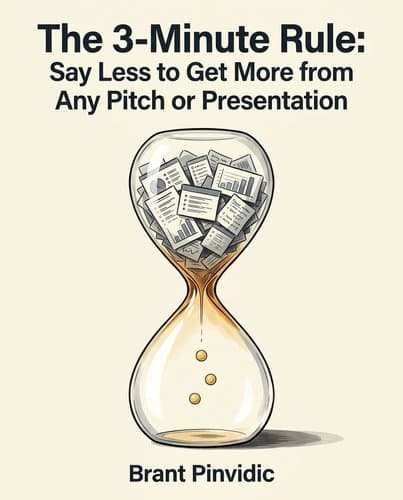
49351774_the-3-minute-rule
by Brant Pinvidic
Your audience will build a three-minute rationalization story about your pitch whether you guide them or not—so stop presenting what you want to say and start…
In Brief
The 3-Minute Rule: Say Less to Get More from Any Pitch or Presentation (2019) argues that every audience constructs a three-minute rationalization story regardless of how long you speak — so your pitch should reverse-engineer that story and become it.
Key Ideas
Categorize ideas into four strategic buckets
Turn every idea about your pitch into single-word or two-word bullets — shoot for 30 or more. Then sort them into four buckets: What is it, How does it work, Are you sure, Can you do it. Eliminate anything that doesn't fit clearly into one of the four. What remains is the skeleton of your three-minute pitch.
Use three-stage ninety-sixty-thirty timing structure
Build your pitch in three timed stages: Conceptualize in the first 90 seconds (what it is and how it works), Contextualize in the next 60 seconds (proof that it's real), Actualize in the final 30 seconds (execution and next steps). Never introduce facts or proof before the audience has a conceptual foundation — they can't evaluate what they don't yet understand.
Information always precedes engagement statements
Label every pitch statement as either Information (what the audience needs to grasp the basics) or Engagement (what they'll find compelling only once they understand). Never open with an engagement statement, even if it feels like your most exciting material. The jigsaw puzzle rule: edge pieces before interior pieces, always.
Build sequentially until audience self-concludes
Don't open with your hook or edge. Build to it through sequential information until the audience is nearly forming your conclusion themselves — then let it land. The test: if you state the claim first and hands go up in disagreement, you're leading with the hook too early. If they finish the sentence for you, you got the sequence right.
Address objections before they fixate minds
Before any pitch, ask yourself: What's the last thing I want the audience to start thinking about? What would a competitor say about us in this room? Identify the objection that's already forming in skeptical minds — then address it in your first three minutes, before they fixate on it during the parts you actually care about.
End in silence, protect the signal
When your pitch is done, stop talking. No tagline, no pun, no call to action. The very first words out of the audience's mouths in the following silence will tell you more about what landed than any self-evaluation. Protect that signal — don't dilute it with a rehearsed close.
Who Should Read This
Business operators, founders, and managers interested in Public Speaking and Persuasion who want frameworks they can apply this week.
The 3-Minute Rule: Say Less to Get More from Any Pitch or Presentation
By Brant Pinvidic
10 min read
Why does it matter? Because your audience is already building a three-minute verdict while you're still on slide one.
The instinct is almost universal: when a pitch matters, you prepare more. More slides. More data. More rehearsed enthusiasm. And it makes sense — if understanding your idea would persuade them, then more information should persuade them faster. Except it doesn't. Brant Pinvidic spent two decades in the room for nearly ten thousand pitches across TV, Fortune 100 boardrooms, and oil fields, and the pattern he kept seeing ran in exactly the opposite direction. The presentations that closed fastest weren't the most thorough. They were the shortest. Because while you're still talking, your audience is already drafting a brief, ordered story to explain their decision — to themselves and to whoever they answer to. That story will almost never exceed three minutes. This book is about writing that story before they do, and making sure it says what you want.
Your Audience Is Already Writing a Three-Minute Summary of Your Pitch — The Question Is Whether They're Getting It Right
Brant Pinvidic was waiting in a Washington DC lobby to take his friend Howard to lunch. Howard had just become president of the National Geographic Channel, and Pinvidic had a show under consideration in the network's green light meeting that morning — the kind of meeting where shows either get ordered or die on the spot. He wasn't worried. Howard loved the concept.
Then Howard's secretary appeared and asked him to come upstairs.
He walked into a conference room with 43 people around the table. Marketing, scheduling, finance, legal, HR, principals, deputies, deputies to the deputies. Howard had been trying to explain Pinvidic's show to this group and something had curdled in the retelling. The room was confused. People were actively hunting for reasons to say no. Pinvidic could feel the order slipping with each minute of muddled discussion.
He gave the pitch himself. The conversation ended. They got a six-episode order. He was escorted out immediately so the committee could do the same thing to the next producer — the one who wasn't waiting in the lobby.
Two realizations came out of that room. The first: this is how decisions get made now, across every industry. The second was more unsettling. Winning over the decision-maker isn't enough. Howard had understood the show completely. He was the president of the network. And he still couldn't relay it in a way that survived one pass through a committee. Your pitch needs to survive being handed from person to person without you there to correct the damage.
Here's the mechanism. When anyone makes a decision, the brain automatically constructs a short, ordered justification from the most important elements. Try it: ask yourself why you drive the car you drive, then keep asking why. Your answers come out in short declarative sentences, most important factors first, without you consciously organizing them. You're not inventing that story — you're discovering the one your brain already built. That's what your mind uses to explain the decision to yourself and anyone who asks.
Every audience member is building that story while you talk. No matter how long your presentation runs, they'll compress it into under three minutes when it counts. The question is never how much information you gave them. It's whether their three-minute version matches yours — or whether they wrote their own. Which means your only real job, before you walk into any room, is to give them the right story first.
Nine Sentences Closed a Billion-Dollar Franchise. Everything You're Saying Beyond That Is Working Against You.
Six TV producers had spent three weeks in a Los Angeles conference room trying to explain a show they all understood but no one else could follow. The concept: take people too obese to qualify for The Biggest Loser, film them losing weight for an entire year, compress that transformation into one episode per person. No teams, no elimination. Just one person's year-long journey collapsed into an hour. Inside that room, the idea was obvious. The moment anyone else walked in, it unraveled into an 18-minute tangle of production logistics and budget caveats that left everyone confused.
In a fit of frustration, Brant Pinvidic had his team write every statement describing the show on individual Post-it notes and cover the wall. More than a hundred went up. Then he started pulling them down — not the wrong ideas, but the inessential ones. He was ruthless about it: every note that explained, elaborated, or proved something the audience didn't need yet came off the wall. When he finished, seven notes remained.
He called John Saade, the head of ABC, and asked for a meeting in thirty minutes. He drove up the freeway, waited an hour in the lobby, then walked into Saade's office carrying no pitch deck, no PowerPoint, no budget breakdown — just a DVD of morbidly obese applicants who'd failed the Biggest Loser tryouts.
He delivered nine sentences. It took just over a minute.
Overweight people too large for The Biggest Loser. Followed for a full year. That entire year compressed into one episode. Starting fat, ending thin, all within an hour. Each person their own episode. The biggest personal transformation ever seen on television, every single week. And then the close: Saade might not even hold this job by the time the show aired, but he could walk his boss a DVD and say he'd seen something big first.
Saade called back an hour later. Ten episodes. Under a million per. Don't pitch it elsewhere.
Extreme Makeover: Weight Loss Edition ran five seasons and more than fifty episodes on ABC, aired in fifty-plus countries, and generated hundreds of millions in revenue.
The before-and-after on Pinvidic's broader slate makes the same argument with numbers. Before the Post-it method: ninety days to get an idea to market, $30,000 per pitch, one sale in ten. After: under thirty days, under $10,000, and a dramatically higher hit rate. He was doing less work and selling more.
What's tempting to resist is the obvious objection: surely some detail he cut might have been the thing that closed the sale? But Saade's questions after the pitch weren't objections. They were a decision-maker working out the logistics himself. He already wanted to say yes; he needed room to figure out the how. Saade didn't need the production calendar or the budget breakdown; he needed enough to want to ask for them. That's what a good pitch does: it gets someone to a question, not an answer. The answer is for later. The question means they're in.
Your Pitch Isn't Failing Because of Bad Information — It's Failing Because of Sequence
Try reading step 12 of a flat-pack manual before you've assembled the base. The words are accurate, the diagram is clear, but nothing connects, so nothing sticks. Information doesn't fail because it's wrong. It fails because there's no foundation to attach it to yet.
On a three-hour bus ride to a British Columbia heli-skiing lodge, Pinvidic sat next to Jeff, a plumber who ran a nationwide re-piping company. His trick: instead of tearing out walls to replace aging copper pipes, his crews fed flexible plastic tubing through tiny holes in the drywall, threading around the old pipes left in place. An entire house re-piped in a day, the homeowner never needing to leave. Jeff had once re-piped a full hotel while guests were sleeping, his crews moving suite to suite each morning in street clothes, no one the wiser.
The value was obvious, once you knew what you were hearing. But Jeff started with copper vs. PEX pipe grades, moved to his contractor certification process, then looped back to explain what the service actually was. Pinvidic pulled a fellow skier over to listen. Polite nods, pleasant small talk, conversation drift. The information wasn't wrong. The sequence killed it.
Pinvidic then pulled over a second skier and delivered the rebuilt version himself. Concept first: they re-pipe entire homes. Then the twist — old pipes stay in place — which triggers the obvious question, answered with the mechanism: flexible plastic, tiny holes, no drywall. Two questions down. The hotel story came last. On its own it sounds like a boast, but it's doing two jobs: confirming the service works at scale (are you sure?) and proving the crews can execute without anyone noticing (can you do it?). Fifteen skiers gathered around the table.
Jeff had been saying the right things for years. The order was the only thing wrong.
He named the sequence WHAC: What is it, How does it work, Are you sure, Can you do it. The first two occupy the first ninety seconds and do most of the work. Proof and credentials follow, but only land once the audience has grasped the concept. By then they're looking for reasons to say yes.
Facts need context to land. Context needs understanding. Understanding needs premise. You can't skip to the hotel story if no one knows what re-piping is yet.
Don't Open With Your Best Idea. Make the Audience Earn It.
What's the instinctive move once you've found your single most compelling claim? Lead with it. Drop your best idea first, then spend the rest of your time proving it was true. Every sales training from the last thirty years built this into its DNA: create desire, then explain the offer. Call it state-and-prove.
The problem is that a conclusion you hand an audience is something they'll argue with. A conclusion they reach themselves is something they'll defend. Audiences saturated by marketing have learned to treat any grandiose opening claim as adversarial. When you lead with your conclusion, you're not creating desire — you're handing them a target. Everything that follows gets measured against it, skepticism as the default.
Pinvidic demonstrated this live at a keynote for a room full of professional speakers. He put a photo of Katy Perry on the screen and stated flatly that she was the most successful female performer in music history. The room erupted. One woman in the corner, Jamilla, looked like she might physically leave. He'd handed them a target and they shot at it immediately.
Then he restarted with the same subject and a different method. No claim — just facts, one after another. First female artist to land five singles at number one from a single album, a record second only to Michael Jackson. First artist with multiple billion-view videos. Eight Guinness World Records. Sixty-nine consecutive weeks at number one. Eighteen consecutive chart-toppers, with no other artist in the same conversation. More than a hundred million records sold. He walked over to Jamilla: "Do I even need to say it?"
Jamilla, the woman who'd looked ready to walk out, fist-bumped him. He hadn't changed a single fact.
That's what Pinvidic calls inform-and-lead. Your hook — the "ah, that's cool" moment — carries far more weight as confirmation than as a claim. By the time you say it out loud, your audience should already be thinking it. The goal, Pinvidic says, is to build to a hook you almost don't need to say.
Name Your Weakness Before the Audience Finds It — and Watch Them Sell Your Idea Back to You
Over breakfast in Los Angeles, Jon Bon Jovi demolished the premise of their show. The concept, working title What If, was to take music stars and film them spending a week in whatever job they might have landed if music hadn't worked out. But sitting across from Pinvidic, Jon cut to it: there was no version of him without music. He'd never considered anything else, and neither had any friend he'd recruited for the project. The whole show rested on a premise the talent didn't believe.
Pinvidic's instinct was to power through, bury the concern in enthusiasm, and sort it out after the pitch. Instead, he put the doubt into the pitch itself. Walk into every network meeting and state plainly that these artists had never once imagined doing anything else, then let that admission become the tension the show had to resolve.
At ABC, the effect was immediate. The moment he acknowledged that no star they'd cast had ever genuinely considered another career, and that this risked coming across as celebrities looking down at regular people, the head of the network cut in. That's the draw, she said: watching someone like Jon actually reckon with a different life, finding things about ordinary existence that years on the road had kept from him. She was selling the show back to him. The pitch had become a conversation, and she was on his side of it. Four networks made offers.
The mechanism is uncomfortable and it works: your audience is already composing their objections while you're still talking. Every skeptical person has a "what about" forming, the flaw they're waiting for you to avoid. When you surface it first, you show you've seen the problem and thought past it. And you hand the audience a role: they become the people defending your idea rather than hunting for holes in it.
In a separate case, a biotech CEO presenting a migraine breakthrough sidestepped a minor debt issue in his financials. He fielded eleven straight questions about the debt before anyone asked about the drug. Investors who passed later told him they didn't trust him. The information was technically disclosed, but the silence around it read as concealment. Audiences don't just resent hidden negatives; they read them as evidence that everything else might be hidden too.
Surface the flaw yourself. If it were a real deal-breaker, you wouldn't be in the room.
The Moment You Feel the Need to Sell, You've Already Broken the Spell
The moment you feel the urge to push — to add one more compelling adjective, to repeat the key point with more force, to end with a memorable tagline — you've already signaled to your audience that you don't trust your own information. And they'll believe you.
Peter, presenting at a small-cap investor conference, proved this. With under an hour before his presentation, Pinvidic helped him strip a 39-slide deck crammed with dense paragraphs down to simple bullet points: six lines, sixteen words, where one slide had previously held over a hundred. The rebuilt version was clean and clear. The test run sounded like a vast improvement.
Then Peter took the stage and fell apart. He sweated through every phrase. He lost track of which slide came next. He stood there visibly uncomfortable, at one point literally reading the bullet points aloud and explaining them as if encountering them for the first time. From his seat, Pinvidic felt secondhand pain.
When Peter asked for questions, the room erupted. Every investor wanted in. It was the most engaged audience response Peter had ever received. He was too consumed by his own embarrassment to notice.
The information performed in spite of the presenter. Not because Peter recovered his footing or found his confidence, but because the information was clear enough to stand on its own once the clutter was gone. The story does the work; style is optional. Delivery confidence, vocal authority, the length of your pauses: none of it matters if the information is organized and simple enough to carry itself. The more you feel the need to sell, the more you reveal that you don't trust what you're saying. Audiences sense it faster than any fact you state.
The same principle that saved Peter's pitch governs what you do when it's over. After your last statement, stop. No tagline, no call to action, no punchy close. The first thing your audience says in the silence after you finish will tell you more about what landed than any amount of crafted performance. A deliberate ending reminds them they've been watching a pitch. Silence lets them stay inside the idea.
The Pitch That Was Always Going to Be Three Minutes
Pinvidic's father drove to Toronto to pitch a dental treatment to one of Canada's largest insurance groups. His car was broken into before the meeting. Slides, projector, luggage — gone. He walked in wearing travel clothes, apologized, and pitched from memory. Without handouts to flip through, eight executives looked up. They listened.
The lesson wasn't about composure under pressure. It was more uncomfortable: the slides had been getting in the way the whole time.
He walked into the most important meeting of his career in travel clothes, with nothing in his hands. And it was one of the best meetings of his career. The three minutes were always the whole thing. He just finally got to hear them unobstructed.
Notable Quotes
“I don't know what to do with this, but it's big, and you are seeing it first.”
“How can you afford to follow the contestants for an entire year?”
“We rotate crews and use remote cameras in their houses,”
Frequently Asked Questions
- What is the 3-Minute Rule about?
- The 3-Minute Rule argues that every audience constructs a three-minute rationalization story regardless of how long you speak. Brant Pinvidic's framework teaches you to reverse-engineer that story and make your pitch become it by stripping it down to four essential questions: What is it, How does it work, Are you sure, and Can you do it. The core premise is that saying less, not more, is what gets buy-in from your audience. The approach focuses on practical steps for organizing your ideas into a framework that audiences can follow and internalize within three minutes, maximizing impact through strategic simplicity.
- How do you structure a pitch using the 3-Minute Rule framework?
- The 3-Minute Rule uses a four-bucket framework to organize your pitch. First, turn every idea into single-word or two-word bullets (targeting 30 or more), then sort them into four categories: What is it, How does it work, Are you sure, and Can you do it. Then build your pitch in three timed stages: Conceptualize in 90 seconds (what it is and how it works), Contextualize in 60 seconds (proof that it's real), and Actualize in 30 seconds (execution and next steps). This structure ensures audiences grasp the core concept before encountering supporting details or proof.
- Why is sequencing information before engagement important when pitching?
- Sequencing information before engagement is crucial because audiences cannot evaluate what they don't yet understand. Every pitch statement should be labeled as either Information (what the audience needs to grasp the basics) or Engagement (what they'll find compelling only once they understand). Never open with an engagement statement, even if it feels like your most exciting material—this follows "The jigsaw puzzle rule: edge pieces before interior pieces, always." Building to your hook through sequential information means the audience nearly forms your conclusion themselves before you land it. If people disagree with your claim, you led with the hook too early.
- Why should you stop talking immediately after your pitch?
- You should stop talking immediately after your pitch because the very first words out of the audience's mouths in the following silence will tell you more about what landed than any self-evaluation. Pinvidic emphasizes: "Protect that signal — don't dilute it with a rehearsed close." No tagline, no pun, no call to action should follow your pitch. This silence is valuable feedback revealing what genuinely resonated with your audience. If you add a rehearsed closing statement or tagline, you risk obscuring the authentic audience response that tells you whether your three-minute structure actually worked.
Related Book Summaries

Read the full summary of 49351774_the-3-minute-rule on InShort