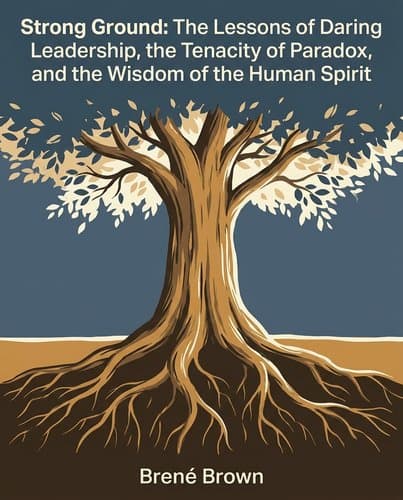
224082571_strong-ground
by Brené Brown
Most leaders build on dysfunction and wonder why the same problems keep recurring—Strong Ground reveals how to audit your core stability first, then lead from…
In Brief
Most leaders build on dysfunction and wonder why the same problems keep recurring—Strong Ground reveals how to audit your core stability first, then lead from genuine human connection, paradox tolerance, and self-awareness that generates lasting force instead of ego-driven compensation.
Key Ideas
Foundation audit prevents compensation injuries
Before launching any leadership initiative — AI adoption, culture change, new capability building — audit the core first: are people operating from fear and shame, or from genuine accountability and connection? Building on dysfunction produces compensation injuries that will keep recurring.
Catching patterns beats right reactions
Practice the Above/Below the Line framework in real time: name when you've gone below the line (fear is driving), call a time-out, and return with Creator/Challenger/Coach orientation rather than Hero/Villain/Victim. The awareness and pause are the skill — not having the right reaction, but catching the wrong one.
Flexibility outperforms plan commitment
Treat your strategies as hypotheses, not convictions. The Italian startup data is unambiguous: teams that pivot when evidence contradicts assumptions outperform teams that stay wedded to their original plans by 40x. Build 'I might be wrong about this' into your planning process explicitly.
Define the real problem first
Use the 5 C's (Context, Color, Connective Tissue, Cost, Consequence) before delegating or presenting strategy — not as a checklist but as a discipline against action bias. The goal is problem identification before problem solving; most requests for data are actually requests for the wrong data.
Transition time is non-negotiable
Design a lock-through protocol for your highest-demand transitions. Identify the specific 'mid-chamber questions' that capsize you, negotiate the time and ritual you need to equalize, and treat that transition time as non-negotiable capacity maintenance rather than self-indulgence.
I don't know is daring
Audit your relationship with certainty: where are you in Preacher, Prosecutor, or Politician mode rather than Scientist mode? Keats's negative capability — staying in uncertainty without irritable reaching — is a trainable skill, and 'I don't know, let's slow down' is often the most daring leadership move available.
Attention is your real bottleneck
Protect the S( )R space structurally, not just personally. Identify which tools, platforms, or habits are colonizing the gap between stimulus and response — and treat attention as the non-renewable organizational resource it actually is.
Who Should Read This
People working on personal growth in Leadership and Decision Making, especially those tired of generic motivational advice.
Strong Ground: The Lessons of Daring Leadership, the Tenacity of Paradox, and the Wisdom of the Human Spirit
By Brené Brown
15 min read
Why does it matter? Because the leadership initiatives you're launching are probably built on the same dysfunction they're meant to fix.
Most leadership development operates on a silent assumption: that you add the new thing on top of what's already there. New framework, new tool, new capability — stack it on and see what happens. The problem is that what's already there is often a compensation pattern, not a foundation. You've been running on the wrong muscle groups for so long that the compensation feels like strength. Brené Brown spent years watching organizations do this — and then blew out her back playing pickleball and had a trainer explain exactly what was happening to her body. The diagnosis was the same in both cases: you can't build functional power on top of dysfunction. What follows is the unsexy, unavoidable work of developing a real core — the emotional regulation, the paradox tolerance, the human connection — before you build anything else on top of it. Because everything you're trying to add? It's only as strong as what it's standing on.
You Can't Build on Dysfunction — and Most Organizations Are Trying To
In 2022, Brené Brown tore something in her leg playing pickleball and ended up on the floor in the kind of pain that makes you reconsider your vocabulary. When she finally got to a trainer named Tony, he ran her through a physical assessment and delivered a verdict that stopped her cold: 'We will not build on dysfunction.' Her quads and arms were strong — impressively so — but they'd been quietly doing the job her core was supposed to do. Her lats, glutes, and abdominal muscles had gone soft, and the rest of her body had compensated so smoothly she hadn't noticed. Until the floor.
Tony's verdict was specific: the problem wasn't the muscles that were hurting. It was the muscles that weren't pulling their weight, forcing everything else to overperform. Add training load on top of that pattern, and you keep getting hurt in new places.
You already know where this is going, because you've lived it at work. A new technology rollout lands on a team that's been running on fear for three years. A culture initiative gets announced in an organization where people have learned that raising concerns ends careers. A leadership development program launches inside a structure that quietly punishes the behaviors it claims to want. These aren't implementation failures — they're compensation injuries. The new capability is real, the investment is real, but it's being loaded onto a core that was never fixed.
Brown calls this 'building on dysfunction,' and she's clear that it doesn't work at the organizational level any more than it worked in her body. The strong ground — what Tony helped her find by pressing her feet deliberately into the floor and activating the muscles actually designed for power — has an organizational equivalent: people, and the quality of connection between them. That's the core. Not the productivity apps, not the AI integration, not the transformation roadmap. When the core is compromised by shame-based leadership, every new initiative just gives the wrong muscles more weight to carry.
The Things That Feel Like Strength Are Often What Make You Fragile
The instinct to reach for certainty when things get hard feels like strength. It isn't. It's the cognitive equivalent of overworked quads — a compensation pattern that looks like performance until it breaks you somewhere you weren't expecting.
Jim Collins interviewed Admiral Jim Stockdale, who survived nearly eight years as a prisoner of war in Vietnam, tortured more than twenty times, tasked with keeping fellow prisoners alive and hopeful. When Collins asked who didn't make it out, Stockdale didn't hesitate: the optimists. The men who told themselves they'd be home by Christmas. Then by Easter. Then by the following Christmas. Each deadline passed, and each failure of faith compounded until, as Stockdale put it, they died of a broken heart. Pure positive belief, deployed as a shield against brutal reality, wasn't resilience — it was fragility with better marketing. What Stockdale actually practiced was something far harder: an unshakeable conviction that he would eventually prevail, held simultaneously with a clear-eyed confrontation of how bad things actually were right now. Brown's organization calls this combination 'gritty faith and gritty facts,' and most leadership cultures systematically reward only one half of that equation.
Analytical firepower runs the same trap, just dressed in credentials. Adam Grant's research found that higher analytical ability doesn't protect against motivated reasoning — it accelerates it. People who excelled at math were highly accurate when analyzing data about skin rashes. Give them identical data, relabeled as evidence about gun control laws that contradicted their political beliefs, and their accuracy collapsed. The strongest math performers showed the biggest drop. The ability to handle numbers didn't make them more objective; it made them more efficient at bending the data toward what they already believed. The optimists set a Christmas deadline. The analysts ran the numbers until the numbers agreed with them. Same move, different costume.
Keats had a name for the actual skill: negative capability. He described it as the capacity to remain in uncertainty and doubt without irritably grasping for facts and explanations that aren't yet available. Most of us are running the opposite program. When the answer isn't clear, we reach — for a confident prediction, a tidy framework, a conspiratorial explanation that feels like knowledge. Negative capability looks different in practice: a leader who says 'I don't know yet, here's what I'm watching' instead of forcing a forecast nobody believes. It's sitting in the discomfort long enough to let the actual signal emerge. The more durable move — the one that takes real strength — is to hold the uncertainty without collapsing it prematurely.
Treating Your Strategy Like a Hypothesis Is Worth $11,700 in Revenue
Think about the last strategy your team committed to. Somewhere in that commitment — in the confidence you projected, the resources you allocated, the timeline you defended — was a quiet assumption that the plan was right until proven catastrophically wrong. That assumption has a cost, and a group of Italian startup founders accidentally ran the experiment that quantifies it.
More than a hundred entrepreneurs went through an identical training program covering strategy, customer interviews, product development, and prototyping. The only difference: half were taught to treat their business model as a hypothesis — something to be measured, tested, and discarded if the evidence said so. One year later, the conventional-execution group averaged under $300 in revenue. The scientific-thinking group averaged over $12,000. They pivoted more than twice as often, not because they were less committed, but because they updated their commitment based on what was actually happening rather than what they'd originally believed.
Adam Grant names the failure mode most leaders fall into instead: the Preacher, who protects convictions from challenge; the Prosecutor, who marshals evidence to win arguments rather than find truth; the Politician, who reads the room. Picture the startup founder who's already decided the product works and runs the customer interview like a closing call — steering toward confirmation, not data. That's the Preacher. It feels like leadership. It isn't compatible with what those Italian founders did. The alternative — the Scientist — starts from a different posture: a plan is an educated guess, data either supports or refutes it, and changing course when the evidence demands it is the job, not a failure of nerve.
Conviction is valuable. The question is whether you're aiming it at your goal or your original plan for reaching it. Those are not the same thing, and the $11,700 difference is what it costs to confuse them.
Fear Is Already Driving — You're Just Not Watching the Road
How much of what you do in a hard moment is actually chosen? Not the outcome — the response. The flash of irritation when someone drops the ball, the protective silence when you're criticized in front of peers, the sudden certainty that you might as well handle it yourself because clearly no one else will. If you're honest, most of that happens before you've decided anything. You're already reacting. Fear is already driving. You just didn't notice you gave it the wheel.
Brown uses a framework borrowed from two psychologists to map what this looks like in practice. Below the line, fear pulls people into one of three reactive roles: the Hero who swoops in to rescue, the Villain who assigns blame, or the Victim who retreats into grievance. Above the line, the same person in the same situation can show up as a Creator who solves, a Challenger who asks hard questions, or a Coach who builds capacity.
Brown offers her own case to make this concrete. A teammate sends an email that accidentally copies the wrong person, leaking early details about a client's unpublished book. In the seconds after she hears this, three below-the-line roles arrive at once: 'I'll just do this myself from now on' — that's the Hero. 'No one understands how much pressure I'm carrying' — that's the Victim. 'This makes me look careless, not them' — that's the Villain. All three, before she's said a word. What she does next is the actual skill: she names it, says she needs a few minutes, and comes back with questions about what happened and how to build systems that prevent it. Creator, Challenger, Coach.
The point isn't that she got it right the second time. The point is the pause — the fifteen minutes between the trigger and the response. That gap is where leadership actually lives. A senior leader proved the same thing recently, mid-session with ninety colleagues. He was delivering hard feedback when he stopped himself and simply said: 'I'm below the line. Can we take an hour?' His direct report immediately answered: 'So am I. Thank you.' A potential conflict became a moment of trust that every person on that call witnessed.
Brown is clear that this is a practice, not a personality trait. Knowing the Drama Triangle by name does nothing if you can't catch yourself in the middle of it. The muscle underneath the framework is the thing — and that muscle is built by doing this badly, repeatedly, until the pause starts to arrive a little sooner.
'Executive Presence' Is a Black Box — Here's What's Actually Inside It
'Executive presence' is a cover story. Adam Grant said it plainly in a text exchange with Brown: it's cover for discriminating against women, introverts, and anyone who doesn't conform to the command-and-control archetype. The phrase sounds like a rigorous assessment. It functions as a black box — you either have it or you don't, and who decides tends to look a lot like whoever already has it.
Brown wanted to know what was actually inside the box. The answer came from football. A quarterback in the pocket has roughly two and a half seconds before an average of four defensive linemen — each weighing around 310 pounds — close in to dismantle him. What allows someone to function clearly under that specific kind of pressure isn't charisma. It's a set of trainable, measurable skills: reading the field, regulating fear without suppressing it, making decisions before the full picture is available, and trusting the preparation that happened long before game day.
That last piece is where Michael Phelps comes in — not as a second example, but as the mechanism made visible. At the 2008 Beijing Olympics, Phelps's goggles filled with water shortly into the 200-meter butterfly. He swam 175 meters blind. He still won the gold and broke the world record. His coach Bob Bowman had spent years rehearsing failure scenarios with Phelps — not just visualizing success, but running through what to do when equipment malfunctioned, when conditions turned hostile. The composure Phelps showed wasn't temperament. It was metacognition prepared in advance: he knew what he was feeling, why he was feeling it, and what to do next, because he'd already thought about it before the crisis arrived.
That's what grounded confidence actually is — not calm as a personality trait, but the practiced capacity to think about your own thinking under load. Brown maps it as a system of interdependent skills: metacognition, emotional regulation, the ability to read a situation because you've seen enough of them, and the courage to hold uncertainty without reaching for false certainty. These are learnable. They take as long to build as a quarterback's pocket presence, and most organizations invest approximately nothing in developing them. The black box isn't mysterious. It's just work we haven't been willing to name.
The Plumbing Needs Poetry, and the Poetry Needs Plumbing
A woman in a hairnet pushes a dessert cart through a children's cancer hospital and tells a visitor, without hesitation: 'I cure cancer.' She's a cafeteria worker at St. Jude Children's Research Hospital, not a researcher or a clinician, and that sentence is the most precise description of her job she could possibly offer. The mission — finding cures, saving children — runs all the way down to the cart wheels.
Brené Brown had a bias she was eventually forced to say out loud: she associated management with compliance, control, and the suppression of human potential. She wanted organizations full of leaders — people who inspire, take risks, connect vision to action. Managers, in her mental model, were leaders who hadn't fully developed yet. Ginny Clarke, a former Google executive recruiter, sat across from her and took that apart. A manager, Clarke argued, is not a pre-leadership state. It's a distinct professional with a specific skill set — planning, organization, delegation, problem-solving — who turns vision into something that actually happens. Without that, vision is just weather. Brown eventually admitted what she'd been doing: testing every manager for their love of poetry and dismissing anyone who couldn't pass.
The St. Jude cafeteria worker is what mission clarity actually produces. When the mission is visible all the way to the cart, the distinction between the poetic and the operational doesn't shrink — it disappears. 'Plumbing' stops feeling like a lesser category of work because it isn't one anymore; it's the mission, expressed in pipes. The manager who ensures the trains arrive on time and the leader who decides where the trains should go aren't doing the same work at different scales. When mission is clear, they're doing the same work. The scale is just where they're standing.
True Transformation Requires Breaking Things — But Not Like That
Imagine someone hands you a sledgehammer and tells you the building needs to come down. That's transformation, right? Move fast, hit hard, clear the ground for what's next. The problem is that a sledgehammer in the hands of someone who's scared is just destruction with a press release.
James Vowles took over as team principal at Williams Racing in Formula 1 knowing exactly what he was walking into: years of underperformance, entrenched habits, a culture that had settled into its own limitations. With the sport's major regulatory overhaul arriving in 2026 — new car designs, new performance equations, the whole competitive landscape reshuffled — he made a decision that would have gotten most leaders fired. He told his team, publicly, that he didn't care about finishing well in 2023, 2024, or 2025. Finish last if you have to. Break everything. You have a free pass from me — if there's a better way to do something, find it. The short-term losses were the point. The breaking was the strategy.
What separates that from recklessness isn't the willingness to destroy something. It's what Vowles was doing underneath it. Brown describes the difference with two words that don't usually appear in the same sentence as 'demolition': intention and affection. Strategic deconstruction is careful. It knows what it's dismantling and why. It's led by people who grieve what isn't working rather than celebrate knocking it down. The people who enjoy the breaking, Brown argues, should never be the ones leading it — because that enjoyment is almost always a signal: the need to be seen as the one who had the courage to burn it down.
The trap organizations fall into is believing that urgency and force are the same thing as readiness. They announce transformation, skip the honest inventory of what they're actually willing to dismantle, and load a new initiative onto the same dysfunctional core. Brown calls this magical thinking about readiness — and it shows up in a specific way: leaders who can name exactly what needs to change but quietly protect the legacy metrics that prove they were never wrong. That's its own form of dysfunction, quieter than the chainsaw but just as costly. Vowles didn't announce transformation and then protect his legacy metrics. He staked three competitive seasons on the willingness to be genuinely, measurably worse before he could be better. That's what real readiness looks like. Most organizations say they want it. Almost none of them are prepared to feel it.
You're Locking In Fine — It's the Lock-Through That's Capsizing You
Gemma is the first woman to hold the Lead Lock and Weir Keeper position at Teddington Lock in over two centuries — which means she manages the unglamorous, essential work of moving boats between bodies of water at different levels. When Brown watched her work and asked whether there was a way to speed up the process of filling the lock chamber, Gemma's answer was immediate: no. The transition takes what it takes. Force more water in faster and the turbulence capsizes the vessels inside.
Brown called her husband Steve from London that night. 'I'm capsizing when I get home,' she told him. 'I'm rushing the transition and it's too turbulent.' She'd spent years arriving home from high-pressure work — deeply introverted, cognitively depleted, still carrying what Sophie Leroy calls attention residue, the previous context that lingers in your mind when you switch tasks before the first one is mentally closed — and getting hit immediately with two questions she described as pushing her so far underwater it felt like drowning: 'How was your day?' and 'What do you want for dinner?' Neither question is hostile. Both arrive mid-chamber, before equalization, and that's the whole problem.
The protocol she and Steve negotiated is specific enough to be worth stealing: twenty to thirty minutes after a full workday — sparkling water, sweatshirt, makeup off, alone. No conversation until the water levels match. Steve got it immediately. He's a fisherman; he understood locks.
Without deliberate reentry, elite lock-in becomes a liability. The chamber stays pressurized. The turbulence follows you home, or inward, and eventually something capsizes.
The capability isn't one thing. It's two: the power to lock in, and the practiced, unhurried skill of locking through. Toughness without tenderness isn't stronger. It's just more likely to flip.
The Space Between Stimulus and Response Is the Only Place Freedom Lives
Brown writes the formula S( )R on everything she owns. The parentheses are the point. That gap — between what happens to you and how you respond — is where freedom actually lives, and keeping it open turns out to require active maintenance, because the things designed to colonize it don't look like threats.
Brown developed the framework in sobriety, and the early version was anything but spacious. Getting sober didn't feel like coming home to herself; it felt like standing in front of a fun-house mirror. She'd spent years building armor — a Good Texas Girl Playbook, a family ethic she summarizes as either react immediately or beat the threat to the punch — and without alcohol, she could suddenly see how little she recognized beneath it. She describes that first year as jamming her foot between the parentheses the way you jam a foot between closing elevator doors.
What the practice eventually built is what the AA Big Book calls neutrality: not white-knuckling against temptation, but arriving somewhere the problem has genuinely been removed. Not cocky, not afraid. The space isn't held open by willpower. The AA literature calls it "fit spiritual condition"; Brown translates it as the ongoing maintenance work of humility, curiosity, and staying human.
The threat she didn't anticipate was structural. She left Twitter when authentic connection became functionally impossible. Then a month of heavy AI use left her feeling, in her word, hollowed out. An MIT study she cites found that heavy reliance on large language models reduces measurable neural engagement — the brain offloads work it used to do itself. Researcher Kate Crawford frames the whole category as an extractive industry: it processes what humans created, runs on planetary resources, and returns something that feels like thinking but has had the actual cognitive labor removed. Brown's response was to build back deliberately — what she calls "symphonic thinking," the practice of holding multiple conflicting inputs in tension long enough for a genuinely original read to surface, rather than reaching for the tool that resolves the tension fastest.
The S( )R space is where grounded confidence lives — where the quarterback reads the field, where the surgeon makes the call in hour eleven, where you catch yourself going below the line and choose otherwise. Every tool that habituates your brain to outsourcing that gap makes the gap smaller. The plumbing Brown builds across this book — the emotional regulation, the metacognition, the deliberate recovery after lock-in — all of it exists to keep that space open. The poetry is what you find there.
What 'Strong Ground' Actually Means
The tools in this book are only useful if you're stable enough to reach for them when it matters — when fear is already driving, when the story you're telling yourself is three steps ahead of the facts, when someone is waiting for an answer and you're still mid-chamber. Strong ground has to be there before the pressure arrives, not summoned in the moment you need it. So the real question Brown leaves you with isn't about capability. It's about honesty. Where are you quietly building on top of something that isn't working — a culture held together by fear, a strategy you've stopped treating as a hypothesis, a transition you keep rushing because stillness feels like weakness? The frameworks are real. The data is real. But none of it fires if the core isn't there. And fixing the core starts with being willing to press your feet into the floor and feel what's actually holding you up — and what isn't.
Notable Quotes
“I’m below the line. This is not productive. Can we pause and circle back in an hour or so?”
“No way, it’s too much.”
“No. The transition takes what it takes. If you force more water into the chamber, it will become very turbulent and vessels could capsize.”
Frequently Asked Questions
- What is the main argument of Brené Brown's Strong Ground?
- Strong Ground argues that effective leadership requires building on a stable human foundation—self-awareness, accountability, and genuine connection—rather than compensating for unexamined dysfunction. The book emphasizes that before launching any leadership initiative—AI adoption, culture change, or capability building—leaders must audit the core: are people operating from fear and shame, or from genuine accountability and connection? Building on dysfunction produces compensation injuries that will keep recurring. The book offers frameworks and practical tools for tolerating uncertainty, managing transitions, and making decisions from strength rather than fear or ego.
- What is the Above/Below the Line framework in Brené Brown's Strong Ground?
- The Above/Below the Line framework helps leaders recognize when fear is driving their actions. When you've gone below the line (fear is driving), you call a time-out and return with Creator/Challenger/Coach orientation rather than Hero/Villain/Victim. The awareness and pause are the skill—not having the right reaction, but catching the wrong one. This real-time practice trains leaders to shift from reactive patterns driven by ego or fear to intentional, values-aligned responses that draw on different strengths and perspectives.
- What does Brené Brown recommend about strategy in Strong Ground?
- Brené Brown recommends treating your strategies as hypotheses, not convictions. She cites Italian startup data showing that teams that pivot when evidence contradicts assumptions outperform teams that stay wedded to their original plans by 40x. Leaders should build 'I might be wrong about this' into their planning process explicitly. This approach replaces rigid adherence to initial assumptions with adaptive learning, creating continuous space for course correction based on real-world feedback and enables organizations to respond to market realities with strategic agility.
- What are the 5 C's framework in Brené Brown's Strong Ground?
- The 5 C's (Context, Color, Connective Tissue, Cost, Consequence) provide a discipline against action bias before delegating or presenting strategy. The framework is not as a checklist but as a discipline against action bias aimed at problem identification before problem solving. Most requests for data are actually requests for the wrong data. By working through the 5 C's systematically, leaders ensure they understand the full picture of their challenges—what's driving the issue, what patterns exist, what's connected, what's at stake—before rushing to solutions.
Related Book Summaries
Read the full summary of 224082571_strong-ground on InShort