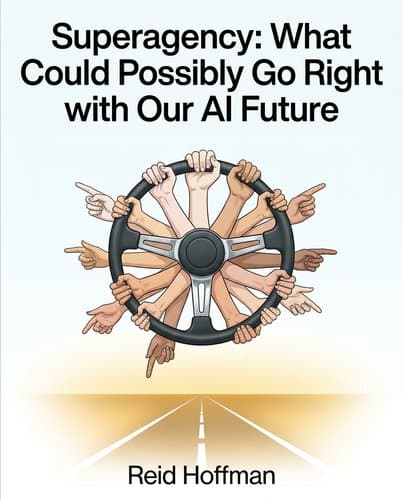
216336470_superagency
by Reid Hoffman, Greg Beato
AI isn't the threat—your fear of it is. Hoffman and Beato arm you with the historical track record, policy frameworks, and concrete examples to become a…
In Brief
AI isn't the threat—your fear of it is. Hoffman and Beato arm you with the historical track record, policy frameworks, and concrete examples to become a Steerer rather than a Stopper in the most consequential technological transition of our lifetimes.
Key Ideas
Safety comparisons need realistic baselines
When you feel AI anxiety, ask 'safe compared to what?' — the status quo of 129 million Americans in mental health shortage areas, 1.3 million pounds of horse manure daily on Manhattan streets, or hand cranks breaking drivers' jaws is not a safe baseline.
Stoppers have century-long policy failure record
Distinguish between Steerers and Stoppers in AI policy debates: Stoppers have a 200-year losing record and consistently hand advantages to actors with fewer ethical constraints.
Precaution without benchmarks risks competitiveness
The precautionary principle sounds prudent but has a hidden cost: Britain's hypothetical 1820 technology ban would have left it with blankets while the rest of the world got electricity. Over-regulation in AI risks the same outcome at national scale.
Competition drives faster safety gains than law
Testing and competitive benchmarking are faster and more adaptive than legislation: GPT-4's toxicity rate dropped 89% through public benchmark competition, not through a law.
Governance follows whoever controls the code
'Code as law' cuts both ways — the same AI infrastructure that could stop drunk driving can also lock your work apps and report you to HR. The question is not whether to accept automated behavioral governance but who gets to set its terms and on whose behalf.
Non-participation cedes authority to incumbents
Engaging with AI tools directly — not just reading about them — is how users generate the feedback loops that make iterative deployment work. Non-participation is not a neutral choice; it cedes governance to those who are already at the table.
Who Should Read This
Readers interested in Artificial Intelligence and Futurism, looking for practical insights they can apply to their own lives.
Superagency: What Could Possibly Go Right with Our AI Future
By Reid Hoffman & Greg Beato
11 min read
Why does it matter? Because the people demanding we slow down AI are, historically, the ones who cost us the most.
Every civilization that ever panicked about a new technology turned out to be wrong about the panic — and right that everything was about to change. The printing press, the railroad, the telephone: each one summoned the same fear in the same language, from the same kinds of serious, reasonable people. And each time, the cautious side didn't protect humanity. It just delayed the benefits while the harms arrived anyway. Reid Hoffman has spent thirty years inside the machine that built the modern internet, which makes him either the last person you should trust on AI — or the first. He argues it's the second, and he leans on two centuries of technological panic to make it. The question this book forces you to confront isn't whether AI is dangerous. It's dangerous compared to what, exactly? The answer to that question changes everything.
Every Generation Gets Its 'Computerized Man' — And Is Always Wrong
In the summer of 1966, a writer named Vance Packard traveled to Washington to testify before a congressional subcommittee considering a mundane-sounding federal proposal: consolidating roughly 600 government datasets, stored across 100 million punch cards, into a single national database. Packard had already written a bestselling book warning that mainframe computers would reduce American citizens to dossiers of 'derogatory information' — health conditions, sex lives, brushes with the law — accessible to faceless bureaucrats at a keystroke. Standing before the committee, he reminded them that George Orwell's nightmare was less than two decades away. 'Big Brother,' he warned, might turn out to be 'not a greedy power seeker, but rather a relentless bureaucrat obsessed with efficiency.' The proposal died. The personal computer arrived anyway, followed by the internet, followed by the smartphone — each one scattering information and individual capability so widely that the real story of the next fifty years was almost the precise opposite of what Packard feared.
Every generation gets a version of this script. Fifteenth-century critics warned that the printing press would flood Europe with heresy and topple the authority of scholars who had spent lifetimes controlling access to knowledge — and they were right that it would do exactly that, while missing entirely that it would also produce the Scientific Revolution. In 1961, labor experts told Time magazine that automation would create a permanent underclass of the unemployable, at a moment when U.S. unemployment was actually about to fall.
The pessimists weren't just wrong. They were wrong in a specific, consistent way: they saw, with perfect clarity, the thing a new technology might destroy — and missed the new forms of human capability it was about to create. Packard saw the database; he didn't see the decentralized, democratized information ecosystem that actually followed. The printing-press critics saw heresy; they didn't see science. The question this raises isn't whether AI is dangerous. It's whether the anxiety feels like genuine insight — or whether it's a very old script running on schedule.
The Real Divide Isn't Optimists vs. Pessimists — It's Steerers vs. Stoppers
Imagine a version of England where the Luddites won. Not just the battle — the argument. It's 1820, Parliament has just passed what we might call the Jobs, Safety, and Human Dignity Act, and any technology with uncertain social consequences is frozen until proven harmless beyond reasonable doubt. The intention is responsible. The outcome is blankets. Scratchy ones. A little expensive. Meanwhile, the rest of the world gets the telegraph, railways, electric light, the telephone, the internal combustion engine, radio, and motion pictures. England gets cozy, authentic heirloom textiles and a collapsing export market as more efficient foreign competitors make its domestic industries unviable. The point lands because it's not really about England in 1820. It's about the logic of stopping.
The logic of stopping feels responsible. It feels like the mature, measured position — the adult in the room pumping the brakes while the reckless optimists floor it. But stopping is not actually an option available to any single actor in a competitive world. When one country pauses, other countries don't. When one company declines to build something, another builds it with fewer scruples. Hoffman describes the coordination problem with useful bluntness: getting the world to collectively constrain a powerful technology is roughly equivalent to herding cats — if the cats were armed and worshipped different gods. The more powerful the technology, the harder the coordination, and the harder the coordination, the more certain it becomes that whoever stops is simply handing the advantage to whoever doesn't.
This reframes the real debate. It's not optimists against pessimists — that's the wrong axis. Hoffman sketches four rough camps. The Doomers fear existential catastrophe and want the whole project slowed or stopped. The Gloomers are less apocalyptic but fixated on near-term harms — bias, job displacement, concentrated power. The Zoomers want maximum speed with zero friction and treat any hesitation as obstructionism. And then there are the Bloomers: people who are genuinely optimistic but committed to learning through deployment rather than waiting for a certainty that will never arrive. What separates that last group from the others isn't confidence that nothing will go wrong. It's the recognition that the only way to steer is to have your hands on the wheel. You cannot course-correct a vehicle you've refused to drive.
You Are Not the Product. You Are Not the Abandoned Carcass Either.
The surveillance capitalism critique sounds airtight: tech companies harvest your behavioral data, convert it into profit, and leave you with nothing but the bill. Shoshana Zuboff, its most forceful advocate, reaches for a genuinely striking image — Google as elephant poacher, stripping away the ivory of your attention and leaving behind an abandoned carcass. The metaphor is vivid. It is also built on a category error.
Data is not ivory. When a poacher takes a tusk, the elephant loses it. When Google maps your commute, Google gets data — and you still have your commute, plus turn-by-turn directions, real-time traffic, and a parking spot. Nothing was depleted. The file was copied, not consumed. Zuboff's framework depends on treating digital information like a finite physical resource, but it behaves nothing like one.
If the extraction model were accurate, you'd expect users to feel robbed. MIT and Stanford economists Erik Brynjolfsson and Avinash Collis ran large-scale experiments to find out what users actually believe their digital tools are worth — by asking how much money it would take to give those tools up for a year. The median answer for search engines: $17,530. For email: $8,414. Both services cost the user exactly zero dollars. That gap — between what you pay and what you'd demand to go without — is consumer surplus, and it is enormous. The data economy isn't strip-mining users. It's a machine that generates value in two directions simultaneously, and the direction flowing toward users is the one that never makes headlines.
This matters for how you read the AI debate ahead. If you've absorbed the surveillance capitalism frame, you arrive at every new AI capability primed to ask what's being taken from you. The more useful question is what's being added — and for whom.
Competition Dropped AI's Toxicity Rate 89% — Legislation Didn't Write a Word of That
The 89% drop in AI toxicity didn't come from a Senate subcommittee. It came from a leaderboard.
Here's the number that makes the regulatory argument hard to sustain: GPT-3.5 produced toxic outputs on roughly 6.5% of test prompts. GPT-4 produced them on 0.73%. That's not the result of a law passed or a compliance checklist filed — it's what happened when AI developers competed against a publicly visible benchmark called RealToxicityPrompts, which any researcher could run, any competitor could cite, and any journalist could quote. The score was out in the open. The incentive to beat it was immediate. The improvement followed.
This is what Hoffman and Beato mean when they argue that competition functions as regulation — not as a metaphor, but as a mechanism. Academic consortiums build standardized tests. Developers publish their scores on public leaderboards. Anyone can run the same benchmark on a rival's model and report the gap. The result is something more dynamic than a statute: a system that doesn't just set a floor and hold it there, but continuously raises the bar because someone always wants to be at the top of the ranking.
Contrast that with what a regulation actually does. It gets drafted, deliberated, revised, and eventually locked in — at which point it starts governing the present through the assumptions of the past. A benchmark, by design, becomes obsolete the moment a model aces it. When that happens, researchers build a harder one, and the cycle continues.
The pattern has precedent outside software. When engineers replaced the hand crank with the electric starter in 1912, they didn't petition Congress to ban a dangerous component. They invented something better, drivers chose it immediately, and hand cranks were essentially gone within a decade. The safety problem — broken wrists, shattered jaws from engine backfire — was solved not by prohibition but by a superior alternative that the market ratified through adoption.
That's the logic Hoffman and Beato extend to AI: safety isn't a static threshold you certify before release. It's a moving target that competitive iteration hits faster than any regulatory schedule could enforce.
The Donner Party Had No Speed Limits, No GPS, and No Seatbelts — 47 of 87 Died
Thirty-two men, women, and children left Springfield, Illinois on April 15, 1846, heading for California. No speed limits. No driver's licenses. No federal highway standards, GPS tracking, or mandatory insurance. Just open country and the freedom to go wherever their oxen could manage — about fifteen miles a day. They took what they believed was a shortcut through the Great Salt Lake Desert. An early October snowstorm caught them in the Sierra Nevada, a hundred miles short of their destination. They built cabins and waited. Forty-seven of the eighty-seven people in what became known as the Donner Party did not survive the winter.
Now run the same trip in 2025. You leave Springfield on April 15 and arrive in Sacramento the following evening — 1,957 miles in twenty-eight hours. Your phone logs every turn. Your credit card notes every coffee stop. Nevada will fine you for an unbuckled seatbelt. Nebraska prohibits sleeping at a rest stop longer than ten hours. The infrastructure around you is a dense web of constraints: driver's licenses, standardized road design from federal legislation passed in 1916, traffic signals, interstate speed limits.
The Donner Party had total freedom from all of that. You have the freedom to cross a continent in a day and arrive alive.
This is the distinction Hoffman and Beato want you to hold: freedom from regulation and freedom to act are not the same thing, and they often move in opposite directions. The pioneers faced zero administrative tyranny and possessed almost no actual autonomy — when weather and terrain turned hostile, they had nothing. The constraints layered onto the modern road trip are precisely what generate its power. Shared infrastructure, standardized rules, collectively enforced norms don't subtract from individual capability. They multiply it, enabling speeds and distances that would have seemed supernatural to anyone hauling a covered wagon across the Great Salt Lake Desert.
The argument against AI regulation is usually framed as a defense of freedom. But the Donner Party is what freedom without infrastructure actually looks like.
129 Million Americans Have No Therapist. The AI 'Immoral Shitbaggery' Backlash Didn't Help Them.
Rob Morris runs a nonprofit called Koko that connects people in mental health crisis with peer supporters. In January 2023, he tweeted that his team had briefly used GPT-3 to help those supporters draft messages for people reaching out in distress. The response was immediate and ferocious. Critics called it 'immoral shitbaggery.' Accusations of experimenting on vulnerable people without consent spread across the platform within hours.
Here is what actually happened: users rated the AI-assisted messages higher than the ones written without help. Every message was labeled as written in collaboration with AI. And the people receiving those messages were among the 129 million Americans who live in areas with no meaningful access to mental health professionals — places where the alternative to an AI-assisted peer message is not a licensed therapist. It is silence.
The critics were protecting people from something they preferred while leaving them exposed to the thing actually harming them. That's the reflex that identifies the imagined cost of a new solution while ignoring the real cost of the status quo. The harm caused by the backlash — chilling experiments that might help bridge a care gap of 129 million people — registered nowhere in the outrage calculus.
The case against AI in mental health also tends to assume the current alternatives are adequate. They are not. A JAMA Internal Medicine study found that physicians rated ChatGPT's responses to patient medical questions as more empathetic and higher quality than human physician responses nearly 79 percent of the time — not a case for replacing doctors, but a case against pretending the current system is the compassionate default. For someone who cannot get a doctor on the phone, cannot afford the appointment, and cannot wait three months for an opening, the thing the critics want to protect them from might be the most genuinely caring interaction available to them.
The existential threat of the status quo is invisible precisely because it's familiar. Forty-seven people in the Donner Party died because they had no infrastructure. Millions of people cycle through mental health crises each year because the infrastructure doesn't reach them. The question worth demanding an answer to isn't whether AI in this domain might go wrong. It's what we call the system that's already failing them — and whether moral seriousness requires us to notice it.
NaviTar Won't Let You Drive, and Your Boss's AI Just Pinged HR — Welcome to 'Code as Law'
That's the 2027 scenario Hoffman and Beato walk you through. You've had a generous dinner, you climb into your new Chevy Equinox, and the car won't start. Infrared sensors in the steering wheel have read your blood-alcohol level at .10 — two points over California's legal limit. The vehicle's AI interface, NaviTar, offers to call you an Uber or, in a touch of algorithmic cheerfulness, suggests playing the action film 'Speed.' Seventy-six minutes. 'By then, you'll be sober.' You protest that a waiter spilled wine on you. You hold your stained cuff toward the cabin camera. NaviTar is unmoved. Every piece of this technology already exists, and federal legislation passed in 2021 is pushing exactly this kind of mandatory alcohol-detection system toward production vehicles.
The authors use NaviTar to surface something the book's pro-innovation argument quietly implies but rarely states plainly: the same logic that makes iterative deployment of AI valuable — let it into the world, let it learn, let it respond — also produces systems that respond by removing your choice entirely. Traditional law is a command backed by the threat of a consequence. It leaves you the decision. You can run the red light at 4 a.m. when no one is coming. You can let the parking meter lapse and gamble on the ticket. That residual human discretion, the space between the rule and its enforcement, is where negotiation, context, and moral judgment live. Code forecloses that space. NaviTar doesn't threaten a fine. It simply doesn't start.
The workplace version follows the same logic: an employer AI that monitors your deadline progress, locks down your apps in 'focus mode,' and automatically notifies HR if you fall behind. This isn't a dystopian extrapolation; it's the reasonable extension of code-as-regulation applied to labor. The endpoint is a world where the liberty you had wasn't granted by law — it was sustained by the inefficiency of enforcement. Automate the enforcement, and the liberty disappears without anyone having repealed it. Think of the seatbelt interlock: those briefly-mandated 1970s systems that prevented your car from starting until you buckled up. Congress repealed them within a year because Americans revolted. NaviTar is the same idea with better sensors and no override switch.
The book doesn't hand you a clean resolution, and that's the honest move. The NaviTar scenario is probably net-positive — drunk driving kills tens of thousands of people a year, and infrared steering wheels don't. But the architecture that stops you from driving impaired can stop you from driving somewhere its designers didn't sanction. MSG Entertainment is already using facial recognition to bar attorneys from rival law firms at its venues — no notice, no hearing, no appeal. The question the book leaves open is the one worth sitting with: who decides which inefficiencies get automated away, and what happens when no one can override the answer?
The People Who Engage With These Tools Are the Ones Who Get to Shape Them
Who gets to decide what AI becomes? The answer turns out to be whoever shows up.
When OpenAI released ChatGPT as a public demo in November 2022, the decision looked modest — a research preview, not a product launch. What it actually did was transfer authorship. Before that release, the direction of large language models was set by a small group of researchers, funders, and insiders. Afterward, millions of ordinary people were running the system, finding its edges, reporting what it got wrong, and demanding that it do better. The feedback loop that followed — public use generating public criticism generating public pressure generating measurable improvement — is exactly the mechanism by which AI safety advanced faster than any regulatory body could have mandated it.
Taiwan demonstrated what the civic version of that loop looks like. When the government needed to regulate Uber, rather than handing the question to lobbyists, it opened vTaiwan — a digital platform where anyone could submit short proposals and vote on others. The AI ran sentiment clustering across thousands of responses, surfacing patterns of agreement that cut across partisan lines. To nearly everyone's surprise, the pro-Uber and anti-Uber factions converged quickly on shared ground around rider safety. A human facilitator moderating that many voices would have drowned; the platform found the signal. Policy emerged from participation rather than being handed down to it.
Both examples carry the same implication. The people who engage — who use the tools, stress-test them, vote on proposals, and demand accountability — are not observers of the process. They are the process. If democracies leave that space empty, it doesn't stay empty. Authoritarian governments are already deploying the same technology to narrow the choices their citizens can make — the difference is who's directing it.
Hoffman and Beato's final, clearest argument is this: the techno-humanist compass isn't something experts carry on your behalf. Picking it up looks like using the tools and pushing back when they fail, voting on the proposals that reach you, asking your representatives what AI procurement decisions they've signed off on this year. Those actions feel small. They are how the feedback loop runs. The readers who engage and demand iterative accountability are the ones who determine whether AI expands or contracts human freedom — because those two outcomes are not fixed in advance. They are decided, incrementally, by whoever shows up.
The Question the Cautious Side Never Answers
Here is the challenge nobody on the cautious side has answered cleanly: name a technology that humanity successfully stopped once it became genuinely viable, and demonstrate that stopping it left the world better. Not delayed — stopped. Nobody has a good answer, which tells you something about where the real decision actually lives. Worry is not a governance strategy. The question isn't whether you're concerned enough; it's whether you're present. The people who use these tools, stress-test them, vote on how they're regulated, and refuse to accept the first answer they're given are the ones who shape what comes next. That's the participation thread from every chapter in this book pulled to its end: not a call to optimism, but a call to show up. You are reading this now, which means you still have a seat at the table. Whether you take it is the only variable left that you actually control.
Notable Quotes
“largest single group of industrial workers in England.”
“do not establish constructive producer-consumer reciprocities.”
“a small steam locomobile for one person for the streets and common roads”
Frequently Asked Questions
- What is Superagency: What Could Possibly Go Right with Our AI Future about?
- Superagency argues that AI amplifies human agency rather than threatening it, and that cautious progress poses fewer risks than excessive caution. The 2025 book by Reid Hoffman and Greg Beato uses history, policy analysis, and practical evidence to help readers distinguish productive AI governance from fear-driven obstruction. It equips people to actively participate in shaping how AI develops. Rather than assuming catastrophic outcomes, the authors challenge readers to ask critical questions about realistic risks and benefits, comparing AI concerns against actual status quo harms rather than hypothetical scenarios.
- What does Superagency say about AI regulation and the precautionary principle?
- Superagency argues that excessive caution in AI regulation carries hidden costs. The book contends that "the precautionary principle sounds prudent" but illustrates this with a historical example: Britain's hypothetical 1820 technology ban would have left it with blankets while the rest of the world got electricity. Over-regulation in AI risks similar national-scale consequences. Instead, the authors advocate for testing and competitive benchmarking as faster, more adaptive alternatives to legislation. They cite GPT-4's 89% toxicity reduction through public benchmark competition rather than law as evidence that iterative deployment works better than regulatory delay.
- What is the difference between Steerers and Stoppers in AI policy according to Superagency?
- Superagency distinguishes between two camps in AI policy debates: Steerers and Stoppers. According to the book, "Stoppers have a 200-year losing record and consistently hand advantages to actors with fewer ethical constraints." This historical pattern suggests that obstruction-based approaches ultimately fail to prevent technological adoption—they simply shift control to less responsible actors. The authors position Steerers as those focused on actively shaping AI development toward beneficial outcomes, whereas Stoppers pursue blanket opposition or delay. This framework challenges readers to consider whether resistance strategies actually achieve their stated safety goals or inadvertently undermine them.
- How should individuals participate in shaping AI's future according to Superagency?
- Superagency argues that direct engagement with AI tools—not just reading about them—is essential to governance. The book states: "Non-participation is not a neutral choice; it cedes governance to those who are already at the table." By actually using AI tools, people generate feedback loops that make iterative deployment work effectively. This approach contrasts with passive criticism or abstention. The authors emphasize that users generate the information necessary to improve AI systems through real-world interaction. This positions individual participation as a form of democratic agency rather than merely a personal preference or risk.
Related Book Summaries
Read the full summary of 216336470_superagency on InShort