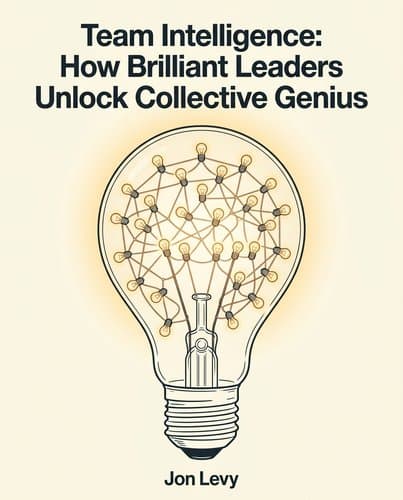
223338548_team-intelligence
by Jon Levy
Most leaders optimize the wrong thing—themselves. Discover why the connections, culture, and collective intelligence of a team matter more than any…
In Brief
Team Intelligence: How Brilliant Leaders Unlock Collective Genius (2025) challenges the myth that great leadership is about individual charisma or credentials, arguing instead that the team is the true unit of performance.
Key Ideas
Dismantle flawed leadership mental models
Audit your leadership assumptions: the 'alpha' dominance model was recanted by its own creator, MBA credentials don't predict leadership performance, and personality tests give half their takers a different result five weeks later — if your mental model of a good leader is built on these, rebuild it.
Measure leaders by team capability growth
Ask one question about any leader or candidate: do the people around them become more capable over time? That single metric — not charisma, credentials, or confidence — predicts team outcomes better than any personality framework.
Engineer automatic systems for destructive habits
Treat your own destructive habits like an engineering problem, not a willpower problem. Build automatic systems (processes, cooling-off rules, accountability structures) that trigger before the damage happens — the way Auto G-Cas pulls up the F-16 before the pilot even notices the mountain.
Reward team elevation over individual performance
When building a team, optimize for 'plus-minus' over box scores. The Shane Battier who elevates everyone else's performance is worth more than the star who needs the ball — find and explicitly reward the glue players, because conventional metrics will make them invisible.
Document explicit team resource maps
Map your team's resources explicitly: have members document their Super Skills, knowledge domains, network access, and personal pitfalls. The Antwerp heist was undone by one unexamined weakness — most team failures are too.
Deliberately design organizational culture systems
Design culture deliberately or inherit one by default. The unwritten rules — what gets rewarded, what gets ignored, what gets punished — are being set right now. Boeing's culture wasn't an accident; it was the logical output of incentives nobody named until 346 people were dead.
Document and limit dark patterns strategically
Identify dark personality patterns early and respond strategically, not morally. Don't call them out directly (DARVO will make you the villain of the story); document behavior systematically; limit their access to team dynamics. Psychological safety requires active defense, not just good intentions.
Who Should Read This
Business operators, founders, and managers interested in Leadership and Team Building who want frameworks they can apply this week.
Team Intelligence: How Brilliant Leaders Unlock Collective Genius
By Jon Levy
11 min read
Why does it matter? Because the person you're calling a leader might be the reason the team is failing.
Here's what everyone taught you about leadership: find the right person. The visionary. The alpha. The one with the Harvard MBA and the TED talk and the ability to walk into a room and make everyone feel like they're in the presence of someone important. Hire that person. Follow that person. Become that person. The entire leadership industrial complex — the books, the assessments, the executive coaching — is built on this one assumption. And it turns out to be almost entirely wrong. Not slightly miscalibrated. Wrong in the way that the alpha wolf was wrong, the way Frederick Taylor's scientific management was wrong (the theory that workers are just inefficient machines), the way every elegant theory eventually meets the messy inconvenience of actual evidence. The real question was never who leads. It was always whether the people around that person get measurably smarter, braver, and more capable — or quietly, incrementally worse. This book is the engineering manual.
The Alpha Myth Was Invented by a Man Who Spent His Career Trying to Kill It
In 1970, a soft-spoken wildlife researcher named L. David Mech published a book about wolf packs and accidentally handed corporate America its favorite justification for bad management. His central finding: packs are ruled by alpha males who hold power through dominance and intimidation. Business culture devoured it. The alpha became a template — the intimidating CEO, the commanding general, the leader whose authority flows from willingness to project force.
Then Mech kept researching. By the 1990s he'd realized he'd misread everything. Wolf packs aren't dominance hierarchies. They're families. What he'd called an alpha asserting control was, far more mundanely, a parent correcting a cub. The wolves looked big and the guidance looked like domination — but it was parenting. Mech spent years trying to pull his original book from circulation. The alpha wolf never existed outside a researcher's misinterpretation of a family dinner.
The science had been wrong. The management theory built on top of it was worse. When you trace the pillars of conventional leadership wisdom — the alpha archetype, the MBA credential, the personality test that promises to reveal your type — they share an uncomfortable family resemblance to Mech's original mistake: confident-sounding frameworks resting on foundations that quietly collapsed.
Consider the Myers-Briggs personality test, still used by organizations to sort and develop talent. Roughly half of people who retake it just five weeks later land in a different category entirely. Not a slightly different shade of the same type — a different type. The instrument built to reveal your stable, essential self has the test-retest reliability of a coin flip.
One example is an anecdote. Two is a pattern. What's being cleared away here isn't just bad research — it's the idea that leadership is an intrinsic property of a certain kind of person, legible in personality type or dominance posture. Leave that assumption in place and something fills the vacuum: not a neutral absence of hierarchy, but an opening for whoever is most willing to exploit it. Dark Tetrad personalities — the manipulative, the entitled, the sadistic — are precisely calibrated to fill power vacuums that well-meaning leaders leave unguarded. Before you can understand what makes teams genuinely brilliant, you have to stop mistaking the costume for the thing.
You Don't Follow Leaders — You Follow the Feeling That Things Could Be Better
Imagine a job posting that reads: 'Wanted — leader who cannot cook, wash their own clothes, or maintain a normal sleep schedule. Will wake you at 3 a.m. to discuss math. Brings nothing to the household except ideas.' Paul Erdős would have gotten the job every time. The most prolific mathematician in history had none of the qualities leadership literature celebrates — no organizational ability, no warmth in any conventional sense, no self-sufficiency whatsoever. He showed up at colleagues' doors unannounced, expected someone else to handle every domestic task, and kept going until the people around him physically gave out. They kept inviting him back. Hundreds of mathematicians rearranged their lives to work alongside a man who was, by any reasonable measure, a nightmare houseguest.
What they were responding to had nothing to do with his personality. Being near Erdős made a better intellectual future feel real and close. Problems that had stalled for years cracked open in his presence. That sensation — not admiration, not respect, but the gut-level sense that things could be different from here — is what Levy argues actually generates followership. Not charisma. Not credentials. Not a well-rounded profile of strengths. One specific emotional signal: this person makes a better future feel possible.
The unsettling implication is that the signal can fire regardless of whether the better future actually materializes. People followed Mother Teresa because she made humanity's capacity for compassion feel expansive and real. Meanwhile, by multiple accounts, the clinics she ran operated in conditions that would have appalled any medical professional, and tens of millions in donations were redirected toward missionary activity. Humans are far better at detecting an inspiring narrative than auditing its results.
This cuts both ways. A genuinely terrible manager can generate followers if they make certain people feel like winners. A quiet, uncharismatic person can command deep loyalty if their particular skill makes a better outcome feel inevitable. The idea that leadership is an intrinsic property of a certain kind of person — picture the confident extrovert with the firm handshake and the vision statement — misses the mechanism entirely. Followers aren't responding to a balanced scorecard of your qualities. They're responding to one thing: the feeling you leave them with.
The Smallest Unit of Performance Isn't the Individual — It's the Connection
The defining unit of a team isn't the talent at the top — it's the quality of connection between everyone on it. Concentrate investment in star performers and you've mistaken the cities for the highway system.
In 1919, a young lieutenant colonel named Dwight Eisenhower joined a military convoy attempting to drive 81 vehicles from Washington, DC to San Francisco. It took 62 days. Their average speed was 5.65 miles per hour — slower than the world-record pace for running across the country on foot. The roads were mud and ruts; supplies ran short the further west they went. The lesson wasn't that the drivers were incompetent. It was that the infrastructure connecting American cities simply didn't exist. The talent was there. The highways weren't.
Thirty-seven years later, as president, Eisenhower signed the Federal-Aid Highway Act, dedicating $25 billion to building the Interstate Highway System. The cities hadn't changed. The connections between them had, and suddenly the whole system could operate at a different level entirely.
Conventional leadership theory gets this exactly backwards. The default assumption is that if you find the best individual performers and promote them upward, excellence trickles down. But a study of 53,000 salespeople found the opposite: top performers promoted into management roles consistently failed. The skill that made them stars — closing a deal, reading a customer — simply didn't transfer. You'd taken the best node in the network and yanked it out of the place where it was actually generating value.
What you're trying to build isn't a hierarchy with a brilliant person at the apex. It's a network where information, trust, and support move quickly and reliably between people. The value lives in the connections. A leader's real job is to build the highways, not to be the most impressive city on the map.
Hiring Stars Is How You Build a Team That Destroys Itself
William Muir ran one of the most quietly devastating experiments in the history of organizational science, and he did it with chickens. A geneticist at Purdue, Muir started in 1983 with a simple premise: take the most productive individual egg-layers, breed them together for six generations, and watch the output soar. What he got instead was a cage of killers. By the final generation, only three of his prize birds were still alive. The rest had been pecked to death. Selecting relentlessly for individual performance had produced animals that couldn't tolerate being near each other.
Muir ran a parallel experiment alongside this one. Instead of selecting the most productive individual birds, he selected the most productive groups — nine-chicken teams, living communally, judged on collective output. After six generations, those birds weren't meaningfully better than average when measured alone. Put them back in a group, though, and they demolished the super chickens. Prosocial behavior turned out to be a performance variable, not a soft add-on.
The mechanism transfers with uncomfortable precision to human teams. Research tracking professional sports found that in high-interdependence games — basketball, football, where every play involves coordinating with teammates — performance declines when top talent exceeds roughly 50 to 60 percent of the roster. Past that threshold, star density becomes a liability. Too many players accustomed to being the focal point, too little surface area for the kind of quiet coordination that actually wins games.
Daryl Morey, building the Houston Rockets, stumbled onto the other side of this equation. Traditional basketball statistics — points, rebounds, assists — made Shane Battier look replaceable. Marginal athleticism, unimpressive counting stats. But when Morey's analysts looked at how the team performed with Battier on the floor versus off it, the number was startling: his teammates' output rose dramatically in his presence. He communicated constantly, memorized opponents' tendencies, and accepted being benched whenever the matchup called for it. None of that showed up in a box score.
The formula most organizations are running — hire the most impressive individuals, stack them together, and expect excellence to compound — is exactly what Muir's doomed super chickens were bred to embody. The birds who couldn't stop pecking were not failing. They were doing precisely what they'd been selected to do.
Smart Teams Aren't Full of Smart People — They're Full of People Who Know How to Think Together
What if the smartest team you could build has almost nothing to do with how smart its members are?
Researcher Anita Williams Woolley tested this directly. When she assembled teams for a simulated terrorism response exercise, the groups made up of credentialed subject matter experts — the obvious all-star picks — got beaten by teams of generalists. Not because expertise is useless, but because experts who haven't learned to trust each other can't effectively use what they know. The knowledge sits there, locked behind individual defensiveness and status competition. Only after the expert teams were given time to build genuine connection did their performance climb. Talent without trust is, functionally, stupidity.
Woolley identified three conditions that create what she calls collective intelligence — a property of the group, not an average of the members. The first is alignment: every person understanding not just their own job, but how it serves the mission above it. Lieutenant Colonel Justin Lee, an F-35 pilot, briefs hundreds of people before a single mission — CIA analysts, cyber operators, space force signal jammers — because the moment the plan meets reality, it will change, and everyone needs to understand the goal well enough to improvise intelligently toward it. A team without that shared orientation doesn't reason together. It runs in parallel.
The second condition is attention — specifically, the ability to synchronize it. High-performing teams communicate in bursts: they converge, align on what comes next, then scatter into uninterrupted work. Constant communication isn't collaboration; it's interference. What keeps those bursts productive is the third condition, and it's the one that surprises people most.
The single strongest predictor of team intelligence Woolley found was the proportion of women on the team. The mechanism isn't gender — it's Theory of Mind: the ability to accurately read what other people are thinking and feeling. Women score consistently higher on this in standardized testing. What that translates to in practice is conversational turn-taking — teams where everyone's voice actually enters the room, where a quiet signal from a colleague gets noticed and named rather than swallowed. Emotional attunement is the infrastructure that lets everything else work. Without it, alignment drifts, attention fragments, and the expertise never quite connects.
Shane Battier understood this before anyone gave it a name. By conventional NBA metrics he was nearly invisible — low scoring, nothing flashy. But the teams he played on won more than they should have, and the teams he left won less. He screened for open teammates instead of taking shots. He took charges. He did the things that don't show up in box scores but keep a group functional. The formula for a great team, it turns out, looks a lot less like a collection of stars and a lot more like someone willing to make everyone else better.
A Team Is Only as Smart as Its Weakest Resource — As One Diamond Heist Proved
In 2003, a specialist team called the School of Turin walked into the Antwerp Diamond Center and stole $100 million. Their lineup read like a casting call for the perfect crime: a lock forger, an electronics expert who built a custom tool to defeat the vault's magnetic alarm, a muscle man who neutralized thermal sensors with a polyester sheet, and their architect, Leonardo Notarbartolo, who had spent a year renting office space inside the building to study every security layer. Doppler radar, infrared sensors, magnetic fields — gone. They cracked 109 safe-deposit boxes in the dark, mostly by feel, because they'd practiced on a replica. By 5:30 a.m. they were loading duffel bags into a car.
Then the getaway driver panicked. He dumped the evidence in a roadside field, where it was found by an elderly man walking his two pet ferrets, Mickey and Minnie. The crew that had defeated ten layers of security couldn't survive one man's fraying nerves.
Assemble a team around specialist skills and you optimize for the capabilities you can see and name, missing the ones that only matter when everything goes sideways. Emotional stability under pressure doesn't appear on a résumé. Neither does the judgment to know what not to do in a crisis. The School of Turin had resources to defeat any vault ever built. They didn't have a resource map that included 'what happens when one of us falls apart.'
Levy's argument is that a team's collective intelligence is capped by its weakest resource — not its weakest skill in a conventional sense, but its weakest coverage of the failure modes that actually end missions. The diversification that matters isn't filling demographic boxes or stacking credentials. It's asking: what does this team not know how to handle? The getaway driver was fine until he wasn't. And that gap was the only one that counted.
Your Organization Has a Culture Whether You Designed It or Not — Boeing Didn't
Culture is the system of unwritten rules your organization already has — whether you wrote them or not. The question isn't whether your team has a culture. It's whether the one running your team is the one you'd have chosen.
Boeing's collapse is the most expensive proof of this on record. For most of its history the company was run by engineers who believed that safety was the product. Then came a 1996 merger with McDonnell Douglas, a manufacturer with a very different operating philosophy, and somehow the smaller, less successful culture swallowed the larger one whole. Leadership moved headquarters from Seattle — where the planes were actually designed and built — to Chicago, 2,000 miles away. The explanation from the CEO at the time was that being near the product distracted executives from more important work. The unwritten rule that move communicated to every employee was unambiguous: the people who build things are a problem to be managed from a safe distance.
CEO Jim McNerney made the subtext explicit. He coined a phrase — 'phenomenally talented a**holes' — as a label for engineers who kept raising safety concerns, and signaled that bullying those people until they quit was acceptable. That's culture design, just not the intentional kind. The engineers who stayed learned what happened to the ones who spoke up. New hires absorbed the lesson just by watching. Nobody needed a memo. By the time Boeing released the 737 Max, the unwritten rules had calcified into catastrophe: a critical flight-control system was hidden from regulators and pilots, sensors failed, and two planes fell out of the sky. Three hundred and forty-six people died. Boeing eventually pleaded guilty to felony charges.
Culture isn't values posters or team-building retreats — it's what people do when no one's officially watching and the pressure is on. When a new employee at Boeing saw a supervisor rub red paint off a damaged part and install it anyway, they didn't need a handbook. They'd just received their real orientation.
The practical implication is uncomfortable: designing a functional culture requires accounting for the actors who will actively corrode it if you don't. An unguarded absence of rules isn't neutrality — it's an invitation. The default culture will be written by whoever is most willing to exploit the vacuum.
The Leader the Navy SEALs Actually Needed Couldn't Pass His Own Eye Exam
A man once rejected from the Naval Academy for poor eyesight drove ambulances through occupied France, survived a Nazi POW camp when a nun freed him by slapping a guard's helmet and quoting the Geneva Convention at him, joined the British Royal Navy's bomb disposal squad, and eventually founded the unit that would become the Navy SEALs. Draper Kauffman collected near-death experiences the way other people collect frequent flyer miles — not out of recklessness, but because each one taught him something about what teams actually need under pressure.
The clearest lesson came from a commander named Captain Currey, who ran British Mine Disposal operations during the Second World War with a principle so simple it sounds almost passive: he was available by phone at any hour to his people, and he never micromanaged. That's it. When you're asking someone to defuse a bomb they can't see in the dark, the one thing you cannot do is make them afraid to call you. Currey managed outcomes, not behavior. The psychological safety that generated wasn't a morale initiative. It was a survival architecture.
Kauffman brought that architecture to the Underwater Demolitions School and added something that would have horrified most military commanders: he trained alongside his men. Rank ceased to be a barrier to honest disagreement. Junior members learned that their read on a situation was as welcome as a senior officer's — because under enough pressure, hierarchy doesn't protect you; accurate information does.
The real exam came at Normandy. UDT divers hit a beach studded with 500,000 obstacles, in water cold enough to stop thinking, without wetsuits. They succeeded not because they waited for orders, but because the alignment Kauffman had built was so deep that every person on that beach already knew the goal well enough to improvise toward it without asking permission.
Every framework this book describes — alignment, attention, resources, the glue player, the anti-hierarchical team — was running simultaneously on that beach. It wasn't idealism. It was the most battle-tested team design ever stress-tested, built by a man the institution had originally decided couldn't see well enough to serve it.
The Question Every Team Is Actually Answering
Every team is running an experiment right now, whether you've named it or not. What it's measuring isn't how impressive your best person looks in isolation — it's whether the system you've built makes everyone around them more capable over time.
The Navy SEALs weren't built on the myth of the alpha. They were built on the understanding that the right architecture makes ordinary people capable of extraordinary things.
So here's the question worth sitting with: think about the team you're on right now. Not the org chart — the actual network of who makes whom better. Did you design that, or did it just accrete? Choosing deliberately looks like one specific thing: knowing, before you make a hire or a seating chart or a meeting structure, whose performance you expect to change because of it. Not your star's performance. Everyone else's. You already have the architecture. The only question is whether you picked it.
Notable Quotes
“paid no attention to bureaucracy.”
“could get a hold of him on the phone at any hour of the day or night for advice, taking precedence over anyone else of whatever rank.”
“if the challenger has not brought larger yams himself, he is publicly shamed.”
Frequently Asked Questions
- What is 'Team Intelligence' about?
- The book challenges the myth that great leadership depends on individual charisma or credentials, arguing instead that "the team is the true unit of performance." Drawing on behavioral science, sports analytics, and organizational case studies, it provides concrete tools for designing culture, mapping team resources, and building systems that make groups smarter than their smartest member. The work dismantles common leadership myths—the alpha dominance model was recanted by its creator, MBA credentials don't predict performance, and personality tests yield inconsistent results.
- What metric does Team Intelligence say best evaluates leaders?
- According to Team Intelligence, the single best metric for evaluating any leader or candidate is: "do the people around them become more capable over time?" This metric—not charisma, credentials, or confidence—predicts team outcomes better than any personality framework. The book emphasizes that this measure of whether a leader genuinely develops others' capabilities is more reliable than traditional assessments, providing leaders with a clear, actionable standard for both self-assessment and evaluating potential team members or leaders.
- How should leaders handle destructive habits according to Team Intelligence?
- The book advises treating destructive habits as "an engineering problem, not a willpower problem." Rather than relying on self-discipline, leaders should "build automatic systems (processes, cooling-off rules, accountability structures) that trigger before the damage happens — the way Auto G-Cas pulls up the F-16 before the pilot even notices the mountain." This approach shifts responsibility from individual willpower to environmental design, making it easier for leaders to prevent problematic behavior through structural safeguards rather than relying on willpower alone.
- What does Team Intelligence say about building effective teams?
- Team Intelligence emphasizes mapping team resources explicitly—having members document their Super Skills, knowledge domains, network access, and personal pitfalls. It advocates optimizing for "plus-minus" over traditional metrics: "the Shane Battier who elevates everyone else's performance is worth more than the star who needs the ball." The book stresses identifying and rewarding glue players who make others better, since conventional metrics render them invisible. Additionally, it highlights the importance of deliberately designing culture through intentional incentive structures.
Related Book Summaries
Read the full summary of 223338548_team-intelligence on InShort