54233524_technology-s-big-bang
by Dana Blankenhorn
Vulnerability isn't recklessness—it's the only mechanism by which love actually works. Two emotionally armored women must choose between the safety of…
In Brief
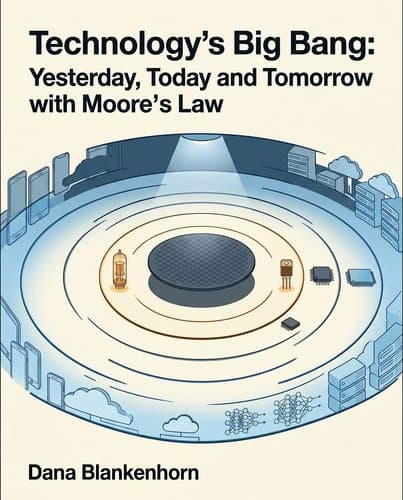
Technology's Big Bang: Yesterday, Today and Tomorrow with Moore's Law (2019) traces how Moore's Law — the doubling of computing power every two years — has driven five decades of technological transformation. Dana Blankenhorn shows how this single principle shaped the internet, mobile, and AI revolutions, and what its limits and legacy mean for the innovations still ahead.
Key Ideas
Identify your self-protection mechanism
Name which self-protection strategy you are currently using — rigid ethical standards, 'no relationships' rules, or workaholic schedules — because each one protects you from future pain by making present intimacy impossible. Knowing which mechanism is running is different from dismantling it, but it is the prerequisite.
Judge circumstances or character separately
When someone does something you find ethically wrong, ask whether you are judging their character or their circumstances. You can reject either. But knowing which you are rejecting tells you whether there is anything to find out.
Distinguish genuine protection from fear
'I don't want to hurt you' is sometimes true and sometimes the story fear tells itself. The test is whether the protective instinct produces protective action or withdrawal that leaves the other person alone with their fear.
Vulnerability precedes certainty in love
The gap between 'I feel it' and 'I can say it' is where most relationships fail. You do not need certainty about the future to say what you feel right now. Waiting for certainty is not caution — it is asking the other person to absorb all of the risk.
Love requires risk before guarantee
Choosing vulnerability before you have a guarantee is not recklessness. It is the only mechanism by which love actually works. Every other approach is just a longer route to the same question.
Who Should Read This
Readers interested in Technology History and Artificial Intelligence, looking for practical insights they can apply to their own lives.
Technology’s Big Bang: Yesterday, Today and Tomorrow with Moore’s Law
By Dana Blankenhorn
9 min read
Why does it matter? Because the self-protection strategies you built after your last heartbreak are probably the reason you're still alone.
Wendy Torres argues for a living, faces down criminals daily, and cannot bring herself to attend a Fourth of July barbecue. Eve Tilman closes million-dollar deals for her family's empire, walks into any room and owns it, and has never once let anyone stay long enough to disappoint her. Both women have a story for why this is fine. Both stories are extremely convincing. Both are lies.
This is a novel about the elaborate defenses that intelligent people build after they've been hurt — the rigid ethics, the no-relationships rules, the eighty-hour weeks that leave no room for anyone — and what happens when two women built entirely from those defenses collide in the same grocery store parking lot. The armor looks like wisdom. It isn't. The argument the novel makes, quietly and then all at once, is that the strategies we use to survive heartbreak are just fear wearing a very convincing disguise — and that love only ever begins on the other side of choosing it anyway.
Two Brilliant Women Chose Loneliness and Called It Strength
The night before the Fourth of July, Wendy Torres is at her desk finishing paperwork nobody asked for. Her colleague Kate finds her there and asks why she's still in the office. Wendy's answer is immediate: Kate has a wife at home. All Wendy has is a dying plant.
That plant is, technically, still alive. Wendy keeps it watered only because her mother gave it to her. She doesn't particularly like plants, but she can't bring herself to throw it out. That combination of minimal care and inability to let go is a self-portrait.
Her holiday plan, when it emerges, is a masterpiece of substitution: laptop, Hallmark movies, leftover kung pao chicken. She has ordered the exact components of an evening that looks like comfort and functions like a bunker. Every slot filled. No room for absence to announce itself.
Wendy doesn't call it hiding. She calls it reliability. She tells herself she's not going to Kate's barbecue because she doesn't want to bring anyone down. She tells herself she's not in Seattle with her family because she can't take the time off. Both things contain some truth. That's exactly how you recognize avoidance: it never feels like avoidance.
The Hallmark movies she sneers at are the same ones she watches every night. She mocks the fantasy of a baker falling for a sad banker who hates Christmas. But she loved Christmas until the woman who broke her heart did it two weeks before the holiday. What she's actually watching is a story where someone in her exact condition gets rescued by a plot she no longer believes in.
She knows this. That's what makes it funny. And what makes it grief.
Across town, a woman named Eve is dodging her mother's fertility statistics and calling that freedom. She and Wendy have never met. They are, already, the same person.
She Stole Your Parking Spot and Now She's at Every Party You Go To
On the hottest afternoon of the summer, Wendy waits with her blinker on for a parking spot at a grocery store packed for the Fourth of July. A woman in a white dress and expensive wedges drives right into it. Wendy gets out of her car. The woman — dark hair, quizzical eyes, completely unbothered — listens to Wendy's complaint and offers one line: "Then I guess you should have parked your car faster."
It's the kind of answer that makes a reasonable person furious because it is technically unanswerable. Wendy gets back in her car and drives away.
The grievance would be forgettable if it ended there. At her friend Kate's Fourth of July barbecue, the doorbell rings. Standing in the doorway is the woman from the parking lot. Eve, it turns out, is a close friend of the hosts. The recognition is immediate and mutual. Both women narrate the same grocery store incident to Kate in the same room, within minutes of each other, each casting herself as the aggrieved party. Eve's version: "Some woman almost bit my head off." Wendy's: "The woman I encountered was a total bitch."
Eve's response to being called a bitch, across the room, is to smile. Not a polite smile. A gratified one. Wendy clocks this instantly and files it as further evidence of insanity.
Wendy has just described a stranger to her friend, and the description is precise enough to constitute a portrait. "Insane." "Obnoxious." "A total bitch." You don't reach for that vocabulary about someone you dismissed. You reach for it about someone who got under your skin and stayed there. Eve, for her part, is fascinated by Wendy's refusal to be charmed. She says as much later that night, in a hotel bar, after sliding her untouched vodka soda two chairs down as a peace offering. "You don't like me," Eve says. "I'm usually liked by everyone I meet." She means it as a puzzle she wants to solve.
The Developer Displacing Your Grandmother Is the Same Person You Cannot Stop Thinking About
The ethical conflict in this story is the romance. Same plot. Same stakes. No obstacle waiting to be cleared.
Here is what happens at a jazz bar called Vincenzo's. Wendy has been watching Eve's legs since she walked in. Eve has been calling Wendy beautiful and funny and worth more than the woman who left her. The air between them is close enough to be uncomfortable. Then the bill arrives. Wendy sees the last name on the credit card — Tilman — and the evening folds in under a minute. And the name just confirmed it: Eve is both the daughter of the man buying Gilford's nursing home and the project manager who sat across from the sellers and persuaded them no better offer was coming. She did that work. The displacement runs through her hands: elderly residents scrambling toward state facilities with worse care.
Eve knows this. She doesn't argue with "true tycoon" when Wendy lands it on her way out. She goes back to the hotel bar and drinks. In the morning she thinks her younger self would find her unrecognizable. She cannot locate the line between doing her job and becoming her parents. A misunderstanding can be corrected. This can't be.
Wendy's grandmother Blanca, a Gilford's resident soon to be displaced by this exact deal, watches her granddaughter dismiss Eve after a chance hallway encounter and delivers one sentence that reopens everything: you found out what she does for a living. You did not find out who she really is.
The first half validates Wendy — what someone does for money, who they work for, what they sign off on, these things matter. The second names what Wendy is also doing: using a defensible ethical position to keep a specific, inconvenient person at a distance. Blanca does not say Eve is innocent. She says Wendy is protecting herself. The book lets both be true. It doesn't decide which one matters more.
One Sentence About Consent Ended Eight Years of Family Loyalty
Eve is already in her father's office when he asks her to lie.
Not in those words. Richard Tilman is careful with words, which is what makes him good at business and useful in a crisis. He frames it as testifying that she knew he and his accuser were in a consensual relationship. She asks if he is asking her to lie. He says he is asking her to defend him to the best of her ability.
She had survived this long by processing incidents, not patterns. Each compromise in its own box.
Then he describes the woman as drunk, troubled, confused. Eve notes, precisely, that a woman too drunk to consent is a woman who couldn't consent. And her father, done with the soft deflections, done performing the reasonable man, says: consent is a word he is tired of hearing. If you start something, you finish it.
There is no box for that sentence. It is not an incident. It is a position. Everything Eve had been rationalizing about her father snaps into a single, legible shape, and she is standing inside it.
She tells him she cannot work for him anymore. He calls her an overly emotional woman — advice, not an insult, delivered in the register of a man who believes he is correcting something correctable. She walks out to his final threat: leave now and you forfeit the comeback. It lands on someone who has already realized she never wanted the thing being offered.
What she carries out of that office is not about him. It is about herself: she stayed too long, kept her eyes appropriately unfocused, and called it loyalty. There is no amount of success, she understands now, that purchases your soul back once you've spent it.
Walking Out Is Not the Same as Not Caring — Unless the Wound Is Identical Either Way
When Wendy's grandmother is hospitalized with pneumonia — oxygen levels low, IV antibiotics, no ventilator but close — Eve gets them both on a last-minute flight and handles every exchange at the hospital desk so Wendy doesn't have to. The Eve Wendy is falling in love with: competent, warm, present. Crisis mode as a love language.
Then, that same night, Wendy finally says what she's been circling for weeks. She doesn't want to get too comfortable. What if Eve changes her mind? Two months ago, Eve had explicitly not wanted a relationship. What Wendy is really asking, in the only language she can manage, is: are we the same person to each other?
Eve knows the answer. The narration names it directly: "I feel the same way" is the sentence she needs to say. She knows this. She thinks it. Then she says they should slow things down. And then she leaves. The conversation first, then the apartment. She checks into a hotel room. During her girlfriend's family medical emergency.
She tells herself this is kindness. The reasoning is legible: she hasn't been in a relationship before, she doesn't know if she can deliver what Wendy needs, it would be worse to promise and fail than to withdraw now. Every step of that logic holds. It is also the exact thing Wendy feared. The cold feeling of being left alone, not because she did something wrong, but because Eve couldn't say four words.
Here is what the book shows you through the arithmetic of that night: the self-protective instinct and the harmful one are not adjacent. They are identical. Eve withdraws to avoid hurting Wendy. The withdrawal hurts Wendy. The method of protection is the wound.
Eve is not the villain of that hotel-room exit. She is genuinely scared. Her fear is legitimate. The problem is that Wendy's fear, the one she named and asked Eve to help with, was the fear of being left exactly like this. And Eve, trying not to be that person, became that person by trying not to be.
Walking out is not the same as not caring. But from the bed where Wendy sits alone during the worst night of the month, there is no difference at all.
Loving Someone Is Easy. Letting Yourself Be Loved Is the Work of a Lifetime.
Wendy Torres flies to Los Angeles with no plan except to say something true. She has crossed the country on a last-minute ticket she hates herself for buying, to stand on the doorstep of a woman who kissed her back and then told her they shouldn't be doing this. On the six-hour flight, she prepares a speech. It covers how she is not pining. How she is an adult. How the kiss doesn't have to mean anything. She delivers it in full, at speed, on Eve's doorstep — preemptive, comprehensive, designed to survive a no.
Eve listens. And then she grabs a fistful of Wendy's shirt and kisses her.
Wendy didn't fly to California to confess. She flew to give herself the option of retreating with her dignity intact. The speech is armor: "I'm not pining after you," "we're adults," "we can forget it happened." She put it on before she knocked because she still didn't know what she was going to find. And she knocked anyway.
The moment of courage is not the confession. It's the knock. It's asking for the address. It's getting on the plane. It's saying "I'm not pining" while you are clearly pining, standing on someone's doorstep having not slept, because what you feel has grown large enough that you'd rather be rejected in person than safe at home.
Eve has something of her own to say when she finally surfaces from the kiss. Four words she couldn't manage in a hotel room during a medical emergency, four words that would have cost her nothing to say and everything to mean: "It means something. The kiss. It means something." She couldn't say it when Wendy needed it. She says it now, not because the risk has gone down, but because she chose to anyway.
The epilogue is set eight months later, in a bedroom covered in photographs and rose petals arranged in a heart. Eve is holding a ring box. She has resolved not to cry. She cries. The proposal speech reaches back to the moment they met: a parking lot, a woman who got out of her car and demanded the spot back like she had every right to it. Eve says she started falling in love with Wendy then. She didn't know it at the time, and when she knew, she didn't want to admit it.
The novel closes on a single thesis: loving someone, it turns out, is the easy part.
Both women would know. They flew across the country, said "I'm not pining" while pining, cried over speeches they promised they wouldn't cry over — and still couldn't quite believe, until the words came, that they were the kind of person who got to have this.
The Parking Spot Was Never About the Parking Spot
Eve's proposal speech starts where the story starts: a grocery store, a stolen spot, a stranger who got out of her car and demanded it back anyway. That, Eve says, is when she began to fall. Not the hotel bar. Not the jazz club. The argument — the one where Wendy refused to be brushed off — is when Eve first had to actually look at her.
Which is what this book keeps showing you about love: you don't decide to feel it. You just, eventually, stop finding reasons not to admit you do.
That requires putting down whatever you built the last time something cost you. The question the book is really asking isn't whether you feel it. It's what you would have to stop protecting yourself from to receive it.
Notable Quotes
“You could have at least texted me back.”
“I lost my phone on the plane.”
“Eve smiled, taking a step towards her and wrapping her arms around Wendy to hug her. She breathed in her scent, sighing in relief at the smell of strawberries and cream conditioner.”
Frequently Asked Questions
- What is Moore's Law and how has it shaped technology?
- Moore's Law states that computing power doubles every two years, a principle that has driven five decades of technological transformation. In "Technology's Big Bang," Dana Blankenhorn traces how this exponential growth in computing capacity became the foundational force behind modern technology. From personal computers to cloud computing, Moore's Law enabled miniaturization, increased processing speeds, and made advanced computing accessible worldwide. This predictable progression created the conditions for each subsequent technological revolution, making it one of the most influential principles in modern history.
- How did Moore's Law drive the internet, mobile, and AI revolutions?
- Moore's Law enabled the internet revolution by making computing affordable for widespread personal computer and networking adoption. The mobile revolution followed as transistors became smaller and more efficient, allowing smartphones to contain processing power that once filled entire rooms. Most recently, Moore's Law supported the artificial intelligence revolution by providing computational resources necessary for machine learning and neural networks. Each revolution depended on the exponential increase in computing capacity that Moore's Law promised, making it central to understanding modern technological evolution.
- What are the physical limits facing Moore's Law today?
- Moore's Law faces physical and economic constraints as transistors approach atomic scales, making further miniaturization increasingly difficult and expensive. Blankenhorn examines how these limitations reshape the technology industry as manufacturers reach the boundaries of silicon-based computing. Quantum effects and heat dissipation become critical obstacles at smaller scales. Rather than ending innovation, these limits force engineers toward alternative approaches—parallel processing, specialized chips, and entirely new computing paradigms—suggesting that Moore's Law's era of dominance may yield to different innovation principles.
- What innovations will drive technology after Moore's Law reaches its limits?
- As Moore's Law hits physical boundaries, innovation will shift toward architectural improvements and specialized computing rather than raw transistor density increases. Blankenhorn explores how this transition opens new frontiers: quantum computing, neuromorphic chips, and distributed systems represent next-generation advancement. Future technology will likely feature diversified computing approaches tailored to specific problems rather than one-size-fits-all models. Understanding this post-Moore's Law shift is crucial for anticipating where innovation goes next and how technological progress will evolve.
Related Book Summaries
Read the full summary of 54233524_technology-s-big-bang on InShort