1565533_the-22-immutable-laws-of-branding
by Laura Ries, Al Ries
Every brand extension you launch quietly erodes the brand you spent years building. These 22 laws reveal why narrowing your focus—not expanding it—is the…
In Brief
The 22 Immutable Laws of Branding: How to Build a Product or Service Into a World-Class Brand (1998) argues that brand power comes from narrowing focus, not expanding it — a brand's strength is determined by the single word it owns in the customer's mind.
Key Ideas
Own One Word in Customer Minds
When a brand tries to stand for multiple things simultaneously, it stops standing for anything — measure brand health by what single word you own in the prospect's mind, not by how many SKUs carry your name
Focus Contraction Drives Category Dominance
Contraction is the engine of brand power, not a retreat: the category killers (Subway, Starbucks, FedEx, DeWalt) all shrank their focus first and dominated their category second
Line Extensions Hide Cannibalization Risk
Never measure a line extension's success in isolation — always track what it does to the core brand's market share, because the cannibalization almost never shows up in the extension's own metrics
Publicity Launches, Advertising Defends Brands
Publicity launches brands by creating news (being first in a new category); advertising defends brands by raising the cost of competition — don't use advertising to do what only publicity can do
Credentials Unlock Belief in Claims
A brand's credentials are its most powerful asset in the market: 'largest-selling contact software' makes every other feature claim believable; without credentials, benefits are dismissed as puffery
New Categories Require New Brands
When the market shifts into a genuinely new category, launch a new brand (like DeWalt, Lexus, or L'eggs) rather than stretching the existing name — the parent brand's strength is the exact thing that will prevent the new product from owning a fresh position
Consistency Compounds Equity Over Time
Consistency over decades compounds brand equity; the moment management asks 'why should we limit ourselves?' they are describing the mechanism that will eventually hollow out the brand
Who Should Read This
Business operators, founders, and managers interested in Branding and Marketing who want frameworks they can apply this week.
The 22 Immutable Laws of Branding: How to Build a Product or Service Into a World-Class Brand
By Laura Ries & Al Ries
12 min read
Why does it matter? Because every instinct you have about growing a brand is probably destroying it.
Every company chasing growth does the same thing: adds products, extends the name, broadens the appeal. It feels like momentum. It looks like ambition. The numbers even cooperate. Briefly. But Al and Laura Ries spent decades watching what happens next, and the pattern is brutal. American Express expanded from a handful of cards to a blizzard of niches and lost a third of its market share. Crest multiplied its SKUs from 38 to 50 and surrendered category leadership to Colgate. Korea's largest companies — spanning chips to supertankers under a single name — averaged a net loss. The mechanism destroying each of them wasn't bad management or weak products. It was the growth strategy itself. This book makes one uncomfortable argument, backed by enough evidence to make you stop arguing back: the same force that appears to build a brand is, running beneath the revenue line, quietly killing it.
The More a Brand Tries to Mean, the Less It Actually Means
Brand power runs opposite to expansion. The more territory a brand tries to cover, the weaker its grip on any of it — and the data makes this uncomfortable to ignore.
Consider American Express. In 1988, it was the prestige card — the one whose tagline 'Membership has its privileges' actually meant something. It held 27% of the credit card market. Then AmEx decided it wanted to become a financial supermarket. The company launched card after card — cards for seniors, students, golfers, frequent flyers, corporate executives — with a stated goal of releasing twelve to fifteen new products every year. The logic seemed airtight. More cards, more customers, more market share. The result: market share fell to 18%. The expansion didn't grow the brand; it blurred it. When a name attaches to everything, it stops meaning anything.
Ries and Ries make the same point with colder precision when they describe a conversation with a Procter & Gamble manager overseeing Crest toothpaste. The manager asked whether 38 SKUs was too many or too few. Their response: how many teeth do you have in your mouth? Thirty-two. Then no toothpaste needs more variants than a human mouth has teeth. At 38 SKUs, Crest held 36% of the toothpaste market and led the category. By the time the brand crossed 50 SKUs, that share had collapsed to 25%, and Colgate had taken the lead. More variety, less dominance.
What makes this pattern so persistent is that expansion genuinely works in the short term. Sales volumes can rise when you push a name into new segments, especially if your competition is equally unfocused. But that's the trap: you're measuring revenue when you should be measuring the thing that generates revenue — the word your brand owns in the consumer's mind. Every extension chips away at that word until the name no longer conjures anything specific. A $100 Rolex would sell millions of units. It would also end Rolex. The forces driving short-term sales are the same forces destroying long-term equity.
A Brand Is Not a Product. It's a Single Word Renting Space in a Human Mind.
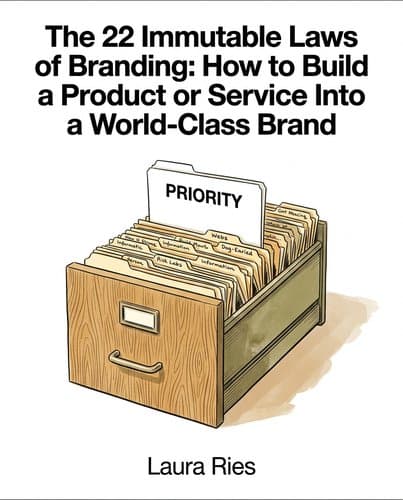
Think of a mind as a filing cabinet with 50,000 slots — one for each word an average adult carries. The United States alone has 2.5 million registered trademarks, every one of them competing for a slot in that same cabinet. The math is brutal before you even account for human attention. Most of those trademarks never earn a slot. A brand earns one only when it collapses everything about itself into a single word that nobody else already owns.
A product sits in a warehouse. A brand occupies a word in a mind. Watch what happens when a company grasps that — or doesn't.
Federal Express grasped it. When Fred Smith narrowed his struggling delivery company to a single promise — overnight, only, no exceptions — competitors and analysts thought he was surrendering the market. Emery Air Freight, the category pioneer founded in 1946, offered everything: small packages, large packages, overnight, two-day, three-day, whatever you needed. 'Whatever you want to ship, Emery can handle it.' That coverage felt like strength. It was camouflage for having no position at all. FedEx sacrificed everything Emery thought was an advantage, planted its flag on one word, and turned that word into a verb. People don't say they're 'Emerying a package.' The company that invented the category became a footnote because it refused to own a single piece of it.
What FedEx understood — and what Emery never did — is that perception isn't a feature list. You can't dislodge a word by offering a longer menu. Volvo owns 'safety' in the minds of car buyers. Saab, BMW, and Mercedes have all built cars with strong safety records. It doesn't matter. Safety belongs to Volvo because Volvo claimed it first and held it exclusively. BMW responded by doing something smarter than competing on Volvo's turf: it claimed a different word entirely. 'The ultimate driving machine' became shorthand so durable that BMW is now synonymous with the pleasure of driving itself. Two brands, two words, both locked in. No advertising campaign, however large, can dislodge either one now — because the problem isn't awareness, it's architecture. The word is already filed.
The Rolex trap illustrates the stakes from the other direction. A $100 Rolex would sell. Millions of units, probably. Short-term revenue that would delight a quarterly earnings call. And it would hollow out the one thing Rolex actually owns: the word 'expensive Swiss watch' compressed into a single proper noun. Destroy the exclusivity, and you haven't made Rolex more valuable — you've handed the word to whatever manufacturer moves in next, some Shenzhen operation happy to own 'luxury watch' once Rolex has abandoned the position. A brand is not a product you can manufacture in higher volumes. It's a perception you can only hold by refusing to contradict it.
Narrowing Your Focus Is Not a Retreat — It's How You Build the Asset
Fred DeLuca opened his first sandwich shop in 1965 with a thousand dollars borrowed from a family friend. The original menu sprawled like any decent deli: multiple meats, multiple breads, multiple everything. The store was forgettable in the way that generalist businesses always are — it had no answer to the question of what it was actually for. Then DeLuca did the thing that looked, from the outside, like giving up. He narrowed the whole operation down to a single item: the submarine sandwich. He even named the chain after it.
The financials that came out in a court case decades later tell the rest without embellishment. In 1990, DeLuca paid himself $27 million in personal salary. By 1991, $32 million. By 1993, $54 million. By 1994, $60 million — from making one type of sandwich, at scale, with an operation simple enough that anyone could execute it consistently. The menu contraction wasn't the consolation prize; it was the mechanism. When you make only submarine sandwiches, you get very good at making submarine sandwiches.
The question contraction forces you to answer isn't 'how do I sell more things to more people?' It's 'what do I want this name to mean in twenty years?' Those are different questions, and they point in opposite directions. The first leads toward menu expansion, line extensions, and the slow dilution of whatever made the name worth something. The second leads somewhere that feels, at first, like restraint — and turns out to be the only path to owning a category.
Papa John's started with cheesesteaks and onion rings alongside the pizza. It only became a dominant brand when it cut everything except the one thing the name could plausibly own. Contraction wasn't how it survived a bad quarter — it was how it built an asset that now occupies a specific, defensible word in millions of minds.
What makes this hard to see is that you encounter successful brands in their mature phase, when they're expanding and acquiring and launching sub-brands, and you assume expansion is what made them strong. It wasn't. Howard Schultz walked into a world full of diners that served coffee alongside sixty other items and decided to run a shop where coffee was the entire point. He cut the menu down to what Starbucks could own, built that into a category, and then — only then — moved into bottled drinks and licensing and everything else. The expansion came after the asset was built. Contraction built the asset.
Line Extension Is Not a Growth Strategy. It's a Slow Brand Suicide with Good Quarterly Numbers.
Line extension looks like a growth strategy. In practice, it's how companies cannibalize themselves in slow motion while the accounting system applauds.
The beer industry is the cleanest proof available. In the mid-1970s, three brands dominated American beer: Budweiser, Miller High Life, and Coors Banquet. Over the following decades, each of those three became a family — Bud Light, Bud Dry, Bud Ice; Miller Lite, Miller Genuine Draft, Miller Reserve Amber Ale; Coors Light, Coors Extra Gold — until the original three had spawned fourteen distinct products. The marketing logic was competitive: each brand targeted its rivals' customers. Coors Light was going to steal drinkers from Budweiser. Bud Light was going to take share from Miller. But the Coors Light drinker wasn't a Budweiser defector — she was a Coors drinker who switched to the lighter version. The cannibalization was internal and invisible, because no one was measuring the erosion of the parent brand, only the sales of the extension. The outcome is in the numbers: per capita beer consumption stayed flat across that entire period while the original flagships shed substantial share to their own children. Fourteen products captured roughly what three products had held before.
That line deserves to land. It should feel like an epitaph.
The pattern recurs because management measures the extension in isolation — its revenue, its shelf velocity, its first-year numbers — and never runs the calculation on what it cost the core brand. Bayer ran a $116 million campaign to launch a line of aspirin-free pain relievers under the Bayer name, positioning them as superior because they didn't contain aspirin. First-year sales hit about $26 million in a $2.5 billion market. One percent. Meanwhile, sales of regular Bayer aspirin kept falling. The campaign had spent over a hundred million dollars teaching consumers to distrust the ingredient that made the original brand famous. Sit with that for a second: when you tell people your new product is better because it doesn't contain your original ingredient, you've just issued a press release about your own brand's limitations.
The damage never shows up in the extension's own metrics. It shows up in the slow shrinkage of a 50-percent brand toward a 30-percent brand — the distance between Coca-Cola, which held its focus, and Budweiser, which didn't.
The Name-Is-the-Brand Trap: Why East Asia Had a Branding Crisis, Not a Financial One
What does a branding mistake look like at the scale of a national economy? Look at East Asia in the late 1990s.
Compare the top 100 companies in the United States with the top 100 in Japan during the same period. Revenue was roughly comparable — $3.2 trillion versus $2.6 trillion. The gap that matters was in profits. American companies averaged 6.2% net profit. Japanese companies averaged 0.8%. Korea's 63 largest corporations, taken together, ran a combined net loss of 0.4% of sales. The conventional explanation pointed to banking exposure, currency instability, political dysfunction. Wrong problem. East Asia doesn't have a financial crisis, it has a branding crisis.
The mechanism is visible the moment you ask a simple question: what is a Mitsubishi? Sixteen of Japan's hundred largest companies sell products under that name — automobiles, semiconductors, consumer electronics, space equipment, transport infrastructure. Matsushita and Mitsui follow the same pattern. When a name attaches to sixteen different businesses, it doesn't mean all sixteen things. It means nothing. The name is a legal fact, not a perception. And a name with no specific perception in the consumer's mind generates no pricing power, no loyalty, and no margin — which is exactly what the profit figures show.
Hyundai is the sharpest illustration. The Korean conglomerate described its strategy as 'chips to ships,' and it meant that literally: microprocessors, telecommunications satellites, passenger cars, supertankers, subway systems, high-speed trains — all sold under one name. The ambition is almost admirable. The financial result is not. Hyundai makes everything except money.
When the dominant corporate logic of an entire economy treats brand names as infinitely elastic containers, the consequences don't stay in one product category. They compound across industries, across decades, and eventually across a currency crisis that gets misdiagnosed as something more respectable than its actual cause. The name was always the asset. Stretching it past the breaking point was always the problem.
Publicity Launches Brands. Advertising Defends Them. Confusing the Two Wastes Both.
Why do companies with the biggest advertising budgets so often end up with the weakest brands? Miller Brewing spent $50 million launching a product called Miller Regular — a line extension with a name that communicated nothing, defined no new category, and gave the press absolutely no reason to write about it. The brand never found an audience. The campaign wasn't badly executed. It was badly sequenced. Advertising arrived before there was anything for advertising to defend.
Here is the sequence that actually works. Starbucks spent less than $10 million on advertising across its entire first decade, during which it grew into a $2.6 billion business. Anita Roddick built The Body Shop into a global brand without running a single ad. She opened 700 stores in 42 countries by generating a sustained flood of magazine profiles, newspaper features, and broadcast interviews — most of them driven by her environmental campaigns, including a high-profile partnership with Greenpeace to save the whales. The media covered her because she was doing something genuinely new. That coverage did what no ad budget could have: it told millions of people, through a source they trusted, that this brand was worth paying attention to. Advertising, by contrast, is a brand talking about itself. The reader's instinctive response to a self-promotional claim is exactly what you'd expect — skepticism.
Once a brand has earned its position through that kind of external validation, advertising takes over a different job. At that stage, a large ad budget functions less like a megaphone and more like a fortification — it raises the cost of entry for competitors who might otherwise chip away at the market. And what a leader advertises matters enormously. Claiming 'our product is better' produces a predictable reaction: so does everyone else's. Claiming 'our product is the leader' produces something different: it must be better. Consumers assume free markets are efficient — so when Heinz calls itself America's favorite ketchup, the message isn't arrogance, it's a shortcut to quality that no 'better product' claim can replicate. Publicity builds the position. Advertising holds it. Run them in the wrong order and you get Miller Regular.
Consistency Is Boring. It's Also the Only Thing That Makes a Brand Worth Anything.
Sometime in the early 1990s, a Little Caesars executive looked at the chain's remarkable run — two pizzas for the price of one, takeout only, a rallying cry so simple it fit on a bumper sticker — and asked the question that ends more brands than any recession ever has: why should we limit ourselves? The chain was the second-largest pizza operation in America. The answer, apparently, was that they shouldn't. So they added delivery. They fell to third. Then, in an effort to recover lost ground, they restructured their sizing — what had been a small became a medium, a medium became a large — until customers ordering over the phone couldn't be sure whether a 'Little Caesars medium' was bigger or smaller than the thing Pizza Hut called by the same name. The 'Pizza! Pizza!' two-for-one was quietly dropped. The brand that had owned takeout value pizza, cleanly and completely, now owned nothing in particular.
That question — why should we limit ourselves? — is the most dangerous sentence in brand management. It sounds like ambition. It is actually the moment a brand stops believing in itself.
The difficulty isn't intellectual. It's institutional: the competitive panic when a rival launches something new, the executive who needs a win on their watch, the sheer boredom of approving the same brief for the fifteenth consecutive year. Volvo has communicated 'safety' for thirty-five years. BMW has held 'the ultimate driving machine' for twenty-five. When Volvo introduced a convertible — the executives probably called it exciting, a sign of range and sophistication — they weren't expanding the brand. They were putting a hairline crack in the one thing Volvo had spent three and a half decades building. A ragtop is not a safety statement. But the brands that feel tireless to the consumer are precisely the ones where someone inside had to kill the exciting idea for the fifteenth consecutive year. That tension is the cost of the asset.
Little Caesars didn't fail because the delivery pizza was bad, or because customers stopped wanting value. It failed because it abandoned the specific, narrow, irreplaceable word it had earned in the mind. Once that word goes, there is nothing left for the advertising to defend. You can't spend your way back to a position you gave away.
When the Category Dies, Let the Brand Die With It
Think of a surgeon who spent twenty years mastering cardiac procedures — every credential, every reputation, every referral built on one specific skill. Now imagine that hospital asks her to run the oncology ward. Her name is still on the door, but what it means to a patient has changed entirely. That's the Kodak problem, compressed into a hallway conversation.
Kodak spent a century earning one word in the mind: photography. Film, cameras, the yellow box at every drugstore — the association was total. When amateur movie film died and videotape took over, Kodak put its name on videotape cassettes. It didn't work. Kodak meant photography, not magnetic tape, and no amount of shelf placement could bridge the gap. That was the warning shot, and the company didn't take it.
The larger battle arrived when digital cameras began replacing film cameras entirely. Kodak fought on two fronts simultaneously. On the conventional side, it poured hundreds of millions into a new 24mm film system — Advantix — requiring photo shops to buy expensive new processing equipment, all to defend a technology history had already scheduled for retirement. On the digital side, it launched 'Kodak Digital Science,' betting that its famous name could carry it into a category built on the premise that film is obsolete. Kodak was literally funding the argument against its own product. The brand that meant photography was now trying to own the thing that was killing photography.
History runs one direction on this question. When digital phones replaced analog ones, the winners were new brands, not old ones wearing new labels. Sony didn't conquer consumer electronics by inheriting a legacy name — it won precisely because it arrived without one, free to own an entirely new category. Dell didn't beat IBM at personal computing by borrowing IBM's credibility. It beat IBM by starting fresh, with a name that carried none of IBM's baggage and all of its own ambition.
The discipline being asked for here is genuinely uncomfortable: when a category dies, resist the instinct to rescue the old brand by dragging it into the replacement category. Launch something new instead. The old name isn't an asset in the new fight — it's the weight around your neck.
The Question Your Brand Has to Answer in One Word
Section 8 ends with a warning about what diffusion costs you. This is what it costs everyone else too — including the reader sitting with this book right now.
Here is the hardest test: find someone who has never encountered your brand, and ask them what it stands for. One word. If they give you three, or hedge, or say 'it depends,' the problem isn't their memory — it's yours. You've spent resources building a catalogue when you needed to build a word. Every section of this argument arrives at the same verdict from a different direction: the companies that chose a word and held it, through boredom, through temptation, through executives asking why they should limit themselves, compounded into something no competitor could buy. The ones who flinched — who added the delivery service, who launched the aspirin-free aspirin, who tried to carry a film brand into the era that made film obsolete — didn't lose to the market. They lost to themselves. That's the discipline on offer here. It isn't complicated. It's just genuinely difficult to practice for decades without blinking. Go back to the filing cabinet: if you can't write one word on the tab, you haven't built a brand. You've built a drawer that won't close.
Notable Quotes
“Crest has thirty-eight SKUs. Do you think that’s too many or too few?”
“How many teeth do you have in your mouth?”
“No toothpaste should have more stock-keeping units than teeth in one’s mouth,”
Frequently Asked Questions
- What is The 22 Immutable Laws of Branding about?
- The book argues that brand power comes from narrowing focus, not expanding it. A brand's strength is determined by the single word it owns in the customer's mind. Written by Laura Ries and Al Ries in 1998, it provides marketers with a framework for building category-dominant brands by resisting line extensions, launching new brands for new categories, and using publicity and consistency to compound equity over time. The authors challenge conventional wisdom about growth and expansion, showing instead that contraction is the engine of brand power.
- What is the core principle of brand building in The 22 Immutable Laws of Branding?
- The core principle is that "when a brand tries to stand for multiple things simultaneously, it stops standing for anything." Measure brand health by the single word you own in the prospect's mind, not by how many SKUs carry your name. The strongest brands—Subway, Starbucks, FedEx, and DeWalt—achieved dominance through focused contraction rather than expansion. This concentration of identity creates what the authors call the engine of brand power, allowing a brand to own a distinct position customers easily recall and associate with specific value.
- What are the key differences between publicity and advertising in building brands?
- According to the book, publicity launches brands by creating news about being first in a new category, while advertising defends brands by raising the cost of competition. Publicity is earned through genuine market innovation; advertising involves paid messaging to reinforce existing positions. The authors state "don't use advertising to do what only publicity can do." This distinction is crucial: use publicity to introduce genuinely new categories, and use advertising to protect market share once your brand owns a category position. Confusing these roles weakens both strategies.
- Why should companies launch new brands instead of extending existing ones into new categories?
- When the market shifts into a genuinely new category, launching a new brand is superior to stretching an existing name. As the authors explain, "the parent brand's strength is the exact thing that will prevent the new product from owning a fresh position." An established brand identity can become an anchor preventing customers from viewing a new product with fresh eyes. Examples like DeWalt, Lexus, and L'eggs succeeded because they launched as distinct brands rather than extensions. Maintaining consistency with a focused parent identity preserves greater long-term brand value than nominal consolidation.
Related Book Summaries

Read the full summary of 1565533_the-22-immutable-laws-of-branding on InShort