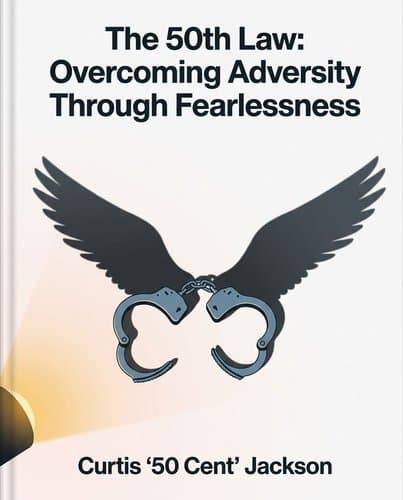
6043946_the-50th-law
by Curtis '50 Cent' Jackson
Fear is a self-built cage, not a rational response to danger. 50 Cent and Robert Greene show how confronting your deepest anxieties—starting with death…
In Brief
The 50th Law: Overcoming Adversity Through Fearlessness (2008) draws on 50 Cent's rise from the streets and Robert Greene's historical research to argue that fear — not circumstance — is the true source of human limitation.
Key Ideas
Framing transforms constraints into advantages
When something bad happens, list every way it could become an advantage before you call it a problem. The constraint is neutral — your framing is the variable you control.
Learn to operate without institutions
Treat your current job as apprenticeship: learn everything about how the operation works, including how to run it without the institution. The knowledge is yours to keep. The job is not the destination.
Distinguish real choice from avoiding
Before any significant decision, ask whether you are choosing it or avoiding the alternative. If walking away feels impossible, you are already being controlled — by the situation, not by your own judgment.
Direct audience feedback is truth
Create a direct feedback loop with your actual audience, not gatekeepers or flatterers. Treat cold or negative reactions as data about the work, not personal judgment. The audience is the only real mirror.
Growth hides in avoided zones
Identify the one domain you most consistently avoid when things get difficult. That avoidance is where your power is locked. The area that feels most uncomfortable to enter is precisely where you need to spend deliberate time.
Silence as fear, not wisdom
The next time you stay quiet in a conflict you should have entered, notice the feeling you call 'being the bigger person.' Then ask honestly whether it is wisdom or fear wearing better clothes.
Who Should Read This
People working on personal growth in Resilience and Self-Improvement, especially those tired of generic motivational advice.
The 50th Law: Overcoming Adversity Through Fearlessness
By Curtis '50 Cent' Jackson & Robert Greene
9 min read
Why does it matter? Because the caution you mistake for wisdom is the prison you built yourself.
You've been told caution is intelligence. That the person who waits, measures risk, doesn't overextend. That person survives. You've watched enough crashes to believe it.
Here's what that belief costs: the most protected people in any room are usually the most confined. The careful calculation you run — what to risk, what to hold, what's safe — isn't protecting your future. It's building the ceiling.
This book starts with a street hustler from Southside Queens. The same discovery keeps turning up across wildly different lives: the people who had the most to fear ended up the most free. Not because they were unusually brave. Because they stopped treating survival as the goal, looked directly at the thing underneath every anxiety, and found it was mostly architecture. The question is whether you're willing to look.
The Mind Going Soft Kills More Hustlers Than Any Rival
On a corner in Southside Queens, a fifteen-year-old Curtis Jackson, already a competent hustler, was complaining to an older dealer named Truth about how hard the game was. The erratic customers. The rivals who'd stab you for a corner. The police everywhere.
Truth cut him off. Stop complaining, he said. The difficulty is the point. The streets force you to keep your eyes open — on who's dangerous, on where opportunity is moving, on what's real versus what people want you to believe. That sharpness is your only weapon.
Then Truth named the real threat: not the police, not a rival with a gun. The mind going soft. He'd watched it happen to hustlers who got comfortable: they stopped seeing the streets clearly, started thinking the money would keep coming forever. One walked into a quick-money scheme that any clear-eyed person could see was a trap. Another slowed down, mistaking avoidance for safety. Both went down fast. Lose your grip on reality on these streets, Truth told him, and you might as well quit.
Years later, inside a collapsing record industry, he watched label executives do exactly what Truth had described. The evidence was there: sales falling, distribution monopolies dissolving, the old model hollowed out by digital piracy. The people in charge refused to look at it directly. They were comfortable, so they kept their eyes closed. Curtis saw it clearly, built a diversified business while the executives clutched their old playbooks, and left them behind.
The dangerous thing in both stories isn't the hostile environment. It's the choice to stop seeing clearly — and it is a choice. What feels like prudence, like reasonable caution, is usually just a mind that has decided comfort matters more than accuracy.
Every Constraint You're Given Can Be Reversed Into an Advantage
The meaning you assign to a setback is the setback. The event itself is neutral.
In May 2000, Curtis Jackson was shot nine times — one bullet through his jaw, one millimeter from killing him. The same week, Columbia Records canceled his debut album and dropped him from the label. Other labels blackballed him. Assassins were still circling. He had no money, no performances, and a social network that evaporated the moment it became clear he was no longer a safe bet.
From the outside, this looked like the end. From where he was lying in his grandparents' house, recovering, it started to look like a complete hand to play.
The bullet fragments lodged in his tongue had changed his voice — slower, with a hiss. He could have spent months retraining it. Instead he built that hiss into his brand. It was the sound of someone who had literally been shot and was still talking. The violence that made labels afraid of him became proof that he was authentic in a genre full of performers pretending to be dangerous. The blacklist that kept him out of formal distribution meant he had no executives to answer to. He could push his lyrics as hard as he wanted, with nothing softened. With no budget to move product, he actively encouraged bootleggers to spread his music for free across New York, turning his invisibility into myth. You heard him everywhere but couldn't see him. By early 2003, Eminem had signed him after discovering one of those mixtapes. What looked like the end was a three-year runway.
Events are neutral. Fear converts them into catastrophes — it makes you read the setback as larger than it is, retreat, and worsen your position. The hustler's instinct is the opposite. Bad events are normal. Tomorrow may bring worse. So extract whatever value is sitting in front of you right now.
The people closest to catastrophe, the ones who had already paid the price in full, are the ones who found the most freedom. Curtis Jackson lying in a hospital bed had nothing left to protect. That's why he could see the assets clearly. You still have things to lose, or think you do. He was lying in his grandparents' house with bullet fragments in his tongue, building a brand out of the sound.
The Moment You Need Something From Someone, They Own You
What's the harm in taking a safe job when you need money?
After Curtis Jackson got out of a Brooklyn rehab program, he was broke, his customer base had scattered, and a friend offered him a steady wage bagging crack for a large operation. It was a reasonable offer. He needed cash. The work was familiar. Maybe, given time, his friend would cut him in on the real money.
He lasted one day before he understood what he'd agreed to.
The other baggers had all once run their own corners. They'd been through violence, prison, reversals: the same gauntlet he'd just survived. But they'd got tired. A paycheck felt like stability. What it actually was, he saw, sitting there working alongside them, was the end of something. They showed up when told and answered to authority; their judgment about their own lives no longer mattered. The trade they'd made — freedom for security — wasn't a temporary arrangement. It was a new identity. They would keep making that trade, in smaller and smaller ways, until there was nothing left to barter.
Curtis didn't wait to see if it would get better. On that first day, he cut a deal with the other baggers: he'd hand them his daily wage if they'd let him teach them to slightly underfill each capsule and pass him the surplus. Within a week he had enough product to return to independent dealing. He swore he would never work for someone else again.
This isn't a story about street hustle. It's about what dependency actually costs. The money you get from someone who controls your work is never just money. It buys them a piece of your time, your decisions, and your ability to act when you need to. Each concession is cheap on its own. That's how the trap works: you rationalize each step individually, and by the time the cost is visible you've lost the habit of moving on your own.
The one position that can't be controlled is the one where you need nothing. Not as an aspiration — as a practice, built by taking back whatever domain you've let someone else control.
The Inability to Fight When It Counts Is Just Fear With Better Manners
Ja Rule was then one of the hottest rappers in the business, his reputation built entirely on street credentials — his lyrics, his alliances with actual New York gang figures, his brand premised on being someone not to cross. When a friend of Curtis Jackson's took Ja's jewelry off him in broad daylight and Ja stared right through it, the message wasn't composure. It was exposure: the image was manufactured. A man who cared about his reputation would have responded. His silence told Curtis exactly where the vulnerability was.
So Curtis engineered the fight. He released diss tracks calling out Ja's fakery. Ja ignored them — too big for small fry. Then Curtis released a song that named real gang figures, including the street ally whose protection gave Murder Inc., Ja's label, its credibility. The naming brought heat onto people who couldn't afford attention. They pressured Ja to respond. Once Ja engaged, Curtis had what he wanted: someone emotional and defensive, swinging at a target that kept moving. Ja's counter-tracks were violent but flat, all threat and no wit. Curtis's were sharp and entertaining. When their debut albums dropped the same week, Curtis's outsold Ja's. Ja faded. Curtis didn't stop the attacks out of mercy — he stopped because Ja had served his purpose.
The point isn't that aggression works. It's that refusing to engage when the moment demands it isn't neutrality. It's fear. The fear of what fighting might cost you, dressed up as professionalism or decency. Ja Rule's silence after the robbery cost him everything the fight might have cost him, and more. He never got to choose when the confrontation happened. Curtis chose for him.
The Vision You Hold With Complete Certainty Becomes More Real Than Your Circumstances
The living room of his grandparents' house, sometime after the shooting: more than twenty young men packed in, guns positioned outside to secure the street. Curtis Jackson had nothing concrete to offer. No label. No income. Assassins still circling. He stood and described exactly what was going to happen. Within two years, his music would land a major deal. The debut record would be large. The mixtapes were already proving it, testing hooks street by street until he knew exactly what it needed to be. That money would fund businesses, then a record label, then an empire. Anyone who wanted a place in it — rapper, road manager, executive — he would bring along and pay their college tuition. Then he named the stakes plainly: you are my pack of wolves, he said, but none of this happens if the alpha wolf gets killed. He needed protection and logistical help. In return, they were being offered a future that didn't exist yet.
Why did over twenty men say yes to someone with no label and no money? Because there were no gaps in the certainty. The vision was complete enough that doubting it required more effort than accepting it. Years later, those who stayed described something that should not have been possible: the future had come to resemble, in remarkable detail, the picture from that afternoon.
Self-belief at this level isn't optimism about your current position. It's constructing an internal picture detailed enough that it starts functioning like reality before it is one. The people around you read that certainty and calibrate to it. Their belief amplifies yours. The thing you described starts organizing actual decisions, yours and theirs.
The paradox: from outside, this looks like delusion. By purely evidential standards, it is. But calibrating your expectations to present evidence is just fear with better posture — you are letting your current position set the ceiling on where you can go. The person who holds the vision with complete certainty is not being reckless. They are refusing to let current circumstances define what's possible. That refusal is not a personality trait. It's a practice, rebuilt each time the evidence argues against it. The men in that room didn't do the math. They believed because the picture Jackson was holding was already more real than anything they could see from where they stood.
All of Your Fears Are One Fear — Dissolve That One and the Rest Follow
The bullet that grazed his skull was the last one fired. He was in surgery. A searing light flooded his vision, then a shadow passed across it, slow and calm, before everything resumed. He didn't panic. He noticed.
In the months after, he woke earlier, wrote songs until almost morning, stopped buying jewelry, poured every dollar back into his mix-tape campaign. The nine bullets hadn't made him more cautious. They had made him incapable of caring about the wrong things.
He traced this back directly to the shooting. Clinging to a bad situation out of fear of the alternative is the same move as clinging to life on any terms: you accept diminished circumstances because the other option feels unthinkable. He had looked at the other option on a surgery table in May 2000, and it had felt oddly calm. After that, what was there to be afraid of?
Every fear you carry is a tributary of one river. Fear of rejection, financial ruin, social embarrassment, losing what you've built: these are all the fear of death in a less honest costume. They feel different and manageable because they're dressed in specific circumstances, but the mechanism underneath is identical. You won't do the thing because something precious might be lost. And the "something precious" at the bottom of the stack is always the same thing.
The Stoic philosopher Seneca spent forty years rehearsing his own death, imagining it in detail, sitting with it until the image stopped frightening him. He wrote about the practice in his Letters to Lucilius: contemplate your death daily; let nothing be postponed; sit with the image until it loses its power to frighten. When Nero sent soldiers with orders to die, Seneca sliced his veins and waited, calling for scribes to keep taking dictation. His students were there. Tacitus records that they wept; Seneca told them to stop. His composure wasn't resignation. It was forty years of practice paying out.
Neither 50 Cent nor Seneca had the option you have: to choose this deliberately, before circumstances choose for you.
50 Cent had to look at death directly. It was not philosophical. You have the option of approaching it on your own terms, before the confrontation is arranged for you. The book ends here — not with a promise, but with a question. What you've been afraid of is one thing wearing many faces. Confront the one underneath, and you'll find the others have nothing left to stand on.
The Choice 50 Cent Never Had
50 Cent did not choose to confront his fears. The streets chose for him — nine bullets, a mother dead before he was old enough to know her, a blacklisted career with nothing left to protect. When circumstances strip everything away, what remains isn't courage exactly. It's just clarity. The thing you were afraid of losing is already gone.
You still have things to lose. Or think you do. The door out of your smaller life is right there, but you get to decide whether to open it, and that option is exactly what makes it harder. Not impossible. Harder. 50 Cent's freedom came from having no alternative. Yours has to come from choosing one.
That is the book's final ask. Not whether you are afraid — you are — but whether you have been mistaking that fear for wisdom. 50 Cent had no choice. You do.
Frequently Asked Questions
- What is The 50th Law about?
- The 50th Law argues that fear—not circumstances—is the primary source of human limitation. Drawing on 50 Cent's personal rise from difficult streets and Robert Greene's historical research, the book shows how to dismantle fear through direct confrontation, reframe adversity as opportunity, and build the psychological independence required to act decisively. The core insight is that constraints are neutral until you apply meaning to them. Your circumstances don't determine your outcomes; your mental framework and willingness to confront fear do. The book combines street wisdom with historical patterns to provide a practical roadmap for anyone seeking greater freedom and effectiveness in their life, work, or relationships.
- How should you respond when something bad happens?
- When adversity strikes, reframe immediately: "When something bad happens, list every way it could become an advantage before you call it a problem. The constraint is neutral — your framing is the variable you control." This practice shifts you from victim mentality to creative problem-solving. Rather than accepting the default interpretation of events, you actively seek how limitations could become strengths. This doesn't mean denying real hardship, but recognizing that your response determines the outcome more than the event itself. The constraint is the same for everyone; your advantage comes from superior thinking about what it means and how to use it.
- What role does fear play in career and decision-making according to The 50th Law?
- Fear subtly controls our choices in ways we don't recognize. Before any significant decision, ask yourself whether you are choosing it or avoiding the alternative: "If walking away feels impossible, you are already being controlled — by the situation, not by your own judgment." This reveals how fear often masquerades as necessity or loyalty. The book suggests treating your current job as apprenticeship—learn everything about the operation, including how to run it without the institution. Knowledge is yours to keep; the job is never the destination. This mindset breaks fear's grip by reminding you that education, not employment, is the true asset.
- What does The 50th Law say about personal growth and feedback?
- Personal growth requires honest feedback from reality, not gatekeepers: "Create a direct feedback loop with your actual audience, not gatekeepers or flatterers. Treat cold or negative reactions as data about the work, not personal judgment. The audience is the only real mirror." Additionally, identify the domain you most consistently avoid when things get difficult—that avoidance reveals where your power is locked. The area that feels most uncomfortable to enter is precisely where deliberate effort creates breakthrough. Identify what you call 'being the bigger person' in conflicts: is it wisdom or fear wearing better clothes?
Related Book Summaries


Read the full summary of 6043946_the-50th-law on InShort