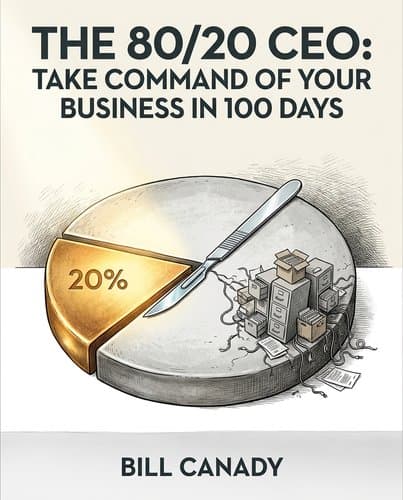
204125516_the-80-20-ceo
by Bill Canady
Most CEOs are busy managing complexity they created—Bill Canady shows how mapping customers and products into a simple four-quadrant matrix reveals that your…
In Brief
Most CEOs are busy managing complexity they created—Bill Canady shows how mapping customers and products into a simple four-quadrant matrix reveals that your top 20% likely generates over 100% of real profit, and how 100 focused days of ruthless prioritization can turn a struggling business around.
Key Ideas
Customer-Product Matrix Drives Resource Allocation
Map your customers and products into a two-by-two Quad matrix (A vs. B customers × A vs. B products). Quadrant 1 likely generates more than 100% of your real profit; Quadrant 4 is producing a net loss. This single analysis should restructure every resource allocation decision you make.
Optimize Before Eliminating Unprofitable Segments
Before cutting any B-product or B-customer, run the 'Dirty Dozen' filter first: can you price it up until only serious buyers remain? Can you aggregate orders until the run is profitable? Can you shift it to online-only, minimum-order, upfront-payment terms? Elimination is the nuclear option, not the first move.
Set Directional Goals With Imperfect Data
Set a financial goal before you have perfect data. Specific numbers — even imperfect ones — replace panic with direction. An unaimed arrow never misses, but it never hits anything worth hitting.
Divergent Thinking Requires Separate Brainstorm Sessions
Never mix brainstorming and decision-making in the same meeting. Divergent thinking (what if?) and convergent thinking (what's best?) cancel each other out when run simultaneously. Brainstorm first, meet second — always in separate sessions.
Zero-Up Reveals Hidden Organizational Complexity Costs
Run the Zero-Up thought experiment: rebuild your company on paper using only your top 20% of customers. The gap between that lean version and your current headcount and infrastructure is the hidden cost of complexity your P&L is not showing you.
Designate Internal Prophet for 80/20 Discipline
Every sustainable 80/20 organization needs a Prophet — an internal leader whose job is to keep the organization from drifting back into serving the trivial many. External consultants can diagnose; only an internal evangelist can make the discipline stick.
Use Leading Indicators for Course Corrections
Treat KPIs as mid-flight course corrections, not scorecards. Leading indicators let you change the arrow's trajectory before it lands; lagging indicators tell you whether your corrections worked. Run both simultaneously and never substitute gut feel for either.
Who Should Read This
Business operators, founders, and managers interested in Leadership and Management who want frameworks they can apply this week.
The 80/20 CEO: Take Command of Your Business in 100 Days
By Bill Canady
9 min read
Why does it matter? Because your instinct to serve every customer and offer every product is quietly bankrupting you.
You've been taught that growth means more. More customers, more product lines, more sales reps chasing more leads. More complexity managed by more meetings producing more slide decks. It feels like momentum. It isn't. Most of that activity isn't just wasted — it's quietly strangling the fraction of your business that actually works. A Navy veteran turned private equity fixer named Bill Canady watched this happen inside company after company, and he developed something blunter than a philosophy: an operating system. Ninety days of structured, data-driven surgery that identifies the twenty percent of customers and products generating eighty percent of your revenue — and then systematically strips away everything that's feeding off them. Not trimming. Not restructuring. Removing. Most businesses are one honest spreadsheet away from discovering they've been at war with themselves — and Canady's operating system is the surgeon's table where that war ends.
The Checklist That Saved His Life — and Became a Business Philosophy
The moment Bill Canady nearly died, he wasn't saved by instinct — he was saved by a checklist. On a solo flight from Waterloo, Iowa to Dodge City, Kansas, Canady brought his Cessna in low over a pond on a hot afternoon. The thermal bouncing off the water launched him skyward by 200 feet without warning. His heart hammered, cold sweat soaking a warm cockpit, and in that instant his rational mind — the part that knows what to do — was perfectly useless. What saved him wasn't flying ability or quick thinking. It was that his training had installed a landing process so deeply that it unspooled in his mind like film credits, step by step, until he felt the tarmac under his wheels. He hadn't been taught to land. He had been taught a process for landing.
Canady calls that distinction an Operating System — the thing that gets between you and the machine, between panic and performance. An OS doesn't ask whether you're frightened or confident; it simply tells you what to do next. Under pressure, human instinct is a liability. Process is the override.
Canady carried this lesson directly into his turnaround work with broken businesses. The instinct most leaders bring to a struggling company — serve every customer, push every product, hustle harder in every direction at once — is the equivalent of yanking the controls in a thermal. It feels like action. It is actually chaos. The brutal arithmetic of the 80/20 principle says that 80 percent of your revenue comes from 20 percent of your customers buying 20 percent of your products. Every hour you spend outside that nexus is an hour you're paying to dilute yourself. Your hustle isn't saving you. It's the thermal. The process is what gets you down alive.
Most of Your Business Is Actively Destroying the Part That Matters
Here is a claim worth sitting with: most of your business is consuming the resources your best customers need. Bottom-tier activity isn't neutral dead weight. It's an active drain, and the numbers are almost uncomfortable to look at directly.
Take a real company segmented by the 80/20 principle into four quadrants — a two-by-two matrix separating top customers buying top products from every other combination. Quadrant 1, the engine, contains the A customers purchasing A products. Quadrant 4, the sump, holds the B customers buying B products: thousands of SKUs, negligible orders, high-touch service demands. Run the profit-and-loss numbers for each quadrant independently, and the picture stops being abstract. Quadrant 1 generates 200 percent of the company's total profit. Quadrant 4 produces a loss of negative 120 percent. Together they explain how an apparently functioning company quietly hemorrhages — Quadrant 1 is covering not just its own costs but the damage Quadrant 4 is doing. The company is a four-cylinder engine running on one cylinder while another works in reverse, fighting the machine the whole way.
The insight here isn't about trimming waste. Your sales team's time spent nursing a low-margin account is time pulled directly from your most profitable customers. Warehouse space occupied by slow-moving B products is space your A products aren't getting. The misallocation doesn't show up on most income statements because the damage spreads evenly across overhead. But it's there, and the quadrant framework makes it measurable.
Pareto's observation — that 20 percent of his pea plants produced 80 percent of healthy pods — isn't a management heuristic. It's a law of nature, in the same category as thermodynamics. It doesn't describe a correctable imbalance. It describes how complex systems work. The skew is baked in. Quadrant 1 customers typically generate 89 percent of revenue while Quadrant 4 generates 1 percent, yet both consume proportional slices of management bandwidth, staff attention, and infrastructure. Expanding your customer base without running this analysis doesn't hedge your risk. It multiplies Quadrant 4 while Quadrant 1 stays fixed. You aren't growing. You're growing the anchor.
Firing Your Customers Feels Wrong. That's Exactly Why You Should Do It.
Is it fair to treat your best customers differently than your worst ones? The instinct — the democratic, everyone-matters instinct — says no. Sit with that discomfort for a second, because it's real. And then ask the harder question: whether identical treatment actually is fair — to the customers who generate the revenue that keeps the lights on, and to the employees whose jobs depend on those customers being served well. When a sales rep spends three hours untangling a minimum-order headache for a B-customer who contributes a fraction of a percent to revenue, those three hours come out of the attention budget for accounts that generate 80 percent of it. You didn't treat everyone fairly. You taxed your best customers to subsidize your worst ones.
McDonald's learned this the expensive way. By 2014, the chain had accumulated more than 100 menu items — a variety that seemed, on paper, like responsiveness to customer preferences. In practice it produced gridlock. Customers stacked up at counters while staff navigated an unwieldy production system, and satisfaction scores were falling. CEO Don Thompson pulled five Extra Value Meals and eight variations from the menu entirely. The counter moved faster. Customers were happier. The paradox is almost offensive in its simplicity: McDonald's got better at serving customers by serving them fewer things.
Canady formalizes this logic into a toolkit he calls the Dirty Dozen — twelve moves for handling the complexity that B-products and B-customers generate, because outright elimination is only one option and rarely the first one worth reaching for. The most counterintuitive is aggressive repricing. Instead of cutting the B-product, you charge whatever a niche customer will actually pay rather than the standard rate. The customer who genuinely needs that low-volume item can still have it — just at a price that reflects the true cost of supplying it. One manufacturer Canady cites applied this to a handful of slow-moving industrial SKUs and watched a third of the B-customers quietly self-select out while margins on the ones who stayed doubled.
Quantity is not equality. Pretending otherwise doesn't make the business more fair. It makes it less solvent.
The First 100 Days Aren't About Fixing Everything. They're About Aiming the Arrow.
Think of a rifle shot in the dark. You cannot aim at nothing — but you also cannot wait for dawn before pulling the trigger. The first hundred days of a turnaround are exactly this problem: you need a target precise enough to orient an organization, even though the full picture hasn't resolved yet.
When Canady walked into Rolling Thunder Engineered Parts — a sprawling global distributor hemorrhaging cash across fourteen countries with no coherent strategy — he had ten days budgeted to set a goal. The actual writing took ten seconds. Three numbers: $2.3 billion in revenue, 18 percent margins, $300 million in EBITDA. He's clear-eyed that these were aspirations, not conclusions drawn from a completed analysis. The company had no reliable financial tracking, no situational awareness. A pilot, he notes, has to know fuel levels and whether the plane is right-side up. Rolling Thunder's instruments were broken.
So why commit to specific numbers before you fully understand the business? Because direction is the product, not accuracy. An unaimed arrow, Canady points out, never misses — and never hits anything worth hitting on purpose. The numbers gave the organization something a struggling company almost never has: a shared destination. That destination replaced panic with a question everyone could actually work on. Not "are we going to survive?" but "what do we need to do this quarter to hit that number?"
The goal alone is step one. Steps two through four — strategy, structure, and action plan — follow in sequence across the remaining ninety days, each feeding the next. Strategy uses 80/20 analysis to identify which customers and products are worth building around. Structure reorganizes the business to serve them. The action plan launches by day 100, explicitly rough, explicitly subject to revision. The entire hundred-day arc isn't meant to fix the company. It's meant to earn the right to grow in year one, so that year two can take market share, year three doubles down, and eventually the whole system runs on its own momentum — a concept Canady calls the flywheel, which gets its full treatment later but starts here, in these first hundred days, when someone finally puts a number on the wall.
The hundred days are not the answer. They are the aim.
Strategy Is Just Brainstorming Plus a Filter — Most Companies Only Do One
Good strategic planning, most people assume, means gathering smart people around a table to think hard together. The problem is that a table of smart people trying to think hard together almost always does one of two things: it criticizes ideas before they're fully formed, or it generates ideas too wild to survive contact with a budget. You get neither real creativity nor real analysis. You get the worst of each.
The two cognitive modes at work here are genuinely incompatible. One asks "what if?" — unconstrained, generative, refuses to be bounded by what's practical. The other measures, cuts, narrows ten options down to one. Both are necessary. Used simultaneously, they destroy each other. The analytical mind suffocates the imaginative one before it can breathe; the imaginative mind muddies the precision required to cut cleanly.
The structural fix is offensively simple: don't mix them in the same room at the same time. Run a brainstorming session first — no criticism, no feasibility checks, no budgets — and generate every possible direction the company could go. Then, separately, convene a decision meeting to filter that inventory down to the three to five initiatives that can actually move the needle. Divergence first. Convergence second. One meeting widens the funnel; the next flips it and squeezes.
This sequencing is exactly how Steps 2 and 3 of the hundred-day framework operate. Step 2 produces the strategic options; Step 3 runs them through the 80/20 filter — which customers, which products, which bets concentrate resources on Quadrant 1 — until what remains is specific enough to hand to someone and say: make this. The goal isn't a vision statement. It's a drawing with instructions.
What If You Started the Company Over — With Only Your Best Customers?
Imagine you could burn the company down tonight — not the building, just the customer list — and rebuild it tomorrow with only the accounts that actually make you money. No legacy clients kept out of loyalty, no minimum-order exceptions that became permanent policy. Just your best twenty percent, a blank org chart, and the question: what does this business actually need to serve these people?
That's the Zero-Up thought experiment, and what makes it useful isn't the fantasy of the bonfire. It's the gap it exposes. When Canady forces leaders to ask what headcount and infrastructure a company would genuinely require to serve only its top customers, the number that comes back is almost always shockingly small. The distance between that number and your actual headcount isn't slack or safety margin. It's the cost of complexity — the organizational mass you're carrying to serve the customers who are draining you.
The cumulative EBITDA bell curve makes this tangible in a way that's hard to argue with. Start with your single most profitable customer and plot total company EBITDA. Add the next most profitable. Keep adding, ranked in order. For a while, the curve climbs. Then it plateaus. Then — at a specific, identifiable moment — it starts to fall. That downward inflection is the exact customer where adding the next account begins destroying the value the previous accounts built. Every customer to the right of that point isn't just low-margin. They're being subsidized by the customers on the left, who are covering not just their own costs but the overhead your B-tier generates: the warehouse space, the service calls, the sales rep hours, the custom invoicing. The P&L never shows this directly because the damage is diffused across overhead. The bell curve makes the hidden tax visible.
The inflection point doesn't tell you what to cut — it tells you what the right side is costing the left.
A Turnaround Needs Three People, Not One Brilliant CEO
Eight hundred and sixty-three days. That's how long it took Bill Canady and his team at Phoenix Industrial to drive revenue from $700 million past $1 billion and lift EBITDA from $70 million to $175 million — a 150 percent gain. The tempting story is that one hard-charging CEO showed up with the right strategy and willed it into existence. That story is wrong, and believing it is exactly what causes the next company to fail.
Canady structures his leadership model around three roles that must be filled simultaneously, each owning a distinct domain. The Visionary — typically the CEO — sets direction and makes final calls, reading the whole sky at once and committing before perfect information arrives. The Operators, the segment and business unit presidents, execute within that direction day to day. They move the needle; they don't set it. Between those two sits the role most companies never create: the Prophet.
The Prophet, often a COO, is the keeper and active evangelist of the 80/20 framework. Not a consultant parachuted in for a quarter, but someone organic to the organization — someone who trains, coaches, and holds the line when managers start drifting back toward comfortable habits. And they always drift. On a given Tuesday, that means the Prophet is in the room when a business unit president wants to add back a product line 'just for this customer,' calling it by name, explaining exactly what it costs, and not letting the meeting end with a vague 'we'll look into it.' Without that, what looks like a transformed company slowly reverts — not through any dramatic failure, but through a thousand small accommodations, each sensible in isolation. Canady calls it running the engine without oil. It feels fine until the block cracks.
Illinois Tool Works proves what happens when the Prophet role becomes permanent. ITW embedded 80/20 so deeply into its operating culture that the logic survived leadership transitions, acquisitions, and market cycles — compounding at 19 percent annual shareholder returns for twenty-five straight years. That's not a turnaround. That's a flywheel.
The Flywheel Only Spins If You Let Go of the Drag
The hardest permission in business isn't the permission to grow — everyone hands that out freely. It's the permission to stop. Stop serving the customer who costs you three hours to generate forty dollars. Stop carrying the product line that makes your catalog feel comprehensive while it quietly murders your margins. The math is never what stops you. It's nerve.
What Canady is really handing you is a flywheel, and flywheels don't run on hustle — they run on concentration. The Visionary aims. The Prophet holds the aim when the organization's natural gravity pulls toward comfortable complexity. The Operators drive. Remove any leg and the machine wobbles back into chaos. Keep all three, and simplification stops being subtraction and starts being acceleration.
Phoenix Industrial got there after 863 days of this work. At the end, they had a company that didn't need heroics — it just ran. Orders moved, margins held, the owner stopped being the load-bearing wall holding the whole structure up. That's the thing you're actually building toward: not a cleaner spreadsheet, not a better org chart, but the specific morning when the business runs and you're not the reason it does. The question was never what to cut. It was always what you were trying to free up.
Notable Quotes
“Ain’t No Mountain High Enough”
“Don’t You (Forget About Me)”
“You’ve Got Another Thing Coming.”
Frequently Asked Questions
- What is The 80/20 CEO about?
- The 80/20 CEO presents a structured 100-day operating system for turning around underperforming businesses. Bill Canady, drawing on his Navy veteran background and private equity experience, shows leaders how to apply the 80/20 principle with surgical precision. The book focuses on identifying your most profitable customers and products, eliminating hidden complexity, and reallocating resources strategically. It provides a practical framework for taking command of your business by concentrating on what truly drives profit, replacing chaos with clarity through data-driven decision-making.
- What is the Quad matrix explained in The 80/20 CEO?
- The Quad matrix divides your business into four quadrants by categorizing customers and products as either A or B tier. Quadrant 1 (A customers × A products) typically generates more than 100% of your real profit, making it your profit powerhouse. Quadrant 4 (B customers × B products) produces net losses. As the book states, "This single analysis should restructure every resource allocation decision you make." Understanding these quadrants reveals where to concentrate resources and where to make difficult cuts or optimizations.
- What is the Dirty Dozen filter and when should you use it?
- Before eliminating any B-product or B-customer, the Dirty Dozen filter should be applied first. The book suggests asking: Can you price it up until only serious buyers remain? Can you aggregate orders until the run is profitable? Can you shift it to online-only with minimum-order and upfront-payment terms? These alternatives should be exhausted before resorting to elimination. As stated in the book, "Elimination is the nuclear option, not the first move." This method preserves customer relationships while improving profitability through pricing and operational optimization.
- What are the key principles for implementing the 80/20 CEO framework?
- Several core principles drive sustainable transformation. Set specific financial goals before collecting perfect data because "An unaimed arrow never misses, but it never hits anything worth hitting." Never mix brainstorming and decision-making, as "divergent thinking (what if?) and convergent thinking (what's best?) cancel each other out when run simultaneously." Run the Zero-Up experiment to reveal hidden complexity costs by rebuilding your company using only top 20% customers. Designate an internal Prophet leader to keep the organization from drifting toward unprofitable segments, and treat KPIs as mid-flight course corrections rather than scorecards.
Related Book Summaries
Read the full summary of 204125516_the-80-20-ceo on InShort