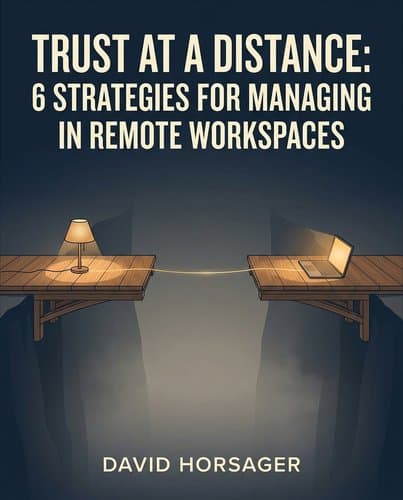
228143013_trust-at-a-distance
by David Horsager, Peggy Kendall
Most remote teams don't have a communication problem—they have a trust problem in disguise. These six battle-tested strategies give managers a precise…
In Brief
Most remote teams don't have a communication problem—they have a trust problem in disguise. These six battle-tested strategies give managers a precise diagnostic framework and concrete tools to rebuild trust brick by brick across distance, time zones, and digital barriers.
Key Ideas
Diagnose specific pillar failures before solving
Reframe your organizational problems: before accepting 'we have a communication problem,' name which of the 8 Pillars is actually failing — Clarity, Compassion, Character, Competency, Commitment, Connection, Contribution, or Consistency. The diagnosis changes what you do next.
Convert goals to concrete executable actions
Use the How-How-How drill: take any goal and keep asking 'How?' until you reach a concrete action with a specific who, when, and where attached. If you can't answer the final 'How?' yourself, you don't yet have a plan.
Clarify outcomes, deadlines, and alignment always
Apply the ODC framework for every significant request: state the Outcome clearly, give a firm Deadline (avoiding one guarantees conflict), and leave room for Clarifiers so both parties know they're aligned.
Quarterly character check with stakeholder groups
Run the quarterly character check Amirah uses: ask yourself and your team, on a scale of 1-10, how consistently you did the right thing for each key stakeholder group. The number matters less than the conversation it opens.
Formal structured connection through Trust Shield
Build connection structurally, not incidentally: the Trust Shield exercise (Background, Mission, Values, Priorities, Strengths, Areas for Growth, Life Goals, Legacy) works even with groups as polarized as opposing political parties — schedule it formally, in small rotating groups.
Treat competency as perishable knowledge
Treat competency as perishable: adopt the one-year test — if you can't name three or four things you know now that you didn't know a year ago, you've stopped being trustworthy in your domain. Build reading, mastermind groups, and short mentorship cycles into your team's default operating rhythm.
Single priority focus during crisis situations
In a crisis, narrow to one priority: pause, ask what you can control and what you can do right now, then pick exactly one thing and complete it before moving to the next. Two priorities in a crisis is still too many.
Daily difference-making action planning routine
Identify your Difference-Making Action each morning: write your most important current goal at the top of a page, list no more than five supporting actions, quantify each one (hours, not intentions), and complete them before responding to anything else.
Who Should Read This
Readers interested in Remote Work and Leadership, looking for practical insights they can apply to their own lives.
Trust at a Distance: 6 Strategies for Managing in Remote Workspaces
By David Horsager & Peggy Kendall
11 min read
Why does it matter? Because 'we have a communication problem' is almost always the wrong diagnosis.
You probably think of yourself as a trustworthy person. You keep your word, you're honest even when it's inconvenient, and you genuinely care about the people you lead. Now here's the part that should make you uncomfortable: none of that guarantees your team feels safe telling you the truth. A leader can score high on every personal integrity measure and still be running an organization where critical problems get buried for months, where people pad their numbers before speaking in meetings, where the real conversation only happens after you've left the room. That gap — between the leader you believe yourself to be and the culture you've actually built — is what this book is about. And closing it turns out to have very little to do with your character, and everything to do with which specific trust pillar you've let go soft and what you do about it.
You Can Be Trustworthy and Still Be Running an Untrustworthy Business
Ethan Parker walked into his company's strategy meeting on a January morning expecting to confirm what he already believed: that his software launch was on track, that his team was competent, and that his hands-off leadership style was a sign of respect rather than neglect. He asked each executive to rate their confidence in the May 1 deadline on a scale of one to ten. His COO, Jenna — a laser-focused operator who'd made VP before thirty — opened with a seven. Uncomfortable, but not catastrophic. Then Iris, the lead UX designer, said three. The CTO agreed: three. And then came the sentence that changed the temperature of the room. Jenna looked at Ethan and said she had to revise her number. Not up. Down to a four. That revision didn't just reveal a project in trouble — it revealed that the people closest to Ethan had been sitting on a crisis for months, waiting for someone else to say it first.
Ethan considered himself a trustworthy person. He kept his commitments. He didn't hover over his team. He was honest. And every bit of that was true — and invisible. His integrity existed entirely inside his own head, where it did his organization no good at all. His team couldn't see it, couldn't feel it in their daily work, and so they had no particular reason to trust him with uncomfortable news. What he had built wasn't a high-trust culture; it was a silence. He had confused not micromanaging with genuine connection, and the gap between those two things was where the crisis had been quietly living.
Leaders find this distinction genuinely stinging: you can be a trustworthy person and still run an untrustworthy organization. Trust doesn't accumulate passively from good intentions — it has to be actively and continuously earned, made visible through specific behaviors, over and over again. Stop reinforcing it and it doesn't hold steady; it erodes.
Every Organizational Problem Is a Trust Problem in Disguise
Every organizational problem you think you have is actually a trust problem wearing a different name. Call it a communication breakdown, a leadership gap, an accountability failure — those labels aren't wrong, exactly, but they're pointing at symptoms while the real lever sits one level deeper, untouched.
When Ethan finally admitted to Sunny Bonaventure, the owner of The Grove, a mountain lodge where executives come to do the kind of thinking they can't do in the office, that his company was fractured — people missing deadlines, executives hiding the truth in meetings — she did something that stopped him cold. She didn't ask about his communication tools or his reporting structure. She asked which of the eight specific pillars of trust had gone soft. Because in her experience, what looks like a leadership problem is almost always a clarity problem: people don't know where they stand, so they stop following. What looks like a communication problem is usually a connection problem: people don't feel seen, so they go quiet. The category you reach for first — leadership, communication, accountability — describes where the damage shows up. The pillar is where the damage actually lives. Until you name the right one, you're treating a fever with cough syrup.
Here's how you feel the difference in real time. Think about the last text you sent to someone you fully trusted. You typed it in thirty seconds, hit send, didn't reread it. Now think about the last message you sent to someone you weren't sure about — someone whose reaction you couldn't predict, whose judgment of you felt uncertain. You rewrote the opening. You cut that phrase that might be misread. You added a softener, then deleted it, then added it back. That gap in time isn't a personality quirk; it's a tax. Multiply it across every email, every meeting, every update your team prepares for a leader they're not sure they can be honest with, and you start to see how a trust deficit turns into a budget line — slower decisions, duplicated effort, information that never travels upward because someone calculated the risk of sending it and chose silence instead.
Name the correct pillar and you've found the actual lever. Everything else is rearranging furniture around a crack in the foundation.
The 'How?' Trap: Why Copying a Good Leader's Technique Can Destroy Trust
Monday morning, Ethan Parker logs into a video call from his ski resort room, crutches leaning against the wall, and decides to become Sunny Bonaventure. The night before, he'd watched her run a leadership meeting in an octagonal glass room at the top of the lodge — twenty minutes, no wasted motion, every person pressed with the same question: 'How?' Not 'Why,' not 'Tell me more' — just 'How?' again and again until the answer stopped being abstract and became a specific person, a specific action, a specific day. Sunny called it the How-How-How drill: keep asking how until the plan gets concrete enough to hold someone accountable. It was the most efficient meeting Ethan had ever witnessed, and it felt effortless. So when his own team appears on his screen the next morning, he tries it. He asks Iris how she's resolving a supplier problem. She gives a vague answer. He asks how again. She snaps at him. He moves to Jenna, his COO. She smiles with polished composure and tells him she'd be 'happy to walk him through the plan in their meeting later.' The technique that had felt like a key the night before had just slammed a door.
The question — 'How?' — was identical. The effect was the opposite. Sunny's drill doesn't generate clarity on its own; it surfaces clarity the culture has already built. Her team trusted that being pressed for specifics was a sign of investment, not suspicion. To Iris and Jenna, the same question landed as an ambush from a leader behaving out of character with no explanation. The tool was fine. The foundation wasn't there yet.
Jenna said it plainly in their one-on-one afterward: brief your team on what you're doing before you do it. But her deeper point cut further. Even as COO, she admitted she had lost track of the company's strategy — didn't know how her own projects connected to the larger direction. Ethan's vision existed on a whiteboard back in Minneapolis, visible only to him. His team wasn't hiding from clarity. They'd never been given it. You can't import a technique that assumes alignment into an organization where alignment has never been named out loud.
Non-Micromanagement Is Not the Same Thing as Connection
How well do you actually know the people who work for you? Not their job titles or their project status — their lives, their stresses, the things that keep them up at night?
Ethan believed he knew his team well enough. He gave them autonomy. He trusted their expertise. He stayed out of their way. What more could a good leader offer? The answer arrived on a video call when he checked in with Zach, his director of software, expecting a timeline update. What he got instead was a man running on no sleep, covering solo for a colleague who'd been hurt in a car accident, with his wife days away from giving birth. Ethan had known about the accident. His response at the time had been to tell Zach to find a way, like he always did. It hadn't occurred to him to ask what that actually cost.
The distance between those two things — leaving someone alone versus knowing what they're carrying — is the whole gap. Autonomy is a management decision. Connection is a relationship. Ethan had been making the first and calling it the second. The result was a team member operating at the edge of collapse while his CEO remained unaware, because Ethan had never built the kind of relationship where that information would travel upward on its own.
Connection requires specific knowledge of another person, earned through genuine attention over time. There's a structured tool for this — the Trust Shield, introduced later in the book — but the tool only works if you've already accepted the premise: that leaving people alone is not the same as knowing them.
Autonomy says: I won't get in your way. Connection says: I see you. Ethan had been delivering the first and wondering why his team felt so far away.
Character Is Not What You Declare — It's What You Measure
Imagine you put up a sign in your break room that says 'We value honesty.' Now imagine your bonus structure rewards whoever closes the most accounts by Friday. Those two things are not in tension — they are at war. And the bonus structure wins every time, because people respond to what you measure and reward, not what you post on the wall.
That is the trap Amirah Clark, The Grove's director of finance, was brought in specifically to dismantle. Her solution was deceptively plain: once a quarter, she asked each person on her team four questions. Over the past ninety days, on a scale of one to ten, how consistently did you do the right thing for the guest? For the staff? For the lodge? For the mountain? No rubric. No surveillance. Just the question and whatever came next. She was clear that the number was almost beside the point. What she was after was the conversation the number opened — the moment someone said, 'Honestly, a six, because I cut a corner last month and I'm not sure it was worth it.' People of genuine character, she found, almost never gave themselves a ten. If someone did, she took it as a signal that hiring had gone wrong somewhere.
The 2016 Wells Fargo cross-selling scandal is the cautionary version of this story. The bank had a written commitment to its customers. It also had a sales incentive system that made opening fraudulent accounts the rational daily choice for thousands of employees. The employees hadn't lost their values overnight. The structure had quietly made doing the wrong thing the easier path, one fake account at a time. The stated values were sincere. The incentive system was doing something else entirely.
Character can be defined, built into hiring criteria, rewarded publicly, and disciplined when it fails — or it can be left to chance. 'Hire on character, train on competency' is a principle attributed to Warren Buffett, and the logic is hard to argue with: skills are teachable. What Amirah understood, and what Wells Fargo's executives apparently didn't, is that the principle only holds if you build the whole system around it. Define what character looks like in your specific context. Measure it the way she did — deliberately, conversationally, quarterly. And then discipline its absence in your strongest performers before the rest of the team concludes that character is optional.
Competency Is Perishable — and the Decay Is Invisible Until It Isn't
Competency is the only pillar on this list that can kill you quietly. The others — connection, clarity, character — tend to break visibly, in blown meetings and fractured teams. Competency erodes in the background, behind a wall of past performance, and nobody sounds the alarm until the skill gap is already a crisis.
Bob, The Grove's director of safety, built his entire staff development philosophy around a single diagnostic: every year, he asks himself what he knows now that he had no idea about twelve months ago. If three or four answers don't surface immediately, he treats that as a warning sign. Not a gentle nudge — a warning. His framing echoes the Navy SEAL standard, which holds that a teammate's life depends on your technical skill and that your training is never finished. Bob applied that same logic to a mountain lodge and, within one year, his three-part staff development program lifted the property's net profit by more than twenty percent.
The three initiatives were simple enough: employees read books chosen to match the lodge's adventure mission — titles on wilderness survival, expedition leadership, high-altitude medicine — small peer groups met regularly to work through shared challenges, and mentorship pairs rotated on short four-meeting cycles rather than yearlong commitments almost nobody sustains. The mechanism underneath all three is the same: urgency. When you build structures that require you to keep learning, you can't coast. The moment those structures disappear, the coasting starts. And the leaders most at risk are precisely the ones who least expect it — the ones whose past success removed the pressure that produced their skills in the first place. That gap doesn't announce itself. It compounds.
Trust Atrophies Like Muscle — and a Single Clipboard Throw Can Undo Years of It
Think about a bodybuilder at peak condition — years of disciplined training, competition-level mass, the kind of physique that doesn't happen by accident. Now put that person in a coma for sixty-six days. No decision is made to lose the muscle. No effort is made in that direction. It simply goes. Sixty-six pounds of it, one day at a time, while the body lies still. That's the rate at which trust atrophies the moment you stop actively building it.
The parallel isn't poetic — it's structural. Trust doesn't hold at the level you last earned it. It degrades. The leader who spent three years establishing credibility with a team and then coasted on that credibility through a difficult quarter didn't preserve what was built; they spent it without realizing there was a bill coming. The bodybuilder's loss wasn't caused by what happened in the coma. It was caused by the absence of what had always been keeping the muscle there.
But atrophy is at least gradual. The other danger is instantaneous. A board member once lost his composure in a meeting and threw a clipboard at someone. One moment. After that, no one on the board would bring him bad news. They weren't being cowardly or political — they were responding rationally to new information about what might happen if they did. That single incident rewired the information environment around that leader permanently, and the company paid the price in every decision made from incomplete data afterward. Years of professional behavior, undone in a second.
The only answer to both threats is unglamorous: small things, done every day. Share the company's direction not at the annual meeting but in daily conversations. Keep the small commitment, not just the visible one. Trust has no savings account — it runs only on what you're doing right now. Most leaders keep looking for the moment to make a big deposit. There isn't one.
Crisis Is the Fastest Opportunity to Build Trust You Will Ever Get
Crisis feels like the worst time to build trust. Every instinct says contain, minimize, and project control. But the inverse is true: a crisis is the highest-leverage trust-building moment you will ever get, precisely because reliability is most visible when the cost of unreliability is obvious. Anyone can seem trustworthy when the stakes are low. Under pressure, character either shows or it doesn't — and your team is watching.
When Ethan returned from Colorado, he called the CEOs of his five largest client stakeholders before he called a single internal meeting. No optimism, no recovery narrative. He told them the May 1 deadline was gone. Then he committed to a substantial interim delivery that would show the quality of the work, and he named a specific revised timeline he was confident he could actually hit. Some clients accepted it quickly. A few were angry, and one made clear his patience had limits. But Ethan held the line: no new promises he couldn't keep, no hedging on what had gone wrong. When he walked into the staff meeting afterward and told his team what he'd done, something shifted in the room. Iris — who had been dreading the question of what to tell clients — visibly exhaled. Dom, the most skeptical voice on the team, leaned back in his chair with something like relief. The admission didn't destroy trust. The months of manufactured optimism had been doing that. Honesty, delivered directly and paired with a concrete commitment, began reversing the damage in a single afternoon.
Horsager calls the framework for getting there the DMA, and it's short enough to use in real time. First, pause — not to delay, but to see the situation clearly before you move. Then ask two questions in sequence: what can I actually control right now, and what is the single most important action I can take immediately? One priority, not two. A crisis collapses normal bandwidth, and splitting focus between two urgent things means completing neither. Do one thing, fully. Then repeat. That's not a simplification — it's the discipline that separates leaders who navigate crises from leaders who get consumed by them.
The Sign in the Lobby Was Never About the Guests
The sign in Sunny's lobby was never really about skiers. It was about the people who worked there — and whether they trusted each other enough to tell the truth before the crisis, not during it. That's the uncomfortable center of everything covered here: trust isn't a quality you possess, it's a system you build or neglect, one small daily action at a time.
Ethan came back to The Grove carrying a cocktail napkin not because the napkin held some magic formula, but because something had shifted. You have the vocabulary now — a way to diagnose which pillar is failing, and a concrete practice for fixing each one. The question isn't whether your organization has a trust problem. It's which pillar. Name it, and you know what to do next.
Notable Quotes
“How does one increase trust?”
“I want to see that report soon,”
“Can I ask you a sort of personal question?”
Frequently Asked Questions
- What is Trust at a Distance about?
- Trust at a Distance provides a structured framework for building and sustaining trust across distributed teams by drawing on the Eight Pillars of Trust. The book gives managers diagnostic tools and concrete practices — from clarifying expectations to building connection deliberately — so they can lead remote teams with consistency and credibility. It reframes common organizational problems by identifying which of the eight pillars (Clarity, Compassion, Character, Competency, Commitment, Connection, Contribution, or Consistency) is actually failing, enabling managers to target their interventions precisely rather than applying generic solutions to remote team challenges.
- What are the practical tools in Trust at a Distance for remote managers?
- Trust at a Distance provides several actionable frameworks. The How-How-How drill takes any goal and keeps asking 'How?' until you reach a concrete action with a specific who, when, and where attached. The ODC framework—stating the Outcome clearly, giving a firm Deadline, and leaving room for Clarifiers—ensures alignment on significant requests. The Trust Shield exercise builds connection by exploring Background, Mission, Values, Priorities, Strengths, Areas for Growth, Life Goals, and Legacy. The quarterly character check asks teams to rate consistency in doing the right thing for stakeholders. The Difference-Making Action process limits daily actions to five quantified tasks.
- What does the Eight Pillars of Trust framework diagnose in remote teams?
- The Eight Pillars of Trust—Clarity, Compassion, Character, Competency, Commitment, Connection, Contribution, and Consistency—help managers diagnose specific failures rather than accepting generic problems like "we have a communication problem." By identifying which pillar is actually failing, managers can target interventions precisely. For example, poor communication might stem from unclear Clarity expectations, weak Connection between team members, or inconsistent Consistency in following through. The diagnosis changes what you do next, moving beyond surface-level problem statements to root-cause interventions that address the actual trust breakdown in distributed teams.
- How does Trust at a Distance recommend managing priorities in remote work environments?
- Trust at a Distance recommends two priority-management approaches. The Difference-Making Action process focuses daily work by writing your most important goal, listing no more than five supporting actions, quantifying each in hours, and completing them before responding to anything else. In crises, the approach is even more restrictive: pause, identify what you can control and do right now, then pick exactly one thing and complete it before moving to the next. The philosophy emphasizes that two priorities in a crisis is still too many, forcing deliberate focus.
Related Book Summaries
Read the full summary of 228143013_trust-at-a-distance on InShort