220493547_the-art-of-less
by Mats Alvesson, André Spicer
Most organizations don't fail from doing too little—they collapse under the weight of every process, meeting, and initiative added with good intentions.
In Brief
Most organizations don't fail from doing too little—they collapse under the weight of every process, meeting, and initiative added with good intentions. Learn how to diagnose and eliminate 'organizational sludge' so your team can finally focus on the work that actually matters.
Key Ideas
Name organizational sludge before addressing it
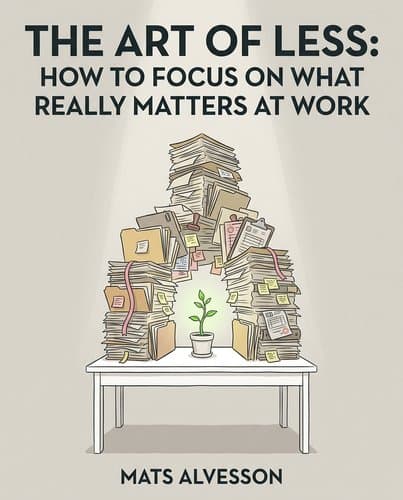
Name what you're fighting: 'organizational sludge' is the accumulation of well-intentioned policies, processes, and initiatives that individually seem reasonable but collectively obstruct the core work the organization exists to do. Naming it is the first step to auditing it.
Test new initiatives with diagnostic
Apply the four-part diagnostic before launching anything new: will this initiative become Virtuous-then-Viscous-then-Vicious-then-Viral? If you can't answer how you'd remove it in two years, you probably shouldn't add it now.
Apply one-in-one-out to processes
Use the 'refrigerator door' rule for rules: every new policy or process should only be added if an existing one is removed. The constraint forces genuine prioritization.
Audit metrics before hiring staff
Cut indicators before cutting staff: the Dutch ICU example shows that removing low-value measurement (from 122 to 17 quality indicators) can recover 30 minutes per worker per shift with no negative outcome. Audit what data you collect before assuming you need more people.
Survival tactics mask system problems
Individual survival tactics (selective ignorance, strategic compliance, meeting avoidance) protect your capacity in the short term but don't reduce systemic pressure — and may actually delay the organizational reckoning by making the system tolerable enough to persist.
Leaders must become corporate plumbers
Leaders who want to de-sludge need to act as corporate plumbers, not visionaries: the job is visiting the front line (Honoré's 'life and limb' mindset, Gordon's 180-office tour), identifying what to stop, and accepting the social cost of saying no to well-meaning colleagues with new initiatives.
Protect core professional work always
When evaluating any new regulation, technology, or initiative, ask: does this shift work onto the core professional (doctor, teacher, social worker) or off them? If it shifts work onto them without reducing something else, it is sludge by definition — regardless of its stated purpose.
Who Should Read This
Readers interested in Organizational Behavior and Management, looking for practical insights they can apply to their own lives.
The Art of Less: How to Focus on What Really Matters at Work
By Mats Alvesson & André Spicer
11 min read
Why does it matter? Because the bureaucracy strangling your workplace was built by people trying to help.
Your first instinct, when you spend three hours in a compliance training that has nothing to do with your actual job, is to look for the villain. The cynical executive who loves control. The empire-building HR department. The consultant who billed for the whole thing. And sometimes you'd be right. But Mats Alvesson and André Spicer have spent years studying organizational dysfunction, and their uncomfortable finding is that most of the people generating the most sludge are earnest, well-meaning, and genuinely trying to help. That's precisely what makes it so hard to stop. They accumulate quietly, initiative by initiative, policy by policy, until one day a physician is spending more time on quality competitions than on patients — and nobody can identify the moment it went wrong, or who to blame. Good intentions don't leave fingerprints. This book is about that accumulation, why it's almost certainly worse than you think, and what to actually do about it.
You're Not Imagining It — Your Organization Is Working Against You
Picture a travel expense form. Not a complicated one — just the usual upload-your-receipts, fill-in-the-fields routine after a work trip. One of the authors of this book was doing exactly that, after flying back from Norway, when the whole process locked up over a single required field: the bus number from the city to the airport. No bus number, no submission. The system would not move. After a call to a local administrator, the solution arrived: enter '0000.' The field had no real purpose — it just had to be filled. By the time the form was finally submitted, the process had consumed nearly as much time as the lectures it was meant to reimburse.
That story is funny, then depressing, then something more useful: it's diagnostic. Mats Alvesson and André Spicer — organizational researchers and the authors here — argue that what happened with that form isn't a local IT failure or a quirky Norwegian policy. It's a symptom of something systematic, and they've given it a name: organizational sludge. Borrowed from the economist Richard Thaler, the term describes the accumulation of processes, rules, and initiatives that create more friction than value — not because anyone designed them to be obstructive, but because each one was introduced by someone trying to solve a problem, and nobody was keeping score of the total cost.
The scale of that cost is striking. A survey of 7,000 Harvard Business Review readers found that 40 percent believed cutting their organization's central staff by a third would have absolutely no negative effect on performance.
What Alvesson and Spicer want you to take from this is the specific relief of finally having a name for it. The friction you feel — the reports nobody reads, the approval chains for minor decisions, the forms that exist because a form once existed — isn't bad luck or weak management in your particular building. It's a structural phenomenon with known causes and, importantly, known remedies. Your frustration is not a character flaw. It's data.
Good Intentions Are the Most Dangerous Ingredient in Organizational Sludge
The most dangerous ingredient in organizational sludge isn't bad faith — it's good intentions. Nearly every policy, committee, reporting requirement, and coordination role that clogs up an organization was created by someone genuinely trying to improve something. This is precisely why sludge is so hard to remove: you're always arguing against someone's sincere effort to make the workplace safer, fairer, more transparent, or more innovative.
It starts as something virtuous — a laudable goal pursued by earnest people. Then it becomes viscous, sticking to the organization and slowing daily movement in ways its creators didn't anticipate. Over time it turns vicious, actively undermining the very goals it was meant to advance. And finally it goes viral, because the problems sludge creates tend to be 'solved' by adding more sludge: another coordinator, another review process, another workshop.
The viral stage is where the trap closes completely. When an initiative causes friction, the natural response is to launch something new to address it. Nobody subtracts; everyone adds. A study of suggestions for improving a university found that fewer than one in ten proposed removing anything. The other nine proposed new additions. So the pile grows, each layer deposited by someone who believed, reasonably, that their contribution was the necessary one.
Two military officers who needed to submit a mandatory written report discovered, over repeated submissions, that no one was reading them. To test the theory, one officer hid a photograph of himself in his underwear somewhere inside the document. No response ever came. The report existed not because anyone needed it, but because a reporting requirement had been created at some point by someone with a legitimate concern — and calcified long after that concern had passed, or been forgotten, or been solved some other way.
That photograph is the whole problem in miniature. The person who originally mandated the report almost certainly had good reasons. The people filing it almost certainly found it pointless. And the gap between those two positions never got bridged, because nobody was formally responsible for asking whether the requirement still served any purpose — nobody who knew the original intention and could tell the people now drowning in the paperwork why any of it mattered.
Sludge Doesn't Just Sit There — It Reproduces
If the problem is administrative buildup, doesn't the solution follow logically? Identify the pointless processes, remove them, watch the organization breathe again. One clean sweep, one committee with the authority to cut. The depressing insight at the heart of this book is that sludge doesn't work that way. It reproduces.
Here's what reproduction looks like in practice. A US social services office was studied over time, and what researchers found wasn't a team of caseworkers wrestling with an overwhelming caseload. It was a team whose informal motto had become 'document, document, document.' Workers spent sixty percent of their time on paperwork and the remaining forty percent following up with clients — not to help them, but to make sure the clients' own paperwork was complete. When a researcher asked one social worker how she helped unemployed clients find jobs, she described matching one list to another and mailing out a letter about a potential opening. By the time the letter arrived, the job was almost always filled. The researcher asked why she didn't simply call clients — faster, more effective, obviously better. The social worker looked puzzled. She didn't call clients about jobs. She called them about paperwork.
What's striking isn't the absurdity. It's how completely the system had rearranged everyone's sense of what the job actually was. Documentation had stopped being the means and become the end. Nobody was being cynical. The team manager explained that meticulous documentation protected the office, helped colleagues, and satisfied the county. Helping clients had become a secondary concern so gradually that nobody had noticed the transition.
This is how sludge makes itself permanent. The social workers weren't following bad rules out of laziness or cynicism — they were following a logic the system itself had taught them. And that logic regenerates. When something goes wrong, the organizational response is almost always to add: more oversight, more reporting, more specialist roles to ensure the mistake isn't repeated. Each addition makes sense in isolation. Accumulated, they shift the center of gravity until the infrastructure built to support the core work grows larger and more demanding than the core work itself. At that point people start optimizing for the infrastructure, because that's where the accountability is.
Think of it like a water system that has no valve for reducing flow — only taps for adding more. The pipes get larger, the pressure drops, and every engineer called in to fix the problem installs another junction. The system doesn't know how to shrink. That's what makes the question worth pressing: why does organizational logic seem to run in only one direction?
The Sludge Isn't Coming From Cynics — It's Coming From Your Colleagues
Alvesson and Spicer identify six societal forces that keep adding pipes to the system. Rising professional expectations have produced a 47 percent surge in the number of people holding 'manager' in their title across the US between 2010 and 2021 — not because organizations suddenly needed more managers, but because graduates expected elevated status and title inflation was the cheapest way to provide it. Each new 'Chief People Officer' or 'Strategic Accounts Executive' then needs activities to justify the role: policies to draft, programs to launch, trainings to mandate. Legislation keeps expanding — UK banking regulation nearly doubled in word count in a single decade — and when the rule book doubles, organizations hire compliance specialists who then, quite rationally, push their expertise into every corner of operations. That means new approval layers, new documentation requirements, and new training cycles that the people actually producing value have to absorb.
The most clarifying example of how this works in practice involves diversity training. HR departments in Canadian firms adopted expensive, US-developed diversity programs not because those programs fit the local situation, but because diversity was 'the thing at the time' and replicating what respected organizations were doing felt safe. The content was designed around American racial dynamics. In one session, a Cree employee tried to raise concerns about land rights and the specific history of Indigenous communities in Canada. The trainers couldn't engage — those issues simply weren't in the program's framework. The training rolled on, the concerns were dropped, and the company filed the certificate of completion. The HR team had acted rationally by industry standards. The Cree employee's experience had been made functionally invisible.
The point isn't that the HR professionals were cynical or careless. Most of them genuinely believed in the program. But they were optimizing within their own silo — tracking what peer organizations were doing, satisfying the certification criteria, demonstrating progress to leadership. None of that required the training to actually work for the people in the room. When the enemy is a bad actor, you can remove them. When the enemy is six interlocking social forces operating through colleagues with good intentions, the problem is simultaneously harder to see and harder to solve — but at least you're finally looking at the right thing.
When You Can't Change the System, You Can Still Protect Your Time
You don't have to fix the system to protect yourself from it. That's the practical claim Alvesson and Spicer make once the diagnosis is done, and it's a genuinely useful one. Six tactics exist — available right now, at whatever level you occupy — for reducing the toll sludge takes on your time and attention.
Before reaching for any of them, though, understand what they cost. A senior research leader responded to a mandatory HR 'game' about workplace environment with open fury. The HR professionals running the session logged his resistance not as feedback but as evidence: clearly this man needed more development. His protest became the justification for further intervention. The cycle didn't break — it tightened. Every tactic here requires a judgment call about when visible resistance costs more than the sludge it's trying to stop.
With that in mind: the first tactic is ignorance, and Alvesson and Spicer mean it seriously. Roughly 71 percent of employees never read the broadcast emails sent by senior executives announcing new strategies or initiatives. This isn't negligence. People are fairly rational about what they tune out: if something doesn't bear on the actual work in front of them, ignoring it frees up cognitive bandwidth for things that do. Selective inattention is a survival skill dressed up as forgetfulness.
Avoidance comes next — declining meetings, ducking initiatives early, letting a project stall at the invitation stage before it colonizes your calendar. After that: outsourcing, which means routing sludge toward subordinates, technology, or generative AI before it reaches your desk. Window dressing and selective compliance let you satisfy the form without surrendering the substance — adopt the vocabulary, file the acknowledgment, continue the actual work unchanged.
Strategic embrace goes one step further, and it's the most counterintuitive of the six. Take a project you were already running and relabel it with whatever term is currently attracting resources. 'Sustainability.' 'Innovation.' 'AI-enabled.' The work doesn't change; the budget line does. A team doing what they'd always called 'operational efficiency reviews' suddenly becomes the 'continuous improvement and innovation workstream' — same spreadsheets, new slide deck, significantly larger allocation.
Real De-Sludging Requires Institutional Surgery, Not Individual Workarounds
In 2019, Steve Gordon took over the California Department of Motor Vehicles knowing its reputation was catastrophic — people lined up outside offices at six in the morning for an eight o'clock opening. Rather than launch a culture transformation program, Gordon visited all 180 offices himself and asked front-line workers a simple question: what steps in this process are actually necessary? What he found, buried in the Real ID card application, was a tangle of redundant reviews, approval duplications, and form questions that confused virtually everyone who read them — including a section on organ donation standards that had no business appearing there at all. He removed the unnecessary steps. He had front-line employees rewrite the confusing questions in plain language. The time to issue a Real ID card dropped from 28 minutes to eight. Customer satisfaction scores nearly doubled. Nobody had to be convinced to embrace a culture of service. The culture wasn't the problem. The procedure was, and the fix was subtraction.
Alvesson and Spicer's core argument about real de-sludging is that it's structural work, not attitudinal work. The tactics from the previous section — ignoring emails, ducking meetings, relabeling projects — are how individuals protect themselves inside a broken system. But the system keeps regenerating. The only intervention that actually changes the load is institutional surgery: capping the number of active initiatives, building a removal requirement into every addition, and having leaders willing to do the unglamorous work of cutting rather than the rewarding work of launching.
The authors make this concrete with a useful framing about the pipeline. At the front end, before new initiatives enter the system, organizations need spam filters — formal or informal checkpoints where someone asks whether a proposed project connects to the organization's core priorities, what it will cost in collective attention, and what will be stopped to make room for it. In the middle, existing rules need active pruning. A startup the authors describe handled this with a refrigerator door: rules were written down and posted there, and adding a new one required removing an old one. The physical constraint forced a discipline that good intentions alone never produce. At the output end, the same logic applies to users: a patient staring at a twelve-page eligibility form written in insurance Latin is absorbing overhead the organization couldn't be bothered to eliminate itself.
The Dutch ICU case makes the stakes of the middle-pipe work measurable. A group of intensive care units was monitoring 122 separate quality indicators per patient. A consultative process reduced that list first to 67, then to 17. Administrative time per shift dropped from 60 minutes to 30. Patient mortality and readmission rates were unchanged. Half the data collection had been pure overhead — generating numbers nobody used to make decisions that nobody made. The hours reclaimed went back to patient care. That's the test for whether a procedure earns its place: remove it and see what breaks. If the answer is nothing, you've found deadweight, and the only honest response is to stop carrying it.
The Real Question Is What We Want Important Institutions to Actually Do
What if the reason your organization can't stop adding things is that the forces driving the addition live outside your organization entirely?
Alvesson and Spicer's answer is that institutional sludge isn't primarily a management problem — it's a civilizational one. The real engine of bloat is what they call expectational inflation: societies have come to believe that schools should guarantee peak performance from every student, that hospitals should extend every life indefinitely, that public institutions should satisfy every imaginable need while generating zero risk. When those expectations inflate beyond what any institution can deliver, the institutions don't push back — they reach. They add programs, specialists, compliance layers, and documentation trails that signal effort without producing results. The sludge isn't a byproduct of bad management. It's the institution's attempt to honor demands that were always impossible.
The technology dimension is particularly clarifying. Economists Daron Acemoglu and Pascual Restrepo coined the term 'so-so technologies' for innovations that don't raise productivity but simply transfer labor from one party to another. Hospital electronic records systems are the canonical example: designed to improve care coordination, they turned physicians into data clerks instead, spending hours entering information into systems that interrupted rather than supported actual diagnosis. Patients didn't benefit. Doctors lost the time they used to spend thinking. The technology's main accomplishment was shifting work downward. And because the system was already installed, already paid for, already mandated by regulators, nobody with removal authority had any incentive to ask whether it was helping.
This is where institutional minimalism — the argument that institutions should protect a narrow core purpose against every sincere demand that they become something more — parts ways with any individual workaround or one-time cleanup. The question it poses comes before all the tactical ones: what is this institution actually for, and are we willing to protect that purpose against every sincere demand that it be something more? That's not an efficiency question. It's a political one, and the answer requires saying — publicly, at the level of policy — that some expectations will not be met, because meeting them would destroy the thing people actually need.
The Subtraction Question Nobody Asks
Every efficiency drive you've ever witnessed eventually produced its own coordinator, its own status update cadence, its own end-of-year report. Not because the people running it were incompetent, but because adding feels like doing something and removing feels like giving up. That reflex runs deep — deeper than any individual manager, deeper than any single organization. So the question worth carrying into your next meeting, when someone tables a new initiative with a compelling slide deck and genuine conviction, isn't whether their idea is good. It's this: what would we have to believe about ourselves to be willing to stop something instead? If nobody in the room can answer that, you already know what happens next.
Frequently Asked Questions
- What is organizational sludge explained in this book?
- Organizational sludge is "the accumulation of well-intentioned policies, processes, and initiatives that individually seem reasonable but collectively obstruct the core work the organization exists to do." Naming it is the first step to auditing it. The Art of Less shows how companies become bogged down not by malice but by layers of reasonable-seeming rules that accumulate over time. Each individual policy makes sense in isolation, but together they consume time, attention, and energy that should go to core work. Leaders need to conduct a diagnostic audit to identify these accumulated obstacles before implementing new initiatives, using a framework that questions whether each initiative might become virtuous-then-viscous-then-vicious-then-viral.
- What is the refrigerator door rule for managing new policies?
- The refrigerator door rule states that "every new policy or process should only be added if an existing one is removed." This constraint forces genuine prioritization rather than endless accumulation. By requiring organizations to eliminate something before adopting something new, the rule prevents the sludge spiral. It acknowledges a fundamental truth: most organizations won't voluntarily subtract unless forced. The refrigerator door metaphor suggests policies should be as carefully curated as items on a kitchen refrigerator—when something new goes on, something old comes off. This simple mechanism breaks the default pattern of addition without subtraction, which drives organizational bloat.
- What does the book teach about removing low-value metrics?
- The Art of Less uses a Dutch ICU example to demonstrate that "removing low-value measurement (from 122 to 17 quality indicators) can recover 30 minutes per worker per shift with no negative outcome." This reveals a key insight: organizations should "cut indicators before cutting staff." Before assuming you need more people, audit what data you collect. Many metrics accumulate for historical reasons rather than current value. By eliminating redundant or low-value measurements, workers reclaim significant time without compromising quality or outcomes. The example challenges the assumption that more measurement equals better performance, showing that thoughtful reduction of unnecessary data collection directly improves front-line capacity and performance.
- How should leaders approach de-sludging their organizations?
- Leaders should act as "corporate plumbers, not visionaries" when de-sludging organizations. This means visiting the front line, identifying obstacles to core work, and accepting "the social cost of saying no to well-meaning colleagues with new initiatives." Rather than pursuing grand strategic vision, effective de-sludging demands practical work: understanding what core professionals (doctors, teachers, social workers) actually do and removing obstacles to their work. Leaders should ask whether initiatives shift work onto professionals without removing something else—if so, they're sludge. The approach requires courage to reject well-intentioned but obstructive additions, guided by a simple principle: does this help core work, or does it obstruct it?
Related Book Summaries

Read the full summary of 220493547_the-art-of-less on InShort