226285393_the-means-of-prediction
by Maximilian Kasy
Financial jargon isn't accidental complexity—it's a power structure. Learn to decode the language of economists and bankers, exposing how terms like…
In Brief
The Means of Prediction: How AI Really Works (2025) examines how economic and financial language functions as a tool of power, obscuring who benefits from policy decisions. By decoding terms like securitization, GDP, and risk, it equips readers to distinguish genuine analysis from political claims dressed as natural law — and to critically evaluate the economic arguments shaping their lives.
Key Ideas
Complexity Conceals Who Benefits Most
When financial language becomes impenetrable, ask who benefits from your confusion — exclusivity is often a feature, not a bug.
Financial Terms Shift to Sound Safer
'Reversification' is a pattern worth memorizing: when a financial term sounds reassuring (securitization, hedge, AAA-rated), ask whether the word still means what it originally meant.
GDP Measures Flow Speed Not Health
GDP measures the velocity of money through an economy, not its size or health — a fast-moving economy with terrible inequality still produces high GDP.
Distinguish Bullshit from Economic Nonsense
The technical difference between bullshit (mild exaggeration) and nonsense (claims that can't possibly be true) is a useful diagnostic tool. The pre-2008 claim that risk and return had been decoupled was nonsense — and spotting it required only basic economic literacy.
Child Mortality Best Reveals Development Progress
Child mortality is the single best proxy for a society's overall development — and its dramatic global decline since 1990 is both real and systematically undercelebrated.
Policy Choices Create Winners and Losers
Economic policy isn't physics — it's a set of choices with winners and losers. 'There is no alternative' is a political claim dressed as a natural law, and you now have enough language to recognize the difference.
Who Should Read This
Readers interested in Artificial Intelligence and Behavioral Economics, looking for practical insights they can apply to their own lives.
The Means of Prediction: How AI Really Works
By Maximilian Kasy
11 min read
Why does it matter? Because the gap between financial insiders and everyone else wasn't an accident — and 2008 proved it.
There's a feeling most people know but rarely admit: that economic news is for someone else. The people who studied the right things, worked at the right firms, learned the right vocabulary somewhere along the way. The rest of us developed a polite, practiced glaze — nodding at yield curves and monetary policy like we're following along fine. Here's the thing: that feeling wasn't an accident. It was convenient for both sides. The experts didn't have to explain themselves. We didn't have to do the work. For decades, that arrangement hummed along quietly — until 2008 revealed that the people who were supposed to understand the machinery had mostly been pretending too, and the bill went to everyone who could least afford it. This is the attempt to fix that. Not an economics lecture — a skeleton key, cut one word at a time.
The Priesthood Built Its Power With a Hidden Device, Not Superior Wisdom
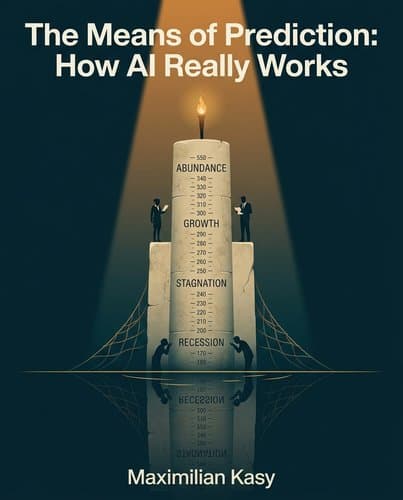
Herodotus, the first outsider to write a systematic account of Egyptian life, was told the device existed. He was not allowed to see it. The Nilometer — a calibrated measuring station built into the riverbank, marked with gradations running from Hunger through Suffering up to Abundance — sat inside temple walls accessible only to the priestly class. While ordinary Egyptians watched the annual Nile flood as a religious mystery, consulting priests who performed elaborate rituals and drew on a rich mythological vocabulary, those priests were quietly reading a gauge. They already knew what the harvest would be. They had known for centuries. And they never told anyone.
Lanchester uses this as the opening template for how expertise organizes itself — not as a metaphor for fraud exactly, but as a template for how expertise organizes itself. The priests weren't necessarily lying. The rituals weren't necessarily fake. But the gap between what the priests knew privately and what they offered publicly was doing enormous work: it was the foundation of their authority. The Nilometer had to stay secret. Share the device, and you share the power.
The same structure runs through financial language — less consciously, maybe, but with the same effect. Lanchester calls the mechanism "reversification": financial innovation gradually turning ordinary words into their opposites. The word "hedge" — originally meaning boundary, limit, safety — now labels one of the riskier vehicles in finance. Section 2 traces exactly how that happened. But the pattern itself is what matters here: language that looks transparent, gestures toward something reassuring, and delivers something else entirely. Whether by design or drift, the effect is the same as a temple wall. It keeps the Nilometer inside.
Words That Mean Their Opposites: How Finance Rewired the Language
Financial language doesn't just obscure reality — it inverts it. Lanchester calls this "reversification": the process by which innovation and pressure gradually turn words into their opposites, so the language points away from what it describes.
The hedge fund is the cleanest example. When Alfred Winslow Jones set up his investment partnership in 1949, he called it a "hedged fund" — and he meant it literally. The hedging was the point. By simultaneously betting on some stocks to rise and others to fall, Jones built a structure that was, by design, protected against wild swings in either direction. Conservative. Bounded. Like a physical hedge around a field. He was so committed to this that he distinguished carefully between a "hedged" fund — one that actually practiced risk limitation — and everything else. The word described a genuine property of the thing.
Today, hedge funds are where roughly a quarter of all the funds in existence disappear every three years, often after making enormous leveraged bets that went wrong. The vehicle invented to limit risk has become a byword for its opposite. Nothing about the phrase tells you this. You cannot deduce it from the word "hedge." The language kept the reassuring connotation and abandoned the underlying reality. The reassuring word, pointing at the alarming thing.
The same mechanism runs through the vocabulary of the 2008 crisis. "Securitization" sounds like making something more secure. What it actually did was let banks package up loans and sell them to other investors almost immediately — which meant the bank that made the loan no longer needed to care whether the borrower could repay it. The risk traveled away from the institution best positioned to assess it. The word "secure" was doing the work of a distraction. And "credit," as Lanchester notes flatly, is just debt — the word that makes people feel good about borrowing, rebranded for mass consumption. It's built to face the other way.
GDP Isn't How Big the Economy Is — It's How Fast Money Is Moving
Think of a ten-dollar bill someone hands you on the street. You spend it on wool socks. The sock seller spends it on wine. The wine merchant buys cinema tickets. The cinema owner picks up chocolate. The sweet shop owner hops on a bus. That original ten dollars has now changed hands six times, generating sixty dollars of economic activity — and nobody is fundamentally richer than they were before. This is what GDP actually measures: not how much money an economy contains, but how fast money moves through it. Not size. Velocity. GDP is the speedometer, not the fuel gauge.
Once you have that model, the statistic starts to make intuitive sense. A recession isn't the economy shrinking like a deflating balloon — it's money slowing down, circulating less, changing fewer hands. Stimulus spending is an attempt to inject velocity. When everyone pays down debt simultaneously, money stops moving and GDP contracts, which is why Keynes called this the 'paradox of thrift': individually rational, collectively ruinous. The numbers you hear in economic news coverage — GDP up 3.1 percent, GDP contracted last quarter — are reports on circulation rate, not on some abstract measure of national wealth.
The velocity model also explains what GDP misses. If you divorce your partner, you pay lawyers — and GDP goes up, because money moved. If your house burns down, you rebuild — GDP goes up again. Meanwhile, if you spend the afternoon teaching your child to read or fixing your neighbor's fence for free, GDP records nothing. The statistic can't distinguish between a society generating genuine well-being and one generating activity. This isn't a flaw someone forgot to patch — it's baked into what the number is. It measures motion, so anything that doesn't move money is invisible to it.
Knowing this won't make you an economist. But it means the next time a politician claims that rising GDP proves the country is doing well, you can ask the follow-up question: whose money is moving? Because GDP can rise while median wages stay flat, which is exactly what happened in the United States for three decades — average earnings climbing while the person in the middle of the income distribution got no raise at all. The speedometer was accelerating. Most passengers couldn't feel it.
The Difference Between Bullshit and Nonsense Is the Difference Between Hype and Catastrophe
What actually caused the 2008 financial crisis? The standard answers — greed, deregulation, bad luck — are all partially true, but they miss something more specific and more detectable. The crisis was caused by nonsense dressed up as innovation, and it went unchallenged for years because almost no one outside the priesthood had the language to name what was happening.
Lanchester draws a distinction that sounds simple until you realize how much it explains. Bullshit is the normal grease of commerce: mild exaggeration, puffery, the inflation that comes with any transaction. When a restaurant calls itself 'exclusive,' that's bullshit — it's open to anyone who can get a table. When a hotel chain describes its standard rooms as 'executive,' that's bullshit. Harmless, expected, part of the dance. Nonsense is something else. Nonsense consists of claims that aren't just false but structurally impossible — statements that contradict bedrock principles the way a perpetual motion machine contradicts thermodynamics.
The pre-2008 financial system was running on nonsense. Banks and investors had convinced themselves they had built instruments that delivered high returns with no corresponding risk. But in investing, risk and return are coupled the way mass and gravity are coupled in physics — one cannot move without the other. You cannot have high reward without high risk any more than you can build a machine that produces more energy than it consumes. The claim that financial engineering had permanently separated the two was pure nonsense, not bullshit. And it cost millions of people their homes.
John Templeton, a veteran investor who had seen several cycles of this, put it with brutal precision: the four most expensive words in the English language are 'this time it's different.' The danger wasn't that the bankers were lying in the way salespeople exaggerate. The danger was that entire institutions had lost contact with reality and didn't know it. Their models classified catastrophic failures as once-in-ten-thousand-year flukes — and then they kept happening. When you are that wrong that consistently, you are not dealing with bad luck. You are dealing with a broken framework that everyone has agreed to treat as science.
The lesson is practical: bullshit you can live with. Nonsense you cannot, because it doesn't just mislead — it operates inside systems where the wrong belief causes actual collapse.
Humanity's Greatest Achievement Has No One Willing to Claim It
And yet while the financial system was detonating in the developed world, something else entirely was happening.
Here is the most important economic fact of your lifetime, and almost no one is claiming credit for it: between 1990 and 2010, the proportion of humanity living in absolute poverty — less than $1.25 a day — was cut exactly in half. Seven hundred million people crossed that threshold. Simultaneously, the number of children dying before their fifth birthday fell from 12.4 million a year to 6.6 million. That gap, translated into a daily rate, is 16,438 fewer child deaths every day. Eleven lives saved every minute, around the clock, for two decades. The Industrial Revolution, which we treat as the benchmark for rapid transformation in human welfare, took a century to reshape living standards in a handful of countries. This happened globally, in twenty-five years.
So why haven't you heard this celebrated the way it deserves?
The silence has a specific shape, and it tells you something true about how ideology operates. The primary engine of poverty reduction was economic growth in China — a system so bizarre, a hybrid of hyper-free-market mechanics and absolute state control, that no one in the Western political conversation wants to touch it. The Right can't claim it as a vindication of free markets because it was orchestrated by a Communist Party. The Left can't claim it as a vindication of state planning because its instruments were nakedly capitalist. The credit sits on the table, and both sides walk past it.
Targeted aid programs added a second layer to the achievement — things like a Yemeni initiative that handed wheat and vegetable oil to parents in exchange for keeping their children in school. More than sixty percent of the children kept home were girls, which meant the program quietly doubled as a female literacy drive. But the Left is nervous claiming victory for aid programs that critics have spent years attacking as dependency-creating and corruption-prone. Easier to say nothing.
The result is a civilizational achievement — arguably the greatest thing our species has ever collectively done — that has no political home and therefore barely registers as news. Meanwhile, in the same period, inequality rose in two-thirds of the world's economies. The world got dramatically better for the very poor and measurably worse for the middle. Both things are real. But only one of them gets reported.
Rising Inequality Isn't Just Unfair — It Breaks the System That Made Progress Possible
What actually happens to a society when the gap between rich and poor widens past a certain point? Most people frame this as a moral question — about fairness, about whether the wealthy deserve what they have. But there's a structural answer that's more alarming than the moral one, and it has nothing to do with envy.
Angus Deaton makes the point directly: extreme inequality is a threat to democracy because the very wealthy lose any stake in the shared institutions everyone else depends on. A billionaire doesn't need public schools — they have private tutors. They don't need public hospitals — they have private clinics. They don't need safe streets built by funded police departments — they have security details. Once you can buy your way out of every system that everyone else has to use, you stop having any interest in whether those systems work. And since the wealthy tend to have outsized political influence, their indifference becomes policy. Medicare gets cut. Public school funding gets squeezed. The institutions decay — and here's the part that connects back to the poverty-reduction miracle described in the previous section — those very institutions are what made the progress possible in the first place. Targeted nutrition programs, vaccination campaigns, basic sanitation: all of it runs through the same public-sector plumbing that inequality slowly corrodes.
In the United States, the median family earned slightly less in real terms in 2012 than in 1989 — a full generation without a raise, in the richest country in history. During the recovery from the 2008 crash, ninety-five percent of all income gains went to the top one percent. The speedometer — remember — was reading positive growth. Almost no one felt it move.
What you get, extrapolated forward, looks less like a modern economy and more like a return to something older. When economic outcomes are inherited — when the social position of parents determines the prospects of children — you haven't built a meritocracy. You've rebuilt feudalism with better branding. The promise of market societies was that talent and effort could override accident of birth. Extreme inequality makes that promise structurally false, regardless of whether anyone intends it to. The world simultaneously achieved its greatest humanitarian success and built the conditions that make sustaining that success harder. Both things are true at once — and that tension is where the next decade's arguments will live.
Economics Has No Iron Laws — Only Choices About Who Benefits
The single most powerful thing you can do with economic language is use it to catch a con. The con runs like this: the neoliberal order — low taxes at the top, privatized services, rising inequality — presents itself not as a policy choice but as a natural law. Cross it and the economy breaks. Question it and you reveal yourself as naive. The framing is deliberate. If what you're doing is just obeying physics, no one gets to vote on it.
Alfred Marshall, the Victorian economist, made a quieter claim about what economic laws actually are. They're more like tides than gravity, he said — probable tendencies that describe what usually happens under normal conditions, not forces that operate regardless of what anyone does. A strong enough wind changes a tide. A strong enough political choice changes an economy. The 'laws' are descriptions of past behavior under specific arrangements, not constraints on what's possible.
This is what Lanchester means when he calls economics a toolkit. The same body of evidence that conservatives used to justify deregulation and shareholder primacy also underlies Denmark's compressed pay scales. In Denmark, a judge earns roughly two and a half times what a cleaner earns. The Danes consistently report the highest life satisfaction on the planet. Or take Singapore: the freest market economy in the world also has the highest proportion of state-built social housing on the planet. These aren't accidents or exceptions. They're different choices made with the same instruments, producing different outcomes for different groups. The question was never 'what do the laws require.' It was always 'who benefits from this version of events, and who's telling you there's no other version.'
That's what the language is finally for. Not to make you an economist. To make you the person in the room who can hear 'there is no alternative' and recognize it as a political move wearing a lab coat.
The Unlocked Door
The Nilometer is still there. The priests didn't dismantle it when Herodotus asked questions — they just kept the wall up. But you've seen the calibration marks now: what GDP actually counts, what
Notable Quotes
“Trust yourself. You know more than you think you do.”
Frequently Asked Questions
- What is The Means of Prediction: How AI Really Works about?
- The Means of Prediction examines how economic and financial language functions as a tool of power, obscuring who benefits from policy decisions. Maximilian Kasy decodes terms like securitization, GDP, and risk to help readers distinguish genuine analysis from political claims dressed as natural law. Published in 2025, the book equips readers to critically evaluate the economic arguments shaping their lives by understanding how financial language obscures particular interests while appearing universal or inevitable.
- What are the key takeaways from The Means of Prediction?
- Key insights include recognizing that financial language impenetrability benefits those creating confusion—"exclusivity is often a feature, not a bug." The book explains 'reversification': when terms like securitization sound reassuring but shift meaning. GDP measures money velocity, not health; inequality coexists with high GDP. The distinction between "bullshit (mild exaggeration) and nonsense (claims that can't possibly be true)" exposes deception. Child mortality is "the single best proxy for a society's overall development." Finally, "'There is no alternative' is a political claim dressed as a natural law."
- How does the book explain financial language as a tool of power?
- The book demonstrates that financial language operates as power by making concepts impenetrable; when confused, ask who benefits. Kasy introduces 'reversification'—how reassuring-sounding terms mask shifting meanings (securitization, hedge, AAA-rated). The analysis reveals that seemingly objective economic claims actually serve particular interests. For example, the pre-2008 claim that risk and return had decoupled was "nonsense—and spotting it required only basic economic literacy." By decoding this language, readers recognize how policy decisions are presented as inevitable when they're actually choices with winners and losers.
- Is The Means of Prediction worth reading?
- Yes, especially if you want to understand how economic language shapes policy and whose interests it serves. The book provides practical diagnostic tools—like distinguishing nonsense from bullshit—requiring only basic literacy but exposing sophisticated deception. It celebrates genuine progress like child mortality decline while critiquing how GDP misleads about economic health. For anyone affected by economic policy yet confused by its language, this work demystifies who benefits from your confusion and equips you to recognize false claims dressed as natural law.
Related Book Summaries
Read the full summary of 226285393_the-means-of-prediction on InShort