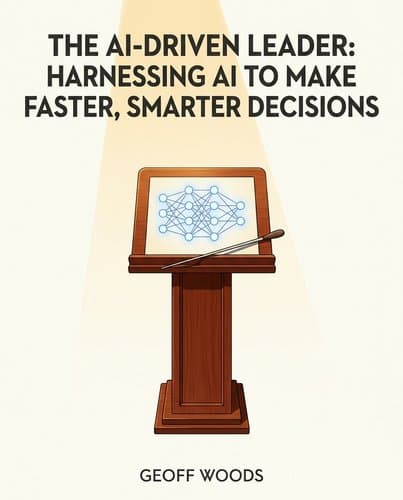
216125077_the-ai-driven-leader
by Geoff Woods
Leaders who master AI won't be those who use it most—they'll be those who ask it the right questions. Geoff Woods reveals how shifting from answer-seeker to…
In Brief
Leaders who master AI won't be those who use it most—they'll be those who ask it the right questions. Geoff Woods reveals how shifting from answer-seeker to question-architect transforms AI into a strategic advisor that challenges your blind spots before they cost you.
Key Ideas
Shift questions to activate AI thinking
Shift your primary question from 'How do I solve this?' to 'How might AI help me solve this?' — this single cognitive habit activates awareness of use cases you'd otherwise miss
AI skeptic simulation before high stakes
Use AI as a Challenger before any high-stakes meeting or decision: upload the plan, ask AI to simulate the skeptic in the room, and fix the gaps before they surface in real time
Prompt quality determines AI output quality
When AI gives you poor results, the problem is your prompt, not the tool — treat the quality of your communication with AI the same way you'd treat communication with a senior advisor: context, constraints, and clear stakes
Stress-test assumptions before planning cycles
Before your next planning cycle, use AI to challenge whether your goals are ambitious enough — ask it explicitly to identify where your plan assumes ideal conditions and where it could fail
Define new work, then announce automation
When rolling out AI in your organization, define the 'new work' before you announce the automation — if workers don't know what replaces the tasks AI takes over, they will quietly resist every tool you deploy
Structured interviews expose hidden assumptions
Ask AI to interview you one question at a time before a major decision — this surfaces assumptions you hold but haven't articulated, which is where the most expensive strategic errors hide
Who Should Read This
Business operators, founders, and managers interested in Leadership and Decision Making who want frameworks they can apply this week.
The AI-Driven Leader: Harnessing AI to Make Faster, Smarter Decisions
By Geoff Woods
11 min read
Why does it matter? Because the experience that made you valuable is now the thing most likely to slow you down.
Here's the uncomfortable truth most executives won't admit: AI doesn't just change what you do — it makes visible how you think. The decades you spent becoming the smartest person in the room may now be working against you. Not because your experience doesn't matter, but because raw expertise is now a commodity. The leaders winning in this era aren't using AI to work faster. They're using it as a mirror that shows exactly how sharp, or how narrow, their strategic thinking actually is. The question isn't whether you'll use AI. It's whether you'll learn to direct it well enough to matter.
If Your Value Is Tied to Having the Best Answers, You're Already Losing
What makes this particularly uncomfortable is that the very thing that got you here — the years invested in becoming an expert, the confidence that comes from hard-won pattern recognition — can become an obstacle. Geoff Woods calls this the Expertise Trap: the tendency to keep reaching for what worked before, even when the environment has been fundamentally rebuilt around you. The danger isn't ignorance. It's fluency. The more fluent you are in the old model, the harder it is to see that the model itself has changed.
The shift demanded isn't from smart to smarter. It's from being a supplier of answers to being an architect of questions. The leaders who will pull ahead aren't the ones who use AI to do what they've always done a little faster — that's running harder just to hold your position. They're the ones who use it to ask better questions, make clearer decisions, and operate at a level of strategic altitude that no prompt, however well-crafted, can reach on its own.
Your experience isn't worthless. But the part of your job description that was secretly just 'knows more than everyone else'? That part is already gone.
You Were Designed to Avoid Strategic Thinking — by Design
It is 1902, and John D. Rockefeller has a problem. American factories are humming, but the workforce is wrong. Schools are producing independent thinkers — curious, questioning, self-directed — and self-directed workers are inconvenient when your business model depends on someone showing up on time, following orders, and repeating the same motion ten thousand times a day. So Rockefeller does what Rockefeller does: he writes a check. One million dollars to establish the General Education Board, with a mandate to redesign American public schooling from the ground up. Punctuality, rote memorization, obedience — in, in, in. Strategic thinking, creativity, problem-solving — out. He was rumored to have stated his goal directly: 'I don't want a nation of thinkers. I want a nation of workers.' Over the following decades, the Board poured in more than $100 million to embed this model in classrooms across the country.
That was one hundred and twenty years ago. The factories are largely gone. The curriculum stayed.
This is the part that should let you exhale: the operational instinct you've been fighting — the reflexive pull toward task lists over long-term vision, the discomfort with unstructured strategic time, the tendency to defer when the path isn't clear — isn't a character flaw. It was installed. You spent twelve or sixteen years in institutions designed to reward correct answers and penalize uncertainty. Then you entered a workplace built on the same logic, one that promotes people for hitting this quarter's number, not for asking whether the quarter is even the right window to be measuring. You were trained, systematically, to be a capable executor and a cautious thinker.
And that wiring doesn't loosen just because the environment changes. When Woods surveyed more than two hundred executives, every single one believed AI was the future of their industry — and believed their organization would eventually adopt it. Fewer than one in twenty had done anything about it. That isn't laziness or cowardice. It's an industrial-era brain trying to navigate a post-industrial moment.
Recognizing this changes what the problem actually is. If the obstacle is structural, so is the solution.
The Moment AI Stops Feeling Like a Gimmick
Florian Zernstein, the CFO of Bayer Indonesia, had been carrying the same problem for weeks. His company was flattening its management structure — up to one in five people managers would be gone — and the leaders who remained would need skills they'd never been asked to develop: strategic thinking, independent judgment, the ability to push decisions closer to the customer instead of waiting for direction from above. He had the broad shape of an upskilling program in his head. What he didn't have was confidence it would actually work.
When the prompt went in — asking AI to act as a 'Challenger' and stress-test his thinking one question at a time — the first few exchanges felt manageable. Then the machine asked something that stopped him cold: how would he ensure the training closed the gap between how confident employees felt in their decisions and how good those decisions actually were? Florian went quiet. After a long pause, he said, simply, 'I don't know.' Most leaders expect that moment — a senior executive hitting a genuine wall in real time — to be where AI disappoints. What happened instead is the point. The consultant typed the admission directly into the prompt and asked the AI to generate five ranked suggestions for moving forward. The wall dissolved. Thirty minutes in, Florian had a decision framework he estimated would have taken weeks to build on his own.
The gap between that outcome and what most leaders experience their first week with AI isn't the technology. It's the communication. Early on, the typical exchange goes like this: vague question in, generic answer out, quiet conclusion that the tool is overrated. Woods calls this the Reality Check — the phase where initial excitement meets disappointing results and the temptation to return to familiar habits is strongest. The mistake is reading those early results as a verdict on AI's capability rather than a signal about prompt quality. The Zernstein session worked because the prompts were structured, the context was rich, and when thinking stalled, the stall itself became the input. That's a learnable skill — and it looks less like mastering software and more like learning how to brief a very smart colleague who knows nothing about your specific situation yet.
Your Biases Are More Dangerous Than You Think — and AI Can Show You Exactly Where They Are
What happens when a leader who trusts their own judgment asks AI to validate a decision they've already made? They get validation. That's not a flaw in the technology — it's a mirror.
The trap: AI produces output shaped by the questions you ask. Ask a biased question, you get a biased answer dressed in the calm, authoritative tone of something that's read two hundred million books. And the leaders who most need their thinking challenged are the least likely to get it — because they're the most confident their questions are already good.
The EMC Insurance case makes this concrete. When employees asked AI to improve their existing ideas, it did exactly that — improved them on their own terms, reinforcing whatever assumptions were already baked in. No one pushed back. No alternative surfaced. The bias didn't disappear when AI entered the room; it got more elaborate scaffolding.
The fix isn't a different AI. It's a different prompt. When a consumer packaged goods executive was preparing to pitch Whole Foods on a strategic partnership, he felt confident — a ten out of ten, in his own estimation. A consultant asked AI to research Jason Buechel, the Whole Foods CEO, identify what he prioritized in partnerships, and simulate his review of the actual deck. AI came back with something the executive hadn't anticipated: ethical sourcing was among Buechel's clearest priorities, the company had a genuine track record on it, and the presentation mentioned it nowhere. The deck got updated immediately. Total time: under fifteen minutes. The insight wasn't buried in some obscure report — it was invisible because the executive had stopped looking for gaps once he'd decided the presentation was finished.
AI, when deliberately assigned an adversarial perspective, creates distance between you and your assumptions. You have to ask it to push back. You have to say, explicitly, act as the challenger, find what I'm not seeing, stress-test this. Leaders who use AI to confirm are getting a faster version of what they already believed. Leaders who use it to interrogate are getting something they couldn't generate alone.
The Leaders Who Win Won't Use AI the Most — They'll Direct It the Best
Think of a conductor who knows nothing about music. They can stand at the podium and wave the baton as vigorously as they like — the orchestra will still produce chaos. The baton doesn't make the music. The musical intelligence behind it does.
That's the frame most leaders miss when they approach AI. The common assumption is that proficiency means knowing the tools — understanding which platform to use, how to navigate the interface, how to generate output faster. But speed of prompting is to strategic leadership what baton speed is to conducting: a surface measure of something that runs much deeper.
Tim Sharp, a seasoned marketer, made this concrete in a demonstration that's hard to forget. He uploaded a spreadsheet containing 40,000 TripAdvisor reviews from Disney theme parks, then walked through a prompt sequence that produced an executive summary of visitor satisfaction, a breakdown of why customers chose Disney over alternatives, a competitor analysis built from uploaded park images, and a full social media campaign — including matching imagery — for a fictitious Disney park in Australia. The entire sequence took minutes. The capability inside the tool was obviously extraordinary. But here's what the demo actually proved: Sharp knew what questions to ask. He knew what a 'jobs to be done' analysis was and why it mattered. He knew what a marketing brief needed to contain. He knew which patterns in 40,000 reviews would move a strategic conversation forward and which were noise. A less experienced marketer handed the same tool and the same dataset would have produced something generic, because they wouldn't have known what to ask for, in what order, or why.
AI is a mirror of your strategic thinking quality. Feed it vague intent, and it reflects vague output back with a confidence that can fool you into thinking you've accomplished something. Feed it sharp, contextually rich direction — built from genuine domain judgment — and it reflects back something that exceeds what you could have built alone. The differentiating skill was never going to be technical. It's the clarity of your thinking before you touch the keyboard. AI doesn't diminish the value of deep expertise. It finally makes expertise the bottleneck again.
Are You Thinking Big Enough to Fail?
Wyatt Graves thought he had an ambitious plan. He was flipping houses at around ten thousand dollars a flip — the strategy that had brought him his first taste of financial success — and he was ready to scale it up. More flips, more revenue. The logic was clean. Then he ran the plan through an AI prompt that asked one uncomfortable question: was this actually pushing the envelope, or was it just more of what had already worked? The AI challenged the assumption underneath the plan entirely. Scaling house flips wasn't the wrong execution of the right idea. It was the right execution of the wrong idea. Within thirty days of shifting focus to multifamily real estate, Wyatt had a deal under contract worth one million dollars. His team never picked up a hammer.
The number matters. That's not a ten or twenty percent improvement on the old model — it's a hundred times the revenue of a single flip. The plan Wyatt considered ambitious was calibrated to what he already understood. AI didn't help him do that plan better. It showed him the plan itself was the ceiling.
This pattern shows up again and again in how leaders set targets. A power company CEO received a board mandate to grow free cash flow to $725 million. The executive team built their plan around that number. When pushed to plan instead for one billion dollars — not as a guarantee but as a structural target — they resisted. Impossible, they said. But when you plan for a billion and execution stumbles, as execution always does, you land at $828 million. That's above the original stretch goal. What looked like overreach became a buffer. What looked like realistic became a floor with nowhere to fall.
Most leaders would describe an ambitious plan as one that makes people uncomfortable — one that requires real stretch, real sacrifice, real risk. Here's the problem: if you built the plan yourself, inside your own head, using your own assumptions about what's possible, the discomfort you're feeling is the discomfort of reaching. Not the discomfort of genuinely not knowing whether you can get there. Those aren't the same thing.
Leaders who use AI to generate efficiency gains get something real. But efficiency doesn't change the question you're asking — it just answers the current question faster. The harder move is using AI to challenge whether the question is right at all. That means feeding it your actual plan and asking it to find what you assumed without knowing you assumed it. The answer will make you uncomfortable in a different way than ambition does. It'll show you the shape of your own ceiling.
AI Doesn't Fail in Organizations — Trust Does
A logistics company spent two million dollars building what looked like a state-of-the-art AI infrastructure — Azure-based data lakes, proprietary models trained on a decade of shipping manifests, predictive APIs running in the background. Then leadership checked the efficiency metrics. Nothing had moved. On the warehouse floor, dispatchers were still opening Excel and making calls based on gut instinct, the same way they'd worked for years. The reason wasn't technical incompetence. It was a straightforward calculation those workers had made in the absence of any information from above: if this system works perfectly, we're redundant. So they ignored it. Two million dollars, sitting unused, because nobody had told them what their job would look like after the AI did its part.
Most leaders misread this as a technology problem or a training problem. It's neither. The dispatchers weren't irrational — they were responding to a silence that felt like a threat. Leadership had defined what the AI would do and said nothing coherent about what that meant for the people the AI was supposedly helping. In that vacuum, the workers drew the only conclusion available to them.
The fix isn't a better onboarding module. It's being honest, specifically and early, about the exchange: here is the work AI will absorb, and here is the higher-value work that replaces it. AI as the extra resource that makes each person more capable, not the headcount reduction that makes them expendable. But that reframe only holds if you can actually describe the new work. If you can't define it, your people will correctly sense that you can't either, and they'll protect themselves accordingly.
Domino's under Patrick Doyle ran the same equation in reverse. Doyle didn't deploy technology and then explain himself afterward. He cast a vision first — quality product, frictionless ordering, fastest delivery in the industry — and positioned technology as the tool his people would use to get there. By 2022, 91 percent of sales ran through digital channels and the stock had gone from $2.82 to over $250. The dispatchers at the logistics firm had no vision to move toward. Doyle's teams did. The difference wasn't the sophistication of the tools. It was whether the humans holding them understood why — and that understanding is a function of trust, which leaders either build through honest communication or forfeit through silence.
The Thing AI Is Actually Threatening Isn't Your Job
The deepest resistance to AI has nothing to do with learning curves or reliability concerns. It's about identity — and most leaders never see it coming.
Geoff Woods discovered this the hard way. After years building the brand behind the productivity framework The ONE Thing, he exited the business and sold his shares. On paper, a successful transition. In practice, a collapse. He had spent years thinking of himself as the face of that brand, and when the role disappeared, so did his answer to the most basic question: who am I? Not what's my next job — who am I. The months that followed were, by his account, among the darkest of his life. He eventually traced the wreckage back to a confusion he hadn't noticed building: he had attached his identity to his work rather than aligning his work with his identity. They feel like the same thing until the work is gone.
That confusion starts early. "What do you want to be when you grow up" is a question about a job title, not a self — and after a few decades of answering it, most people stop noticing the difference. Which is why so much AI resistance isn't really about AI. The skepticism about reliability, the concerns about accuracy, the talk about learning curves — those are real, but they're also socially acceptable ways to avoid confronting something rawer: if an algorithm can do what I do, what exactly am I?
Woods' answer is that you are not what you do. You have innate strengths — ways of operating that leave you more energized at the end of the day than when you started — and those have nothing to do with your job title or your output metrics. Becoming an AI-driven leader doesn't require you to reinvent yourself. It requires you to stop mistaking your role for your identity. That separation is uncomfortable. It's also the actual work.
The Question Worth Sitting With
The executives who survived the internet didn't survive because they learned HTML fastest. They survived because they asked an honest question about what the internet actually changed — and were willing to hear an uncomfortable answer. AI is the same test, with higher stakes and less time. But here's what's different this time: AI doesn't just change what you do. It makes visible how you think. Every prompt is a small audit. Every output reflects the quality of what you brought to it. Which means the real invitation here isn't to become more efficient. It's to find out what kind of thinker you actually are when you're no longer the person with all the answers — when your value isn't your expertise but your judgment, not your knowledge but your questions. That's not a productivity challenge. That's an identity one. And it's the only one worth solving.
Notable Quotes
“If our online strategy had not been essentially abandoned, Blockbuster Online would have ten million subscribers today. We’d be rivaling Netflix for leadership in the internet downloading business.”
“AI showed me that my strategic plan would have gotten me to my goal, but it was not a path I wanted to travel. I wanted to hit my goals faster, easier, and with more leverage. Not the way I’ve done it in the past.”
“I’ve got to cut the cord with my old way of thinking on how I can achieve my goals.”
Frequently Asked Questions
- What is 'The AI-Driven Leader' about?
- "The AI-Driven Leader: Harnessing AI to Make Faster, Smarter Decisions" reframes how leaders should approach their role in an AI-enabled world. Rather than focusing on providing better answers, the book emphasizes asking better questions and using AI as a strategic thinking partner. Geoff Woods provides practical frameworks for leveraging AI to challenge plans, surface hidden assumptions, and accelerate decision-making. The book also addresses how to roll out AI tools across organizations effectively, covering both the strategic and human dimensions of AI adoption.
- What mindset change does The AI-Driven Leader recommend?
- The book advocates shifting your primary question from "How do I solve this?" to "How might AI help me solve this?" This single cognitive habit activates awareness of AI use cases you'd otherwise miss. By deliberately asking how AI can support your thinking, leaders naturally begin recognizing opportunities across their decision-making processes. This mindset change is foundational—once leaders adopt this questioning pattern, they discover practical applications throughout their organization. The shift emphasizes augmenting human judgment rather than replacing it, helping leaders see AI as a partner in strategic thinking.
- How should leaders prepare for important meetings according to The AI-Driven Leader?
- Woods recommends using AI as a "Challenger" before any high-stakes meeting or decision. The process involves uploading your plan to an AI tool and asking it to simulate the skeptic in the room. AI can identify potential objections, weak arguments, and blind spots in your reasoning before the actual meeting occurs. By addressing these gaps beforehand, you're better prepared to handle objections when they arise. This approach stress-tests your thinking and is particularly valuable before presentations or decisions where stakes are high and you want to ensure you've considered counterarguments thoroughly.
- How does The AI-Driven Leader recommend rolling out AI in organizations?
- When rolling out AI in your organization, Woods emphasizes defining the "new work" before announcing automation. According to the book, "if workers don't know what replaces the tasks AI takes over, they will quietly resist every tool you deploy." This human-centered approach recognizes that people need clarity about their evolving roles. By articulating what jobs will become and how responsibilities will shift, leaders can overcome organizational resistance. The book shows that successful AI adoption requires more than deploying tools—it requires helping people understand how their work will change and what new opportunities await them.
Related Book Summaries
Read the full summary of 216125077_the-ai-driven-leader on InShort