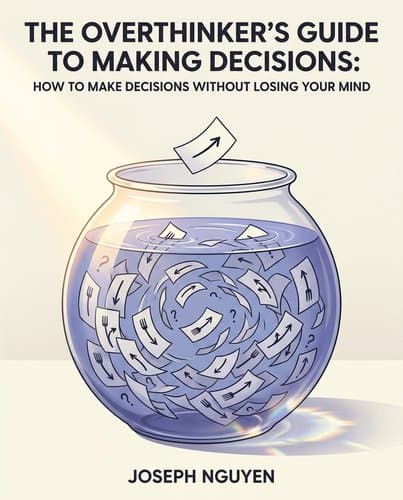
228046273_the-overthinker-s-guide-to-making-decisions
by Joseph Nguyen
Stop letting overthinking steal your best decisions—this systematic guide gives you battle-tested frameworks like the 10/10/10 rule and Eisenhower Matrix to…
In Brief
The Overthinker's Guide to Making Decisions: How to Make Decisions without Losing Your Mind (2025) identifies the cognitive traps that degrade decision quality and pairs each with a concrete tool to neutralize it.
Key Ideas
Make high-stakes decisions in morning
Schedule your highest-stakes decisions for the morning, when your decision-making fuel is full — the Israeli parole judge data shows that even trained experts make worse choices as the day progresses without breaks.
Test worst-case scenario survivability
When loss aversion is stalling you, name the specific worst-case scenario and run two questions against it: Can I survive this adversity? Will I eventually recover? In nearly every case, the honest answer to both is yes.
Filter decisions with Eisenhower matrix
Use the Eisenhower Matrix to immediately sort every pending decision into four quadrants (Urgent/Important, Not Urgent/Important, Urgent/Unimportant, Neither) — then schedule only the top two quadrants and ignore the bottom-right entirely.
Apply 10-10-10 temporal perspective check
Apply the 10/10/10 rule before any emotionally charged decision: ask how you'll feel about this choice in 10 minutes, 10 months, and 10 years. Short-term anxiety almost always shrinks to irrelevance at the 10-year horizon.
Eliminate complexity before analyzing options
Reduce options aggressively before analyzing them — eliminate anything complex, opaque, or outside your risk tolerance first. The cost of discarding complicated options is nearly zero; the gain in mental clarity is immediate.
Measure opportunity cost of persistence
When you catch yourself committed to a failing endeavor, identify the opportunity cost explicitly: what guaranteed return are you forgoing to protect a loss that has already happened? The arithmetic usually makes the right move obvious.
Trace second and third-order consequences
Apply second-order thinking to every significant decision: trace consequences two and three steps out. The first-order result is almost never where the real risk or reward lives.
Build feedback loops for decisions
Build a feedback loop for recurring decision types: set specific expected metrics before you act, measure actual results against them afterward, and treat any divergence as data about your process — not just bad luck.
Who Should Read This
People working on personal growth in Decision Making and Cognitive Psychology, especially those tired of generic motivational advice.
The Overthinker's Guide to Making Decisions: How to Make Decisions without Losing Your Mind
By Joseph Nguyen
11 min read
Why does it matter? Because the decision-making process you think is working is quietly failing you in ways you can't see.
You assume bad decisions come from bad information or bad luck. That assumption is the first problem. The actual culprits are biological — a brain running on depleted glucose, a nervous system wired to avoid loss more than it pursues gain, a cognitive architecture that shortcuts ruthlessly and calls it instinct. Research suggests we make 200-plus daily choices before dinner; layer in emotional static, survivorship bias, sunk costs, and the paralysis that arrives when options multiply past three, and the picture becomes clear: your judgment degrades in predictable, measurable ways that have nothing to do with intelligence. The framework in this book treats that not as a personal failing but as an engineering problem. The systems that follow are the diagnostic tools. Apply them correctly and the fog doesn't just lift — you start to see exactly which mental trap was running which decision all along.
Your Willpower Tank Empties by Noon — and the Consequences Are Worse Than You Think
Picture a judge settling into his chair at 8:45 a.m., case files stacked in front of him, coffee still warm. A prisoner appears requesting parole. The judge reviews the file, weighs the arguments, grants the request. Favorable rulings happen roughly 65% of the time in morning sessions. Now picture the same judge at 3 p.m., a dozen hearings deep, no break taken. A nearly identical case lands on his desk. The prisoner is denied. Researchers tracking Israeli parole courts in 2011 found that approval rates collapsed from 65% to near zero as sessions wore on — then snapped back to 65% the moment judges returned from a food break. These were trained legal professionals making life-altering calls. Their reasoning didn't fail them. Their fuel did.
Decision fatigue: the capacity to choose well behaves like a tank of gas, full at 7 a.m. and running on fumes by checkout. Every choice draws from the same reservoir — not just the hard ones, but the trivial ones too. What to eat, whether to answer that email, how to respond to a coworker's request. Volume is what matters, not difficulty. By evening, the same person who walks past the candy aisle without a second glance in the morning is loading chips onto the belt.
Most people read that as weak willpower — a character flaw, evidence of poor discipline. The actual mechanism is a battery reading zero. The willpower was there; the mental energy to deploy it ran out. That shift matters because it changes the question from 'what's wrong with me?' to 'when and how am I spending this resource?' Which is exactly where the next problem enters: a depleted mind doesn't just make worse choices — it makes predictably worse ones.
The Ten Cognitive Traps That Are Running Your Decisions Behind Your Back
Your reasoning errors are not random. There are exactly ten named patterns — each with a specific trigger and a specific countermeasure — that are quietly running your decisions while you believe you're thinking clearly.
Most people assume that when they make a bad call, something situational went wrong: too much stress, too little information, bad timing. That framing is almost never accurate. The real culprits are cognitive biases — mental shortcuts the brain builds to process information faster. They're not bugs exactly; they evolved to help filter an overwhelming volume of daily input. The problem is they routinely distort the very decisions where accuracy matters most, and they do it invisibly. You don't feel them activate. You just feel certain.
Consider what happens under genuine pressure. A study in the Journal of Economic Psychology tracked professional soccer goalkeepers during penalty kicks. The data showed that goalkeepers who stayed still in the center of the goal blocked shots at a higher rate than those who dove. Yet almost every goalkeeper dives — left or right — almost every time. These are elite professionals whose careers depend on making this exact decision correctly, practicing it repeatedly, with real consequences for failure. They dive anyway. That's action bias: the compulsion to do something rather than nothing, even when inaction is the statistically superior choice. The feeling of agency — I moved, I tried — overrides the evidence. Staying still requires overriding an instinct so strong it defeats expertise.
That one example contains the architecture of all ten biases. Each is a place where a mental shortcut hijacks a decision and replaces careful analysis with something that merely feels like careful analysis. Anchoring bias locks your judgment to the first number you hear — why car salespeople show you a model above your budget before showing you anything else. Confirmation bias filters incoming information so that evidence supporting what you already believe gets amplified and contradicting evidence gets quietly discarded. Survivorship bias populates your mental model of what's possible with only the people who succeeded, invisibly hiding everyone who tried the same thing and failed.
One bias operating in one domain is manageable. But these ten patterns don't take turns. They stack. Survivorship bias inflates your confidence in a plan, optimism bias underweights the risks, action bias rushes you past careful analysis, and confirmation bias ensures you never seriously engage with the evidence that would have stopped you. By the time the decision is made, you've run through four separate distortions and experienced none of them.
The countermeasure for each bias exists and is specific. For action bias, ask whether the decision is actually time-sensitive. For confirmation bias, find someone who holds the opposite view and force yourself to engage their best argument.
The Real Reason You Can't Quit a Losing Investment (Or a Losing Anything)
Imagine you're already running late, and halfway through a movie you can clearly see is terrible, you stay anyway — not because anything's about to improve, but because you paid twelve dollars and leaving feels like admitting defeat. That instinct, so ordinary it barely registers, is the same mechanism that keeps people in failing careers, dead-end relationships, and money-losing investments. The sunk cost fallacy doesn't announce itself. It just makes continuing feel like the responsible choice.
Whatever you've already spent — money, time, emotional energy — is gone. It was gone the moment you spent it. The question in front of you right now is never 'how do I recover what I've lost?' It's always 'what's the best use of what I have left?' Those are completely different questions, and conflating them is where the damage happens.
The mutual fund example makes this concrete in a way that's hard to argue with. Suppose you're putting $1,000 a month into a fund that's losing value. You keep contributing because selling would 'lock in' the loss — a phrase that sounds prudent but is actually a rationalization. The money already lost is gone whether you sell or not. Now layer in a second fact: you're also carrying $20,000 in credit card debt at 15% annual interest. That's a guaranteed negative return, every month, without exception. Even if the fund recovers and eventually matches the market at 8 to 10% annually, you're still running a net loss — you're just never forced to see it as a single number. The sunk cost fallacy creates tunnel vision. It keeps your attention locked on the fund's performance and pointed away from the debt bleeding you out in the background.
Every dollar you continue putting into that fund isn't a recovery attempt. It's a fresh decision to forego paying down a guaranteed 15% loss. The past investment has nothing to do with it. What you're actually choosing, in the present, is which use of your money makes more sense going forward — and the answer becomes obvious the moment you stop treating the original decision as something that binds you.
Stop Asking 'What Could Go Wrong?' — Start Asking 'What's the Actual Worst Case?'
Most people treat risk as a fog — shapeless, expanding, impossible to reason about. That's exactly why it paralyzes. The fix is mechanical: name the specific worst case, then run two questions against it.
Here's the sharpest demonstration of why this works. Say you invested money in the stock market at the single worst possible moment in American financial history — the absolute peak, just before the Dow Jones Industrial Average began a collapse that wiped out 89% of its value. Great Depression, bread lines, the whole catastrophe. By pure bad timing, you chose the worst entry point in a century. If you stayed in, you recovered fully by late 1936 — roughly seven years. That's the actual worst case, drawn from real history, with a real number attached to the recovery window.
Once you have that, you run two diagnostic questions: Can I survive this? Will I recover? For the 1929 investor, the answers are yes and yes — uncomfortable, but survivable and reversible. This is the move loss aversion prevents. It manufactures a catastrophic scenario with no floor and no exit, and you negotiate against a ghost. Replace the ghost with the historical worst case and the fear doesn't disappear — but it gets bounded. Bounded fear is workable.
The same logic applies to separating imagined risks from real ones. For a $10,000 market investment, total loss isn't a real risk — it's never happened in market history. A partial loss during a downturn is real. Those two things deserve completely different responses: dismiss the first, factor the second into your timeline. Treating both as equally threatening is what stalls the decision indefinitely.
A four-box tool called the decision-making quadrant extends this into a second dimension most people never look at: the cost of inaction. The boxes are positives of choosing, positives of not choosing, negatives of choosing, negatives of not choosing. That second box — positives of inaction — almost never gets examined. Filling it in forces you to put a concrete number on what stalling actually costs. Inaction looks safe until you've written that down.
The Thinking Error That Makes Simple Decisions Feel Impossible
More options feel like more freedom, but past a threshold they function as a tax — on time, on confidence, on your ability to act at all. The fix isn't better analysis. It's subtraction.
Suppose you have $5,000 to invest. The full menu runs from mutual funds and stocks to bonds, derivatives, commodity futures, and cryptocurrency. Most people read that list and start researching. That instinct is wrong. The right first move is to throw things out. Strip away derivatives, futures, and crypto immediately — not because they're necessarily bad investments, but because their complexity multiplies your decision surface. Bonds look simple until you're staring at the sub-categories: government, corporate, high-yield, municipal. Cut those too. What's left? Stocks and mutual funds. Two things instead of eight. The cost of that elimination is exactly zero. The mental clarity is immediate.
A principle called satisficing explains why this works: 'good enough' is frequently superior to 'best' because the hunt for the optimal choice consumes more resources — time, attention, energy — than the marginal improvement in outcome justifies. A 'good enough' option chosen quickly and executed well beats a theoretically perfect option chosen after exhausting deliberation, because the exhaustion is part of the cost.
Once you accept that, the framework becomes mechanical. First, cut anything whose complexity exceeds your willingness to understand it — confusion is a signal, not a challenge. Second, rank what remains by how directly each option moves you toward your specific goal, and discard anything at the low or dangerously high end. Third, run your personal constraints against the survivors: budget, risk tolerance, time horizon. By the third pass, you're no longer choosing from a field. You're confirming one or two options that cleared every filter.
The goal isn't to avoid thinking. It's to make sure the thinking you do is pointed at something small enough to be actionable.
When Your Gut Is an Asset and When It's a Liability
When should you trust your gut, and when is trusting it the fastest way to a bad outcome?
The answer depends on which kind of gut you're consulting. William Duggan distinguishes three types. Ordinary intuition is raw feeling — the vague sense that something is off, or that you should go for it. Under emotional load, it's not a signal worth following. Expert intuition is different in kind, not just degree. It's pattern recognition built from accumulated experience in a specific domain — the kind that lets a seasoned doctor notice something wrong before they've consciously named it, because they've seen the pattern hundreds of times. That one is worth trusting. Strategic intuition is the third type: connecting dots across unfamiliar territory by drawing on experience from adjacent situations. It needs time, not just instinct. A founder who spots a pricing model from one industry and applies it to solve a problem in another is running on strategic intuition — not a hunch, but a deliberate synthesis.
The practical implication is sharp. When a decision falls inside your area of genuine experience, stop second-guessing the signal. The scoring matrices and weighted criteria lists covered earlier exist precisely for decisions where you lack that experience base. Apply them there. Where the pattern is familiar, the analysis is often just expensive friction.
Values work the same way — a legitimate input that pure logic can't replace. Consider a small business owner watching revenue fall. Nothing in a spreadsheet rules out cutting ethical corners to stabilize the numbers. The tactics might even work. But the owner who ignores their values in the process doesn't get a neutral outcome — they get the financial result plus regret, guilt, and shame. The values weren't inefficiencies to be optimized away; they were load-bearing. Factor them in from the start, and even a disappointing outcome lands differently, because you made the choice on your own terms.
The toolkit isn't asking you to suppress instinct. It's asking you to know which instinct you're holding.
Second-Order Thinking: The One Mental Model That Changes Everything
Marcus was furious. Someone had said something unforgivable at a dinner party, and he hit them. That's the first-order outcome: they hit back. End of Marcus's mental model. But the chain doesn't end there. The other person calls the police. Marcus is arrested. A criminal record follows. Six months later, he's passed over for a promotion because the background check surfaced the assault charge. A year after that, he can't refinance his mortgage because the conviction affects his credit profile. One impulsive decision at a dinner table and the blast radius is still expanding.
That cascade is what second-order thinking is designed to catch. Most people stop at the first consequence — the immediate, obvious response to a decision. Second-order thinking asks one additional question: then what? Not as a vague anxiety exercise, but as a deliberate tracing of the downstream chain. What happens after the first thing happens? And after that?
Ray Dalio built Bridgewater into the world's largest hedge fund and put it plainly: failing to consider second- and third-order consequences is behind a disproportionate share of the worst decisions people make. The first-order response is almost always visible in advance. It's the subsequent links in the chain that get buried — not because they're hard to see, but because most people don't look for them.
The practical move is simple: before you commit to a decision, write down the first-order consequence. Then ask 'then what?' twice more. Trace the single most likely path one or two steps further than feels necessary — that's where the real cost or opportunity lives.
Suppose you find a stock with strong recent financials. First-order thinking stops at 'this stock has been performing well.' Second-order thinking asks what happens next — other investors notice the same financials, buy in heavily, and drive the price well above what the company is actually worth. Now you're paying a premium for momentum, not value, and you're exposed when the correction comes.
The System That Turns Your Decisions into a Learning Machine
Think of a chess player who never reviews a game after losing it. Each defeat lands as a verdict — they played badly, they got unlucky, it's over. Now think of the player who replays every game, move by move, asking where the position first went wrong. The second player isn't more talented. They've built a mechanism for converting experience into improvement. That mechanism is what most people are missing when they make decisions.
Most people treat decisions as discrete events, judged entirely by how they turn out. Good outcome means good decision; bad outcome means bad decision. That framing makes every choice a verdict and every result a referendum on your judgment. It also guarantees you extract almost nothing useful from the experience.
The alternative is to treat each decision as the opening move in a loop. Here's what it looks like. Suppose you start a strength training routine with two specific targets for the first thirty days: lose eight pounds, add twenty-five pounds to your bench press. Day by day you track the numbers. At the thirty-day mark, you compare what actually happened against what you predicted. Maybe you lost six pounds and your bench press is up twenty, not twenty-five. Positive results — but they diverge from your targets. That gap isn't evidence that you worked hard enough or didn't. It's a diagnostic signal about the quality of the original plan. Maybe three training days a week wasn't enough. Maybe you needed a second interval session. The data tells you where the decision was off, not just whether the outcome was satisfying.
One condition kills this entirely: delay. Start the routine in January, neglect to run the numbers until June, and the window has closed. The metrics no longer connect to the decisions that generated them. Speed of analysis matters as much as accuracy of data — the two are equally load-bearing.
Once the loop is running, something shifts. A bad outcome stops feeling like a verdict and starts feeling like a data point. You made a decision, measured it, learned something specific, adjusted. That's not a consolation prize for failing. It's the actual structure of getting better — and it's what converts everything in the preceding chapters from a collection of isolated techniques into something that compounds.
The Question Worth Carrying Forward
Here is what this book actually gave you: not better instincts, but a process that gets sharper the longer you run it. Every time you name a worst case instead of fearing a fog, every time you trace a second consequence instead of stopping at the first, every time you measure an outcome against what you predicted — you are feeding a machine that compounds. The decisions you made before reading this were data too, but you had no apparatus to extract anything from them. Now you do. That's the real gap between where you are and where you keep intending to be: not intelligence, not information, not willpower. Process. Consistent, documented, iterated process. The experiments were always running. Now they have a feedback loop. That changes now — or it doesn't, and you already know exactly which bias to blame.
Notable Quotes
“What do I want to achieve?”
“Why do I want to achieve this outcome?”
“What will be required of me to achieve this outcome?”
Frequently Asked Questions
- When is the best time to make important decisions?
- Schedule your highest-stakes decisions for the morning, when your decision-making fuel is full. The Israeli parole judge data shows that even trained experts make worse choices as the day progresses without breaks. This cognitive decline affects all decision-makers. By protecting morning hours for significant choices, you access peak mental energy. This timing principle works across all life domains—from career transitions to major purchases. Combine this with decision frameworks like the Eisenhower Matrix for maximum effectiveness. Morning decisions paired with structured analysis create the conditions for clearer, faster, and more confident outcomes.
- How should I organize decisions using the Eisenhower Matrix?
- Use the Eisenhower Matrix to immediately sort every pending decision into four quadrants (Urgent/Important, Not Urgent/Important, Urgent/Unimportant, Neither) — then schedule only the top two quadrants and ignore the bottom-right entirely. This framework eliminates decision paralysis by clarifying which choices deserve attention. Overthinkers tend to invest equal cognitive energy in trivial and consequential decisions, draining mental resources unnecessarily. By filtering aggressively upfront, you focus only on high-impact items. The matrix immediately reveals which decisions matter and which waste your time. The result is faster decision-making with greater confidence in your priorities.
- What is the 10/10/10 rule for decision-making?
- Apply the 10/10/10 rule before any emotionally charged decision: ask how you'll feel about this choice in 10 minutes, 10 months, and 10 years. Short-term anxiety almost always shrinks to irrelevance at the 10-year horizon. This multi-timeframe approach decouples emotional reactivity from strategic thinking. Many decisions feel urgent and overwhelming in the moment but become insignificant months or years later. By zooming out to the longest horizon first, you gain perspective that dismantles overthinking. The rule proves especially valuable for social decisions, career moves, and relationship conflicts where immediate emotional stakes cloud clear judgment.
- How do I overcome loss aversion when making decisions?
- When loss aversion is stalling you, name the specific worst-case scenario and run two questions against it: Can I survive this adversity? Will I eventually recover? In nearly every case, the honest answer to both is yes. This technique forces you to examine fear rationally rather than abstractly. Once you acknowledge survivability, the emotional grip of potential loss weakens significantly. Loss aversion prevents many people from leaving bad situations, ending toxic relationships, or pursuing necessary life changes. By naming and testing fears explicitly, you expose their exaggeration and move toward concrete action.
Related Book Summaries
Read the full summary of 228046273_the-overthinker-s-guide-to-making-decisions on InShort