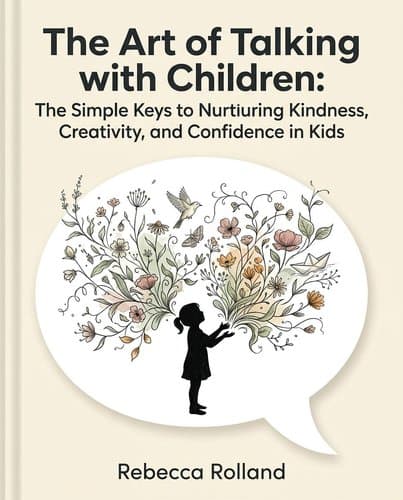
58283073_the-art-of-talking-with-children
by Rebecca Rolland
Most parents talk *at* children when they should talk *with* them. Swap "let me explain" for "tell me more," and the free, ten-second shift in conversational…
In Brief
The Art of Talking with Children: The Simple Keys to Nurturing Kindness, Creativity, and Confidence in Kids (2022) reframes conversation as the most powerful developmental tool parents already own. Rebecca Rolland shows that genuine back-and-forth exchange — not word count or enrichment programs — drives children's creativity, confidence, and neural growth.
Key Ideas
Shift from explaining to collaborative dialogue
Replace 'let me explain' with 'tell me more' — this single shift moves you from expert-delivery mode to back-and-forth mode; the change is not in vocabulary or topic but in conversational posture
Use 'yet' to preserve child agency
Use the word 'yet' when children hit obstacles: 'you're not there yet' implies progress is coming and keeps agency with the child, rather than attributing the outcome to fixed ability
Admit uncertainty and ask what they think
Practice curious waiting: when a child asks a hard question, admit you don't know and ask what they think before reaching for an answer; children engage more deeply when adults are genuinely uncertain alongside them
Three Es fill conversational gaps effectively
Apply the Three Es to any ten-second gap: Expand (stretch what the child said), Explore (push beyond the immediate situation), Evaluate (ask them to assess their own thinking); all three can happen in a single response without preparation
Relabel behavior to reshape your response
Change the label before you try to change the behavior: calling a child 'persistent' instead of 'stubborn' will change how you respond to them, which will change how they act — language about children functions as a self-fulfilling mechanism that shapes adult behavior first
Strategic silence invites deeper questions
Give more silence: leave deliberate pauses instead of filling every gap; the space you leave is what allows children to surface their real questions, fears, and ideas rather than responding to yours
Conversational turns matter more than words
The brain science supports turns, not words: conversational back-and-forth — not word count, not vocabulary drills — is what correlates with neural connectivity in children; this means the car ride, the bedtime, and the dinner table are more valuable than any structured enrichment activity
Who Should Read This
People working on personal growth in Child Development and Education, especially those tired of generic motivational advice.
The Art of Talking with Children: The Simple Keys to Nurturing Kindness, Creativity, and Confidence in Kids
By Rebecca Rolland
11 min read
Why does it matter? Because the conversations you're already having with your child are doing more — or less — than you think.
There's a version of talking to children that looks like good parenting — feelings validated, questions asked, praise calibrated for effort over ability. And then there's what actually shapes them. Rebecca Rolland spent years watching the gap between those two things, and what she found makes most communication advice look like it's optimizing the wrong variable entirely. The conversations that build a child's curiosity, empathy, and confidence don't happen when a parent says something smart. They happen in the silences adults are afraid of — the genuine "I don't know," the pause held long enough to mean something, the question left genuinely open. Most of us are accidentally crowding out the very moments we most want to create, and the fix is stranger and simpler than anything you've been coached to say.
Most Family Conversations Are Logistics in Disguise — and Your Kids Feel the Difference
Most families are talking constantly. Almost none of it is the kind of talking that matters.
One Sunday evening, after the kids were in bed, Rolland, who studies language development for a living, asked her husband what they'd talked about that weekend. Neither could remember.
The Edwards family fills in the picture: two working parents, two teenage sons in a small northeastern town. By conventional measures, things were fine: decent grades, jobs, no major conflicts, everyone constantly connected. Then the calls started coming. The school counselor reported that Charles, the older son, was depressed and had specifically said he didn't feel he could tell his mother. Days later, the soccer coach called about Todd bullying teammates. When his parents confronted him, they discovered he'd been stressed and had recently ended a relationship with a girlfriend they hadn't known existed. Jan, the mother, wasn't negligent or distant. She was there every day. She'd just been present without actually listening.
What passed for family life was a shared logistics operation. Meals, schedules, grades, rides, college application deadlines. The practical business of raising teenagers absorbed all available conversation, and nobody was tracking how anyone felt or what anyone feared.
The numbers she points to are bleak. Empathy among college students has dropped steeply since 2000, precisely when everyone got more connected. Roughly a third of teenagers now qualify for an anxiety disorder. Children are surrounded by words. What they're missing is talk that makes them feel known, and they carry that gap forward.
The More You Try to Have the Right Answer, the Less Your Child Learns
Sophie is five years old, sitting on a bench in a dim Egyptian gallery, swinging her legs. Her mother — the speech-language pathologist who studies children's language for a living — sits beside her. They've spent an hour peering into sarcophagi. Now Sophie goes quiet, and then: "Where did the mummies go?"
Her mother answers as best she can: the Egyptians believed in another world, that's why they worked so hard to preserve the body. Sophie is unsatisfied. The body is still here. So which part left? And before people were born, where were they? And then her gaze finds her mother's: where were you before you were born?
Rolland doesn't know. She says so. She tries to buy time by turning the question back: do you remember? Sophie squints and shakes her head. If she had to guess? A pause. Then, with surprising certainty: she'd been an old man. Got tired of being old. Turned into a baby.
What Rolland notices on the walk back matters as much as what Sophie said. Her daughter had arrived, unprompted, at something close to reincarnation, a concept most adults spend their whole lives avoiding. She got there not by being guided toward the right answer, but because her mother admitted she didn't have one. Rolland had spent months answering Sophie's questions about mummies — whether they were real, whether they could bite. Those were answerable. This one wasn't. The moment she stopped performing expertise and started genuinely wondering alongside her daughter, Sophie's thinking leaped forward.
Rolland names this "curious waiting": treating conversation as an open window rather than a lesson to deliver. The instinct runs against everything most parents feel they're supposed to do. We prepare. We anticipate what the child needs. We arrive with the right information, the right encouragement, the gentle correction that steers them toward a better understanding. All of that consistently crowds out the thing that actually works: following the child's energy until you reach whatever they were really asking. Curious waiting is how you enact what Rolland calls "child-driven" conversation, starting from what is alive for the child rather than what you arrived prepared to discuss.
The irony is structural. When a parent already knows where the conversation is going, the child's job becomes catching up. When the parent genuinely doesn't know, the child leads, and children who are leading ask better questions, take bigger leaps, and stay engaged longer. Sophie's conversation wasn't remarkable because her mother said the right things. It was remarkable because her mother got out of the way.
The Three Es Work in the Ten Seconds Between a Child's Comment and Your Response
Imagine every curious observation a child makes as a door left slightly open, not an invitation to lecture but an invitation to enter. Whether you walk through has nothing to do with how much you know about what's on the other side.
That distinction is the spine of Rolland's practical framework, which she calls the Three Es: Expand, Explore, Evaluate. Together, they're what Rolland calls ABC talk: Adaptive, Back-and-forth, and Child-driven. The names suggest a curriculum. The mechanism is simpler: it operates in the ten seconds between what a child says and what you say back.
The clearest illustration happens near a railway crossing in Boston. A father and his young son are watching trains. The son challenges his father to guess which color will come next. The father guesses green; green appears. The son is astonished. The father doesn't perform expertise — he says he noticed a pattern, then connects the word to something already in front of them: the boy's striped shorts, green and blue alternating. The boy looks up. Clouds and blue sky, same pattern. Then he reasons his way to a conclusion: the trains must be taking turns to be fair.
Nearby, a girl the same age hears a loud horn and asks why faster trains sound different. Her mother pivots to alphabet drills. E, F, G. The girl asks again about the trains. The lesson continues.
Rolland's point isn't that the mother was wrong. The alphabet matters. The problem was a mismatch of aims: the girl had landed on a genuinely interesting question (the answer involves the Doppler effect), and the conversation closed before she could follow the thread. The father didn't know more about trains. He just walked through the door when his son opened it.
Expand means stretching what a child says by one degree: not correcting, not simplifying, but adding vocabulary or complexity while staying with the same interest. The father did this when he named "pattern" and anchored it to the shorts. Explore means pushing into hypothesis and imagination, beyond the immediate scene: where does the next train go, what happens when they run out of colors? The boy did this himself, extending from shorts to clouds to the logic of taking turns. Evaluate means inviting children to examine their own reasoning, not critically but with genuine curiosity: "Why do you think the trains were taking turns?" These are pause-button questions, not prompts for a right answer.
None of this requires preparation. It requires a different orientation to the ten-second gap.
The brain science confirms it. Romeo and colleagues' 2018 brain-imaging study found that what predicts children's neural connectivity and brain structure is not the number of words they hear, and not vocabulary exposure — it is conversational turns. The back-and-forth itself builds the architecture. The train park father wasn't feeding his son information. He was giving him reps.
Confidence Is Made or Destroyed in the Smallest Everyday Comments, Not the Biggest Praise
On a winter afternoon at a playground, Rolland sat with her daughter and watched two groups of four-to-six-year-olds tackle the same climbing structure. From a distance, the groups looked identical. Up close, they were running completely different experiments in confidence.
The first group's adults were nearly silent. No cheering, no "You've got this!" When a child moved farther along the suspended ladder, an adult said quietly: "You took three more steps than before — how many more do you think you can do?" When a girl dropped mid-climb, the response was: "You're not there yet. But I bet you'll get there later today, or maybe tomorrow." Twenty minutes later, when the same girl tried again and didn't make it, the adult said the same thing: "Not yet." No evaluation, no consolation — just a direction. That word — yet — implies a future the child controls. The kids in this group were higher up the structure, calling to each other about how far they'd gotten, trying again after falling.
The second group's adults were loud. High fives, constant encouragement, standing close. When a boy looked down (which an adult had specifically told him not to do), he lost his grip and fell. The adult held him and said sharply: "Stop crying. You're not a baby. I told you not to look down." The boy said, through sobs: "I know. It was my fault."
That sentence is the whole argument. Nobody designed that exchange to damage anything. The adult was trying to stop a cry from becoming a scene. But the boy had just been handed a story about what happened: he failed because of his own defect. The first group's adults gave kids a different story: you're in process, progress is visible, falling is a waypoint.
Confidence is a belief children form about their own agency (what psychologists call an internal locus of control). When feedback consistently implies that outcomes are in a child's hands, they persist longer, attempt harder things, and recover faster from failure. When feedback implies they are either capable or not, failure confirms the worst interpretation. Researchers at Ohio State identify this as the Praise Paradox: inflated praise ("that's incredibly beautiful!") specifically decreases challenge-seeking in children with low self-esteem. The adults who most want to encourage are most likely to use the language that backfires.
None of this is about the grand occasions. Not the trophies, not the sit-down talks about believing in yourself. It's the word "yet." It's whether you ask "how many more do you think you can do?" instead of "good job." Those micro-choices, repeated across thousands of ordinary moments, are what confidence is actually built from.
You Cannot Lecture a Child Into Empathy — But You Can Grow It Through Conversational Structure
Can you teach a child to care about others the way you teach them to add fractions? Most parents assume empathy is installed through enough good examples and moral instruction — by naming kindness when they see it, correcting cruelty when they hear it, and explaining, patiently and clearly, why some attitudes are wrong. Rolland used to think the same way, until she watched herself do exactly that and realized, with real discomfort, that it probably hadn't worked at all.
William was an eighth-grader who mocked a Mexican student's accent during a class video: "He ought to practice. He's such a loser." Rolland calmly explained why that attitude was wrong. He shuffled his feet, mumbled an apology. She moved on, thinking she'd handled it.
Then came parent-teacher conferences. William's family had immigrated from Poland when he was two. His parents still spoke with heavy accents. His friends had started mocking them — and he'd stopped inviting anyone over. He'd absorbed shame and, the moment he could, passed it toward someone more vulnerable. The lecture hadn't reached any of that. It couldn't, because lectures address what a child says, not what's driving it.
What actually develops empathy is the same structural move that develops thinking and confidence: conversations that stay with the child's own experience, help them name feelings precisely, and let them explore another person's perspective until they reach conclusions the adult couldn't hand them.
When Rolland worked through this with Alex, a teenager who wanted to cut off his closest friend after Jackson stopped returning his texts for a week and then showed up at school as if nothing had happened, she didn't argue his friend was good. She asked Alex to trace that friend's behavior over time. He'd been steady through Alex's mother's cancer treatment. Alex made the call himself: the friendship was worth repairing. That verdict was unreachable by argument. It had to be found by following Alex's own account far enough that he got there.
The Foundation of Rich Talk Is Not What You Say — It's the Gaps You Leave
The night Philippe took the rails off Paul's toddler bed, he made the standard play. "You're a big boy now," he said. Paul dissolved — three years old, crying at the edge of what suddenly felt like an unprotected expanse of mattress. Sophie, overhearing from the hall, offered tactical advice: read him a boring book, he'll probably fall asleep. Philippe tried that too. He read, then held the boy, then simply stayed. They talked briefly about how everyone needs sleep, then stopped talking. Philippe sat in the dark, possibly meditating, he said afterward. Paul lay down, knowing his father was nearby, and drifted off. Twenty minutes later Philippe emerged.
Rolland asked what happened. He shrugged: they read, they held each other, they went quiet. That was all.
Philippe stopped convincing, rewarding, and correcting. The conversation that worked was barely a conversation: a presence, a willingness to sit with Paul at the scale he actually needed. Paul didn't want to be told he was big. He was three, and he knew it, and being praised for bigness only sharpened the distance between what he felt and what he was supposed to feel. What he needed was to be heard as small: held, accompanied, not abandoned to his new bed. Philippe needed quiet too. The silence gave them both something real.
Rolland calls this attunement — reading the moment accurately enough to respond to what it actually calls for, not what the script says to do. A script would have told Philippe to validate Paul's feelings, then explain the developmental milestone. That's the version that failed the first time. What worked was harder and simpler: he stopped performing the role of reassuring parent and just sat with his son.
The frameworks in this summary (Three Es, the "yet" move, child-driven questioning) are useful, but Rolland is honest about their limits. They're diagnostic: ways of noticing when you've drifted from genuine exchange, not substitutes for it. Your child doesn't need ten prepared things to say, she concludes. He needs you to sit with him as your interests develop together. The dialogue itself teaches what to say next. You notice where he opens up, where he freezes, where you do too. That noticing, not the frameworks, is what moves things forward. Good conversation leaves room to go badly, to feel unproductive, to stumble. If you're paying attention, the stumbling shows you the way.
What One Silence Can Do
Philippe didn't fix anything that night. He sat in the dark next to a three-year-old who was afraid of his own bed, and when he ran out of useful things to say, he stopped saying them. The boy fell asleep. That's the whole story — and somehow it contains everything the book has been building toward.
You don't need a framework for tonight. You need what Philippe had: the willingness to stay without performing. The conversations that reach your child aren't the ones you prepared. They're the ones where you left enough space for your child to finally ask what they actually wanted to ask. Every time you resist filling it — every "yet," every curious pause, every moment you follow instead of lead — you're giving your child room to become someone worth listening to.
Notable Quotes
“You're not going to pull my tooth,”
“the dentist said, and I sighed, fearing we'd have to return. Pulling out the X-rays, she passed them to Sophie.”
“She pointed to one spot.”
Frequently Asked Questions
- What is The Art of Talking with Children about?
- The Art of Talking with Children reframes conversation as the most powerful developmental tool parents already own. Rebecca Rolland shows that genuine back-and-forth exchange — not word count or enrichment programs — drives children's creativity, confidence, and neural growth. The book delivers concrete techniques for shifting from expert-delivery mode to curious, open dialogue in everyday moments. The core message: conversational posture matters more than content. Moving from 'let me explain' to 'tell me more' represents the fundamental shift required to unlock children's deeper thinking and confidence.
- What are the key takeaways from The Art of Talking with Children?
- Key techniques include replacing 'let me explain' with 'tell me more' to shift from expert-delivery to back-and-forth dialogue. Use 'yet' when children face obstacles to imply progress ahead and maintain their agency. Practice curious waiting by admitting uncertainty and asking what children think first. Apply the Three Es to any ten-second gap: Expand what the child said, Explore beyond the immediate situation, and Evaluate their own thinking. Change labels before behavior — calling a child 'persistent' instead of 'stubborn' reshapes how adults respond. Finally, prioritize silence and pauses over word count, as conversational turns build neural connectivity.
- Does The Art of Talking with Children have brain science support?
- Yes, Rolland grounds the book in neuroscience research. 'The brain science supports turns, not words: conversational back-and-forth — not word count, not vocabulary drills — is what correlates with neural connectivity in children.' This means everyday interactions like car rides, bedtime conversations, and dinner table discussions are more valuable than structured enrichment programs. The research supports that quality dialogue builds brain development more effectively than passive learning. By prioritizing conversational turns over content delivery, parents can maximize neural growth through moments already present in daily family life, without special programs.
- What does The Art of Talking with Children say about labeling children?
- Change the label before you try to change the behavior. Calling a child 'persistent' instead of 'stubborn' will change how you respond to them, which will change how they act. Language about children functions as a self-fulfilling mechanism that shapes adult behavior first. This core principle recognizes that parental language is not merely descriptive but transformative. By reframing how parents label children—internally and externally—they shift their own mindset and responses, creating ripple effects in daily interactions. The mechanism works through adult perception first, then influences child behavior and self-concept.
Related Book Summaries

Read the full summary of 58283073_the-art-of-talking-with-children on InShort