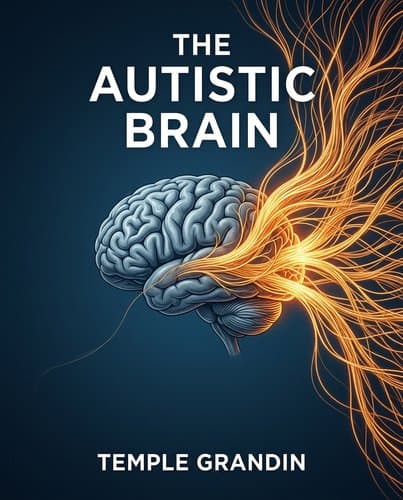
16056498_the-autistic-brain
by Temple Grandin, Richard Panek
Temple Grandin dismantles the myth of the 'broken brain' by revealing autism as a distinct cognitive profile—object visualizer, pattern thinker, or verbal fact…
In Brief
Temple Grandin dismantles the myth of the 'broken brain' by revealing autism as a distinct cognitive profile—object visualizer, pattern thinker, or verbal fact thinker—where the right environmental and sensory adjustments don't merely accommodate difference but unlock hidden intelligence entirely invisible to standard assessment.
Key Ideas
Profile cognitive style over autism severity level
Stop asking 'how severe is the autism?' and start asking 'what type of thinker is this person?' — object visualizer, spatial/pattern thinker, or verbal fact thinker — because the three profiles have different strengths, different failure modes, and respond to different interventions
Recognize meltdowns as sensory overload signals
When an autistic person shuts down or melts down in a public space, treat it as a sensory overload signal first and a behavioral problem last — the outward behaviors (withdrawal vs. tantrum) can look opposite while sharing a single internal cause
Use non-verbal tests to reveal true ability
If you're assessing anyone's intelligence or ability using a test that requires social knowledge to interpret, you are measuring the test's social scaffolding as much as you are measuring the person — use non-verbal, pattern-based measures alongside standard ones
Diagnostic labels begin inquiry, not end it
A DSM label is a starting point for a conversation, not an ending point for expectations — ask for concrete, specific examples of what the person can and can't do rather than treating the category as a complete description
Sensory engineering unlocks hidden cognitive access
Sensory modifications (tinted lenses, acoustic panels, reduced visual clutter) are not accommodations in the charitable sense — they are environmental engineering that can unlock access to a cognitive profile that is otherwise invisible to standard assessment
Work portfolios bypass social screening barriers
When thinking about employment, route around HR and go straight to the work: a portfolio demonstrating the skill bypasses the social screening that filters out people whose neurology is an asset for the job but a liability in the interview
Who Should Read This
Curious readers interested in Neuroscience and Cognitive Psychology and the science of how the mind actually works.
The Autistic Brain
By Temple Grandin & Richard Panek
12 min read
Why does it matter? Because the diagnosis you've been given — or given someone else — describes behavior, not a brain.
You probably think you know what autism is. A spectrum — mild to severe — diagnosed by watching how a child behaves in a room. Maybe you've seen the statistics about rising rates and assumed an epidemic. Here's what's actually true: the diagnostic manual is a behavioral checklist that has rewritten its own rules with every edition, part of the apparent epidemic traces back to a single changed word in a policy document, and the dominant research framework has spent decades studying social deficits while almost entirely ignoring the sensory experience that makes daily life unworkable for millions of people. Scans of Temple Grandin's brain found a visual processing tract four hundred percent larger than average and a cerebellum twenty percent smaller — which suggests we've been describing people by their weather rather than their climate. The label is not the thing.
The Diagnosis Is a Behavioral Checklist, Not a Medical Test — and That Distinction Has Cost People Decades
In 1943, a lawyer in Mississippi named Oliver Triplett wrote a thirty-three-page letter to a Johns Hopkins psychiatrist named Leo Kanner, describing his son Donald: the tantrums, the indifference to other people, the obsessive fascination with spinning objects, and the uncanny ability to recite the entire Presbyterian catechism from memory at age two. Kanner recognized a pattern he'd seen in other children and named it. That act of naming — clinical, careful, grounded in observed behavior — is the foundation on which every autism diagnosis since has been built. The problem is what happens when you build a diagnostic system on behavioral observation rather than biology: the categories drift, committees reshape them, and every few years the same child becomes a different kind of patient.
Kanner himself was the first to demonstrate how unstable this ground was. His 1943 paper leaned toward a biological explanation — these children seemed wired differently from birth. But by 1949, his follow-up paper spent more than half its pages analyzing parent behavior, and a decade later he was telling Time magazine that autistic children were often the offspring of parents who had barely "defrosted" enough to have a child at all. Nothing about the children had changed. Kanner's interpretive framework had. And because he was the field's founding authority, that shift echoed through clinical practice for the next quarter century.
The DSM didn't help clarify things. Autism didn't appear as a standalone diagnosis in either the 1952 or 1968 editions — only as a symptom of childhood schizophrenia. The 1980 edition finally gave it its own category. The 1994 edition added Asperger syndrome and a catch-all called PDD-NOS. And somewhere in that edition, a single word was printed wrong — quietly reclassifying thousands of children overnight. The full story belongs to the epidemic chapter, but the short version is this: by the time the error was caught six years later, a Columbia University study of California children found that one in four new autism diagnoses were children simply moved from an earlier label of intellectual disability. The children were the same children. The word had changed.
Grandin herself cycled through three labels — brain damage, then schizophrenia, then autism — before anyone connected her behavior to the structure of her brain. Each reclassification came with a new prognosis, new interventions, new assumptions about her future. Her brain, meanwhile, stayed exactly as it was.
The Research Has Been Studying the Wrong Thing for Decades
A 2011 scholarly volume on autism ran to more than fourteen hundred pages — eighty-one papers covering genetics, theory of mind, behavioral intervention. Exactly one addressed sensory processing. Grandin wrote it. This in a condition where roughly nine in ten people have at least one sensory disorder. The field had been studying what autistic people do in social situations while almost entirely ignoring what the environment was doing to them before any social behavior had a chance to occur.
Carly Fleischmann spent the first decade of her life classified as nonverbal and severely autistic, and when she eventually gained access to a keyboard, she described a coffee shop encounter in terms no outside observer could have guessed. Before the conversation with the person across from her had gone anywhere, a woman brushing past left a trail of perfume that commandeered her attention. Then the voices from the table behind her. Then the seam on her sleeve. Then the grinding shriek of the espresso machine blending into the general roar. By that point the person in front of her — talking, making eye contact, doing all the things a social interaction requires — was gone. She had lost them entirely. Her response? Either she shut down and went still, staring at nothing, or she erupted into tears or screaming that seemed to come from nowhere.
An outside observer watching her shut down would classify her as underresponsive — socially withdrawn, disengaged. An outside observer watching the tantrum would classify her as overresponsive — hypersensitive, dysregulated. Two opposite diagnoses from the same internal state. The coffee shop hadn't changed. The sensory overload hadn't changed. Only her coping mechanism had. But because autism research has been built around behavioral observation rather than inner experience, both responses get filed under different labels and studied as if they were different problems. They aren't. They're the same brain, saturated, trying two different exits from the same trap.
The implication follows directly. If the core problem is social, you design interventions around socialization — practicing facial expressions in a mirror, rehearsing eye contact. But if the core problem is that a restaurant feels like standing inside a concert speaker, none of that reaches it. You are training someone to swim better while they are drowning.
The First Time Grandin Saw Her Own Brain, the Hardware Argument Became Real
In 1987, Temple Grandin slid into an MRI machine at the University of California, Santa Barbara, lay completely still for half an hour, and then walked straight to the technician's room to demand a look at the results. A researcher pointed to her cerebellum — smaller than it should be — and for the first time she held concrete proof that something physical was different about her brain. Not a choice. Not a failure of willpower. Hardware.
The clearest vindication of that framing came decades later, in a Pittsburgh lab, when researcher Walter Schneider ran Grandin through High-Definition Fiber Tracking — a scanning method originally developed by the Department of Defense to map traumatic brain injuries with the same specificity that X-rays bring to broken bones. Schneider was looking for areas where Grandin's brain differed from a control subject's by at least fifty percent. Two findings cold-stopped him. Her visual tract was four hundred percent of the control's size — not somewhat enlarged, but monstrous by comparison. And the fiber connecting the "what you're hearing" region to the "what you're saying" region was one percent of the control's size. Nearly absent.
That single pair of numbers explains more about Grandin's inner life than a library of behavioral observation could. The speech difficulties she described in her early memoir — words that simply wouldn't come, as if the signal kept dying before it reached her mouth — weren't a mystery anymore. The connection was almost literally not there. Meanwhile, the visual system had grown enormous, possibly as compensation, fibers branching into territory that language-production pathways normally occupy. When Grandin says she thinks in pictures, she isn't reaching for a metaphor. The wiring that routes experience toward visual representation is four times the standard gauge. The wiring that routes experience toward speech is gone.
Scheider traced the asymmetry to a specific developmental window: somewhere between ages one and two, when fibers are supposed to link the babbling-sound system to the word-production system. In Grandin's case, those fibers didn't form the right bridge — and her brain responded by growing elsewhere instead, proliferating connections in the one direction it could. The result is a brain that can run a detailed simulation of a piece of industrial equipment while struggling to describe it out loud. The autistic brain isn't underconnected to the world. It's overconnected in specific directions while underconnected in others — and you can see both facts, at the same time, on the same scan: one fiber bundle the width of a highway, another barely a footpath.
The Autism 'Epidemic' Is Partly a Punctuation Mark — and the Genetics Are Far More Complicated Than Anyone Admits
Think of counting a country's population by changing the definition of 'citizen' every decade, then announcing an immigration crisis because the numbers keep rising. The citizens didn't move. The border did. That is more or less what happened with autism between 1980 and 2000. A single copyediting change in the 1994 DSM shifted the eligibility standard for one autism-related diagnosis — PDD-NOS — from requiring impairment in social interaction and communication to requiring impairment in social interaction or communication. Meet either criterion instead of both, and you qualified. The correction arrived in 2000. In the intervening years, researchers tracked what happened in California: roughly one in four new autism diagnoses during that period were children reclassified from an earlier label of intellectual disability. The children were identical. The paperwork had changed. Add the introduction of Asperger syndrome in the same edition, the growing cultural awareness that pushed more parents to seek testing, and the broadening of the spectrum to include high-functioning individuals who in an earlier era would simply have been called awkward or obsessive — and the arithmetic of an 'epidemic' practically writes itself.
The genetics tell a comparably humbling story. Researchers had hoped autism might work like Down syndrome: one chromosomal anomaly, one outcome, clean cause and effect. What the Autism Genome Project found instead was hundreds of copy number variations associated with autism by 2012, with no single mutation accounting for more than one percent of cases. Think of it less like a broken part and more like corrupted software — the hardware looks fine, but the instructions running on it are each subtly, differently wrong. One neurogeneticist studying a large sample put it plainly: every child showed a different disturbance in a different gene. The condition is not one thing with many faces; it appears to be many things that happen to produce overlapping behaviors, which is precisely why a behavioral checklist was always the wrong tool for measuring it. We named a shadow and called it a substance. The science is catching up, but slowly — and the honest position right now is that we are still closer to mapping the chip than to understanding how the software runs.
The Same People, Two Tests, a Chasm Between the Results
What if the test you used to measure someone's intelligence was itself built for a brain unlike theirs? That's the trap Michelle Dawson, an autistic researcher at the University of Montreal, walked into when she started examining how her field had been measuring autistic cognition — and what she found was a problem baked into the methodology itself, not the people being measured.
The standard tool was the Wechsler Intelligence Scale, a twelve-subtest battery mixing verbal and nonverbal tasks. Many of its questions require the kind of incidental knowledge that accumulates through social interaction — the kind you pick up from people, not from looking at the world directly. Alongside it, Dawson's 2007 study administered the Raven's Progressive Matrices, a purely visual test: sixty geometric sequences, no language, no social scaffolding, just pattern recognition. The same fifty-one autistic participants took both.
The gap between the two results was a chasm. On the Wechsler, a third of the autistic group scored in the 'low functioning' range. On the Raven's, only five percent did — and a full third scored in the 'high intelligence' band. Two tests, same people, same day, opposite pictures of the same minds.
Dawson's finding is precise enough to be unsettling: the Wechsler wasn't measuring raw cognitive ability. It was measuring how well participants had absorbed socially transmitted knowledge, which is exactly the domain where autistic brains are most likely to differ. Using it as a neutral yardstick is like assessing color vision with a test written entirely in red ink and concluding that everyone who fails is blind.
The bias ran deeper than test design. Dawson and her colleagues found that fMRI studies had been doing something similar at the level of brain imaging. When scans showed autistic brain regions activating differently from neurotypical ones, researchers labeled those differences deficits almost automatically, regardless of whether the deviation correlated with worse performance or better. A region showing more activation than expected got filed as impairment. So did a region showing less. In practice, this meant that autistic participants who outperformed neurotypical controls on certain tasks still had their brain activity logged as pathological — the higher recruitment of neural resources that produced better results was classified as a sign of dysfunction. The direction of the difference didn't matter; the difference itself was treated as proof of damage. The conclusion was built into the classification system before a single result came in.
What Dawson's study forced into the open was that the field had been measuring the distance between autistic cognition and a neurotypical standard, then calling that distance a deficit — when in some cases it was simply an alternative that the tools weren't designed to detect.
There Are Three Kinds of Autistic Minds — and Confusing Them Is Costing People Their Careers
The autism spectrum is not a line. Every intervention designed as if it were — every classroom accommodation, every hiring program, every therapy protocol calibrated to 'mild' versus 'severe' — is working from a map that gets the terrain fundamentally wrong. The more accurate map has three regions. The difference between them explains why two people with identical diagnoses can have completely opposite strengths, and why helping one of them often does nothing for the other.
Here is the clearest evidence that the three regions are real: cognitive neuroscientist Maria Kozhevnikov, analyzing data from spatial manipulation tests in the late 1990s, noticed something that didn't compute. People who described themselves as visual thinkers scored, on average, no better on spatial tests than people who described themselves as verbal thinkers. That made no sense — you'd expect someone who thinks in images to be better at mentally rotating a three-dimensional object than someone who thinks in words. So she looked at the individual scores instead of the group average, and there it was: the visual thinkers weren't clustered in the middle. They were split between two extremes. Some scored near the top. Some scored near zero. Kozhevnikov recognized this as a bimodal distribution, which in statistics means you're not looking at one population but two. The self-described visual thinkers who aced the spatial tests were using the brain's dorsal pathway, the one that processes how objects relate to each other in space. The ones who scored near zero were using the ventral pathway, the one that builds detailed photographic representations of individual objects. Same label, opposite hardware.
Grandin herself is the zero end of that distribution. She can hold a cattle-handling facility in her mind with enough resolution to spot a dangling chain that will spook an animal before the facility is even built — but ask her to mentally rotate a three-dimensional block figure and she literally cannot do it. Her short-term memory drops the original image before the rotation completes. On a perspective-taking test — stand at the flower, face the house, point to the stop sign — she scored zero. What she has is object imagery: photographic, dense with texture and color and specific memory, organized around individual things rather than the relationships between them.
That's region one. Region two is the pattern thinkers: people whose visual thinking runs on the dorsal pathway, processing mathematical relationships, structural regularities, and spatial configurations. They are the programmers who see a coding tree in their heads and type out each branch, the musicians who intuit geometries of sound that mathematicians won't formally describe for another century. Region three is the verbal fact thinkers. Their minds run on words and sequences rather than images at all — and since this book is primarily about visual thinking, they appear here mainly to complete the map rather than as its focus.
What this means practically is that a single intervention aimed at 'autistic thinking' is almost guaranteed to miss at least two of these three people. Teaching through diagrams helps Grandin; it may do nothing for someone whose strength is linguistic recall. Channeling a pattern thinker's fixation toward music theory or software engineering is a completely different move than channeling an object visualizer's fixation toward design or veterinary medicine. The spectrum metaphor implies a dial you can turn. The three-region map implies a branching road where the first fork is the one that actually matters.
The Wiring That Makes a Fluorescent Classroom Unbearable Also Produces a Visual Tract 400% Larger Than Normal
Think of a coin. The same metal that gives it weight also gives it value. You cannot shave off the heaviness and keep the purchasing power — they come from the same material. The autistic brain works something like that.
The same scan that showed Grandin's speech connection at one percent of a control subject's showed her visual tract at four hundred percent. The structural asymmetry that made speech nearly impossible in childhood is not separate from her ability to mentally simulate an entire cattle facility in operational detail before a single beam goes up. It is the same thing, looked at from two angles.
This is not compensation the way the word usually implies — a consolation prize, the brain making do. The visual capacity is genuinely, measurably, economically large. Grandin can spot the dangling chain or the shadow falling at the wrong angle that will send a herd sideways, while the neurotypical engineers standing beside her see nothing. That ability comes from the same structural asymmetry that made her classroom years brutal. The wiring is not tragic with a silver lining. The wiring is the whole thing — limitation and strength braided together in the same fiber tracts.
The practical implication is that the goal was never symptom management. It was always environment design: put that wiring somewhere it can run.
The Question the Scan Actually Answers
That reframe is the whole argument. Not why won't she cooperate but what is this brain actually doing. The decades of scans Grandin keeps returning to, as the technology sharpens, are a standing challenge to everyone still arguing about the output while ignoring the hardware. The visual tract running four hundred percent of normal and the nervous system that made a fluorescent classroom unbearable aren't a trade-off — they're the same wiring, inseparable, non-negotiable. Society's job isn't to sand down one side until the other looks more convenient. It's to stop calling abundance a consolation prize and start building rooms large enough to hold it.
Notable Quotes
“wired at birth to allocate capital.”
“It was clearly a bimodal distribution,”
“Clearly. It was so obvious from the statistical data that you had two types of people who report themselves as highly visual. One group had very high spatial ability, and the other group had very low. And I had the idea: Maybe the two groups are just different.”
Frequently Asked Questions
- What is "The Autistic Brain" about?
- The Autistic Brain reframes autism as a set of distinct cognitive profiles — visual, spatial, or verbal — rather than a single behavioral disorder. Written by Temple Grandin and Richard Panek, the book draws on neuroscience and personal experience to show how identifying a person's thinking style, addressing sensory barriers, and bypassing social screening unlocks capabilities that standard labels and assessments routinely miss. The authors ask readers to move beyond "how severe is the autism?" and instead ask "what type of thinker is this person?"
- What are the three thinking styles Temple Grandin identifies in "The Autistic Brain"?
- Temple Grandin and Richard Panek identify three primary cognitive profiles in autistic people: the object visualizer, the spatial/pattern thinker, and the verbal fact thinker. These three profiles have different strengths, different failure modes, and respond to different interventions. Rather than treating all autistic people with the same approach, the authors emphasize that understanding which thinking style applies to a specific person is crucial for designing effective support and unlocking capabilities. Each profile has distinct advantages and challenges that standard autism assessments typically overlook.
- How does "The Autistic Brain" explain autistic shutdowns and meltdowns?
- The book clarifies that when an autistic person shuts down or melts down in a public space, it should be treated as a sensory overload signal first and a behavioral problem last. The outward behaviors can look opposite — withdrawal versus tantrum — while sharing a single internal cause: overwhelming sensory stimulation. This reframing shifts focus from punishing behavior to identifying and modifying the environmental triggers causing distress. Understanding the sensory basis of these responses enables more compassionate and effective interventions than behavioral approaches alone.
- What does "The Autistic Brain" reveal about assessing autistic intelligence?
- If you're assessing anyone's intelligence using a test that requires social knowledge to interpret, you are measuring the test's social scaffolding as much as you are measuring the person. To obtain accurate assessments, Temple Grandin and Richard Panek recommend using non-verbal, pattern-based measures alongside standard tests. This approach prevents social barriers from masking genuine cognitive abilities. The authors also warn that diagnostic labels should be treated as starting points for conversation, not ending points for expectations, emphasizing the importance of asking for concrete, specific examples of capabilities.
Related Book Summaries


Read the full summary of 16056498_the-autistic-brain on InShort