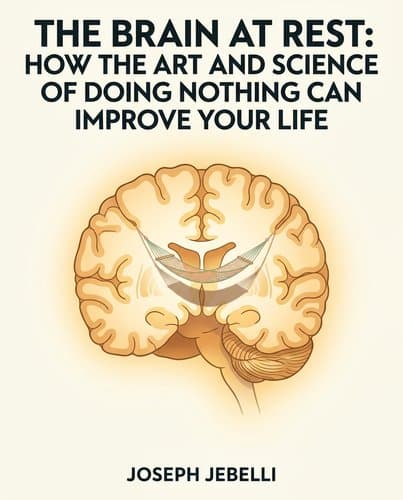
219520719_the-brain-at-rest
by Joseph Jebelli
Your brain's most powerful problem-solving system only activates when you stop working—and modern culture is systematically destroying it.
In Brief
The Brain at Rest: How the Art and Science of Doing Nothing Can Improve Your Life (2025) draws on neuroscience to show that the brain's resting state — the default network — is essential for creativity, emotional processing, and long-term decision-making.
Key Ideas
Default network thinking requires scheduled inactivity
Schedule 30–60 minutes of genuine doing-nothing daily — no podcast, no phone, no task — to activate the default network that handles your deepest problem-solving and emotional processing
Napping measurably enlarges brain and cognition
Take a 20–40 minute nap when cognitively depleted rather than pushing through; nappers have measurably larger brains and the cognitive equivalent of six fewer years of aging
Nature exposure threshold for mental health
Spend at least two hours in green space each week — this is the threshold at which psychological well-being benefits become statistically significant, and it requires no equipment or cost
Guilt reflex weakens through deliberate rest
When you feel productivity guilt, recognize it as a learned neurological reflex, not a moral signal — the brain's guilt pathways weaken through disuse, so each time you choose rest without apologizing, the reflex becomes quieter
Incubation solves problems at rest only
Let your mind wander deliberately: the incubation effect is real, and the problems you can't crack at your desk are often solved the moment you step away from it — schedule walks, baths, or screen-free commutes as active thinking time
Solitude powers creative and strategic thinking
Treat solitude as cognitive infrastructure, not social failure — intentional time alone activates the DMN regions responsible for autobiographical planning, creative insight, and long-term decision-making
Reduced hours eliminate burnout while maintaining output
Cap work hours and protect play: Iceland's national experiment proved productivity doesn't decline when hours drop — what declines is burnout, and burnout is what actually kills output
Who Should Read This
People working on personal growth in Neuroscience and Mental Health, especially those tired of generic motivational advice.
The Brain at Rest: How the Art and Science of Doing Nothing Can Improve Your Life
By Joseph Jebelli
11 min read
Why does it matter? Because the brain you're exhausting at work is quietly destroying itself.
You've been taught that pushing harder is how you earn your rest. Grind now, recover later. The people who stop are the ones who fall behind. Joseph Jebelli believed that too — right up until he watched his father, a man whose entire identity was built around relentless work, shatter completely. Not metaphorically. Clinically. Permanently. And then, years later, Jebelli caught himself walking the same road. What neither of them knew — what almost nobody tells you — is that while you're busy being productive, a network of brain regions sits quiet and idle, waiting to do the most important cognitive work of your life. It only activates when you stop. This book is about what that network is, what happens when you deprive it, and why everything you think you know about rest, idleness, and doing absolutely nothing is wrong in the most useful possible way.
Your Brain Has a Hidden Superpower — and You've Been Turning It Off
Abolfazl Jebelli spent twenty years at a desk in Bristol, tapping through code, eating lunch alone, and measuring his worth in hours logged. His son — the neuroscientist who eventually wrote this book — watched that life grind his father down until one afternoon, without warning, it broke him entirely. The breakdown was loud, frightening, and irreversible. Abolfazl was diagnosed with major depression, quit his job, and never went back.
His son Joseph would spend years trying to understand what actually happened to his father's brain — and what he found inverts almost everything our culture believes about effort and achievement.
Your brain is not most active when you're focused. It's most active when you stop. A network of neurons spanning the frontal, parietal, and temporal lobes — the default network — powers down the moment you concentrate on a task and surges back the moment your mind drifts. It governs memory consolidation and the kind of slow, associative thinking that produces your best ideas — the connection you make in the shower that eluded you for three hours at your desk. Every hour of relentless focus suppresses it.
Marcus Raichle, the neurologist who identified this network in 2001, describes the brain as an orchestra. Focused work turns the music down to a whisper. Rest turns it all the way up. Jebelli asked the obvious, uncomfortable question: what happens if we keep the music turned down — if we simply never give that conductor room to work? Raichle paused, then said it makes creativity nearly impossible. He looked genuinely troubled saying it.
The mechanism is physical. When your executive network — the part that grinds through tasks — runs at full capacity, it actively mutes the default one, the way a neighbor's WiFi drowns your own signal. The more relentlessly you work, the more thoroughly you shut down the part of your brain responsible for your best thinking.
The cult of busyness has this exactly backwards. You are not protecting your productivity by staying focused. You are quietly depleting it — hour by hour, meeting by meeting — and the discipline you're congratulating yourself for is precisely what's doing the damage.
Overwork Doesn't Just Exhaust You — It Physically Ages Your Brain
Here is something worth sitting with: the fatigue you feel after a punishing week at work is not simply tiredness that sleep will fix. It is measurable anatomical damage — the same kind the brain accrues through aging.
Jens Foell, a German doctor, discovered this the hard way. Colleagues had started describing him as "sped up," running on overdrive. His diagnostic accuracy was slipping. Friends told him he looked hollowed out. He dismissed all of it — until he slipped on a coastal path on Christmas Day, fractured his leg, tore the muscles in his thigh, and dislocated his ankle. Burnout hadn't arrived with the fall. It had been quietly dismantling him long before.
What was happening inside his skull has a precise neurological description. Chronic overwork thins the frontal cortex — the region handling judgment, planning, and decision-making — at the same rate as biological aging. On a brain scan, a chronically overworked forty-year-old can look neurologically closer to fifty. Simultaneously, the hippocampus, which anchors learning and memory, shrinks. The amygdala, the brain's alarm system, grows larger and more reactive. And the body floods the brain with glucocorticoids, stress hormones that cross directly into neural tissue and degrade the fine circuitry there. The resulting mental state — frightened, hesitant, unable to focus or remember — looks, on a scan, identical to what you see in trauma survivors and PTSD patients.
The cruel irony is that this destruction is invisible from the outside. Research has shown that managers cannot tell the difference between employees genuinely working eighty hours a week and those only pretending to — which means the neurological cost is real while the professional reward is largely imaginary. The World Health Organization estimates that overwork kills 745,000 people annually. That number is not a metaphor for burnout culture. It is a body count.
The pride many of us take in our relentless schedules deserves a second look. The brain keeping score is not impressed. It is just getting older.
The Brain Wanders for a Reason — and That Reason Is Genius
What if the moments when your concentration slips — when you find yourself staring at a taxi out the window instead of finishing the report — are actually the moments your brain is working hardest?
In 1904, Henri Poincaré was grinding through a problem that refused to yield. The more he pressed, the further the solution retreated. Eventually he gave up, stepped out, and boarded a bus. The moment his foot hit the step, the answer arrived — complete, unprompted, as if it had been assembled quietly while he wasn't looking. It had been. When focused effort stops, a different system takes over: the default network, freed from the tunnel of task-oriented thinking, begins connecting information in ways that deliberate concentration physically cannot. Poincaré wasn't distracted. He was, at last, using the right tool.
For a long time this remained a pleasant anecdote without a mechanism. Then in 2020, researchers located something specific inside the hippocampus: tiny electrical pulses called sharp wave-ripples, firing with each episode of mind wandering. This state consumes a quarter of your waking life. That's not an accident — it's a parallel processing system running your hardest problems in the background while your conscious mind handles the routine.
There's also a repair function at work. The brain's neurons run on glucose and oxygen, and when those supplies thin out under sustained effort, performance degrades — a state so disorienting it can feel permanent. Mind wandering allows the mitochondria inside each cell to redistribute, shuttling energy to wherever it's been depleted. You can feel this yourself: repeat a single word in your head until it loses all meaning — what researchers call semantic satiation.
Then let your mind drift for a minute and come back to it.
The meaning returns. The neurons reset.
Your wandering mind isn't failing to concentrate. It's solving problems you haven't consciously asked it to solve yet.
A Walk in the Woods Outperforms Most Pharmaceuticals
Think of your body as a pharmaceutical plant that requires a specific raw material to run. Remove that material and the factory breaks down: immune cells falter, stress hormones accumulate, the system quietly degrades. Supply it again, and production surges within days. That raw material, it turns out, is trees.
In the 1980s, immunologist Dr. Qing Li recruited a group of middle-aged Tokyo businessmen — stressed, sedentary, urban — and sent them into the forest for three days. No medication. No supplements. Just walking slowly through woodland. When he measured their blood afterward, their natural killer cells — the white blood cells that hunt down tumors and virus-infected tissue — had climbed by 40 percent. A week later, still up 40 percent. Even after a full month, the count remained 15 percent above baseline. Three days in the woods had rewritten their immune chemistry for a month.
The mechanism runs through smell. Trees emit compounds called phytoncides — the resinous, earthy fragrance of forest air — which are natural antimicrobial oils the trees produce to protect themselves. When humans breathe them in, anti-cancer proteins respond. In Li's businessmen, two such proteins whose job is to punch holes in the membranes of cancer cells and stop them replicating rose by 48 percent and 28 percent respectively. The forest was, without hyperbole, dispensing chemotherapy through the air.
No pharmaceutical company funded this research, and it's worth asking why. In 1984, surgeon Roger Ulrich had already shown that hospital patients who could see trees from their beds recovered faster and needed fewer painkillers than those staring at a brick wall. The finding was solid. It was also unmonetizable. You cannot patent a forest.
What Li's work confirms is something the brain already knew: nature is not scenery. It is medicine — and the dose is smaller than you'd think. Twenty minutes a day is enough to shift your neurochemistry. The default network responds almost immediately.
Solitude Is Not the Enemy of Connection — It's the Price of Having Something Worth Saying
The way our culture talks about solitude, you'd think being alone was a slow-acting poison. The science says the opposite — and the gap between those two positions is where a lot of people are quietly making themselves worse.
Here is the number that should reframe everything: seeing friends and family every single day raises your mortality risk by 8 percent. Not because connection is bad, but because the relentless performance it demands — the social niceties, the conforming, the suppression of your own interiority — generates chronic stress. Researchers at the University of Virginia put the underlying psychology into a room and watched it play out: given a choice between sitting quietly with their own thoughts for a few minutes or administering mild electric shocks to themselves, a significant number of participants chose the shocks. We have been so thoroughly trained to flee our own minds that actual physical pain beats a moment alone with them.
That's the flight. Sociologist Jack Fong has a name for what happens when you stop. He calls them existentializing moments — flashes of intuition that surface from the parts of the brain responsible for self-reflection when the noise finally clears. He first encountered them not in a meditation retreat but in a military barracks in Myanmar, stationed there during a civil war with only a hen for company. Fear, austerity, and enforced solitude forced him to confront questions he'd been too busy to ask himself: what do I actually value, and why am I here? He describes that period as having permanently altered him. He now seeks it deliberately — monthly solo nights in the California desert, lying under the constellation Sagittarius with nothing but a telescope, resetting something the rest of his life cannot reach.
This is the mechanism the loneliness headlines miss entirely. Intentional solitude activates the default network's regions of self-reflection and moral reasoning. The reward isn't isolation — it's arriving back at other people with something real.
Your Sleeping Brain Is Cleaning, Rebuilding, and Solving Problems You Couldn't Crack Awake
Gabrielle is still at her desk at 2 a.m., eyes burning, telling herself she'll sleep when the project is done. What she doesn't know is that right now, her brain is accumulating a kind of debt that no future sleep can fully repay.
During every waking hour, your neurons produce metabolic waste — including a sticky protein called beta-amyloid, the same substance found in the brains of Alzheimer's patients. The brain clears it through a dedicated plumbing system that operates almost exclusively during sleep: cerebrospinal fluid pulses through the tissue, flushing the buildup away. Miss a single night, and measurable quantities of beta-amyloid accumulate. Over years, that residue hardens into something closer to permanent damage. A study of more than 100,000 people found that regular night-shift workers had a 12 percent higher rate of dementia than those who didn't. The brain doesn't just get tired without sleep. It gets dirty, and leaves itself that way.
That same night of deprivation produces cognitive impairment equivalent to a blood alcohol concentration of 0.1 percent — legally drunk in most countries. You wouldn't drive like that. But millions of people show up to work, make consequential decisions, and assess their own performance in exactly that state. The cruel part: sleep-deprived brains are poor at detecting their own decline.
Sleep, then, is active biological maintenance — washing the brain, consolidating the day's learning, running an emotional processing cycle during REM that lets you wake up less distressed than you fell asleep. Passive recovery is the wrong frame entirely.
This is why Dr. Victoria Garfield's research at University College London carries such weight. By identifying genetic variants that predispose people toward napping, she compared brain volumes across 35,000 people. Regular nappers had brains roughly 15 cubic centimeters larger than non-nappers — about the size of a small plum — a difference equivalent to six fewer years of brain aging. Gabrielle never finished the project that night. But her brain, given the chance, might have gotten bigger anyway.
Play and Boredom Are Not the Opposite of Work — They Are What Makes Work Possible
What do you imagine your brain is doing when you're stuck in a dull meeting, mind drifting toward nothing in particular? Most of us assume it's idling — squandering time that could be spent producing something. A study from King's College London suggests the opposite. Researchers induced boredom in one group of students by having them guess the odds of picking colored balls from a bag, then told all participants about a charity providing education in Zambia. The bored students not only donated more generously — the more bored they felt, the more they gave. Boredom had made them hungry for meaning, and the brain responded by activating the temporo-parietal junction, the part of the brain that thinks about other people and moral choices. Far from being empty, boredom is the brain searching for something worth caring about.
Play works through a related mechanism. When Simone Kühn at the Max Planck Institute tracked what happened to people who played Super Mario 64 for thirty minutes a day over two months, she found visible growth in the hippocampus and prefrontal cortex. The game wasn't entertainment with benefits. It was neural construction. Action games also sharpened decision-making: players made accurate choices under pressure on average 25 percent faster than non-gamers, with no loss in accuracy.
The systemic implication arrived in Iceland between 2015 and 2019, when roughly 2,500 workers shifted from forty-hour weeks to thirty-five or thirty-six hours. Productivity held steady or improved. Burnout dropped sharply. Workers who'd spent years pushing back against shorter hours voted for them once they'd tried it — and by the trial's end, 86 percent of Iceland's workforce had negotiated the right to shorter hours. The conclusion wasn't that work matters less. It was that the brain — given room to wander, to play, to be briefly and productively bored — simply does more with the hours it has.
Productivity Guilt Is a Social Construct — and Your Brain Can Unlearn It
Think of a blush. You can know, intellectually, that you have no reason to be embarrassed — and still feel the heat rise in your face. The knowing doesn't stop the reflex. Productivity guilt works exactly this way: it isn't a rational assessment of what needs doing. It's a learned neurological pattern, and like a blush, it fires whether or not the situation warrants it.
What psychologists call overgeneralized guilt is a pervasive sense that you aren't contributing enough, that you're resting when you should be working, that stillness is a moral failing. When it fires, the amygdala, the anterior insula, and the prefrontal cortex light up together, generating enough internal pressure to push you back to your desk even when your desk is making you worse. The guilt isn't pointing at an actual transgression. It's just habit, wearing the clothes of conscience.
The cultural villain here isn't laziness or weakness — it's the equation, absorbed early and reinforced constantly, between busyness and worth. Every childhood
The Easiest Rest Protocol Science Has Found
The minimum effective dose is far smaller than your guilt has been telling you. A 2024 American study found that just 25 minutes of exercise per week — less than four minutes a day, gentle enough that you could hold a conversation throughout — is enough to actually grow the tissue that protects you from memory loss. Not 150 minutes. Not a gym membership. Twenty-five minutes spread across seven days, and the hippocampus expands.
Once you have that number, the rest of the protocol nearly writes itself. Two hours of green space per week — a threshold so low it amounts to a brief lunchtime walk each day — produced measurable improvements in psychological well-being across 20,000 people in Dr. Mathew White's research, regardless of age, income, or disability status. Ten to twenty minutes of genuine mind-wandering before sleep and again upon waking costs nothing and activates the brain's default network at exactly the moments it is most receptive. A thirty-minute nap, wherever you can fit it, adds the equivalent of six years of brain protection according to the genetic napping research at University College London.
None of this requires a retreat, a career change, or a personality overhaul. The science keeps arriving at the same embarrassing conclusion: the gap between what your brain needs and what you're currently giving it is not measured in hours. The walk you take instead of a second coffee, the ten minutes you spend staring at nothing before you check your phone. That's not a luxury. That's the plan.
The Conductor Is Still There
Marcus Raichle's orchestra never went silent. Every time you stepped away from your desk — every shower, every aimless walk, every afternoon when the task blurred and you couldn't push through — the default network surged back to full volume, doing the work you didn't know needed doing. You just couldn't hear it over the noise of believing stillness was failure.
You don't need a new life to change this. You need a nap when you're running dry, twenty minutes outside when the screen starts blurring, ten quiet minutes in the morning before the day tells you what to think about. Boredom is your brain reaching for meaning. Wandering is your hippocampus solving the problem you abandoned. Rest isn't the pause between good work. It is, the science keeps insisting, where the good work actually happens. The music was always there. Now you know how to let it play.
Frequently Asked Questions
- What is "The Brain at Rest" about?
- "The Brain at Rest: How the Art and Science of Doing Nothing Can Improve Your Life" (2025) draws on neuroscience to show that the brain's resting state—the default network—is essential for creativity, emotional processing, and long-term decision-making. Author Joseph Jebelli explores how structured rest activates cognitive systems responsible for deep problem-solving and emotional processing. The book provides evidence-based strategies for reclaiming rest through mind-wandering, napping, nature exposure, and solitude. Rather than viewing rest as laziness, Jebelli presents doing nothing as cognitive infrastructure necessary for peak performance. The work challenges modern productivity culture by revealing that rest actively enhances mental health and creative thinking.
- What are the key takeaways from "The Brain at Rest"?
- The book recommends several actionable strategies for reclaiming cognitive rest. Schedule 30–60 minutes of genuine doing-nothing daily — no podcast, no phone, no task — to activate the default network that handles your deepest problem-solving and emotional processing. Take a 20–40 minute nap when cognitively depleted; nappers have measurably larger brains and the cognitive equivalent of six fewer years of aging. Spend at least two hours in green space each week — this is the threshold at which psychological well-being benefits become statistically significant, and it requires no equipment or cost. Protect work-life balance through capped hours and protected play, as Iceland's national experiment proved productivity doesn't decline when hours drop.
- How does "The Brain at Rest" address productivity guilt?
- The book reframes productivity guilt as a learned neurological reflex rather than a moral imperative. When you feel productivity guilt, recognize it as a learned neurological reflex, not a moral signal — the brain's guilt pathways weaken through disuse, so each time you choose rest without apologizing, the reflex becomes quieter. This insight challenges the cultural narrative that equates rest with laziness. By understanding guilt's neurological basis, readers can gradually desensitize their guilt response through repeated instances of choosing rest without self-judgment. The evidence-based approach suggests guilt weakens with practice, empowering readers to reject productivity-at-all-costs thinking. This perspective aligns with neuroscience showing that genuine rest enhances long-term performance.
- What does "The Brain at Rest" say about napping and nature exposure?
- The book provides specific, research-backed recommendations for both practices with measurable cognitive benefits. Take a 20–40 minute nap when cognitively depleted rather than pushing through; nappers have measurably larger brains and the cognitive equivalent of six fewer years of aging. For nature exposure, spend at least two hours in green space each week — this is the threshold at which psychological well-being benefits become statistically significant, and it requires no equipment or cost. These simple interventions demonstrate that accessible practices produce meaningful improvements in brain health. The evidence shows that even modest changes like short naps and regular nature time can significantly enhance cognitive function and overall psychological well-being.
Related Book Summaries

Read the full summary of 219520719_the-brain-at-rest on InShort