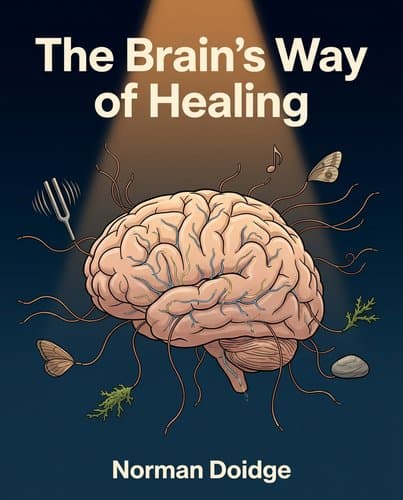
22522293_the-brain-s-way-of-healing
by Norman Doidge
The brain heals itself through senses—light, sound, movement, vibration—not just drugs or surgery. Doidge reveals how 'noisy' surviving neurons can be…
In Brief
The Brain's Way of Healing (Janu) presents evidence that the brain can recover from neurological conditions once thought permanent, using sensory inputs — light, sound, movement, and vibration — to trigger rewiring. Drawing on neuroplasticity research and case studies, it gives readers a framework for understanding how targeted, active engagement with these stimuli can restore lost function.
Key Ideas
Noise signals survival, not permanent damage
Neurological symptoms often reflect 'noisy' surviving neurons rather than permanently destroyed tissue — which means the treatment target is reset, not repair. Ask whether a condition has been assessed through this lens before accepting a prognosis of permanent damage.
Pair stimulation with active participation
The PoNS and similar devices work only when paired with relevant mental or physical activity — stimulation alone doesn't rewire anything. Any neuroplastic intervention requires active participation during the stimulation window to direct where new connections form.
Sensory pathways bypass surgical intervention
The tongue provides one of the body's most direct sensory routes to the brain stem — a reminder that noninvasive entry points for brain stimulation exist throughout the body's sensory systems, not just in pharmaceutical or surgical pathways.
Rhythm entrains measurable neurological effects
Sound and music act on the brain through entrainment — neurons literally synchronize their firing patterns with rhythmic external frequencies. Practices like Gregorian chanting, meditation, and certain music therapies have measurable neurological effects, not just psychological ones.
Healing requires weeks across four stages
Healing unfolds in four stages (functional, synaptic, neuronal, systemic) over a timeline measured in days to weeks. Expecting instant permanent change — or giving up after initial improvement plateaus — misunderstands how consolidation actually works in neural tissue.
Wholeness heals better than suppression
Doidge's core reframe: 'heal' comes from the Old English 'haelan,' meaning to make whole — not to suppress a symptom. Treatments that address the whole patient's engagement will systematically outperform those that treat the brain as isolated broken hardware.
Who Should Read This
Science-curious readers interested in Neuroscience and Mental Health who want to go beyond the headlines.
The Brain's Way of Healing
By Norman Doidge
10 min read
Why does it matter? Because the brain you were told couldn't heal has been healing all along — medicine just wasn't looking.
For four centuries, medicine operated on a quiet assumption: that the brain, unlike every other organ, could not meaningfully heal itself. Damage was deficit. Loss was permanent. This wasn't cruelty — it was the logical conclusion of a metaphor. We'd decided the brain was a machine, and machines don't regenerate. What nobody quite noticed was how much that single metaphor quietly determined which patients doctors fought for and which ones they discharged with instructions to adjust.
Here's where it gets strange. The assumption was never really science. It was a story — one we kept telling until researchers started watching stroke survivors recover, paralyzed limbs wake up, voices silenced for decades return. Not through surgery. Not through pharmaceuticals. Through sound. Light. Vibration. The ordinary electricity of the senses, redirected.
The Hardwired Brain Was Always a Story, Not a Fact
The brain cannot repair itself. For roughly four hundred years, this was not framed as a hypothesis to be tested — it was treated as an obvious consequence of what the brain fundamentally is. René Descartes and the scientists who followed him understood the brain through the most sophisticated technology of their era: clockwork machinery. Clocks are marvels of precision, but they cannot regrow a broken gear. Map that metaphor onto the brain, and you get a field of medicine that stops trying. If each mental function lives in a fixed location, and that location is damaged by stroke or injury or disease, the clinical response becomes: manage the symptoms, adjust the chemicals, accept the loss. Doidge calls this 'neurological nihilism,' and the machine metaphor is its philosophical engine.
What makes this history unsettling is how much the metaphor shaped treatment, not just theory. Medications were designed to prop up failing systems — to compensate for what the brain could no longer do, not to help it learn to do it differently. The underlying assumption was that asking a damaged brain to rewire itself was like asking a broken clock to repair its own springs. Rehabilitation was brief because breakthrough was considered impossible. Patients were told, accurately enough given the prevailing understanding, that whatever function they had lost after six weeks was probably gone for good.
The word 'heal' comes from the Old English haelan, meaning not to suppress a symptom but to make whole. That distinction carries real clinical weight. The brain, it turns out, is not clockwork. Its cells communicate electrically and re-form connections moment by moment. That capacity — the very thing that makes the brain sophisticated — is also the source of its ability to heal. The clock was a story. The question is what four centuries of telling it actually cost.
The Problem Isn't Damage — It's Noise
Imagine a radio that's been dropped. The components are mostly intact — the circuit board didn't shatter, the speaker still works — but somewhere in the wiring, connections are loose. What comes out isn't silence. It's static: fragments of signal buried in noise, intelligible for a moment, then chaotic again. You could try to rebuild the radio from scratch. Or you could find the interference and cancel it.
That distinction is the conceptual hinge of Yuri Danilov's work. For decades, neuroscience assumed that most neurological symptoms — the tremor, the lost balance, the cognitive fog — meant tissue was gone and function went with it. Danilov's insight was more precise: in many patients, the neurons haven't died. They survived the stroke, the injury, the disease. But instead of firing in coordinated patterns, they've fallen into something like electrical chaos, each cell misfiring on its own schedule, the whole network producing noise instead of signal. The symptom isn't absence. It's disorder. And disorder, unlike destruction, can potentially be corrected.
Danilov and his colleagues at the University of Wisconsin-Madison built a device that delivers electrical stimulation to the tongue — which, with fifteen thousand to fifty thousand nerve fibers at its tip, connects almost immediately to the brain stem and from there to the rest of the brain. The technical details of how it works come later; for now, what matters is the logic behind it.
That logic has real clinical stakes. If the problem is dead tissue, treatment means compensation — working around the loss. If the problem is noise, treatment means reset — restoring the conditions for normal function. Same symptoms, fundamentally different target. The implications, as the patients in the chapters ahead will show, are hard to overstate.
A Broadway Baritone Who Hadn't Sung in 28 Years
Ron Husmann had been a world-class Broadway baritone. Then multiple sclerosis took his voice, and for twenty-eight years he couldn't sing. Not diminished, not strained — gone. When he came to Yuri Danilov's lab at the University of Wisconsin-Madison, he placed a small device on his tongue and sat through four sessions, each twenty minutes long. After those eighty minutes total, he stood up and sang 'Old Man River.' Not a whisper of it. He belted it.
That fact deserves a moment. Twenty-eight years is a career. It's a marriage, a childhood, a version of yourself you stop imagining getting back. And here it is — not from surgery, not from a drug protocol years in development, but from a device resting on his tongue for the length of a lunch break, four times over.
What the device was doing, if the noise hypothesis holds, wasn't teaching his brain something new. It was clearing interference that had been drowning out something the brain still knew how to do. The neurons governing Husmann's voice hadn't all died. They'd fallen into disorder — misfiring, out of phase, producing chaos instead of coordination. The PoNS device delivered electrical pulses at 200 Hz in a precise rhythm: three pulses, pause, three pulses — calibrated to match how the tongue's sensory neurons naturally fire. That signal, fed through the tongue's dense concentration of nerve fibers directly into the brain stem and outward from there, gave the disordered networks a coherent pattern to lock onto. The brain didn't have to build anything. It had to stop misfiring long enough to remember what it already knew.
Somewhere in the gap between a working brain and a broken one, there's a third state: a brain that still has the architecture for a function but has lost the ability to coordinate it. The PoNS found that state and addressed it directly.
Jeri Lake had been a functional, active person before a traumatic brain injury rewrote the terms. She lived for five and a half years unable to turn her head without falling, her balance system wrecked entirely. The Husmann case and hers look different on the surface — voice versus balance, MS versus TBI — but the underlying logic is the same: surviving neurons trapped in noise. During one session with the device, Lake turned her head and didn't fall. In that same moment, she realized she was seeing the world in three dimensions for the first time since the accident. Two systems, both disordered, both resetting at once. She hadn't lost either function permanently. She'd lost the signal. When the noise cleared, two different parts of her brain came back online simultaneously, the way a room goes from dark to lit the moment you find the right breaker. You don't rebuild electricity. You restore the conditions for it to flow.
The Tongue Is a Broadband Port to the Brain
Why the tongue? Of all the possible routes into a damaged brain — electrodes on the scalp, implants threaded through tissue, drugs crossing the blood-brain barrier — why would a small device resting on your tongue reach anything important?
The answer is evolutionary. Yuri Danilov's argument starts not in a laboratory but in deep time: when the first animals began moving across the earth's surface, the tongue and the tip of the nose were their primary instruments for sensing the world. Not the eyes, not the ears — organs that evolved later for more complex tasks. The tongue came first, and the brain built its most direct sensory highway there. The numbers reflect this history: the tongue's tip alone carries 15,000 to 50,000 nerve fibers and 48 distinct types of sensory receptors. That's not an organ — that's a broadband antenna the body has been refining for hundreds of millions of years.
Those fibers feed directly into the cranial nerve system, which connects to the brain stem sitting roughly two inches behind the back of the tongue. The brain stem is where every major incoming and outgoing neural pathway converges — the hub through which signals fan out to the networks governing movement, sensation, balance, mood, and cognition all at once. Electrical signals that enter through the tongue don't have to find their way slowly through cortical relays. They arrive at the junction and go everywhere simultaneously, and brain wave activity stabilizes almost immediately — regions that had been firing out of phase begin to coordinate within less than a second of the device activating.
The device doesn't rewire the brain. It gives the brain's existing architecture the conditions it needs to rewire itself.
Healing Has Stages — and Skipping Them Is Why Treatments Fail
Here's what Danilov's framework actually demands — and why the same treatment that restores a Broadway voice in four sessions can fail completely in a different patient who skipped a step.
Danilov identifies four stages of induced plasticity. The first is immediate: when the device runs, disordered networks recalibrate and symptoms ease within the session itself. This is neuromodulation — not healing, but a temporary clearing of noise. The second stage unfolds over days as the synaptic connections that briefly fired together begin to strengthen, like a path that gets easier to walk the more it's used. The third takes roughly 28 days: structural proteins inside the neurons themselves begin to change, the hardware updating to match the new firing patterns. The fourth stage is the goal — a consolidated, self-sustaining network that holds its shape without the device.
Here's where the framework gets clinically sharp. The device alone drives none of this. Danilov's requirement is that stimulation must be paired with the specific activity you're trying to restore — balance exercises if balance is the target, vocal work if voice is. The reason is mechanical: neurons only rewire pathways they are actually using. The PoNS clears the noise and opens a window of heightened plasticity, but the brain will only consolidate new connections along circuits that are firing during that window. Stimulation without activity is like warming up an engine and leaving the car in park.
That's the architecture behind results that might otherwise look miraculous. Ron Husmann wasn't handed his voice back passively — the device created conditions, and the relevant circuits had to activate. The dramatic recoveries are real, but they follow a logic: four stages, each building on the last, each requiring the patient to do something while the window is open. That's not a miracle. It's a protocol. And protocols, unlike miracles, can be repeated.
Seventy Monks Collapsed Because They Stopped Singing
In 1967, seventy Benedictine monks at Abbaye d'En Calcat began collapsing into a collective stupor. They slouched in their cells, couldn't work, couldn't stay awake despite sleeping far more than usual. A medical mystery — except Alfred Tomatis, when he arrived to investigate, noticed something that dietary adjustments and extra rest couldn't fix. A new abbot, interpreting Vatican II reforms as permission to modernize, had recently abolished the monks' six to eight hours of daily Gregorian chanting. No infection. No nutritional deficiency. Sound deprivation.
Tomatis's explanation sounds almost too simple until you sit with its implications: the ear is a battery to the brain. High-frequency sounds — dense in overtones and harmonics, exactly what Gregorian chant generates — stimulate the cochlea's most receptor-rich regions, and that stimulation charges the cortex the way sunlight charges a solar cell. Strip that input away and the brain doesn't just lose something pleasant. It loses energy. The monks weren't resting too little; they were running down without a power source they'd relied on for years without knowing it. Tomatis reinstated the chanting, then used filtered recordings to emphasize the high-frequency components in the monks' own voices. By November, most were restored — back to working long days on four hours of sleep, exactly as Benedictine schedules require.
The monks thought they were singing for God. They were also, without knowing it, charging themselves the way you'd plug in a phone overnight. When the charging stopped, they ran flat.
Eastern Medicine Wasn't Mystical — It Was Using the Same Mechanism Without the Explanation
Every neuroplastician Doidge interviewed was deepening their clinical work by reaching back into Eastern traditions: Tai Chi, Gregorian chant, Buddhist meditation, traditional Chinese medicine's meridian system, yoga. Not as philosophy, but as applied technique. The bridge turns out to be electrical entrainment.
That link found its clearest demonstration in Nina Kraus's lab at Northwestern. She recorded the sound waves from a Mozart serenade and simultaneously recorded the brain waves of someone listening to it. When she overlaid the two, they were the same waveform — the brain wasn't analyzing the music, it was physically synchronizing with it, neuron by neuron locking onto the incoming pattern. A damaged or disordered brain fires its regions out of phase, spending energy constantly while accomplishing little. Structured sound, rich in the high-frequency harmonics that dominate both Gregorian chant and certain classical compositions, gives scattered networks an external rhythm to synchronize with. The noise drops. Efficiency returns. This is why the monks who stopped chanting collapsed — they lost their daily source of entrainment — and it's the same mechanism Tomatis was targeting when he filtered their voices toward higher frequencies. Millennia of monastic practice had discovered something real. The monks called it prayer. Kraus called it entrainment. The mechanism is identical.
What this reframes isn't just the history of medicine. It's what counts as evidence. Practices refined across generations of practitioners on millions of patients, producing consistent enough results that they were transmitted intact across centuries, were doing something — even when no one could explain what. The bridge was always mechanistic. We just spent four centuries too committed to a machine metaphor to look for it.
What Medicine Missed When It Decided the Brain Was a Machine
What changes when medicine stops treating the brain as broken hardware and starts treating it as a living electrical system that the body can reach from the outside — through the tongue, through sound, through rhythm and movement? The answer isn't a new device. It's a different question to ask your doctor. That difference has a practical consequence the next time someone you love gets a neurological diagnosis: has this been assessed as damage, or as disorder? Those are not the same diagnosis, and they don't point toward the same future. Every tradition that Western medicine spent centuries calling superstition — the chanting, the meditation, the slow choreography of Tai Chi — was working with this system through mechanisms we can now measure. The bridge was always there. What it cost to ignore it wasn't philosophical. It was Ron Husmann's twenty-eight years. It was patients told, accurately by the standards of a false model, that they had already recovered as much as they ever would.
Notable Quotes
“When the carnivores started to move on the surface of the earth,”
“slumping in their cells like wet dishrags.”
“had been chanting in order to ‘charge’ themselves, but hadn’t realized what they were doing.”
Frequently Asked Questions
- What is The Brain's Way of Healing about?
- The Brain's Way of Healing presents evidence that the brain can recover from neurological conditions once thought permanent, using sensory inputs—light, sound, movement, and vibration—to trigger neural rewiring. Drawing on neuroplasticity research and patient case studies, the book provides a framework for understanding how targeted, active engagement with sensory stimuli can restore lost function. It directly challenges the conventional wisdom that permanent neurological damage is irreversible, offering evidence-based recovery pathways through noninvasive sensory stimulation combined with meaningful patient participation.
- What does The Brain's Way of Healing say about permanent neurological damage?
- The book argues that symptoms often reflect 'noisy' surviving neurons rather than permanently destroyed tissue. This distinction fundamentally shifts the treatment target from repair to reset. Rather than accepting a permanent prognosis, Doidge suggests asking whether a condition has been assessed through this lens before accepting the diagnosis of permanent damage. The implication is significant: if brain tissue survives but malfunctions, rewiring through appropriate stimulation and active engagement becomes possible.
- How do sensory stimulation devices work according to The Brain's Way of Healing?
- According to the book, devices like the PoNS work only when paired with relevant mental or physical activity—stimulation alone doesn't rewire anything. Any neuroplastic intervention requires active participation during the stimulation window to direct where new connections form. The tongue provides one of the body's most direct sensory routes to the brain stem—a reminder that noninvasive entry points for brain stimulation exist throughout the body's sensory systems, not just in pharmaceutical or surgical pathways.
- How does The Brain's Way of Healing define healing?
- According to Doidge, 'heal' comes from the Old English 'haelan,' meaning to make whole — not to suppress a symptom. This etymological reframing is central to the book's philosophy. Treatments that address the whole patient's engagement will systematically outperform those that treat the brain as isolated broken hardware. This holistic understanding means recovery requires considering sensory, mental, and physical aspects of the patient, not just targeting specific dysfunctional areas.
Related Book Summaries

Read the full summary of 22522293_the-brain-s-way-of-healing on InShort