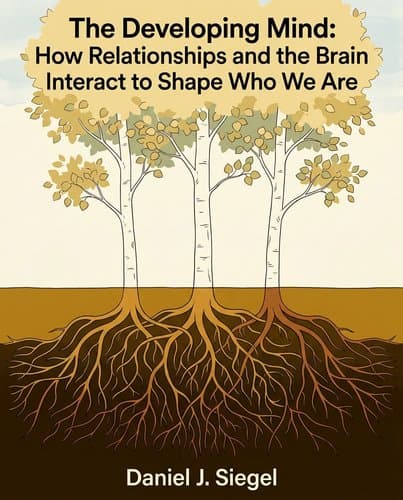
403028_the-developing-mind
by Daniel J. Siegel
The brain wires itself through relationships, and emotional health isn't about staying calm—it's about integration: learning to link your inner states so old…
In Brief
The Developing Mind: How Relationships and the Brain Interact to Shape Who We Are (1999) explores how the brain and close relationships co-create the mind, showing that psychological health is built through integration — linking differentiated neural systems rather than suppressing emotion.
Key Ideas
Recognize your state to respond freely
Notice which 'state of mind' you're already in before you react. The same event looks different from different neural states — your current perceptual filters, memory access, and self-model are all state-dependent. Recognizing 'I've shifted into an old state' is the first move toward response flexibility.
Disproportionate reactions signal triggered patterns
Unexplained emotional reactions are often implicit memories, not present-tense problems. When a bodily or emotional response feels disproportionate to the situation, ask whether an old relational pattern has been triggered — the feeling has no 'I am remembering' label attached, but the pattern is retrieving something real.
Narrative coherence shapes child security most
The way you talk about your own childhood is itself a parenting intervention. Narrative coherence — being able to give a balanced, evidenced account of difficult experiences without being overwhelmed or dismissive — is a stronger predictor of your child's attachment security than any specific parenting behavior.
Naming emotions opens space for choice
Name it to tame it: explicitly labeling an emotional state in words recruits prefrontal integration and reduces limbic activation. The label doesn't suppress the feeling — it creates the pause between impulse and action where choice lives.
Adaptability matters more than calmness
Integration — not positivity, not calm — is the target for mental health. A mind that can be flexible, adaptive, coherent, energized, and stable (FACES) across different emotional states is healthier than one that suppresses chaos by becoming rigid. Therapy, mindfulness, and attuned relationships all work by increasing integration, not by reducing negative emotion.
Earned security rewires attachment patterns
Earned security is real and achievable. Adults who experienced insecure or disorganized attachment but developed reflective understanding of it — through significant relationships, therapy, or sustained mindfulness practice — show parenting behavior indistinguishable from those who were continuously secure. The brain's plasticity doesn't expire.
Who Should Read This
Curious readers interested in Neuroscience and Cognitive Psychology and the science of how the mind actually works.
The Developing Mind: How Relationships and the Brain Interact to Shape Who We Are
By Daniel J. Siegel
10 min read
Why does it matter? Because the relationships you had before you could form memories are still shaping what you see, feel, and believe today.
You probably think of your mind as something happening inside your skull. Reasonable assumption — that's where you feel it. But here's the puzzle: neuroscientists can predict, with roughly 75% accuracy, how securely you'll relate to your own children, just by listening to how you narrate your childhood for about an hour. Not what happened to you. How you tell it. Something about the coherence of that story, made inside your head, was shaped by relationships you had before you could form a single retrievable memory. Daniel Siegel's central claim is both simple and disorienting: your mind was never fully inside you. It emerged from the intersection of your brain's biology and the people who held you. And it's still emerging, right now, in every meaningful relationship you have. That process has a name, a mechanism, and — more importantly — a direction you can influence.
The Skull Is Not a Boundary — It's a Conceptual Error
The boundary you believe separates your mind from everything else isn't real. It's a perceptual habit dressed up as anatomy.
Psychiatry and psychology, the fields devoted to mental life, rarely define what "mind" actually is. The field's working assumption has been that mind is what the brain does, and the brain lives in the skull. Daniel Siegel spent four years in the 1990s with forty scientists, from anthropologists to neuroscientists, trying to find common ground. The concept that worked for all of them was energy and information flow. Brain scanners and anthropologists were approaching it from opposite ends and arriving at the same thing. That convergence forced a question: if mental life flows between people — carried on sound waves, embedded in cultural pattern — what exactly is flowing?
The mind itself. The regulatory process we call mind operates both inside the body and between people simultaneously. Skull and skin are permeable points on a continuous circuit. For Siegel, treating them as hard mental boundaries is a mistake so routine it goes unnoticed, like mistaking the radio for the broadcast.
This redraws the map. Brain, relationships, and mind are three aspects of one reality: the brain is the mechanism of energy flow, relationships are the sharing of it, and mind is the regulation, wherever it runs. Your mind lives in your relationships as much as in your head.
Your First Year Wired You Before You Could Form a Single Memory — and That's the Whole Problem
Why do so many adults feel inexplicably anxious around authority figures, or experience a familiar dread the moment a relationship gets close? The easy answer is that difficult early experiences left their mark. The harder answer is that those experiences were encoded through a memory system that produces no sensation of remembering, and shows up not as recollection but as automatic reflex.
The brain runs two memory systems on different developmental timelines. Explicit memory, the kind that produces the internal signal "I am remembering this," requires a functioning hippocampus, which doesn't mature enough for reliable use until the second year of life and isn't fully online for autobiographical recall until around age three. Before that point, infants have no access to this system.
Implicit memory is another matter. It operates from before birth, running through subcortical circuits that predate conscious awareness. When it's retrieved, there is no "I recall" signal — the experience arrives as a behavioral impulse, an emotional reaction, a bodily sensation. An infant who once encountered a toy that made a terrifying sound doesn't think back on the incident. She just gets scared when she sees the toy again, without knowing why.
The first year matters with uncomfortable specificity. By a child's first birthday, patterns of caregiving are already deeply encoded in the implicit system. What gets laid down isn't content (not scenes or stories) but expectation: a set of neural probabilities about what the world offers when distress arises. For a securely attached infant, those probabilities are weighted toward "signal distress, caregiver arrives, regulation happens." For an infant whose caregiver was unavailable, rejecting, or frightening, the weights are different. The difference is architectural: in the circuitry governing how threat is detected, how emotion is regulated, whether proximity to others feels safe or dangerous.
These encodings don't feel like memories because they aren't memories in the ordinary sense. They feel like reality. The adult who flinches from intimacy isn't remembering being hurt. She's experiencing a predictive system built in her first year of life, running invisibly through every new relationship she enters. When an experience overwhelms the system, stress hormones suppress the hippocampus while the amygdala amplifies — the narrative record goes blank, the bodily record intensifies. The result is a person who carries dense bodily residue of something they cannot narrate: the trembling, the freeze, the sense of dread with no available story attached. The archive is full. The index is missing.
Going Home for the Holidays Is a Neuroscience Experiment
She's thirty-four, has her own apartment, a job she's good at, and people who rely on her. Then she walks through her parents' front door for Thanksgiving. Within twenty minutes, she's sulking at the kitchen table while her mother corrects how she's cutting the bread.
A neuroscience experiment, running exactly as designed.
A "state of mind," as Siegel defines it, is a complete neural package that context activates wholesale. When a state fires, it brings perceptual bias (what you notice and how you interpret it), emotional tone, memory access (which episodes surface easily), a self-model, and behavioral tendencies — all at once, as a unit. What feels like reacting to the present situation is the whole package coming online simultaneously.
States get engrained through repetition. Neurons that fire together wire together: each time a particular configuration fires, it becomes more probable next time, like a path worn into a hillside by repeated foot traffic. The first hiker leaves barely a trace; after a season of walkers, the trail is carved into the ground. Repeated states become attractor states, patterns the system gravitates toward when given the right initial conditions.
Here's what makes the holiday table strange: the daughter didn't have to do anything wrong. Neither did her parents. The contextual cues alone (the childhood bedroom, the smell of the house, the arrangement around a familiar table) were sufficient to pull old states online in everyone simultaneously. Her parents began reading her through a mental model built when she was sixteen. She began responding to treatment aimed at her sixteen-year-old self. Neither party chose this. The family system, as a larger functional unit, has its own attractor states: patterns that reassemble automatically when the right conditions appear.
Implicit memories encoded in early childhood don't surface as recollections. They surface as this: a rapid reorganization of perception, emotion, memory access, and self-concept around expectations built long ago. You aren't reacting to your parents as they are now. You're running a state of mind from twenty years ago, updated only superficially by everything that's happened since.
The way out is catching the state as it assembles, before it completes — noticing, say, that you're not upset about the bread comment but about a fight you've been having since you were sixteen. That gap between cue and completion is where something different becomes possible. But it only opens once you see that what feels like present reality is, in part, a very old neural package running on pattern recognition.
Your Kindergarten Teacher Already Knew Your Attachment History — Without Being Told
A five-year-old walks into his first day of kindergarten. His teacher has never met him, knows nothing about his family, has never spoken to his parents. By June, without being told a word about him, she will have treated him in a way that confirms everything he already believes about what adults are for.
Alan Sroufe's team at the University of Minnesota followed over 150 children from birth into adulthood, assessing attachment at one year and tracking outcomes across decades. When the children reached kindergarten age, Sroufe brought in outside coders to watch videotapes of teacher-child interactions. The coders knew nothing about which children had been securely, avoidantly, or ambivalently attached as infants.
The pattern held across every tape. Teachers treated securely attached five-year-olds with warmth and clear expectations: setting age-appropriate standards, then moving on with the confidence the child would comply. With avoidantly attached children, the same teachers showed little warmth and the most anger, while holding low expectations. With ambivalently attached children, teachers were warm but oddly controlling, helping with tasks the children could manage themselves, setting low standards, and hovering.
No one had told the teachers anything. They were responding to behavioral cues the children had carried into the room from infancy. The children, in turn, got from their teachers exactly what their implicit memory had led them to expect.
Attachment patterns are durable because they generate their own evidence. They produce behavioral tendencies that pull confirming responses from the world, a loop that requires no original attachment figure to keep running. The securely attached child, having learned that people can be relied on, acts in ways that make her easy to trust. The avoidantly attached child, having learned that emotional needs produce rejection, minimizes attachment-related behavior and reads as cold, which produces exactly the low warmth and hostility his nervous system was already predicting. The ambivalently attached child, having learned that distress requires amplification to get noticed, stays preoccupied with connection and pulls the excessive, poorly calibrated nurturing that keeps his anxiety exactly where it's been.
The Minnesota study found that the most severe pattern — disorganized attachment, produced when the caregiver is simultaneously the source of fear and the only available safe haven — predicted dissociative symptoms, the fragmentation of memory and self, in adulthood.
Every Psychiatric Symptom Is Either a Flood or a Wall
Imagine a river. The center current runs clean and fast — water flowing with what Siegel calls FACES quality: flexible, adaptive, coherent, energized, stable. Think of someone who absorbs bad news at work, feels it, and is still present with their family by dinner — that's the center current. On one bank: chaos, where everything rushes without containment. On the other: rigidity, where nothing moves. Mental health isn't feeling good. It's staying in the river's center. Mental illness is being pushed onto one bank or the other, or pinballing between them.
That reframe has an uncomfortable implication: the entire DSM-5, psychiatry's master catalog, is a taxonomy of chaos and rigidity. The categories describe what dysfunction looks like from outside; the river model asks what structural failure is producing it. Depression tends toward the rigid bank: thought patterns frozen, behavioral range narrowed to almost nothing. Borderline personality floods back and forth between both banks at once. OCD is a rigid loop the system can't exit. Psychosis is a cascade past the chaotic edge.
A choir makes integration concrete. Imagine a hundred singers, each covering their ears. Every voice goes its own direction: cacophony, the chaos bank. Now force every singer to hold the same note at the same volume indefinitely. Sound coheres but deadens (the rigidity bank). Neither extreme is music. What music requires is harder: singers who remain distinctly themselves, different voices and different ranges, while listening and joining. The harmony isn't uniformity. It's differentiated parts linked in real time.
Verbal abuse from parents or peers, psychiatrist Martin Teicher found, measurably disrupts the development of the corpus callosum, the neural bridge joining the left and right hemispheres. The flood or the wall isn't a metaphor at that point. It shows up in the structure of the brain.
Earned Security Is Real — and Indistinguishable From Never Having Been Hurt
The mind that has made sense of its own history produces the same integrative presence as the mind that never needed to. That's not therapeutic optimism. It's what the data show.
When researchers categorize adults using the Adult Attachment Interview (a structured interview that assesses how adults narrate their own childhoods), they find a subset called "earned secure": people whose described childhoods would strongly predict insecurity (neglect, inconsistency, or fear), but whose narratives show coherence: balanced, evidenced, able to hold both positive and negative memories without collapsing into either. These adults typically point to a particular later relationship as the experience that let them make sense of what happened: a therapist, a close friend, a romantic partner.
The brain allows for this kind of change. Integrative circuits keep developing well into adulthood; the same plasticity that encoded early relational patterns remains available to encode new ones.
Earned-secure parents are indistinguishable from continuously secure parents in their parenting behavior under stress. Same attunement, same repair after ruptures, same capacity to stay present with a distressed child. Their children show equivalent rates of secure attachment. The mind that worked its way through a difficult history into coherence behaves like the mind that was never disrupted.
Therapy, reflective relationships, and mindfulness practices all drive the same underlying process: making differentiated systems better at linking. Coherence of mind isn't a trait you either have or don't; it's something the mind does, and something that can be cultivated. The brain that learned early to minimize emotional signals or flood under threat can, with sufficient integrative experience, begin to flow more like the river's center channel. Not identically — the particular history remains — but functionally, in the moment that matters most, indistinguishably.
The Root Ball Beneath the Separate Trunks
That's what integration looks like inside a nervous system. What it looks like beyond one is harder to measure.
In Utah, there is a grove of quaking aspen that looks, from the surface, like a forest of separate trees — 57,000 individual trunks, each trembling independently in its own wind. Beneath the ground, they share one root system, one organism, something possibly eighty thousand years old. Siegel stood among those trunks before a meditation retreat. Days later, he couldn't locate where he ended and the creek and the sky began.
The question he brought out of that grove is the one this whole book has been working toward: what if the separate self is what the eye registers, and interconnection is what's actually there? Every insight here — about attachment, about integration, about minds forming inside relationships — points the same direction. The most healing move may also be the most ancient one: rewriting who "we" includes.
Notable Quotes
“Integration is not a function of the self, it is what the self is.”
“an assault on belonging and social coherence. The same might be said as well about modern culture's common isolation of human beings from nature, a way of”
“there are many descriptions of mind, but rarely if ever a definition. Common descriptions include our emotions and thinking, our reasoning and memory. But what exactly are these descriptions really pointing to? What is the essential”
Frequently Asked Questions
- What is the main argument of The Developing Mind by Daniel Siegel?
- The Developing Mind explores how the brain and close relationships co-create the mind, showing that psychological health is built through integration. Siegel argues that the mind is strongest when it can link differentiated neural systems rather than suppress emotion. The framework explains how attachment, memory, and emotional reactivity are shaped by relationships and how reflection, therapy, and attuned relationships can rewire ingrained patterns at any stage of life. Integration—the ability to be flexible, adaptive, coherent, energized, and stable (FACES)—is the target for mental health, not positivity or calm alone.
- What does 'name it to tame it' mean in Siegel's framework?
- "Name it to tame it" refers to explicitly labeling an emotional state in words, which recruits prefrontal integration and reduces limbic activation. According to Siegel, the label doesn't suppress the feeling—it creates the pause between impulse and action where choice lives. This technique is central to Siegel's therapeutic approach because naming emotional states engages the higher brain regions responsible for reasoning and self-awareness. By articulating what you're experiencing, you gain response flexibility and can choose how to act rather than react automatically from limbic-driven impulses.
- How does narrative coherence relate to parenting outcomes in Siegel's work?
- The way you talk about your own childhood is itself a parenting intervention. Narrative coherence—being able to give a balanced, evidenced account of difficult experiences without being overwhelmed or dismissive—is a stronger predictor of your child's attachment security than any specific parenting behavior. This means parents don't need to have had perfect childhoods; they need reflective understanding of their experiences. Developing this coherent narrative through therapy, relationships, or mindfulness practice fundamentally shapes how secure and attuned parents can be with their own children.
- What is earned security and can it really be achieved?
- Earned security is real and achievable. Adults who experienced insecure or disorganized attachment but developed reflective understanding of it—through significant relationships, therapy, or sustained mindfulness practice—show parenting behavior indistinguishable from those who were continuously secure. This concept challenges the fatalism of attachment theory by demonstrating that the brain's plasticity doesn't expire. It means that adverse early experiences are not destiny; adults can genuinely rewire their relational patterns and become secure parents through conscious reflection and supported growth.
Related Book Summaries



Read the full summary of 403028_the-developing-mind on InShort