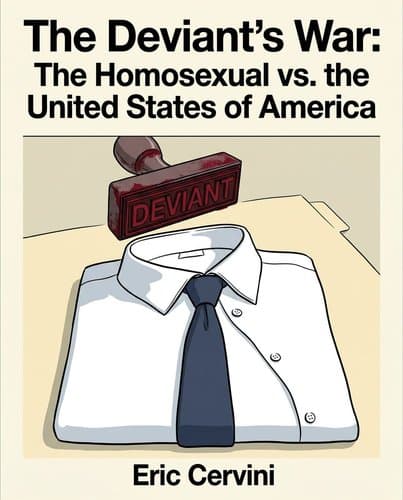
51542229_the-deviant-s-war
by Eric Cervini
Before pride was a feeling, it was a legal weapon—Frank Kameny declared homosexuality morally good in a 1961 Supreme Court brief because it was the only…
In Brief
Before pride was a feeling, it was a legal weapon—Frank Kameny declared homosexuality morally good in a 1961 Supreme Court brief because it was the only argument that demolished a government purge built entirely on a forged spy cable and admitted "blind, unthinking prejudice."
Key Ideas
Logical argument against false institutional premises
Movements don't begin with people who identify as activists — they begin with individuals who refuse to accept a false institutional premise and have the stubbornness to argue it systematically for years. Kameny never set out to lead a movement; he set out to correct a logical error the government had made about him.
Prejudice masquerading as policy without evidence
The U.S. government's decades-long purge of gay employees was never grounded in actual evidence. When officials were finally pressed to justify it face-to-face, a Pentagon official admitted the policy rested on 'blind unthinking prejudice' — and laughed. The Hoey Report that codified the purges into federal doctrine was built on a 40-year-old story about an Austro-Hungarian spy that a 1907 Russian cable had already proven false.
Moral declarations as strategic legal maneuvers
Gay pride was invented as a legal maneuver before it was a cultural feeling. Frank Kameny declared homosexuality 'moral in a real and positive sense, and good, right, and desirable' in a 1961 Supreme Court brief not because he had fully internalized it, but because it was the only argument that demolished the government's entire case — and filing it under his real name removed the blackmail threat his opponents relied on.
Respectability politics permanently exclude the radical
Respectability politics and liberation politics are in permanent, unresolvable tension. The tactics that make a marginalized movement legible to power — the suits, the careful speech, the distance from 'unrespectable' members — also enforce who counts as the movement. Kameny understood this and chose strategy anyway. The next generation chose differently, and moved faster.
Stonewall's frontline erased from institutional memory
The most politically transformative slogan of the gay rights movement was made real not by the lawyers and strategists who coined it, but by the trans women, drag queens, and street youth the movement had been systematically turning away from its picket lines. The people who proved 'Gay Is Good' bled for it at Stonewall and were then excluded from the organizations that benefited.
Who Should Read This
History readers interested in Social Issues and World History who want a deeper understanding of how we got here.
The Deviant's War: The Homosexual vs. the United States of America
By Eric Cervini
8 min read
Why does it matter? Because the story you know about gay liberation starts at the wrong moment.
Most people place the beginning of gay rights in Greenwich Village, June 1969 — a bar raid that finally went wrong for the wrong people, a riot that became a movement. That's the tidy version. The actual machinery was built a decade earlier, in federal courtrooms and bureaucratic waiting rooms and one audacious Supreme Court brief, by a Harvard-trained astronomer who had been fired from his government job for being gay and responded the way scientists respond to a faulty hypothesis: by dismantling it. Frank Kameny didn't picket the State Department because he felt proud. He picketed it in a suit and tie because he had already proven, on paper, with citations, that the government's entire case against homosexuals rested on a logical error — and if you wanted to correct a logical error in 1961, you had to become the argument yourself. Stonewall was the detonation. This is the story of who lit the fuse.
The Government's War on Gay Americans Was Built on a Story That Was Already False in 1913
The entire legal apparatus America used to purge gay employees from government for three decades rested on one piece of evidence: a story about a dead Austrian spy that was already false before World War I began.
In 1950, CIA Director Roscoe Hillenkoetter arrived before the Senate's Hoey Committee with a 38-page statement. Ten of those pages were devoted to what he called a "classic case," one "known all through intelligence circles": the story of Colonel Alfred Redl, an Austro-Hungarian counterintelligence chief who had sold his empire's war plans to foreign governments in the years before WWI. Redl was gay. After his exposure in 1913, the Austrian military blamed him, and by extension homosexuals generally, for the empire's catastrophic losses in the war's first year. Hillenkoetter dressed this myth up as settled intelligence tradecraft and used it to anchor thirteen official reasons why gay people couldn't hold government jobs: they were emotionally unstable, promiscuous, constitutionally gullible, and prone to forming secret brotherhoods. In his words: "one pervert brings other perverts." The men were also "too stupid to realize" when they were being indiscreet.
Here's the part that should permanently disqualify this as serious analysis: a 1907 Russian diplomatic cable had already labeled Redl "a lover of women." The CIA director built America's gay employment policy on an anecdote that was factually wrong before it was even forty years old.
The Hoey Committee transcribed Hillenkoetter's testimony and called it a report. That report became official government doctrine, incorporated into federal security manuals, forwarded to foreign embassies, shared with allied intelligence services. When the government needed to justify any future purge, it pointed to the Hoey Report. Eisenhower signed an executive order extending the purge authority to every federal agency and bragged in his 1954 State of the Union about removing 2,200 "security risks" in a single year.
After World War II, homosexual arrests — for sodomy, yes, but also for dancing or holding hands — ran at one every ten minutes, around the clock, for fifteen years. A million Americans. Their names, ages, addresses, and employers appeared in the next morning's newspaper. The machinery was efficient because it didn't need to be right. It just needed the Hoey Report.
Kameny Didn't Choose Activism — His Government Made the Choice for Him
On November 26, 1957, Frank Kameny sat across from two Civil Service Commission investigators in the brick headquarters of the Army Map Service in Brookmont, Maryland. He had been summoned back from Hawaii, where he was supervising a team of government scientists, with a letter vague enough to sound like a clerical error. It wasn't. "Information has come to the attention of the U.S. Civil Service Commission," one investigator said, "that you are a homosexual."
What followed was a bureaucratic trap so precise it almost looks designed. When Kameny applied to the Army Map Service months earlier, he disclosed his 1956 San Francisco arrest exactly as the probation officer had told him to describe it: "Disorderly Conduct; Not Guilty; Case Dismissed." The AMS hired him three days later. Now, a year into the Space Race, with Kameny mapping missile trajectories, the investigators had a different complaint. The formal charge hadn't been disorderly conduct; it had been "lewd, indecent, or obscene conduct." Kameny had used the wrong legal label for an arrest that no longer existed on his record. For that, the Army Map Service fired him. "I was hired as a scientist, not as a lawyer," he wrote in his appeal. It didn't matter.
That same month, while Kameny's career was being erased, the New York Times was celebrating a different scientist. Wernher von Braun had spent World War II designing V-2 rockets for the Third Reich — missiles manufactured by concentration camp labor, the same weapons nineteen-year-old Kameny had watched fall on London from Hyde Park. The Times called him "a hit." His sins were forgiven. Kameny's one dismissed arrest, three wrong words on a government form, was not.
Gay Pride Was a Legal Argument Before Anyone Called It Pride
Where did gay pride come from? The likely answer — that it bubbled up from community life until it finally had a name — is wrong in the most specific way possible. The first formal declaration of gay pride was a sixty-page legal brief, written by Frank Kameny, a Washington astronomer, in early 1961 and filed with the Supreme Court of the United States under his real name.
By that point, Kameny had lost at district court, lost unanimously at the court of appeals, and watched his attorney, Byron Scott, decline to take the case any further. The reason Scott stepped back matters: two NSA code clerks had just defected to Moscow, and congressional investigators blamed the breach on their susceptibility to blackmail, which they traced back to their homosexuality. The political climate was the worst it had been in years. Scott couldn't find a path to winning.
So Kameny wrote the petition himself. The government's entire authority to purge gay employees rested on a single claim: homosexuality was immoral. That claim had no formal definition, no evidentiary standard, no mechanism for rebuttal. The Civil Service Commission simply asserted it, as though morality were a fact like longitude. Kameny, working through the brief alone, noticed the trap had an exit. If the government's power derived from declaring homosexuality immoral, he could deny the premise. Not sidestep it — deny it flat.
The brief argued that homosexual acts are "moral in a real and positive sense, and are good, right, and desirable, socially and personally." He compared the government's conduct to Jim Crow and called its regulations "a stench in the nostrils of decent people." The persecutors, not the persecuted, were the ones behaving without decency.
Filing under his own name was the sharpest move. The government's security argument rested on the threat of blackmail: gay employees could be coerced because they had something to hide. Kameny's open brief destroyed that logic. He had nothing left to hide. He'd said it himself, on the record, to the highest court in the country.
The court unanimously rejected his petition. He didn't have a term yet for what he'd invented. But the document existed — not born from self-acceptance, but from a cold assessment of which argument the government couldn't answer.
When the Government Was Finally Forced to Justify Itself, All It Had Was 'Blind Unthinking Prejudice'
On October 23, 1962, Marie Duncan (a Bethesda mother whose son happened to share an apartment with Kameny) walked into the Pentagon with three gay men and sat down to take stenographic notes. The meeting was the first between Department of Defense officials and representatives of any gay organization, and Kameny wanted it documented. For three hours, he pressed the officials on the security clearance logic that had ended his career and derailed thousands of others.
The government's case rested on two pillars: gay employees were blackmail risks, and homosexuality was a mental illness. Kameny went after the first one methodically. The government's own policies, he argued, created the vulnerability. Gay clearance holders couldn't report blackmail threats without exposing themselves, so extortionists operated without fear of consequences. Acknowledge gay employees openly and the leverage disappeared. The officials deflected to the second pillar: all homosexuals were unstable because psychiatrists said so. When Kameny compared that logic to calling all Black people stupid, the official didn't answer the comparison. He restated the assertion.
Finally, Kameny asked what evidence, specifically, supported the claim that individual gay people were unreliable. Herbert Lewis, director of the Industrial Personnel Access Authorization Review Division, paused. "Blind unthinking prejudice," he said, and laughed. Kameny asked the question a second time, not laughing. Lewis retreated to "history of 1,900 years' society." The government's position, dug to its foundation, was: we've always done it.
Two years later, that logic collapsed from within. Walter Jenkins, LBJ's closest aide for twenty-five years and the man who knew the administration's most classified secrets, was arrested in a YMCA men's room two blocks from the White House. The FBI spent nine days and more than 500 interviews investigating whether he'd endangered American security. He had not, the Bureau concluded. A homosexual was not automatically a threat. The FBI's own report now said so.
While Jenkins lay sedated behind a DO NOT DISTURB sign, a bouquet of fall flowers arrived at his hospital room. The card read: "J. Edgar Hoover and Associates." The man who had spent fifteen years building the gay surveillance apparatus sent flowers to the most famous gay man in America. The position was always empty. Hoover had just sent flowers to prove it.
The Man Who Coined 'Gay Is Good' Required Exactly Five Staples Per Side on Every Picket Sign
Imagine the person who coins a liberation slogan and then issues regulations specifying the exact number of staples to use when mounting it on its post. Not as satire. As policy.
In August 1968, Frank Kameny was watching television when he heard Black students chanting "Black is Beautiful" and recognized the mechanism: a minority fighting the psychological damage of internalized inferiority, the same self-doubt that kept gay Americans from resisting the purges. He needed an equivalent phrase. He was eating an orange in his kitchen when he found it: "Gay Is Good." He chose "good" over "great" or "grand" because it also carries moral weight — three words compressing seven years of legal argument into a slogan.
Then came the regulations.
Male marchers wore suits, ties, and white shirts. Women wore dresses. Men had to have recent haircuts; beards were discouraged. Signs measured exactly twenty-two by twenty-eight inches, identical on both sides, attached to their posts with exactly five staples (ten per sign). No smoking, no eating, no talking on the line. At Philadelphia's Independence Hall on July 4, 1965, in ninety-degree heat, two men arrived from New York in informal summer attire. They had traveled nearly a hundred miles. Kameny turned them away.
Dick Leitsch of the Mattachine Society of New York, a rival gay rights organization, wrote the next day that Kameny was "making the same mistakes… an effort to form an elite, based on high moral principles. In other words, to out middle-class the middle-class." Kameny was unapologetic: the picket wasn't about self-expression. It was about winning. "Much of my life has been devoted to fighting conformity," he wrote, "but that applies to MY life as an individual." For the movement, strategy came first.
He wasn't wrong about the strategy. Respectability politics worked: CBS cameras at the State Department picket filmed what looked like sober professionals making a legal argument, and it got coverage. But "Gay Is Good" pointed somewhere Kameny couldn't follow — it said gay people were already worthy as they were, including the drag queens who'd been getting arrested at bars like the Stonewall for years, the ones who would never clear a dress committee.
The People Who Proved Gay Was Good Were the Ones the Movement Had Been Turning Away
On the night of June 27, 1969, Yvonne Ritter celebrated her eighteenth birthday in her mother's black-and-white cocktail dress. She'd spent hours in Brooklyn Heights applying makeup and fitting a partial wig, then rode the subway into Manhattan to the Stonewall Inn: eighteen years old, born "Joseph," Catholic, knowing she was a woman since age six. When police raided the bar, she showed her ID: Joseph. They arrested her. She slipped out of the police van, sobbed to the officer that it was her birthday, and he looked away. She ran into the crowd. Then she picked something off the ground (a brick or a piece of glass, she still doesn't know) and threw it.
Kameny's picket dress code required women in dresses and men in suits; anyone in drag was turned away. By July 1969, just two weeks after Stonewall, he was physically separating women who held hands during a demonstration at Independence Hall. When fellow activist Craig Rodwell confronted him in front of a reporter and called the picketers "Auntie Toms," Kameny wrote afterward that family disputes belonged in the living room, not on the front lawn.
He understood "Gay Is Good" as an argument. The people who made it a tangible truth were the ones he'd spent a decade asking to dress differently.
The fracture held after Stonewall too. Sylvia Rivera joined the Gay Activists Alliance, the largest post-Stonewall gay rights organization in New York, and was arrested on Forty-Second Street petitioning for gay rights. She and Marsha P. Johnson — who had dropped a bag of bricks from a lamppost in high heels during the riots — co-founded Street Transvestite Action Revolutionaries to shelter homeless trans youth. The GAA refused to fund it. The organization that won city council meetings and secured sessions with the deputy mayor couldn't find money for the people whose resistance had made gay politics possible.
"Gay Is Good" started as a legal gambit, became a psychological weapon, and turned real only when the people the movement found least presentable — bleeding, sobbing, throwing things in the dark — made it undeniable. The movement exploded not because Kameny finally persuaded America but because people could join it as themselves, without clearing a dress committee.
What Eva Freund's Fiction Actually Proves
In 1969, a writer named Eva Freund published a piece describing 150 people singing "God Bless America" in a Baltimore lesbian bar, GAY IS GOOD bumper stickers on the walls. She admitted fifty years later that she'd invented every word. But imagine finding that article crumpled on a restroom floor in 1969 and not knowing that. What you'd have known: somewhere, right now, strangers are not ashamed. The sheer possibility of it was what a decade of suits, staples, and Supreme Court briefs filed under a real name had been building toward — not a statute changed but a condition created. Kameny got his apology from a president, his name on a street, his vindication. He also lived to watch a world arrive that had outgrown his dress code entirely. That's probably what winning always looks like: you prove it's possible, and then someone else decides what to do with the proof.
Notable Quotes
“the officer in charge of the raids later recalled of those raids.”
“fancy, go-to-bar drag for a butch dyke.”
“She put up a struggle,”
Frequently Asked Questions
- What is The Deviant's War about?
- The Deviant's War chronicles astronomer Frank Kameny's decades-long legal challenge against the U.S. government's policy of purging gay federal employees. Published in 2020, Eric Cervini's work shows how Kameny's systematic legal arguments, including his radical claim that "homosexuality [is] moral in a real and positive sense, and good, right, and desirable," laid the strategic foundation for modern gay rights. The book reveals that this government purge was never grounded in evidence—when pressed, officials admitted it rested on "blind unthinking prejudice." Kameny's refusal to accept false institutional premises and his systematic argumentation transformed a personal grievance into a philosophical and legal blueprint for the movement that followed.
- How did Frank Kameny challenge federal employment discrimination?
- Frank Kameny refused to accept the false premise underlying the government's gay purge policy and systematically argued against it for years. Dismissed from his job at the Army Map Service, Kameny filed legal challenges and, crucially, declared that homosexuality was "moral in a real and positive sense, and good, right, and desirable" in a 1961 Supreme Court brief filed under his real name. This radical claim served strategic purpose—by removing the blackmail threat, it demolished the government's entire legal case. His methodical approach was revolutionary: Kameny didn't begin as an activist seeking to launch a movement; he began as an individual correcting a logical error, which catalyzed broader transformation and established the philosophical framework for modern gay rights.
- What did The Deviant's War reveal about the government's anti-gay policy?
- The book reveals that the U.S. government's decades-long purge of gay federal employees was never grounded in actual evidence. When Pentagon officials were finally confronted face-to-face about the policy's justification, one "admitted the policy rested on 'blind unthinking prejudice' — and laughed." The Hoey Report that codified these purges into federal doctrine was built on a 40-year-old false story about an Austro-Hungarian spy that Russian intelligence had already disproven in 1907. This exposure of the policy's foundation as fabricated prejudice rather than rational security concern fundamentally undermined the government's legal and moral standing, making Kameny's systematic challenge increasingly persuasive and establishing that discriminatory federal policies operate on institutional inertia rather than defensible reasoning.
- What does The Deviant's War teach about respectability politics versus liberation movements?
- The book illuminates a permanent tension within marginalized movements: respectability politics and liberation politics conflict fundamentally. The tactics making movements legible to power—formal attire, careful speech, distance from "unrespectable" members—also enforce who counts as part of the movement. Kameny chose strategic respectability: filing his Supreme Court brief under his real name while employing formal legal arguments. Yet the book shows that "Gay Is Good," the most transformative slogan, was ultimately proved real not by lawyers and strategists, but by trans women, drag queens, and street youth—the very people earlier movement organizations systematically excluded. This paradox reveals the cost of respectability: marginalized people fight for liberation only to restrict it from others.
Related Book Summaries

Read the full summary of 51542229_the-deviant-s-war on InShort