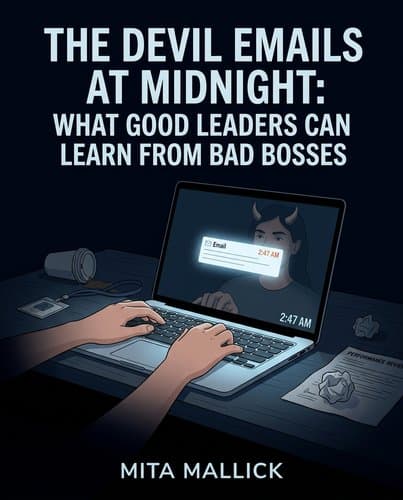
217289676_the-devil-emails-at-midnight
by Mita Mallick
Every toxic boss you've suffered—and every toxic boss you might become—shares the same origin story: fear, ambition, and unchecked blind spots.
In Brief
The Devil Emails at Midnight: What Good Leaders Can Learn From Bad Bosses (2025) draws on Mita Mallick's firsthand experience with toxic managers to identify the specific behaviors — false urgency, benevolent bias, credit-hoarding — that derail teams and careers.
Key Ideas
Calendar Audits Reveal Leadership Priorities
Audit your calendar before auditing your team: if you've given a direct report fewer substantive conversations than you've given recurring status meetings, you've already signaled what you value. Time is the most honest leadership currency.
Naming Problems Enables Real Solutions
Name the behavior precisely before trying to fix it. Mallick's vocabulary — The Chopper, The Napper, The White Rabbit — isn't decoration. Naming a failure mode makes it actionable; calling it 'a difficult personality' keeps it invisible.
Question Who You're Actually Protecting
Protect from above, not just within: the most dangerous toxic leaders survive because a senior executive finds their aggression useful. Ask yourself who you are protecting in your organization and why — you may be the enabler, not the solution.
Benevolent Bias Still Harms People
Benevolent bias is still bias. The Great Pretender never raised her voice. She smiled, expressed concern, cited your wellbeing — and systematically removed every opportunity. If your 'support' makes the decision for someone else, it isn't support.
Preserve Urgency Through Clear Thresholds
False urgency destroys the signal. When everything is a fire drill, nothing is. A team that stops believing you will stop coming when the building actually burns. Define urgency with a concrete threshold: if delaying 48 hours has no negative business impact, it isn't a real fire.
Share Credit, Build Real Loyalty
Credit is not a zero-sum resource. Naming contributors in meetings, facilitating skip-levels, and refusing to be the sole voice at the table costs nothing and earns the kind of loyalty no performance review can manufacture.
Know Yourself Before Leading Others
Grief, burnout, and fear don't excuse bad behavior — but they do explain it. The most important diagnostic question isn't 'is my boss toxic?' It's 'what is happening in my own life that might be making me one?'
Who Should Read This
Business operators, founders, and managers interested in Leadership and Management who want frameworks they can apply this week.
The Devil Emails at Midnight: What Good Leaders Can Learn From Bad Bosses
By Mita Mallick
11 min read
Why does it matter? Because every bad boss you've survived is a mirror showing you who you might become.
You probably picked up this book because you've had a bad boss. Maybe several. You've mentally cast them as the villain, yourself as the survivor, and you're here for the framework to prove you were right. Mita Mallick will give you that framework — twelve archetypes, each one a specific and recognizable species of workplace destruction. But somewhere around the final chapter, she did something most career books refuse to do: she turned the camera around. Because after years of cataloguing every terrible thing done to her by every terrible manager, she looked up one sleepless night and realized she was sending emails at 2 a.m. She had become the thing she'd spent a decade escaping. That confession is what separates this book from a survival guide. The real question it's asking isn't how to outlast a bad boss. It's whether you're already becoming one.
The Devil Gave Her Two Meetings in Eleven Weeks — and Still Expected Everything
The summer intern arrived on a Monday in June, ice cream in hand, scanning the cafeteria for her new boss. Everyone else's manager had shown up to welcome them. Hers had not. A colleague named Jeff collected her instead, handed her an onboarding binder, and offered a warning she didn't fully understand yet: the woman she'd be working for was so reliably absent that her team had nicknamed her the Devil.
Within three weeks, the Devil's entire full-time marketing staff — three managers — had either resigned or transferred out. That left Mita Mallick, MBA student and summer intern, as the only person on the team. She drafted creative briefs, coordinated with supply chain, signed off on product samples, managed price increase discussions with finance. Full-time work, all of it. And while she did it, she found herself doing something embarrassing: pacing outside the Devil's office like a dog waiting for its owner, once chasing her boss's car across the parking lot before it pulled away.
In eleven weeks, she got two meetings. Fifteen minutes each. The second one ended at the seven-minute mark when the Devil announced she had something more important to attend to — this while Mallick was seeking feedback on the final presentation that would determine whether she received a full-time job offer.
What the Devil did give her was emails. A dozen or more at a time, arriving between ten and midnight, stripped of context: forwarded threads with no explanation, requests that required detective work to decode. Never a question about how she was doing. Time, when it came, existed only to extract something.
Inaccessibility isn't a scheduling quirk. When a leader withholds their time, the people working for them quietly conclude they don't matter — and eventually, they act accordingly. Jeff left first. Then Tessa. Then Tate. The only one who stayed was the one with too much at stake to walk away yet.
He Couldn't Pronounce Her Name — So He Gave Her a New One
Calling someone by the wrong name is not absent-mindedness. It is a transaction in power, and the Sheriff knew exactly what he was buying.
Mallick had arrived at business school carrying a shortened version of herself. Her full name, Madhumita, had spent years being mispronounced, misspelled, and simply ignored — so she went by Mita. Then a career counselor drew a red line through 'Madhumita' on her résumé and said, flatly, that no one could pronounce it and she wouldn't get callbacks. The message was familiar enough to be internalized: shrink yourself to fit the room. When she finally entered Corporate America, she decided to reclaim the full name anyway — a small, deliberate act of self-restoration.
The Sheriff dismantled it in a different direction entirely. He didn't mangle her name or reach for a casual abbreviation. He replaced it. Because he couldn't pronounce Madhumita and had no interest in learning, he decided she would be Mohammed. Not a nickname. A different name, belonging to a different person, coded male. He used it in one-on-ones, in hallways, in emails, in front of his own boss. Two of his deputies picked it up the way you pick up a cold — casually, without much thought, and then it was everywhere. Some mornings Mallick took the long route out of the building to avoid walking past his office. Some days she called in sick. When she finally asked him to just call her Mita, he smiled and told her she was being too sensitive.
Mallick's point isn't that the Sheriff was unusually cruel, though he was. It's that this kind of sustained microaggression is a productivity drain with measurable consequences. When your boss is the source of daily grinding-down, your working capacity doesn't stay at full strength — it bleeds down to half. The research she cites puts a dollar figure on that bleed: turnover costs U.S. businesses roughly a trillion dollars a year, and replacing a single employee runs anywhere from half to twice their annual salary. The Sheriff's deputies made it contagious. His boss watched and said nothing. That silence was its own kind of decision.
The Boss Who Stole Your Work Didn't Do It Out of Malice — He Did It Out of Incompetence
The first time a monthly team meeting became a trophy ceremony, nobody was quite sure what to do. A colleague of Mallick's had spent months building the work that earned the company a major industry award — the kind that ends up in press releases and lobby display cases. But the award had been accepted by the incoming CEO, and when it made its way back to the office, it arrived in the hands of a boss Mallick's team had quietly nicknamed Spotlight. He held it over his head at a team meeting, kissed the glass, and passed it around the room while his lip-smudge was still warm on the surface. He never mentioned who had done the work. Mallick suspects it went home with him that night and never left.
The easy read on someone like Spotlight is ego — a man drunk on credit, willing to steal from the people who trusted him. But look more closely and a different portrait emerges. Spotlight didn't present his team's slides because he relished the theft. He presented them because he didn't know what else to say. He memorized statistics he couldn't interpret, recited talking points he hadn't developed, and held dress rehearsals where his team sat nodding as he parroted back what they'd told him — as though hearing their own ideas for the first time. What looked like arrogance was, underneath, pure helplessness. The incompetence came first. The credit theft was the cover story.
A Korn Ferry survey found that half of all workers have had a boss take credit for their work. Once you've absorbed that, you start noticing it in the person who always volunteers to 'take the presentation from here,' and in the manager who asks for your 'quick thoughts' before a meeting with their boss. The behavior is widespread enough that the question isn't whether it's happening near you. It's whether you've already started doing it yourself.
Chaos Isn't a Crisis — It's a Status Symbol
Think of a fire alarm that goes off every day at the same time. At first, you grab your bag and head for the stairs. By the second month, you don't look up at all. This is exactly what happened to the team of a boss Mallick calls the White Rabbit — a manager who sprinted through the office each morning clutching an oversized tote, phone on speaker, dispatching all-caps emails with subject lines like 'NEEDS IMMEDIATE ATTENTION' and 'INPUTS REQUIRED BY EOD.' She called emergency huddles for non-emergencies, sat on real leadership requests until they became genuine crises, and wore her relentless busyness like a badge of rank. Colleagues started calling her the boss who cried wolf.
The cost of that reputation arrived on a Summer Friday. A genuine CEO deadline materialized — a presentation deck due by five — and the White Rabbit fired off her usual summons. Of the eight or nine people on her team, only three showed up. One took a personal day, another stared at his screen and ignored the email, a third had stopped showing up for weeks. When she looked around the conference room and asked where everyone was, the answer was everywhere the alarm had trained them to stay.
What followed was worse. After the author left to see her parents, the White Rabbit dragooned a junior manager named Jessie into accompanying her to a chiropractor appointment, had her finish the deck in the waiting room, and sent her home to Manhattan in an expensive Uber at seven that evening.
Here is what the White Rabbit understood, even if only instinctively: in certain organizations, visible busyness functions as proof of indispensability. Running from fire to fire signals that fires need you. The chaos wasn't a symptom of bad management — it was the strategy. One senior leader believed in her completely, and that was enough to keep her insulated long after her team had stopped trusting her. HubSpot research puts a dollar figure on what that kind of culture ultimately costs: lost productivity across U.S. businesses runs to $1.8 trillion annually. The White Rabbit's fire drills didn't just waste afternoons. They hollowed out the one thing no alarm system can restore — a team's willingness to believe the building is actually burning.
Toxicity Survives Because Someone Upstairs Finds It Useful
Why do organizations keep their most toxic leaders around? The easy answer is that no one at the top has noticed, or that HR is toothless, or that the paperwork is too complicated. But Mallick's experience points somewhere less comfortable: the most dangerous bosses don't survive despite their behavior. They survive because someone above them finds that behavior useful.
Consider Medusa — a Chanel-saturated executive whose screaming could be heard from the elevator banks before you'd even reached the floor. She mocked employees' accents, hurled pens across rooms, once threw an actual shoe at a colleague during a meeting prep session, and ordered her team to line up mascara samples 'like good little Black soldiers' before a president's walkthrough. Her entire output — the emails, the decks, the data, the talking points, the conference room staging — was produced by the people she terrorized. She had already driven two full teams out of the company in two years, each of fifteen or more people, before Mallick was assigned to her. None of this was a secret. Her nickname had preceded her from her previous employer, where survivors were still filing into Mallick's LinkedIn inbox years later.
So why was she still there? Mallick's lunch companions put it plainly: Medusa was division president Greta's pit bull. She did the work Greta wanted done without Greta having to ask twice or touch it herself. The logic is clean and ugly — a powerful executive outsources the cruelty, keeps distance from the fallout, and retains the results. When Mallick warned her VP during the reassignment that Medusa wasn't an inclusive leader, she was immediately labeled a troublemaker. Two years of perfect performance reviews dissolved overnight. The organization's real message wasn't 'we didn't know.' It was 'we prefer you didn't say.'
The accountability problem doesn't live in HR. It lives one floor up, in the executive who has decided that a Medusa is worth the damage she leaves behind. Until that calculation changes — until the people protecting the pit bull face the same reckoning as the pit bull — the pattern holds.
The Advocate Who Punished You for the Thing She Claimed to Champion
Not all harm arrives with screaming and thrown shoes. Some of it comes wrapped in workshops about pregnancy advocacy.
Three weeks after her daughter was born, Mita Mallick got a text from her boss: 'Hope you and baby are great! Can you please log in quick and send me that file?' She logged in. She found the file. She sent it back within minutes, eager to prove she was still a team player. That single accommodation opened a months-long flood — files, passwords, meeting summaries, requests to debrief the consultant on each team member's performance, all arriving while Mallick was home with a newborn. The requests kept coming because Mallick kept answering.
Here is the part that makes this story harder to shake than the ones that came before it: the boss sending those texts had four children of her own. She ran workshops on pregnancy advocacy, appeared in internal resource guides for expecting employees, and filled her social media feed with posts championing mothers in the workplace. Mallick calls her the Great Pretender, and the name earns its keep. The moment Mallick announced her pregnancy, her promotion — for which she had been called the 'clear front runner' — quietly ceased to exist. Projects migrated off her plate. She was blocked from the leadership academy, removed from a major customer presentation, all with the same gentle logic: we're thinking of you, you need your rest, you may feel differently once you're holding that baby. Always warm, never hostile — impossible to argue with because the warmth was the argument.
When Mallick returned from leave, the Great Pretender gave her a performance rating of 2 out of 5 for a year in which she had been absent for six months. The consultant hired as her stand-in — the boss's personal friend — earned twice Mallick's salary for that same stretch, and was overheard vacuuming during conference calls. The performance review, the pay gap, the unpaid leave-time labor: each one deniable individually, devastating in sequence.
One study found that mothers are six times less likely than childless women to be recommended for hire. The data confirms what the Great Pretender's behavior already demonstrates — bias doesn't require a hostile actor. It requires someone convinced they know what's best for you, and willing to decide your career accordingly.
You Can Be Too Absent and Too Present — Both Are the Same Betrayal
The Napper made $150,000 a year, nearly twice Mallick's salary, to do almost none of his job. He arrived around 10:30 most mornings, sometimes later. He fell asleep during quarterly town halls, during small team check-ins, and during Mallick's annual brand plan presentation — the one she had spent weeks preparing. Absence and omnipresence are mirror images of the same failure. He assigned her a mid-year rating of 'meeting expectations,' generous given that he'd delegated his entire workload to her, then kept rescheduling the follow-up conversation until she let it disappear from the calendar. Nobody fired him. Gallup estimates that disengaged employees cost the global economy $8.8 trillion annually. The Napper's contribution to that figure was, apparently, not large enough to matter.
Then there was his opposite: a manager who never left, never stopped watching, and required his name on every invoice for a $50 product sample he had already approved twice. The Chopper hovered in literal circles around the open floor plan, inserting himself into tasks no one had asked for help with, peppering the team with messages that began only with 'Hi' and then went silent while he typed something, then stopped. Mallick spent hours composing simple emails, knowing they would be interrogated or rewritten the moment they landed in his inbox. The effect was the same as the Napper's abandonment: she stopped wanting to try.
The more unsettling part is what happened after Mallick escaped the Chopper and got her own team. During a routine deck review, her people asked — gently, carefully — why she had changed their images and graph colors without explanation. She hadn't noticed she was doing it until they asked. She had absorbed the habit without realizing it and passed it forward. That's the part that stayed with her. Bad bosses are not always created from scratch. Sometimes they are inherited.
The Night Mallick Became the Devil She'd Been Writing About
The email landed in her team's inboxes at 2:47 a.m. Not an emergency. Not even particularly important — just something Mallick had thought of while lying awake, figuring she might as well be productive. She'd been sending them for weeks by then, reasoning that people could simply read them in the morning. What she couldn't see, at 2:47 in the morning, was the picture those timestamps were assembling over time: a boss who was present at every hour except the hours that actually mattered.
Then her father died — without warning, on Valentine's Day 2017. The grief arrived like a system failure: not a clean shutdown but a cascade of small malfunctions, each one mimicking bad boss behavior she'd spent her entire career cataloguing. She screamed at a security guard in front of her own team because she'd left her badge in another building. She canceled weekly meetings an hour before they started because she couldn't figure out what value she'd add. She sat in the back of presentations she should have been leading and said nothing. And then there was the deck: her team had sent it three times, she'd never opened it, and ninety minutes before the meeting she stood at one of their desks insisting she'd never seen it — only to find it sitting right there in her inbox, three times over. She spent the next hour rewriting most of it. Her team presented slides they had never rehearsed.
The clearest bill for all of this arrived in the exit interview notes from a team member who quit that summer. The woman had tried to warn her months earlier — gently, over tea, asking whether Mallick was okay, mentioning that the team would love more time with her. Mallick had brushed it off with something sarcastic about how bosses are busy. The exit notes said she had stopped coaching and teaching, that the team member saw no path for growth anymore. The last line was the one that hit hardest: Mallick had once been one of the best bosses she'd ever had.
Every previous chapter invited you to locate yourself on the victim's side of the ledger — to recognize the Devil, the Chopper, the Great Pretender in someone who had power over you. Mallick's confession resets the question entirely. She didn't become a bad boss because she was selfish or oblivious or hungry for credit. She became one because she was devastated, and no one gave her permission to grieve, and so the grief found its own exits. The conclusion she draws is uncomfortable in the specific way that useful conclusions always are: leadership isn't a status you achieve and then hold. It's a daily practice, and it degrades under pressure the same way everything else does. The question was never only whether you'd survived a bad boss. It was always also what you'd become if the conditions were right.
The Villain in the Mirror
Here is the uncomfortable thing Mallick leaves you with: every person in this book — the one who ignored you for eleven weeks, the one who reassigned your title, the one who took credit for your work — was shaped by someone who came before them. Survival doesn't interrupt that lineage. Awareness barely does. What actually breaks the chain is the willingness to look honestly at yourself during the moments you'd most prefer not to — when you're drowning in grief, when you're terrified of being found out, when you're one bad quarter away from needing someone else's work to look like yours. The reader who finishes this book feeling righteous about the bosses they've outlasted has missed the point. The reader who finishes it a little unsettled, running through last Tuesday in their head, has found it.
Notable Quotes
“I never got a chance to review the deck,”
“The meeting is in 90 minutes.”
“Well … umm … we sent it to you a few times, we didn't hear back …”
Frequently Asked Questions
- What is "The Devil Emails at Midnight" about?
- "The Devil Emails at Midnight" examines toxic leadership patterns through the author Mita Mallick's direct experience with harmful managers. Rather than focusing on abstract theories, the book identifies specific toxic behaviors like false urgency, benevolent bias, and credit-hoarding that damage teams and derail careers. Mallick argues that toxic leadership isn't limited to naturally cruel people—it's a failure mode available to anyone under pressure. The work provides readers with practical tools and a precise vocabulary to recognize these patterns in others and in themselves, making toxic leadership visible and actionable.
- Why does Mita Mallick emphasize naming toxic behaviors precisely?
- Precisely naming toxic behaviors transforms invisible patterns into actionable problems. Rather than dismissing a difficult manager vaguely, Mallick introduces specific archetypes like The Chopper, The Napper, and The White Rabbit. Her vocabulary isn't decorative—"Naming a failure mode makes it actionable; calling it 'a difficult personality' keeps it invisible." Vague descriptions allow dysfunction to persist unaddressed; precise names make patterns impossible to ignore. By giving toxic behaviors exact names, leaders can recognize these patterns in their organizations and themselves, moving from denial to addressing specific failure modes. This precision enables real organizational change.
- What is benevolent bias and why does it matter as a leadership concept?
- Benevolent bias occurs when leaders appear supportive and caring while systematically removing opportunities from team members. The book's Great Pretender archetype exemplifies this: "never raised her voice. She smiled, expressed concern, cited your wellbeing — and systematically removed every opportunity." This distinction matters because benevolent bias operates invisibly. A leader can claim to support someone while actually undermining their growth and advancement. "If your 'support' makes the decision for someone else, it isn't support." Recognizing benevolent bias forces leaders to examine whether their caring language truly serves their team's interests or masks power moves disguised as protection and concern.
- How does false urgency damage team performance and trust?
- False urgency erodes team credibility and response to genuine emergencies. "When everything is a fire drill, nothing is," so teams eventually stop believing urgent claims, creating dangerous situations when real crises emerge. The book recommends: "Define urgency with a concrete threshold: if delaying 48 hours has no negative business impact, it isn't a real fire." This approach protects the signal—teams maintain calibrated responses to actual emergencies. Excessive urgency also burns out teams and wastes resources. By establishing objective criteria for urgency, leaders preserve both team productivity and the credibility necessary for genuine emergency response.
Related Book Summaries

Read the full summary of 217289676_the-devil-emails-at-midnight on InShort