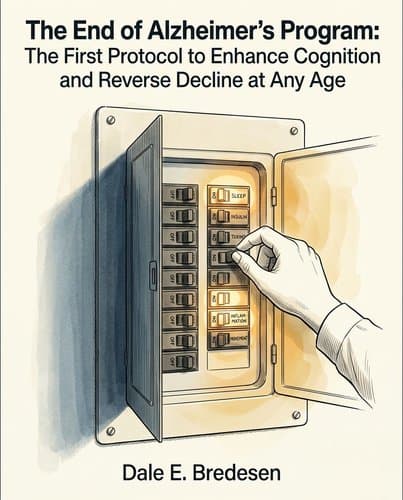
51158469_the-end-of-alzheimer-s-program
by Dale E. Bredesen
Alzheimer's isn't a genetic sentence—it's a network failure with dozens of measurable, fixable upstream causes that medicine keeps missing by hunting for a…
In Brief
Alzheimer's isn't a genetic sentence—it's a network failure with dozens of measurable, fixable upstream causes that medicine keeps missing by hunting for a single drug. A 'cognoscopy' at 45, optimized insulin, sleep, and inflammation markers can reverse cognitive decline before symptoms ever appear.
Key Ideas
Comprehensive biomarker screening at age 45
Get a 'cognoscopy' at 45: a blood panel including fasting insulin (target <5.5 µIU/mL), homocysteine (target ≤7 µmol/L, not the lab's 'normal' ceiling of 12), hs-CRP (<0.9), vitamin D (target 50–80 ng/mL), hemoglobin A1c (4.0–5.3%), and omega-3 index (target 8–10%; ApoE4 carriers should aim ≥10%)
Determine ApoE4 status for personalized protocol
Know your ApoE4 status — it changes the protocol: ApoE4 carriers should extend overnight fasting to 16+ hours, approach saturated fat cautiously, prioritize phospholipid DHA (fish roe, krill oil) over standard fish oil supplements, and consider higher BHB targets (1.0–4.0 mM)
Optimize fasting glucose and ketone levels
Target a fasting blood glucose of 70–90 mg/dL and ketone BHB of 1.0–4.0 mM; a minimum 12-hour overnight fast (dinner to breakfast, with dinner ending at least 3 hours before bed) is the most direct lever for restoring insulin sensitivity and producing ketones
Avoid benzodiazepines and anticholinergic sleep aids
Stop or avoid benzodiazepine and anticholinergic sleep aids: 3–6 months of use raises Alzheimer's risk 32%; 6+ months raises it 84%, with cognitive impairment persisting up to 3.5 years after stopping — and antihistamine sleep aids (Tylenol PM, Benadryl) suppress the exact neurotransmitter Alzheimer's drugs are designed to protect
Monitor nighttime oxygen and sleep apnea
Check nighttime oxygen saturation with a continuous pulse oximeter before assuming your sleep is restorative; the target is 96–98% throughout the night with fewer than 5 apneic events per hour — sleep apnea is one of the most commonly missed Alzheimer's contributors
Lower homocysteine with targeted supplementation
Homocysteine's 'normal' ceiling of 12 µmol/L is not optimal — brain atrophy associations begin above 6; reduce it with methylcobalamin 1mg/day, methylfolate 0.8mg, and P5P 20mg, and check your MTHFR status (affects 70% of the population) to determine if you need higher doses
Partner dancing reduces dementia risk most
Replace novel choreographed partner dancing for 45–60 minutes at least twice weekly — a New England Journal of Medicine longitudinal study found it reduced dementia risk by 76%, higher than any cognitive or physical activity studied; the key mechanism is real-time response to a partner, not memorized steps
Who Should Read This
Science-curious readers interested in Neuroscience and Mental Health who want to go beyond the headlines.
The End of Alzheimer's Program: The First Protocol to Enhance Cognition and Reverse Decline at Any Age
By Dale E. Bredesen & David Perlmutter
9 min read
Why does it matter? Because the assumptions you have about Alzheimer's — that it's genetic, inevitable, and untreatable until symptoms appear — are all wrong.
Most people treat Alzheimer's the way they treat weather — something that arrives or doesn't, determined by forces you didn't choose and can't influence. That's the model medicine has operated under for decades, and it's why the approved drugs haven't reversed a single case. Every documented reversal in this book began the same way: not with a new drug, but with a blood panel. Not with a diagnosis, but with a question medicine never asks: what specifically, in this particular person's biology, is driving the brain to retreat? The answer is almost always plural, and always years in the making before a single symptom surfaces. Bredesen and Perlmutter don't offer a pill. They offer a map of the upstream failures that look nothing like dementia until suddenly, catastrophically, they do.
Four Hundred Drug Trials Failed Because They Were Asking the Wrong Question
Claudia was 78 when her husband realized she couldn't speak anymore — not really. A yes, occasionally a no, but nothing more. She couldn't dress herself. The bicycle she'd ridden for years sat untouched. Her score on a standard cognitive test was zero.
Four months later, she was emailing. She dressed herself. She rode her bicycle. She danced. Her husband wrote that on an evening walk she looked up at pink-lit clouds and told him she thought she was going to be all right. Bredesen is careful to note she is the exception: the earlier treatment begins, the more complete the recovery tends to be. But her case establishes what had been unthinkable: improvement at any stage is now conceivable.
What changed was the question her doctors started asking.
For decades, medicine approached Alzheimer's the way it approaches pneumonia: identify the disease, find the molecule that targets it, prescribe that molecule. The logic seems reasonable. It worked for penicillin. Alzheimer's is a different kind of disease.
At the center of Alzheimer's sits a protein called APP (amyloid precursor protein) that protrudes from brain cells and works as a switch. When the environment is favorable (adequate nutrients, no active infections, no insulin resistance, no significant toxins), APP cleaves one way, producing fragments that build the synaptic connections underlying memory and thought. When any combination of those conditions turns hostile, it cleaves the other way, producing amyloid-beta and fragments that dismantle those connections. The amyloid isn't random destruction. It's a brain in retreat.
Alzheimer's is a syndrome: the brain's final common pathway when any of dozens of problem combinations accumulate past a threshold. Some patients arrive there through chronic inflammation. Others through insulin resistance, undiagnosed infections, mercury exposure, mold toxins, vascular disease, or head trauma. Most through several at once. Treating one contributor while the others advance is like patching a single hole while thirty others leak.
This is the structural reason four hundred drug trials failed — not bad science, wrong philosophy. Each drug targeted one thread in a problem requiring thirty to be pulled simultaneously. And the failure went further than inefficacy: a JAMA report found that FDA-approved Alzheimer's medications, including donepezil and memantine, the two most prescribed, were associated with faster cognitive decline.
Claudia's recovery came from identifying her specific combination (mold toxins and insulin resistance were the primary drivers) and addressing them together. That is the premise this book follows.
The Blood Test Your Doctor Calls 'Normal' May Already Be Shrinking Your Brain
What if the "normal" result on your last blood test was only telling you that you're average — not that your brain is safe?
"Within normal limits" is a statistical boundary, not a physiological one. It describes the range that 95 percent of the tested population falls within, shaped by the health of that population, not by what the brain actually needs. For homocysteine, a compound linked to brain atrophy and inflammation, the standard ceiling is 12 µmol/L. Bredesen's protocol targets below 7, because atrophy associations begin climbing above 6. A patient reading 11 and hearing "you're fine" is not fine by the standard that matters.
The protocol therefore begins with a different question: not "do you have Alzheimer's?" but "why might you be developing it?" The answer differs by person because Alzheimer's is not one disease. Bredesen identifies five subtypes, each driven by a distinct mechanism requiring different interventions.
Type 1 is inflammatory: chronic activation of NFκB (a signaling protein that switches on the body's inflammatory response) drives amyloid production directly. Type 1.5 is glycotoxic. Insulin resistance causes two problems at once: it sustains the same NFκB-driven inflammation, and it removes insulin's separate role as a neuronal growth signal. The brain doesn't just catch fire; it also loses the growth signals it needs to repair. Type 2 is atrophic: gaps in nutrients, hormones, and growth factors leave neurons unable to maintain the billions of synaptic connections that underlie memory. Type 3 is toxic: mercury or mold compounds (ochratoxin A and trichothecenes are specific byproducts of mold metabolism) disrupt synaptic function, typically before memory loss appears and often in ApoE4-negative patients, so it looks nothing like the Alzheimer's most clinicians expect. Type 4 is vascular: reduced blood flow starves neurons of oxygen, compounding the atrophy seen in Type 2. Type 5 is traumatic: prior head injury triggers inflammatory cascades that, unaddressed, accumulate over decades.
Knowing your subtype converts treatment categories into a personal protocol. Addressing insulin sensitivity, optimizing nutrients, treating pathogens, removing toxins, fixing sleep — the same pillars apply across subtypes. But which ones matter most, and how aggressively, depends entirely on which mechanism is driving the damage in you.
Your Brain Has Been Starving for a Decade — and Your Breakfast Is Accelerating It
Imagine a child who plays drums at full volume every day for years. To cope, you start wearing earplugs. Then one afternoon someone puts on a string quartet in the next room. You can't hear a note — not because the music stopped, but because you've permanently muffled your own hearing.
That's insulin resistance, and it's happening in your brain right now if you've spent years eating the way most people do.
Every time you eat sugar or refined carbohydrates, your pancreas fires insulin into the bloodstream to manage the glucose surge. Do this often enough and your cells, overwhelmed by the relentless signal, start turning down their sensitivity, the cellular equivalent of earplugs. This would be merely a metabolic inconvenience except for one thing: insulin is more than a glucose chaperone. In the brain, it's a survival signal, a trophic factor that activates the biochemical pathways neurons use to stay alive, grow connections, and communicate. When cells stop listening to it, neurons lose the signal that tells them to keep building synapses at all. This is why Alzheimer's has been called "type 3 diabetes": not as a metaphor, but as a mechanistic description.
The timing of the damage is the part medicine has mostly missed. In ApoE4 carriers, PET scans already detect 5 to 10 percent reduced metabolism in the brain's memory-processing regions by their thirties, before any cognitive symptoms appear. The brain isn't declining because they're sick. It's starving because their fuel system is already compromised. This goes on for decades, silently, before anyone thinks to look.
The intervention that addresses this most directly isn't a drug. It's a twelve-hour overnight fast. When you stop eating long enough to deplete your liver's stored glucose, the body shifts to burning fat and producing ketone bodies, an alternative fuel that crosses into the brain in proportion to its blood concentration, independent of whether insulin is working. Even a modest ketone level around 0.4 mmol/L offsets the fuel deficit in high-risk carriers. A six-week trial in patients with mild cognitive impairment found that those who dropped carbohydrates to 5 to 10 percent of calories improved on cognitive tests in direct proportion to how deeply they achieved ketosis. The high-carbohydrate group showed no improvement at all.
The fast doesn't require a prescription. It requires stopping dinner three hours before sleep and not eating again for twelve hours.
Your Sleep Aid and Your Paraffin Candles May Be Doing More Damage Than Your Genetics
The sleep aid on your nightstand may be doing more damage to your brain than your ApoE4 status.
Benzodiazepine sleep medications — Halcion, Restoril, and others — taken for just three to six months raise Alzheimer's risk by 32 percent. Use them for more than six months and the risk climbs to 84 percent. Stop after a year or more and the cognitive impairment doesn't simply lift: it can persist for up to three and a half years after the last dose. The mechanism explains why. Benzodiazepines work by suppressing acetylcholine, the neurotransmitter that Alzheimer's drugs like donepezil (Aricept) are specifically designed to preserve. A patient taking both is running a biochemical contradiction: one medication propping up the exact chemical the other is draining.
Non-prescription alternatives compound the problem. Ambien, Lunesta, and the antihistamine-based staples in almost every medicine cabinet (Benadryl, Tylenol PM, Advil PM) work by the same acetylcholine-suppressing mechanism. A label that reads "sleep aid" and comes from a pharmacy doesn't change the acetylcholine math.
What makes this actionable is that exposure is measurable. Bredesen calls chemicals that cause dementia "dementogens," the toxin analogue of carcinogens. Paraffin candles, a petroleum derivative, release benzene, formaldehyde, and mercury when burned. Blood mercury panels, urinary mycotoxin screens, organic toxin tests can now quantify the load. The protocol treats dementogens the way it treats insulin resistance: not as an abstract threat but as a variable you can shift. The goal isn't zero exposure (impossible) but a dynamic balance where your body's detoxification capacity, supported by sweating, glutathione precursors, fiber, and liver function, consistently outpaces what's coming in.
The practical update: check the mechanism of your sleep aid before tonight. And if you burn candles regularly, check whether they're paraffin.
The Single Best-Studied Alzheimer's Intervention Isn't a Drug — It's a Dance Class
Half were stretching. The other half were on treadmills four days a week, forty-five minutes at a stretch. All seventy had confirmed mild cognitive impairment, the clinical stage that often precedes Alzheimer's. Six months later, the brain scans showed something the researchers had to check twice: tau — the protein whose accumulation into tangles is Alzheimer's second hallmark, alongside amyloid — had declined in the aerobic group.
Tau reduction isn't a secondary benefit. It's the explicit target of most Alzheimer's drug candidates currently in development. Six months of treadmill walking produced it, without a prescription, while also improving blood flow to the brain's memory and processing centers and measurably strengthening executive function. The stretching group showed none of this.
The biology runs through several distinct channels. Aerobic exercise produces a sustained increase in cerebral blood flow; reduced flow here is one of the first detectable signs of Alzheimer's, appearing years before any cognitive symptoms emerge. It raises BDNF, a protein that signals neurons to generate new connections and support existing ones. And it more than doubles activity in the glymphatic system, the brain's waste-disposal network, where glial cells flush accumulated beta-amyloid through channels that require physical movement to open.
Then there's what happens when you add partners who keep changing.
A six-month study compared vigorous conventional exercise against a different intervention: learning complex choreographed sequences with rotating, unfamiliar partners. Only the dancers showed significant improvement in brain imaging. The gain didn't come from memorized footwork. What built new pathways was improvisation: reading a new partner in real time, adjusting continuously, responding to something unpredictable rather than repeating something known. Physical effort combined with social and cognitive novelty produced something greater than any element could on its own.
No compound in any Alzheimer's trial has matched what six months of movement produces. The most powerful tool you have is free and starts working the moment you use it.
The Right Time to Start Is Twenty Years Before You Think You Need To
Nina came to the clinic at 48 for what she described as prevention — her mother had lost the ability to calculate a tip at 55, her grandmother had developed dementia in her sixties, and she carried one copy of the ApoE4 gene. She had no cognitive complaints. She thought she might be one of the worried well.
She scored 23 out of 30 on a standard cognitive screening test. Normal is 28 to 30.
She was already in mild cognitive impairment (the clinical category that precedes Alzheimer's) without knowing it. After beginning Bredesen's protocol, she scored a perfect 30. She wrote that the program had saved her life. The more striking detail is what that implies: she hadn't known she needed saving.
The underlying biology of Alzheimer's builds silently for ten to twenty years before it surfaces in daily experience. These contributors accumulate the way debt does — invisibly at first, then catastrophically at once.
This is why Nina's case matters more than Claudia's — the patient who recovered from a cognitive score of zero. Claudia's recovery establishes that improvement is possible at any stage. Nina's establishes what the protocol is actually designed for: the moment before decline feels inevitable, when contributors are still reversible with far less effort and the window is fully open.
The intervention at that moment is a blood panel, not a treatment. Fasting insulin. Homocysteine. ApoE4 status, among others. These numbers tell you which of the dozens of possible contributors are already active in your specific biochemistry. You can't address contributors you haven't named, and you can't name them by waiting for symptoms.
Bredesen calls this a "cognoscopy" — a comprehensive cognitive health panel at 45, analogous to the colonoscopy at 50 that catches precancerous changes before they become cancer. Both exist for the same reason: the pathology announces itself through blood chemistry long before it announces itself through experience. The question is whether you're paying attention before the bill comes due.
What Waiting Costs You
The question was never whether you have risk. Everyone does — the biology doesn't ask for your family history before it starts. The real question is which contributors are already running in your specific biochemistry, and how long you've been giving them a head start without knowing it. That's what the blood panel at 45 actually measures: not whether you're sick, but which of dozens of mechanisms are already accumulating in the background while you feel fine. The pathology builds for a decade or two before it surfaces as a skipped word or a missed name. Every year the contributors run unchecked, the window narrows. And unlike your ApoE4 status, timing is the one variable you still control. Earlier isn't a comfort — it's a variable.
Notable Quotes
“(A, C, G, or T) at a single site, and these are thus called single nucleotide polymorphisms (SNPs), pronounced”
“Furthermore, the MRI atrophy did not appear until well after cognitive decline, so using a”
“is a concern. Beware those who tell you to”
Frequently Asked Questions
- What is The End of Alzheimer's Program about?
- The program argues that Alzheimer's is a network failure driven by dozens of addressable causes, not an inevitable genetic fate. It presents a comprehensive protocol covering metabolic, sleep, and nutritional interventions that allows readers to identify personal risk factors and take targeted action. Rather than accepting cognitive decline as genetically predetermined, the book emphasizes that Alzheimer's is preventable and reversible at any age through lifestyle modifications and biomarker optimization, including specific targets for blood glucose, ketones, sleep quality, and nutrient levels.
- What specific blood tests does The End of Alzheimer's Program recommend at age 45?
- The program recommends a 'cognoscopy' at 45, a blood panel including fasting insulin (target <5.5 µIU/mL), homocysteine (target ≤7 µmol/L, not the lab's 'normal' ceiling of 12), hs-CRP (<0.9), vitamin D (target 50–80 ng/mL), hemoglobin A1c (4.0–5.3%), and omega-3 index (target 8–10%; ApoE4 carriers should aim ≥10%). These specific markers help identify metabolic and nutritional risk factors for cognitive decline. The homocysteine target is notably lower than conventional lab ranges because brain atrophy associations begin above 6 µmol/L. Regular monitoring enables personalized interventions.
- How should ApoE4 carriers modify their Alzheimer's prevention protocol?
- ApoE4 carriers should extend overnight fasting to 16+ hours, approach saturated fat cautiously, prioritize phospholipid DHA (fish roe, krill oil) over standard fish oil supplements, and consider higher BHB targets (1.0–4.0 mM). This genetic variant increases Alzheimer's risk, requiring stricter metabolic control. The extended fasting and ketone targets help ApoE4 carriers achieve deeper metabolic states associated with neuroprotection. Phospholipid DHA crosses the blood-brain barrier more effectively than conventional fish oil. Knowing your ApoE4 status is critical for personalizing the Alzheimer's prevention protocol.
- Why does The End of Alzheimer's Program emphasize partner dancing for dementia prevention?
- Partner dancing reduced dementia risk by 76% in a New England Journal of Medicine longitudinal study, higher than any cognitive or physical activity studied. The program recommends 45–60 minutes of novel choreographed partner dancing at least twice weekly. The key mechanism is real-time response to a partner, not memorized steps, which engages dynamic brain systems differently than solo exercise or fixed routines. This combination of cardiovascular activity, cognitive engagement, social connection, and motor coordination creates a uniquely powerful protective effect against cognitive decline.
Related Book Summaries


Read the full summary of 51158469_the-end-of-alzheimer-s-program on InShort