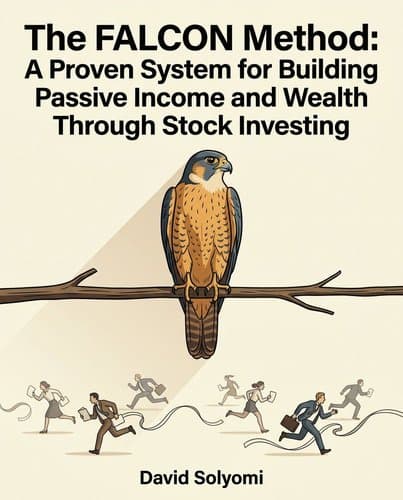
37642023_the-falcon-method
by David Solyomi
A mediocre strategy you stick with always beats a brilliant one you abandon — the FALCON Method builds passive income through dividend stocks selected not just…
In Brief
A mediocre strategy you stick with always beats a brilliant one you abandon — the FALCON Method builds passive income through dividend stocks selected not just for financial quality, but for the psychological staying power to hold them through every inevitable downturn.
Key Ideas
Real Risk Is Capital Loss
Redefine risk as permanent capital loss, not price volatility. Bonds that feel 'safe' because they don't fluctuate are quietly destroying purchasing power through inflation. Stocks that feel volatile are the only asset class with 200+ years of evidence behind real wealth compounding.
Dividends Uncut for Two Decades
Only consider stocks with 20+ years of uninterrupted dividend payments (no cuts required, but no cuts allowed). This isn't just quality screening — it selects household names you'll actually hold during market panics, when abandoning a strategy causes the most permanent damage.
Compare Valuation to Historical Average
Never evaluate a stock's current valuation multiple in isolation. Compare it to the same company's own historical fair-value multiple. A stock trading at 10x when its historical average is 15x has a built-in return tailwind; one at 20x is a headwind even if the business is excellent.
Three Yield Metrics Screen Quality
Check three metrics before deploying capital: dividend yield (income signal), free cash flow yield (is the dividend backed by real cash?), and shareholder yield (is management diluting you through share issuance even while paying the dividend?). A negative shareholder yield is a disqualifier regardless of how attractive the headline yield looks.
Hold Cash, Skip Mediocre Opportunities
Hold cash when nothing passes your threshold criteria. Being fully invested at all times is a habit dressed up as discipline. The FALCON Method explicitly instructs investors to sit on the sidelines rather than settle for second-rate opportunities.
Sell Only on Dividend Cuts
Sell only when the company cuts its dividend or becomes extremely overvalued. Every other trigger — market drops, scary headlines, one bad quarter — is noise your pre-selection process already accounted for. Activity in a buy-and-hold portfolio is a cost, not a contribution.
Discipline Matters More Than Method
Treat consistency as the most important investment skill you can develop. Fidelity's internal data showed dead investors outperformed active ones. Hulbert's decades of newsletter tracking showed subscribers consistently underperform the newsletters they follow. The method is available to everyone; the discipline to execute it through bad stretches is not.
Who Should Read This
Business operators, founders, and managers interested in Investing and Wealth Building who want frameworks they can apply this week.
The FALCON Method: A Proven System for Building Passive Income and Wealth Through Stock Investing
By David Solyomi
10 min read
Why does it matter? Because investing failure is almost never about picking the wrong stock.
Most people approach investing as an information problem. If they just knew which companies were strongest, which numbers to watch, which metrics actually predict returns, they'd do fine. So they read more. Research more. And they still underperform.
Here's what the evidence actually shows: strategy isn't the bottleneck. Countless investors know perfectly sound approaches and still abandon them the first time a portfolio drops twenty percent. The real constraint is whether a system is built to hold through the moments when every instinct screams sell.
That's what David Solyomi built the FALCON Method to solve. It's part stock-selection framework, part behavioral defense mechanism. And understanding the difference — why both matter, why neither works without the other — changes how you'll think about every investment decision you've ever made.
Bonds Feel Safe Because You're Measuring the Wrong Kind of Risk
The asset that feels safe is quietly destroying your purchasing power. The one that feels dangerous is the only reliable path to wealth. That's not a paradox — it follows directly from a distinction most investors never make: volatility is not risk. Risk is the probability of permanently losing purchasing power.
Warren Buffett divided the investing world into three categories in his 2011 shareholder letter. Currency-based instruments (bonds, money-market funds, bank deposits) sit in the first. Their prices don't swing wildly, which makes them feel safe. What they do instead is worse: their returns are fixed in dollar terms, and whether those dollars will buy anything meaningful in ten or thirty years is entirely up to inflation. You think you're earning; you may be slowly losing. Buffett puts it bluntly: instruments sold as risk-free are now priced to deliver return-free risk. The loss doesn't show up in your account balance; it shows up in what that balance can actually buy, years later.
The second category is gold, collectibles, anything that produces nothing. Pure speculation. Every buyer is betting someone else will want it more later. If that buyer never arrives, you hold the bag.
That leaves productive assets — and two centuries of data make the case without ambiguity.
Jeremy Siegel, a Wharton finance professor, tracked real (inflation-adjusted) returns across asset classes from 1802 to 2012. One dollar invested in stocks grew to roughly $705,000 in purchasing power. Bonds, second place, reached $1,778. Cash declined. The gap isn't a rounding error: it's nearly 400-fold. Two centuries of wars, depressions, currency crises, and technological upheaval, and stocks still compounded at a pace that made every other option look like standing still.
Stocks feel risky because prices fluctuate. But that fluctuation is the price of admission to real, compounding growth. Bonds offer stable prices. That stability costs you your financial future.
The Investors Who Beat the Market Aren't Smarter — They're More Boring
What separates investors who consistently beat the market from those who don't? Most people assume the answer involves better spreadsheets, sharper analysis, or faster access to information. The actual answer is stranger: the investors who win are mostly just more consistent.
Consider the S&P 500. It runs one mechanical rule (own the 500 largest American companies) and holds to it without exception. No panic selling when markets collapse, no retreating to bonds when headlines turn grim, no abandoning the strategy after two bad years. Yet this index outperforms the vast majority of professional fund managers over any long measurement window. Finance professor James O'Shaughnessy spent decades studying what actually works in markets. His conclusion: the index wins not because it identifies great companies, but because it's completely emotion-free. It never flinches.
Most professionals lose not because they pick the wrong stocks, but because they're human. Behavioral finance exists to catalog the ways instinct corrupts judgment: selling at bottoms, buying into momentum, abandoning approaches the moment they get uncomfortable. Joel Greenblatt, whose quantitative models have decades of back-tested results, describes how this plays out in practice: the stocks that score highest on his screens are often obscure, struggling companies that feel alarming to actually commit capital to. And when those strategies lag for a year or two, as every strategy does, investors quit. They exit the system at precisely the moment the evidence says to stay.
A system you'll follow through a painful stretch will outperform a theoretically superior one you abandon when results disappoint. An investor who executes a good process for twenty years will beat one who rotates between excellent processes every time conviction wavers.
Solyomi designs FALCON around this reality. The method is roughly 90% mechanical — structured to remove the decisions where psychology does the most damage, with a final qualitative check that even Solyomi admits he can't fully justify. It targets well-known, dividend-paying companies deliberately, because those are holdings investors can actually keep when markets get ugly. That behavioral property is part of the design.
The 20-Year Dividend Filter Is Behavioral Insurance, Not Just a Quality Screen
The dividend filter is the clearest example of how that design thinking works in practice. When David Solyomi placed Mercury General and Boeing side by side, the first looked like the obvious choice. Mercury General had thirty consecutive years of higher dividends — a Dividend Champion, a company no dividend database would dare question. Boeing had been quietly dropped from those lists for pausing its annual raises. The income investor's calculus was simple: Champion versus disqualified.
What the database didn't show: Mercury General's recent raises had come in below 1% per year. Boeing, after sitting out the streak competition, delivered a 30% raise in a single year.
Solyomi's conclusion cuts against the grain of most dividend investing. The streak itself can be maintained by anyone willing to raise the dividend by a penny per quarter, enough to keep the database from dropping you. That kind of streak-chasing says something unflattering about management. Executives who sacrifice balance sheet health to preserve a database entry are not the partners you want running your retirement savings.
The FALCON Method's first filter draws a sharper line. It requires twenty years of dividend payments with no cuts, a generally rising trend but no annual-increase requirement. That small difference in definition catches something the streak can't: management quality under pressure. When a recession arrives and a company faces a choice between cutting the dividend or stretching its finances dangerously, which way does it lean? Twenty years of uncut dividends across multiple recessions answers that with data, not projection.
Solyomi borrows this logic from Jeremy Siegel. Siegel's point is that surviving fifteen-plus years without cutting tells you something the balance sheet alone can't: this is a business that earns consistently enough to keep paying through downturns. Here's what the record is actually proving: the dividend history is evidence of the underlying business, not the investment thesis itself. A company doesn't become worth owning because it paid dividends; it paid dividends because it's worth owning.
That reframe does quiet but important psychological work. What Solyomi calls the Premium Dividend Club (the filtered watchlist FALCON draws from) is mostly household names, companies recognizable enough that an investor can hold their shares through a market crash without losing sleep. That behavioral property is part of the design. A portfolio of quality companies you'll actually keep when things get bad will outperform a theoretically superior portfolio you sell at the bottom.
Three Investors Buy the Same Great Company. One Earns 2.5%, Another Earns 20.6%.
Late 1998. An investor pulls up CVS Health, a pharmacy chain growing its earnings at a steady clip, expanding its footprint across America. Every metric looks good. He buys.
By September 2008, he was right about the company. CVS's profits had grown considerably over that decade. But his annualized total return came in at 2.5%, barely above the inflation rate he was trying to outrun. What went wrong?
He paid 55 times earnings for a stock whose historical fair value sat around 15 times earnings. That gap — not the business, not the economy, not bad luck — is what destroyed his return. Earnings can grow and dividends can accumulate, but if you overpay by that much, the eventual collapse of the multiple back to rational levels wipes out most of what the underlying company built for you.
Solyomi calls this the "double-dip benefit," an insight he draws from Buffett's 1991 Berkshire letter. Total return from a stock has three components: the dividends you collect, earnings growth (which lifts the stock price over time), and the change in the valuation multiple. Most investors think about the first two. The third, multiple expansion, is what turns a good investment into a great one. Multiple compression is what turned CVS into a decade of wasted opportunity.
Three buyers, three entry prices, same stock. The 1998 buyer at 55x earnings earned 2.5% annualized. A second buyer who entered at fair value, around 14x earnings, and sold at roughly the same multiple pocketed 15.2% annualized. Same company, same dividend income, but no multiple headwind dragging against growth. A third buyer found CVS trading at just 10x earnings during a period of market pessimism, held until the multiple recovered to 14x, and walked away with 20.6% annualized. The difference between 2.5% and 20.6% is not a different company or a different decade of economic history. It's a different entry price.
The practical implication is uncomfortable: a stock's current price-to-earnings ratio tells you almost nothing on its own. You need to know what multiple the market has historically considered fair for that specific company, then ask whether today's price is above it, at it, or below it.
FALCON screens its shortlist for historical undervaluation before anything else. The method doesn't require a bargain. Buying at fair value still earned 15.2% in the CVS example, and Solyomi is explicit that this is acceptable. But when the market's mood pushes a genuinely strong company below its historical fair-value multiple, that discount becomes a third engine of return. Ignore it and you risk turning a decade of genuine business success into a near-total waste.
The Dividend Yield Is Almost Always Hiding Something
Entry price is one lever. How you read the yield on a stock you're already watching is another, and it's almost always misread.
Imagine two restaurants both advertising 50% off their menu. The percentage is identical. But one is running a genuine sale; the other quietly raised its prices last week before marking them down. The number is the same. The actual deals couldn't be more different. Dividend yield works exactly this way: it shows you a percentage but tells you almost nothing about what generates it.
Solyomi makes this concrete with three companies, each with a dividend yield around 3.5–4%. Teva, a pharmaceutical firm, leads the group at 4.1%, and its free cash flow yield of 14.9% makes it look even better. An income investor chasing yield would stop right there. But the shareholder yield (dividends plus net share repurchases) comes in at negative 5.4%. That negative sign means Teva was issuing new shares faster than it was returning cash to owners. Each dividend check was partly funded by diluting the people who received it. Not returning capital — running a shell game.
Coca-Cola, the darling of dividend investors, clears the shareholder yield screen: its 4.7% figure confirms it's buying back stock rather than issuing. But the free cash flow yield sits at just 3.6%, barely above the 3.4% dividend. In that snapshot, Coke is paying out nearly everything it generates in cash. The yield looks attractive precisely because the company is stretching to sustain it.
Target, with the middle yield of the three at 3.7%, turns out to be the obvious choice. Its free cash flow yield of 8.7% means it pays out less than half of what it generates (plenty of room for the dividend to grow), and its 15.2% shareholder yield reflects aggressive buybacks that keep compressing the share count. Target is doing the most for shareholders; its headline yield just doesn't announce it.
Yield alone answers one question — how much — while leaving the more important ones unasked: how sustainable is it, and is management treating owners fairly in the process? Running these filters before committing capital is what separates companies you can hold through turbulence from ones that eventually surprise you badly enough to sell.
The Best-Performing Investors at Fidelity Were Dead
All of those screens exist for the same reason: the filters don't matter if you can't hold through the rough stretch. Which brings us to what Solyomi recounts from Fidelity's account reviews.
Fidelity analysts pulled the performance records of every client account and asked which investors were doing best. The top-performing accounts didn't belong to the most active traders, the most sophisticated analysts, or the clients who called their advisors most frequently. They belonged to people who were either dead or had simply forgotten they had accounts at all.
That finding exposes something most investment education ignores. Nearly every strategy assumes the main obstacle is finding the right method: get that right, and the results follow. Fidelity's data says otherwise. The dead investors weren't running a better process. They weren't running any process. What they'd eliminated was themselves: the tax-generating trades, the transaction costs, and above all, the instinct to do something when the market got ugly.
Solyomi builds FALCON around this reality. After all the filtering — 20-year dividend histories, free cash flow yield thresholds, shareholder yield screens, ROIC hurdles (a screen for whether the business earns more than it costs to run), historical valuation comparisons — the sell rules compress into a single sentence. Two triggers: the company cuts its dividend, or shares become genuinely extreme in valuation. If neither happens, you hold. The design identifies good stocks and then removes the investor from the loop entirely.
Mark Hulbert spent decades independently tracking investment newsletter performance. His finding: most subscribers consistently underperform the very newsletters they pay to follow. The newsletters aren't the problem. Subscribers can't hold the line when things get difficult. A strategy enters a rough stretch (inevitable with every approach, including solid ones), and readers bail, rotate to whatever has been working lately, and miss the recovery. They buy the method and skip the execution.
That's what both pieces of data show. The process is the easy part: it can be written down, backtested, handed to you in a book. What can't be handed over is the psychological capacity to keep running it through two bad years while every instinct says to do something different. That part is entirely yours.
The Part of the System That Can't Be Proven
The most telling moment in the book isn't the CVS return chart or the shareholder yield screens — it's when Solyomi concedes that the qualitative final pass of his own method (a gut-check scan of each candidate that resists any formula) is the one part he can't prove actually works. He keeps it anyway. That kind of honesty reframes everything before it: the parts he does defend with data feel worth trusting precisely because he didn't defend everything. But it also names the book's real argument. There is no purely mechanical solution to a human problem. The Fidelity data and Hulbert's newsletter tracking make the same point from different directions: most investors don't fail the method — they fail the execution. They quit in the months when it lags, when everything in them says to do something different. The process is available to you right now. Whether you'll still be running it in year three is the question that actually matters.
Notable Quotes
“buying on the cheap side of valuation”
“No asset is so good that it can't become a bad investment if bought at too high a price.”
“As the saying goes, a stock well bought is half sold.”
Frequently Asked Questions
- What is the FALCON Method about?
- The FALCON Method is a rules-based stock-picking system designed to build passive income and wealth through dividend stock investing. The method combines long-tenured dividend payers, historical valuation benchmarks, and cash flow checks to guide investment decisions. It teaches investors to buy only at fair prices, hold through volatility, and sit on cash when nothing qualifies, emphasizing that consistent execution of a sound process is what builds lasting wealth. The system focuses on removing emotion from investing by establishing clear criteria before deploying capital.
- What are the specific stock selection criteria in the FALCON Method?
- The FALCON Method requires stocks to have 20+ years of uninterrupted dividend payments with no cuts allowed. Before investing, check three metrics: dividend yield (income signal), free cash flow yield (confirming the dividend is backed by real cash), and shareholder yield (ensuring management isn't diluting shareholders through excessive share issuance). Additionally, compare a stock's current valuation multiple to its historical fair-value multiple rather than evaluating it in isolation. A negative shareholder yield is a disqualifier regardless of headline yield attractiveness.
- How does the FALCON Method define investment risk?
- The FALCON Method redefines risk as permanent capital loss, not price volatility. According to the method, bonds that feel 'safe' because they don't fluctuate are quietly destroying purchasing power through inflation. In contrast, stocks that feel volatile are the only asset class with 200+ years of evidence behind real wealth compounding. This philosophical shift means investors should focus on selecting quality companies at reasonable prices rather than avoiding price fluctuations, which are a normal part of equity ownership.
- When should you sell stocks in the FALCON Method?
- The FALCON Method instructs investors to sell only when the company cuts its dividend or becomes extremely overvalued. Every other trigger — market drops, scary headlines, or one bad quarter — is treated as noise that the pre-selection process already accounted for. The method emphasizes that Activity in a buy-and-hold portfolio is a cost, not a contribution. This approach minimizes trading and transaction costs while allowing quality companies to compound wealth over time.
Related Book Summaries
Read the full summary of 37642023_the-falcon-method on InShort