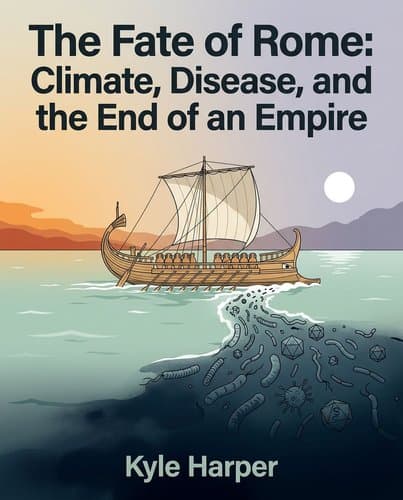
34427005_the-fate-of-rome
by Kyle Harper
Rome didn't fall despite its roads, trade routes, and continental reach—it fell because of them. The same networks that built history's greatest empire became…
In Brief
The Fate of Rome: Climate, Disease, and the End of an Empire (2017) argues that Rome's collapse was driven not by political failure but by climate shifts and catastrophic pandemics that the empire's own scale and connectivity made inevitable.
Key Ideas
Infrastructure spreads wealth and pathogens together
The infrastructure of civilization and the infrastructure of pandemic transmission are the same thing. Roads, trade networks, port cities, and global supply chains amplify both economic growth and pathogen spread simultaneously — this is structural, not accidental, and no level of political competence changes it.
Environmental causes masked as leadership failures
When environmental conditions silently underwrite civilizational success — stable climate, favorable rainfall, hospitable growing seasons — their eventual end registers not as an environmental event but as political and military failure. Leaders make bad decisions in response to forces they cannot see, and historians blame the leaders.
Trade routes distribute goods and diseases equally
Every time a civilization extends its commercial reach into a new ecological zone, it simultaneously extends its exposure to pathogens evolving in that zone. The Antonine Plague likely entered Rome via the Indian Ocean trade axis Rome itself built. Expanding trade and expanding biological risk are the same expansion.
Pathogens evolve outside political control cycles
Bacteria and viruses operate on their own evolutionary logic, independent of human political cycles. The Justinianic Plague's 38 amplification events over 191 years were not caused by any emperor's failure — Y. pestis maintained animal reservoirs and re-seeded human populations regardless of what happened in Constantinople. Managing a pandemic is a sustained long-term problem, not a crisis with an endpoint.
Biological exposure diversity predicts civilization resilience
The most useful single metric for assessing civilizational resilience may not be military power or GDP but pathogen exposure diversity — how many distinct biological environments a civilization is connected to via trade and migration. Rome's exposure was nearly total: sub-Saharan Africa, India, the Eurasian steppe, and the tropical Red Sea littoral all fed into the same grain ships and army supply lines.
Who Should Read This
History readers interested in World History and Climate Change who want a deeper understanding of how we got here.
The Fate of Rome: Climate, Disease, and the End of an Empire
By Kyle Harper
10 min read
Why does it matter? Because the Romans thought they had conquered nature — and they were wrong in exactly the way we might be.
In the spring of AD 400, Rome staged an animal hunt in the Colosseum: boars from Germany, leopards from Africa, elephant tusks from India, and sailors who had ferried the lions and reportedly refused to board those ships again. The slaughter was theology, proof that Rome had subdued wild nature itself. Ten years later, Goths were inside the walls for the first time in eight centuries.
Every explanation historians have offered (bad emperors, overstretched frontiers, financial collapse) is probably true, and none of it is enough. Kyle Harper's argument is stranger: the actual killers were invisible, operating at scales no Roman could measure, and were delivered by the very things Rome was most proud of. Its trade routes, grain ships, and teeming cities weren't just achievements — they were vulnerabilities wearing the same face. This book changes how you read every civilization that came after, including ours.
Rome Peaked Exactly When Its Borrowed Climate Was About to Close
The Roman Empire at its height looked like pure human achievement: thirty legions coordinated across three continents, a million people fed daily by grain ships from Egypt, a legal architecture scholars would still cite fifteen hundred years later. All of that was real. But underneath the whole enterprise was something no instrument could detect: a climate window, already beginning to close, that had been quietly making everything easier.
The astronomer Ptolemy, working in Alexandria in the second century AD, recorded something that reads today as an obvious error. He noted rain in Alexandria every month of the year except August. Today, Alexandria sees roughly one rainy day across the entire span from May through September. Ptolemy wasn't confused or mistaken. Summer rain in Alexandria was routine in his world, normal enough to include in a reference calendar, the kind of detail a farmer or a sailor could count on. He was describing an atmosphere that has since vanished. His weather calendar is among the sharpest evidence of what disappeared.
Scholars call it the Roman Climate Optimum: a stretch of unusual warmth, reliable rainfall, and meteorological stability across the Mediterranean heartland from roughly 200 BC to AD 150. Solar activity ran high and steady through the whole period, recoverable now from isotopes locked in polar ice. The volcanic record is almost uniquely quiet across the full span of the early empire; in two and a half millennia of eruption history, none of the twenty largest falls between Julius Caesar's death and AD 169. In hilly Italy, even a single degree of sustained warming made roughly five million additional hectares suitable for wheat — enough to feed three to four million people. Most of Rome's population growth between Augustus and Marcus Aurelius may trace back to that one invisible gift.
Everything you'd need to sustain an empire — armies, tax rolls, bread supply, demographic growth — ultimately ran on grain. A climate delivering reliable summer rain in a region where summer rain has since nearly vanished wasn't scenery. It was the mechanism. When Gibbon named the second century the happiest age in human history, he was right. He just had no way to see what was underneath it.
The Geography of Roman Power Was Identical to the Geography of Roman Vulnerability
The same features that made Rome the most powerful state in the ancient world made it the most vulnerable to emerging infectious disease — and these two facts are inseparable.
Consider what moved along Roman trade routes. A single merchant ship, the Hermapollon, sailed from the Indian port of Muziris to Egypt carrying 544 tons of pepper, ivory, and aromatic resins. The cargo was worth roughly 7 million sesterces, or about 200 square kilometers of Egyptian farmland. This was ordinary commerce by the second century. The number of ships making the annual run from Egyptian ports to India had grown from 20 to 120 since Augustus took power. Roman merchants had trading colonies deep in southern India; Roman coins circulated across the subcontinent. A detachment of soldiers had established a fort on the Farasan Islands, a thousand kilometers below Egypt's southernmost port, watching the mouth of the Red Sea.
The Indian Ocean axis was the engine of Roman prosperity. It was also the fastest highway on earth for emerging pathogens. The nearest known relatives of the smallpox virus are African rodent pathogens, their lineage diverging roughly 2,000 years ago in Central Africa. That's where evolution works hardest: more solar energy, less periodic ice-age erasure, denser layers of biological complexity stacked up over longer timescales. Sub-Saharan Africa alone hosts some of the richest microbial diversity on the planet. Every ship carrying pepper and ivory from Muziris was threading a biological needle, connecting a Mediterranean world of 75 million densely packed people to the incubators that generate pathogens capable of racing between them.
Once a pathogen cleared that threshold, Roman infrastructure became its best friend. Roads built to move legions moved disease carriers just as efficiently. Cities packed with migrants from every corner of the empire (people arriving without immunity to local germ pools, crowded into multi-family housing with cesspit toilets next to kitchens) were ideal amplifiers. Rome itself generated an estimated 100,000 pounds of human waste daily, most of it inadequately removed. The aqueducts were genuinely impressive; the drainage, on close inspection, was mostly storm runoff.
At Adrianople in AD 378, Gothic invaders destroyed the main body of the eastern field army — perhaps 20,000 soldiers dead in a single day, the worst military defeat in Roman history, the event that opened the western provinces to permanent barbarian settlement. The Antonine Plague, traveling via these same Indian Ocean networks two centuries earlier, killed roughly 7 million people. No enemy on any frontier came close to what a single virus could do moving through Rome's connectivity. The empire's greatest infrastructure achievement and its greatest biological liability were the same thing.
Three Named Plagues Each Killed More People Than Any War Rome Ever Fought
Around AD 166, in Rome, Galen watched a patient develop sores on the ninth day of fever, the same progression he'd seen across hundreds of victims now flooding the city. He recorded what he saw: fever, a black pustular rash erupting across the entire body, deep lesions in the throat, scabs coughed up and peeling away. Patients whose eruptions dried and crusted had a chance; those who passed dark, bloody stools rarely survived the twelfth day.
Eighteen hundred years later, those notes are good enough to make a diagnosis.
The progression Galen described — roughly twelve days of incubation, sudden fever, pustules erupting across the whole body in a single wave, throat lesions, scabbing that left permanent scars — matches the clinical course of Variola major almost day by day. What he called the "great pestilence" was almost certainly smallpox. Its nearest known relative is an African rodent poxvirus, the lineage diverging 2,000–4,000 years ago in Central Africa and reaching Rome via the Indian Ocean trade routes the empire had spent a century building. Galen's case notes didn't survive as antiquarian curiosity. They survived as a clinical record specific enough to identify the virus's family tree.
The death toll: roughly 7 million people in the first wave, perhaps 10% of the entire empire, with recurrences for decades. The worst single military defeat in Roman history (the ambush in the Teutoburg Forest) killed around 20,000 soldiers. The Antonine Plague killed the equivalent of that disaster three hundred and fifty times over.
The second named plague arrived ninety years later. The Plague of Cyprian, named for the bishop of Carthage who preached through it, left something even more clinically precise than Galen: a sermon addressed to a congregation watching its neighbors die. Cyprian wasn't trying to document a disease. He was trying to give his congregation a reason to endure, to tell them that the deaths all around them were divine testing, not random destruction, suffering that had shape and purpose. Then he listed the symptoms: bowels dissolving in bloody flux, fire erupting in the throat, eyes inflamed with blood, hands and feet rotting with gangrenous infection. Those symptoms, hemorrhagic and acute-onset, burning through households with the dead remaining infectious, map onto filovirus pathology, the family that includes Ebola. The bishop composing a Christian meditation on suffering was, without knowing it, producing the closest ancient description of a hemorrhagic fever.
By the third plague, the biological machinery was fully assembled. Yersinia pestis had spent 55,000 years acquiring three successive genetic tools, culminating in a single genetic change — an amino-acid substitution — that in laboratory tests transforms an already dangerous organism into something categorically more lethal. It arrived at the Egyptian port of Pelusium in AD 541, carried in the fur of black rats aboard grain ships from the Indian Ocean trade. Constantinople, receiving 310 million liters of Egyptian grain annually in warehouses the rats shared, lost an estimated quarter-million people, more than half the city, in four months. Citizens wore name tags around their necks, afraid of dying in the street unidentified. Corpses were stacked in military towers, floor by floor, until the towers couldn't hold more.
Three pathogens. Three evolutionary histories readable in genomes. Three entry routes through the same trade infrastructure Rome had built. Combined death toll across two centuries: tens of millions. The legions never came close.
The Coldest Decade in Two Thousand Years Arrived at Exactly the Wrong Moment
The Roman Empire wasn't finally broken by barbarians or fiscal overextension. It was broken by the decade of 536 to 545, which tree rings across the Northern Hemisphere record as the coldest in two thousand years, arriving alongside the first bubonic plague pandemic.
In early 536, a massive volcanic eruption ejected megatons of sulfate into the stratosphere. A second, larger eruption followed in 539 or 540, this one tropical, leaving its signature at both poles. European summer temperatures dropped up to 2.5 degrees after the first event, then another 2.7 after the second. The resulting decade was colder than the worst years of the seventeenth-century Little Ice Age. The 530s and 540s were worse.
Cassiodorus was Praetorian Prefect in Italy in 536, a senior imperial administrator trained in law whose job was keeping the state running. He wrote a letter about the solar dimming that year. Not to raise an alarm. To explain. The sky had gone blue. Midday shadows had vanished. The harvests were failing. He described the year in administrative language that doubles as elegy: the storms never came in winter, no warmth arrived in spring, and summer brought no heat. He offered a calm scientific explanation for the dimming (cold air creating atmospheric density blocking sunlight) and instructed his deputy to draw from the previous year's surplus to cover the shortfalls. A man performing governmental normality while documenting a global catastrophe. The tree rings confirm exactly what he saw. So does a Chinese chronicle recording snowfall in Shandong (the latitude of Sicily) in July. So do Irish famine records, and a Chinese note that a bright navigational star had vanished from the sky.
Five years after that letter, bubonic plague appeared at the Egyptian port of Pelusium and moved through grain trade routes toward Constantinople. The volcanic cooling had likely disturbed burrowing rodent colonies in central Asia that harbored the plague bacterium, triggering the cascade that eventually loaded infected fleas onto ships heading west. An organism whose lethality had taken millennia of bacterial evolution to assemble, capable of traveling in rat fur, surviving flea guts, and killing half a city in four months, arrived just as the population was already thinned by failed harvests and depleted by two prior pandemics.
Justinian issued 142 laws in the nine years before plague reached his capital. He issued 31 in the twenty-three years after. Gregory the Great, writing from Rome near the century's end, presided over a city of perhaps 20,000 people where a million had once lived. The Roman army shrank from 645,000 men to 150,000. The eschatological dread of the age — the prayer processions, Gregory searching Rome for men healthy enough to ordain as clergy and finding almost none — wasn't collective irrationality. It was people accurately reading that the physical world had been reorganized by forces no political system had any mechanism to address. The world that emerged from that decade looked nothing like what entered it, and the question of what compounding shocks do to civilization did not die with Rome.
We Are the Most Connected Civilization in History — Which Is the Point
What separates our world from Rome's, beyond the sheer scale of everything that destroyed it?
The obvious answers are real — germ theory, antibiotics, vaccines turned smallpox from a civilization-ending pathogen into a laboratory specimen. But the epilogue's argument is less comfortable than that. The same growth that built those tools has created the evolutionary conditions in which pathogens accelerate their experimentation. There are roughly a trillion microbial species on earth. About 1,400 are capable of harming us. What determines whether that number grows or shrinks isn't primarily our medicine — it's the evolutionary pressure we generate. Every emerging infectious disease of the modern era, from HIV to Ebola to SARS, emerged from wild animals, not domestic ones. HIV traces back to chimpanzees in the Congo basin. Exactly the pattern Harper identifies in Rome: not the old civilized germ pools, but emergence from ecosystems disrupted by human expansion, trade routes pressing into African forests as poxvirus ancestors crossed over. Rome disturbed the wild around the Mediterranean and along Indian Ocean trade routes, and viruses moved. We've disturbed nearly every ecosystem on the planet, and we've done it faster.
Average incomes in 18th-century England were closer to Roman levels than to ours. The Industrial Revolution is the real rupture, and it created urbanization at densities Rome never approached, global shipping at velocities no grain fleet could match, and ecological disruption at continental scale. A pathogen can now travel from a forest in central Africa to every major hub airport in 36 hours. Rome's greatest plague moved from Egypt to Constantinople in weeks, along grain ships. We've made those ships faster by orders of magnitude, and there are now eight billion people to infect rather than seventy-five million.
The epilogue's title ("Humanity's Triumph?") carries a genuine question mark because the microbes haven't been defeated. They've been given a larger laboratory. The last few thousand years, in this framing, aren't a story of human victory over nature — they're the opening act of a new era of accelerated evolutionary churn. Rome was caught in it early. We've scaled it. The uncomfortable mirror the book holds up: not that we might fall as Rome fell, but that the mechanism is the same, and we've made it faster.
The Equation Rome Couldn't Escape
The Romans filled their amphitheaters to watch leopards and lions die, and they weren't performing false confidence — they meant it. They had genuinely won. What they couldn't see was that the machinery of their winning and the mechanism of their dying were the same: the same grain ships, the same roads, the same commercial reach into every ecological incubator on earth.
Harper ends on a question mark that earns its punctuation. You have tools Galen never imagined — mRNA platforms, genomic sequencing, outbreak surveillance fast enough to name a virus while it's still crossing a border. What you also have is a civilization more connected, more densely packed, and more ecologically disruptive than anything Rome attempted. The equation is unchanged. Only the speed is different. That's not a story about a dead empire. It's a description of now.
Notable Quotes
“The sun becomes dim because the air is dense from rising moisture—as happened in the course of the recently passed fourteenth indiction [535–36] for nearly a whole year.”
“Nothing is done without a reason, nor is the world involved in fortuitous happenings,”
“Men are anxious [literally, tortured] when kings change their established customs, if they go forth in a guise that is other than what tradition has long implanted.”
Frequently Asked Questions
- What is The Fate of Rome about?
- The Fate of Rome: Climate, Disease, and the End of an Empire (2017) argues that Rome's collapse was driven not by political failure but by climate shifts and catastrophic pandemics that the empire's own scale and connectivity made inevitable. The book uses climate science, genomics, and ancient sources to demonstrate how Rome's infrastructure—roads, trade routes, and continental integration—both built civilization and amplified the biological forces that eventually destroyed it. Harper shows that the same networks enabling Roman prosperity became vectors for pandemic spread, making collapse inevitable rather than a result of poor leadership.
- What caused Rome's collapse according to The Fate of Rome?
- According to Harper, Rome's collapse resulted from climate shifts and pandemics rather than political failure. The infrastructure of civilization and the infrastructure of pandemic transmission are the same thing. Roads, trade networks, port cities, and global supply chains amplify both economic growth and pathogen spread simultaneously—this is structural, not accidental, and no level of political competence changes it. The Antonine and Justinianic Plagues exploited the very commercial networks Rome built, making biological catastrophe an inevitable consequence of imperial expansion and interconnection.
- How does Rome's trade expansion relate to disease in The Fate of Rome?
- Every time a civilization extends its commercial reach into a new ecological zone, it simultaneously extends its exposure to pathogens evolving in that zone. The Antonine Plague likely entered Rome via the Indian Ocean trade axis Rome itself built. Rome's pathogen exposure was nearly total—connecting sub-Saharan Africa, India, the Eurasian steppe, and the tropical Red Sea littoral—meaning the same supply chains fueling prosperity carried diseases from every biological environment Rome touched. Expanding trade and expanding biological risk are inseparable.
- What are the key takeaways from The Fate of Rome?
- Harper's core insight is that environmental collapse appears as political failure to contemporary observers. When environmental conditions silently underwrite civilizational success—stable climate, favorable rainfall, hospitable growing seasons—their eventual end registers not as an environmental event but as political and military failure. Additionally, pandemics operate independently of political cycles: the Justinianic Plague's 38 amplification events over 191 years resulted from pathogen biology, not imperial mismanagement. Civilizational resilience depends less on military power or GDP than on pathogen exposure diversity.
Related Book Summaries

Read the full summary of 34427005_the-fate-of-rome on InShort