721931_the-great-partition
by Yasmin Cordery Khan
Twelve million people paid in blood and displacement for a decision made in weeks by a handful of elites who never consulted them. Khan dismantles the "ancient…
In Brief
Twelve million people paid in blood and displacement for a decision made in weeks by a handful of elites who never consulted them. Khan dismantles the "ancient hatreds" myth, exposing Partition as a preventable political catastrophe manufactured by colonial categorization, organized violence, and deliberate speed.
Key Ideas
Ancient Hatreds Mask Recent Colonial Institutionalization
When a communal or ethnic conflict is described as rooted in 'ancient hatreds,' ask when those identities were institutionalized as political categories. In India, the pivotal move was the 1909 separate electorates decision — within living memory of Partition. Manufactured urgency and colonial categorization can accelerate group identity faster than centuries of coexistence can erode it.
Popular Symbols Conceal Incompatible Policy Visions
Mass support for a political symbol ('Pakistan,' 'freedom,' 'swaraj') does not equal support for any specific policy outcome. People attach their own local meanings to large symbols. The League's landslide in 1946 reflected dozens of incompatible aspirations — millenarian dreams, economic grievances, anti-Congress feeling — none of which mapped onto a coherent territorial demand. When reading electoral results, separate enthusiasm for a symbol from agreement on its contents.
Organized Paramilitaries Behind 'Spontaneous' Communal Violence
Ethnic and communal violence at scale is almost never purely spontaneous. In Punjab and Bengal in 1946-47, it was carried out by organized paramilitaries with military equipment, political cover, and logistical support from provincial governments. The 'ancient hatreds' framing functions politically to diffuse accountability away from the planners and onto the perpetrators.
Political Speed Extracts Costs From Most Vulnerable
Speed in political transitions is a choice with costs that fall on those least able to absorb them. The Partition plan was rushed through in weeks when officials knew mass violence was likely. The Radcliffe Line was withheld until after Independence Day to preserve ceremonial optics. When institutional actors move faster than populations can adapt, the gap is paid for in human lives.
Women's Bodies Bear Elite Political Choices
In political crises, the costs of decisions made by elites fall disproportionately on women and the poor — those absent from the rooms where decisions are made. In 1947, women became the literal surface on which new nationalisms wrote their territorial claims. Any assessment of a political settlement should ask: who will actually carry the costs?
Partition Persists Through Law, Borders, Enclaves
Events that displace millions of people do not end when the displacement stops. They create legal structures, border regimes, and enclave populations that persist for generations. The 123 Bangladeshi enclaves within India are not a historical footnote — they are the Partition, still in progress. The myth that an event 'ended' is often what prevents the work of resolution.
Who Should Read This
History readers interested in World History and Geopolitics who want a deeper understanding of how we got here.
The Great Partition: The Making of India and Pakistan
By Yasmin Cordery Khan
11 min read
Why does it matter? Because the 'ancient hatreds' story that explains Partition was written by the people most responsible for it.
On June 3, 1947, four men broadcast the end of British India from a radio station in New Delhi. They spoke for thirty minutes. Not one of them said the word "Pakistan." No maps accompanied the announcement. The border had not been drawn. Twelve million people — on crackling radios, through bazaar gossip, from neighbors who'd heard it secondhand — had no idea what had just been decided about their lives, their land, their neighbors.
We inherited a story about Partition as inevitability: ancient hatreds, incompatible faiths, a fracture waiting to happen. Yasmin Khan spent years in the archives where officials wrote down what they actually knew and when they knew it. The documents do not describe inevitability. They describe a decision made fast, secret, and careless — by a handful of men in marble-floored rooms — while millions of people outside those rooms had no idea the rooms existed.
Communal Hatred Was Not Ancient — Colonial Policy Put the Labels On
Communal identity in colonial India was a bureaucratic construction before it became a murderous one. The British turned religious difference into the operating system of the state, and by 1947 the machinery had been running long enough that even thoughtful people couldn't always see where the infrastructure ended and their own convictions began.
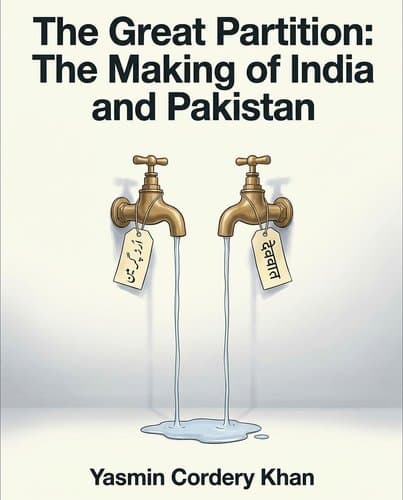
The mechanisms were concrete: drinking taps at railway stations labeled "Hindu water" and "Muslim water"; a census that sorted hundreds of millions of people into bounded religious categories as the primary fact about a person; and, most consequentially, a 1909 decision to give religious communities separate electorates, meaning Muslims voted for Muslim candidates, Hindus for Hindu ones. What had been locally varied and permeable religious belonging hardened into political identity with institutional weight. Religious spokesmen acquired power. Co-religionists across vast distances had reason to organize together in ways they never had before.
Mohammad Mujeeb, Muslim scholar, nationalist, close friend of Nehru, tried to act on this new logic around 1946. Feeling the pull of communal solidarity, he resolved to shop only at Muslim-owned stores in Old Delhi, directing his household's spending toward co-religionists. The women in his household refused. They would shop where the produce was fresh and the service courteous, they told him flatly — not on the basis of some abstract idea about community. When Mujeeb went himself to the Muslim shops, he found them no different from any others: good salesmen and bad, busy when they deserved to be. Muslim customers, he noticed, made up only a small fraction of Muslim shopkeepers' trade. The abstract category and the daily reality wouldn't stick together.
One of the most prominent Muslim nationalists in Delhi, in 1946, was actively trying to enforce communal solidarity on his own household — and failing, because ordinary commerce kept dissolving it. The violence that consumed Punjab the following year did not well up from primordial depths. It required active manufacturing: institutional, political, and then paramilitary. The census came first, then the separate electorates in 1909, then the labeled taps at railway stations across the country, the whole apparatus assembled over sixty years. The taps had been labeled long before anyone reached for a weapon.
Pakistan's Loudest Supporters Had No Idea Where It Was or That They'd Have to Leave
Pakistan's most devoted supporters, in 1946, had no agreed picture of what Pakistan actually was.
Three propaganda maps were circulating simultaneously, each depicting the future state. One labeled the entire Indian subcontinent, from the Himalayas to Cape Comorin, "Pakistani Empire." A second showed a fragmented patchwork: Dravidstan, Bangsamistan, Rajistan, and Pakistan as separate nations. These were not fringe documents. They were produced and distributed by the movement itself, at the same time, among the same supporters.
The incoherence was architecture, not accident. Jinnah needed to hold together Punjabi landlords, urban professionals, and university students in cities like Aligarh — hundreds of miles from any plausible Pakistani border — under a single emotional banner. "Pakistan" did that work precisely because it meant different things to different people. The League won decisively across India in 1946. Almost none of its supporters had worked out what that vote committed them to.
The blind spots ran all the way to senior leadership. Begum Ikramullah, a prominent League figure, was walking through Delhi one afternoon when her husband gestured toward Humayun's Tomb, the great Mughal emperor's mausoleum in the center of the city, and promised her Delhi would definitely be in Pakistan. She wrote it down without any sense it was implausible. What she and her husband seem to have imagined, like most of the League's senior figures, was something looser than a hard-bordered state: a confederation, perhaps, or a dominion capacious enough to include the Mughal capital. Nobody had worked out the geography because nobody expected geography to become the question.
Aligarh, whose Muslim university Jinnah called his "arsenal" and whose students claimed retrospective credit for founding Pakistan, sits hundreds of miles from the eventual border. It is still an Indian city.
Nobody in 1946 was contemplating migrating. The twelve million people who would cross the border in 1947 were living in their homes, assuming Pakistan would include them, or at least not force them to choose.
The Massacres Were Not Mob Hysteria — They Were Planned Operations with Military Tactics
Gopal Mukherjee had earned his nickname — "Patha," the goat — because his family ran a meat shop in Calcutta. He'd built a harder reputation in the wrestling pits of the city, where young men competed for status and older men recruited muscle. By August 1946, when the Muslim League called a Direct Action Day and the worst riots Calcutta had ever seen broke out over three days (at least four thousand dead), Gopal was ready. He'd already sourced grenades from army contacts. He grew a beard and let his hair go long as camouflage. Then a Congress Party leader loaded him into a jeep and drove him through the city, past lorries stacked with Hindu corpses, blood still seeping between the bodies. At each stop, Gopal confirmed: yes, there will be retaliation. He went back to his gymnasium, called his boys together, and organized.
The framing usually applied to events like this is ancient hatreds, a pressure cooker of religious resentment finally released. What that framing conceals is the pipeline. The League's Chief Minister of Bengal had addressed the morning's mass rally and made clear, without saying it, that the crowd could act without consequence. Police would stand down. The ministry would look the other way. Rioters used state-owned trucks and petrol coupons no one later accounted for. The political class on both sides was not trying to contain the violence. It was providing the infrastructure for it.
Gopal is the bottom of that pipeline. He had political cover, military equipment, trained men, and organizational structure. He was not swept up in frenzy. He had been preparing — and a Congress leader's jeep was his signal that now was the time.
The pattern was even more explicit two months later in rural Noakhali, Bengal. Roads in and out of the nearly inaccessible district were cordoned off before the killing began, trapping Hindu peasants inside. Containing the operation eventually required 1,800 troops, 600 armed police, and Royal Air Force planes. That scale was available because the organizations doing the killing had been deliberately built. The Khaksars, a Muslim paramilitary, were founded by a man who acknowledged reading Mein Kampf and modeled his forces on the SA and SS. The RSS, a Hindu nationalist paramilitary, had a leader who praised Nazi racial purges in print. They looked like fascist movements because they were consciously designed as such. The organizer was Golam Sarwar, an elected politician who had fed his followers carefully constructed stories about Calcutta, linking distant atrocities to local enemies and giving the slaughter the emotional logic of legitimate revenge.
Ancient hatreds is a story that protects the planners. The evidence keeps pointing somewhere more specific: a Congress leader's jeep, a cordoned road, a politician's morning rally, an army-sourced grenade.
British Officials Knew the Plan Would Kill People — and Chose Speed Anyway
Sometime in the weeks before June 3, 1947, reports reached the Viceroy's office in New Delhi: over sixty villages in Gurgaon district, just south of the capital, had been wiped out. Mountbatten recorded his private response. He could not help feeling, he wrote, that the renewed violence might work to his advantage — that the massacres, arriving on the eve of his meeting with Indian and Pakistani leaders, might push them toward accepting the plan he was about to present.
Mountbatten's note is not an official's despair at a situation spiraling out of control. It is a man explicitly cataloging dead civilians as political leverage and writing it down. Yasmin Khan, one of the period's historians, called it "almost breathtaking callousness."
That diary entry is one data point in a documented pattern. Paul Patrick, a British official at the India Office (Britain's government department managing the transition), told American diplomats privately that widespread violence and bloodshed was probable from the first week of June, and that Britain retained full legal responsibility for Indian security until the Independence Act cleared Parliament. The response to that admission was not to slow down. The bill was rushed through Westminster in under six weeks. The previous major India Act, passed in 1935, had taken six years.
The hurried legislation gave the British legal cover to exit a crisis they had already predicted. What it did not provide was deniability about the prediction.
The Radcliffe Line, the actual border through Punjab and Bengal, completes the picture. The British judge appointed to draw it arrived in India on July 8, worked from census maps in closed rooms, never visited the land he was dividing, and left six weeks later. The resulting border cut irrigation headworks from their protective embankments, divorced factories from the farmland that supplied them, and severed communities that had lived intertwined for generations.
Penderel Moon, a British administrator who had spent years in Punjab before Partition and wrote one of its earliest accounts, documented what this meant on the ground. Shortly after Independence, Indian troops and Pakistani police found themselves at a standoff over a canal headworks — a control station that diverted river water into irrigation channels serving thousands of acres of farmland — now cut in two by the new border. Each side controlled half the machinery. Moon called it "an absurd error" that "could very easily have been done differently." The land around the headworks was uninhabited and mostly uncultivated; a slight rerouting would have cost nothing and displaced no one. The correction was never made.
The line was completed on August 12. It was withheld from the public until August 17 — two days after Independence Day ceremonies in both capitals. Releasing it earlier, Mountbatten calculated, might have clouded the celebration.
By the time people learned where the border ran, the killing was already underway. The sequence was a decision. The information was available. Officials who held it chose to protect the ceremony.
Women's Bodies Became Political Territory — Branded with Slogans, Traded Like Produce
Taran was sixteen the night the drums started outside her house. Her mother heard them and moved fast: she gathered the family's gold, divided it into handkerchiefs, pressed portions into each person's hands. Then she layered her daughters in multiple sets of clothing, one outfit over another, shoes and socks on top of everything, as if enough cloth could stop what was coming. She kept crying while she gave instructions. None of them knew, Taran remembered later, where any of them would end up.
Taran escaped. Countless others did not.
What happened to women seized from the refugee columns (those slow-moving lines sometimes 40,000 strong, where the exhausted fell behind and were taken) goes beyond any single violation. Nationalist slogans were branded onto women's faces and breasts: the competing rallying cries of each new nation written into skin. The logic was deliberate. Women carried community honor, so possessing or destroying women's bodies demonstrated territorial dominance to the enemy. When both governments organized recovery operations for what they classified as "abducted women" (roughly 83,000 between India and Pakistan), officials found that at least one in three was under twelve years old. Not women. Children.
Social worker Kamlaben Patel spent five years in Lahore coordinating the recovery effort. She watched women traded between men "in the same way that baskets of oranges or grapes are sold" — priced, transferred, gifted. Some became forced labor in new households. Some were kept as replacements for women taken from the other side, permanently converted and absorbed. The misogyny was, one of the grimmer ironies of 1947, genuinely shared across religious lines: Hindu and Muslim men held identical ideas about female purity and what rape by the enemy signified. The shame, in both communities, collapsed inward rather than outward. A violated woman was treated as evidence of her community's failure to protect its own honor, not as a witness to what had been done to her. The insult belonged to the enemy; her body was where it landed. So the shame fell on her, not on the men who had organized the violence.
Survivors found families who sometimes could not take them back. Relatives described even violated children as ruined — their character spoiled, what remains of them now? The recovery operations ran for years: border negotiations, transit camps, hearings to establish who belonged where. At least a third of the 83,000 were under twelve, children designated "abducted women" in government paperwork, processed through the machinery of restoration, returned to families who sometimes shut the door.
Partition Never Ended — It Just Became Visa Queues, Stateless Enclaves, and a Few Cold Lines in School Textbooks
Ahmad Hussain worked at a Lahore tin-printing plant until 1947, when his employer, a Hindu mill-owner named Amar Nath Bindra, fled to India and the factory was looted. Two years later, Bindra tracked him down. He'd rebuilt in Mathura, borrowed government money, but needed someone who knew how to run the equipment. He applied to bring his old workers over. The government said yes. Ahmad Hussain left his wife and children in Lahore, crossed the border with his teenage son, and went back to work.
For three years it held. Bindra kept renewing their permits, calling them his most useful men. In 1950, Ahmad Hussain applied for permanent residency in India.
By 1951, the border had hardened into passports. Application rejected. Police orders: return to Pakistan. He and his son were separated from their employer for the last time.
Gandhi, at a prayer meeting on August 1, 1947, told the crowd he would walk to the Punjab without a passport — nobody could stop him. Within four years the border had become exactly what he dismissed as absurdly dramatic: seven visa categories, goods restrictions, police registration on arrival. The machinery wasn't built to protect anyone in particular. It was built to answer the question the Partition plan never answered: who is Indian, who is Pakistani? Once a state starts sorting people that way, the categories need enforcement.
Enforcement has sharpened. Along the India-Bangladesh border sit 197 territorial anomalies, enclaves of one nation stranded inside the other, whose residents exist in a legal void. A 1958 agreement to exchange them was never implemented. They have no roads, schools, electricity, police, or franchise. In 2010 alone, India's Border Security Force shot 75 people dead trying to cross.
Open the schoolbooks of either country and you find a few cold lines devoted to what happened to the millions caught in the middle. The massacre is a footnote. The nation is the story.
The Last Gift the Architects Gave Themselves Was a Story About Inevitability
The inevitability story is the most useful thing the decision-makers ever produced. If ancient hatreds did this — if twelve million people were swept along by forces no one could control — then Mountbatten, who noted privately that village massacres might smooth his negotiation, bears no weight. The Viceroy who withheld the border until after the ceremony was managing the unmanageable, not buying optics with other people's lives. The guards at the enclave fences are just enforcing geography.
You inherit that framing every time Partition gets three sentences in a textbook and the nation gets the rest of the chapter. What Khan's archives show, patient and damning, is that specific people in specific rooms knew what was coming and chose to call it fate. That weight hasn't been settled. It's been distributed — mostly to people who had no seat in the room.
Notable Quotes
“How can we keep them now? Better that they are dead.”
“Will the curfew never be lifted? Shall we never get milk?”
“Do not burn now. It is Pakistan's property.”
Frequently Asked Questions
- What is "The Great Partition: The Making of India and Pakistan" about?
- The Great Partition examines how a small colonial elite divided the Indian subcontinent in weeks, displacing twelve million people who had no voice in the decision. Drawing on ground-level accounts and political history, Yasmin Cordery Khan dismantles the myth of inevitability surrounding Partition. The book shows how speed, elite secrecy, and manufactured identity categories—particularly the 1909 separate electorates decision—turned a political choice into a human catastrophe. Rather than treating Partition as inevitable consequence of ancient religious tensions, Khan reveals how colonial institutions and deliberate political choices created the conditions for mass displacement.
- What does the book say about the causes of communal violence during Partition?
- The book challenges the 'ancient hatreds' explanation for Partition violence. Ethnic and communal violence at scale is almost never purely spontaneous. In Punjab and Bengal in 1946-47, it was carried out by organized paramilitaries with military equipment, political cover, and logistical support from provincial governments. The 'ancient hatreds' framing functions politically to diffuse accountability away from the planners and onto the perpetrators. Khan shows how manufactured identity categories and elite coordination created organized violence rather than spontaneous communal hatred driving events.
- What do the 1946 election results reveal about support for partition?
- The League's 1946 election landslide did not reflect support for a specific partition plan. Mass support for a political symbol ('Pakistan,' 'freedom,' 'swaraj') does not equal support for any specific policy outcome. People attach their own local meanings to large symbols. The League's landslide in 1946 reflected dozens of incompatible aspirations — millenarian dreams, economic grievances, anti-Congress feeling — none of which mapped onto a coherent territorial demand. When reading electoral results, separate enthusiasm for a symbol from agreement on its contents.
- What are Partition's lasting effects according to the book?
- Events that displace millions of people do not end when the displacement stops. Partition created legal structures, border regimes, and enclave populations that persist for generations. The 123 Bangladeshi enclaves within India are not a historical footnote — they are the Partition, still in progress. The myth that an event 'ended' is often what prevents the work of resolution. Khan argues we must examine how Partition's consequences—unresolved displacement, border disputes, stateless populations—continue reshaping the region beyond 1947.
Related Book Summaries

Read the full summary of 721931_the-great-partition on InShort