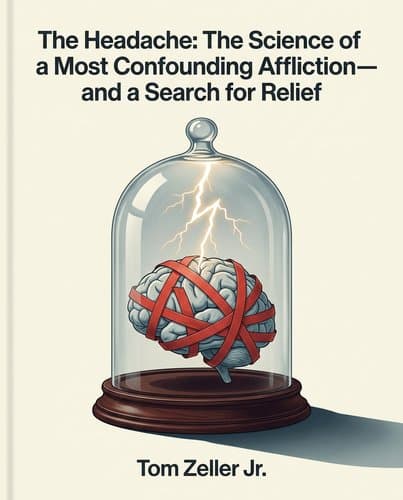
220435871_the-headache
by Tom Zeller Jr.
Migraine ranks among the world's most disabling conditions—yet medicine ignored it for decades, language trivializes it, and sufferers often blame themselves.
In Brief
The Headache: The Science of a Most Confounding Affliction―and a Search for Relief (2025) investigates why migraine and cluster headache — among the world's most disabling conditions — remain so poorly understood and undertreated. Tom Zeller Jr.
Key Ideas
Migraine disabling as quadriplegia, culturally minimized
Migraine and cluster headache are among the world's most disabling conditions by WHO metrics — a day of severe migraine is rated as equally disabling as a day with quadriplegia or acute psychosis — and most people, including many sufferers, don't know this because the cultural language of 'headache' has been designed to minimize it.
Headache patients face diagnostic and treatment failure
The diagnostic system fails headache patients at every level: average delay to diagnosis is 7–9 years, only ~700 certified headache specialists exist in the US, and 20% of migraine patients are still prescribed opioids that clinical evidence shows worsen the condition.
Pharmaceutical success reinforces outdated disease theories
A successful drug can calcify a wrong theory: sumatriptan's effectiveness reinforced the vascular theory of migraine for decades, delaying the neurogenic research that eventually produced CGRP inhibitors — meaning pharmaceutical success is not the same as scientific understanding.
CGRP inhibitors represent incomplete scientific progress
CGRP inhibitors (Aimovig, Ajovy, Emgality) represent a genuine 40-year scientific breakthrough, but Thien P. Do's studies show migraines can still be triggered when CGRP is fully blocked, meaning these drugs treat a major pathway without explaining the disease.
Funding trap requires external political pressure
The NIH funding gap is self-reinforcing: because headache research attracts so little money, talented early-career scientists choose better-funded fields, which produces fewer quality grant applications, which the NIH uses to justify continued low funding — a trap that requires external political pressure to break, and that pressure has so far been insufficient.
Stigma fundamentally shapes headache research systems
Stigma around headache disorders is not just a social inconvenience — it shapes research funding, clinical training, specialist supply, and patients' own willingness to seek care. Migraine ranks highest among 79 chronic conditions in 'judgment' scores, above cirrhosis and obesity.
Who Should Read This
Science-curious readers interested in Neuroscience and Biology who want to go beyond the headlines.
The Headache: The Science of a Most Confounding Affliction―and a Search for Relief
By Tom Zeller Jr.
11 min read
Why does it matter? Because 'it's just a headache' is one of the most expensive phrases in medical history.
Say the word
The Best Tool Medicine Has for Measuring Your Pain Is a Row of Cartoon Faces
When Tom Zeller describes a cluster headache attack — fingertips ground into the scalp, drool, writhing on the bathroom floor, something he calls a childbirth happening behind the eyeball — he is not being dramatic. He is running headlong into the oldest wall in medicine: pain cannot be transmitted from one person to another. Elaine Scarry put it clinically; Virginia Woolf put it with more sting, noting that a schoolgirl in love has Shakespeare to speak for her, but a person trying to describe head pain to a doctor finds language runs completely dry. The asymmetry is diagnostic. Without shared language or objective measurement, a patient's suffering depends entirely on whether the person across the desk believes them.
And belief, it turns out, is doing almost all the work. Brain imaging and AI have chased an objective pain signature; none of it is clinically usable. So the visual analog scale — cartoon grimaces grading from grin to anguish, numbered one to ten — remains the standard. Zeller's cluster attacks register in his own accounting somewhere around seventy-five, a number the scale doesn't contain. He cannot prove that. You cannot verify it.
Medicine can explain the molecular cascade of a stroke, image a tumor to the millimeter, and sequence a pathogen's genome within hours. For measuring how much something hurts, the best tool available is a laminated poster of cartoon faces. That gap between what is felt and what can be shown is where chronic pain patients have been stranded for centuries, quietly suspected of exaggerating, unable to show the wound that would make a doctor believe them.
A Disease Affecting 3 Billion People Is Considered a Research Backwater
On May 16, 2010, Pam Erwin was walking back to her son's Boston hotel room carrying a prescription she'd just picked up for him. Will was twenty-four, a onetime skydiver and entrepreneur from Houston who had spent the better part of two years pursuing every available treatment for cluster headaches — psilocybin and LSD under a Harvard psychiatrist, herbal concoctions, opioids, two separate surgeries to implant deep brain stimulators. None of it had held. By the time Pam turned the corner onto Tremont Street and saw the yellow tape, Will was already gone. He had jumped from the hotel roof while she was at the pharmacy. Firefighters hosed his blood into the gutter. Boston carried on around it.
His parents later founded a headache research center in his name. The world that failed him barely noticed it had done so.
Cluster headache affects roughly one percent of the population — rare enough to be overlooked, common enough to destroy lives by the hundreds of thousands. Migraine, its more prevalent cousin, afflicts around a billion people globally and ranks as the second leading cause of disability worldwide. For people between ten and twenty-four, it trails only road accidents. The World Health Organization has formally assessed that a day lived with severe, continuous migraine is as disabling as a day with dementia, quadriplegia, or acute psychosis. Zeller confesses his own eyes rolled when he first read that — pinching coins from a blind man's cup, he calls it. Then he sat with it long enough to believe it.
None of this has produced funding that matches the scale of the problem. By 2024, the NIH was spending roughly fifty million dollars annually on migraine — high burden, bottom-tier funding. ALS, which affects a comparable fraction of the population as cluster headache, receives more than two hundred million. Migraine wasn't even tracked as a distinct NIH category until advocates fought for it in 2007.
The Mayo Clinic's Amaal Starling names the consequence plainly: talented scientists follow the money, and the money says migraine is not important. Will Erwin's story makes that judgment lethal.
The Word 'Headache' Was Designed to Make You Dismiss It
If you renamed diabetes 'the sweats' — a term generic enough for every anxious student — research funding would drain away. That's roughly what happened to migraine. The word 'headache' did the work of a century of institutional neglect.
A 2023 University of Michigan study processed 4.7 million news articles spanning nearly four decades and mapped 106 diseases against two axes of stigma: disgust and judgment. Herpes led on disgust. Depression and addiction led on judgment. And topping all 79 chronic conditions for sheer moral judgment — above cirrhosis, above obesity, above chlamydia — was migraine. Not because journalists set out to mock it, but because the word attached to it had already done that work. A separate analysis of over a million articles found that 'headache' functioned as a metaphor for petty annoyance roughly half the time it appeared in print. Fox News executives gave staff 'headaches.' The disease shared its name with the mildest possible inconvenience, and the culture treated them as interchangeable.
Medicine was not innocent here. Harold Wolff, a mid-century neurologist at Cornell who shaped how the profession thought about migraine for decades, concluded that most of his female patients were sexually dissatisfied, that migrainous women resented maternity, and that the headaches in his male patients were caused by their frigid wives. His findings were not fringe. They were mainstream, widely cited, and they lodged the disease inside a framework of female hysteria and moral weakness that persisted in clinical culture long after Wolff was gone.
The Michigan study found something particularly damning: stigma scores for mental illness and many infectious diseases declined steeply over time. Advocacy moved those numbers. The formal reclassification of migraine as a neurobiological disorder rather than a psychosomatic complaint moved nothing. The judgment score held. The word had already done its work, and a scientific correction couldn't reach it.
When the Only Doctor Who Believed You Was a Terrible Doctor
Zeller drove five hours each way — from Washington, DC, to Queens — to see a doctor he knew was incompetent. The man opened appointments by asking whether Zeller was currently having a headache. This after years of treating him. He routinely dictated the diagnosis as migraine into his recorder, apparently unable to retain the distinction between migraine and the disorder that had Zeller raking his own scalp bloody. Later, Zeller would discover his doctor's license had previously been suspended for a sexual relationship with a patient, and that a jury had ultimately awarded fifteen million dollars to the women he'd harassed at work. The mustache witnesses remembered him by: walrus-like, which is exactly how Zeller had always thought of him.
And yet Zeller stayed. Drove the five hours. Accepted the misdiagnosis on the dictation tape. Because the alternative — re-entering the system, finding a new doctor, winning over a stranger with his boring story of torment, hoping that stranger happened to know anything about cluster headaches — was genuinely worse. The fear wasn't irrational. Across the entire United States, roughly 700 physicians hold board certification in headache medicine, for tens of millions of patients. Headache sits so low in the neurology pecking order — trailing movement disorders, epilepsy, neuro-oncology, and by one researcher's accounting, even dementia — that talented clinicians are actively steered away from it. What's left is a system where the competent are scarce, and patients who find any doctor willing to engage stay put out of rational fear.
That scarcity has a body count measured in years. The average cluster headache patient goes 6.6 to 8.9 years before receiving a correct diagnosis, cycling through ENT surgeons and dental offices while the actual disease goes untreated. A specialty nobody respects produces a shortage of specialists nobody trains, which makes every working relationship precious beyond its actual value. Zeller wasn't naive. He was doing the math correctly — and so, somewhere right now, is everyone else still driving five hours to see a doctor who doesn't know their name.
The Drug That Saved Millions of Lives May Have Delayed the Science That Could Have Cured Them
Can a drug that genuinely saves millions of lives also set medicine back by thirty years? The uncomfortable answer, when you trace the history of sumatriptan, is yes.
In the early 1970s, a chemist named Patrick Humphrey was tasked by Glaxo with finding a new migraine treatment. The animating assumption was simple: migraines hurt because blood vessels in the head dilate and press on surrounding nerves, so constrict those vessels and you stop the pain. Humphrey was hunting for a better vasoconstrictor. What he found instead, after years of experiments in anesthetized dogs and cats, was a molecule that latched onto a highly specific serotonin receptor — one intimately involved in migraine and apparently nothing else. The drug that became sumatriptan, sold as Imitrex, didn't work because it narrowed blood vessels the way Humphrey had intended. It worked for reasons his team didn't fully understand at the time, and which remain contested today. In his own retrospective, written nearly two decades after the drug reached pharmacy shelves, Humphrey admitted he still couldn't say whether the vasoconstriction was essential or merely incidental to how sumatriptan actually stopped a migraine.
That uncertainty didn't slow anyone down. The drug was electrifying — roughly 80 percent of trial participants saw significant pain relief within an hour. Glaxo flooded the airwaves. Competitors rushed their own versions to market. And the scientific community, confronted with a drug that constricted blood vessels and relieved migraine pain, concluded what seemed obvious: dilated vessels cause migraine. A successful treatment had been mistaken for a proven theory.
UCLA neurologist Andrew Charles calls this a dominant paradigm at work — one that blocks researchers from seeing competing evidence. If a blood-vessel drug relieves pain, investigators pursue more blood-vessel drugs. Funding follows. Careers are built. Questions that don't fit the framework stop being asked. Charles puts the cost at thirty years of retarded progress, a field that kept drilling in the wrong direction because the first well came in.
The science that finally broke from the vascular paradigm — tracing pain to the trigeminal nerve system, then to the neuropeptide CGRP — was genuinely elegant detective work. It also arrived decades late, delayed in part by a drug that worked too well to question.
It Took Forty Years and a Dead End in a Liver Ward to Find the Right Target
Just after 4 p.m. on May 17, 2018, pharmacologist Cen Xu heard a scream down the hallway of Amgen's California campus and ran toward it. She'd been shuttling anxiously between buildings all day, waiting for the FDA to render a judgment that had been two decades in the making. When the news hit, researchers spilled into the corridors for hugs and high fives. Then Xu, recounting the moment on a Zoom call years later, started to cry. "That 99.9 percent of the people who are scientists," she said, "will never have a chance to make a real drug."
The drug was Aimovig, the first medication purpose-built to block the neuropeptide CGRP, and its path to that corridor celebration was less a triumphant march than a four-decade stumble across competing continents and a near-fatal detour through a liver ward.
The relay began in 1979, when Michael Moskowitz proposed that migraine pain originated not from dilated blood vessels, as Harold Wolff had insisted, but from the trigeminovascular system — the network of nerve fibers connecting the trigeminal nerve to blood vessels surrounding the brain. In the 1980s, Swedish researcher Lars Edvinsson and Australian Peter Goadsby, collaborating in Sweden in 1985, ran experiments in anesthetized cats and then in humans, demonstrating that a neuropeptide called CGRP was released in the cranial circulation during migraine attacks — and was suppressed by sumatriptan. The implication was obvious: if you could block CGRP, you might stop the headache at its source.
Pharmaceutical companies pursued that target for a decade using small-molecule drugs — ordinary pills, cheap to manufacture, easy to distribute. Merck's candidate, called telcagepant, worked roughly as well as the triptans and sailed through early clinical trials. Then a small number of participants developed elevated liver enzymes. Because small-molecule drugs are metabolized in the liver, toxicity is an occupational hazard of the approach — acceptable when treating a life-threatening disease, disqualifying for one medicine only calls highly disabling. Merck pulled the molecule. Its backup candidate failed the same way. The industry's CGRP ambitions had wandered into a dead end.
Xu's insight, developed at Amgen, was structural. Monoclonal antibodies — large proteins derived from living cells — bypass the liver entirely; the body doesn't metabolize them the same way. They're expensive to manufacture, can't be swallowed, and must be injected or infused. But they're also precise, long-lasting, and not toxic to the organ that had killed every competitor's pill. The approach required Xu to absorb years of skepticism from brain-centric researchers who insisted the molecules were too large to cross the blood-brain barrier and therefore couldn't possibly work. She read the evidence and disagreed. She was right. Aimovig reached the pharmacy shelf where telcagepant could not, and three more CGRP antibodies followed within two years.
The relay had covered forty years, four continents, and one catastrophic detour — and arrived not where the science had pointed, but where the chemistry finally allowed.
The Scientists Who Won the Brain Prize Fundamentally Disagree About Whether Migraine Is a Brain Disease
Imagine a medical prize committee celebrating definitive proof that smoking causes lung cancer — and then, at the champagne reception, having half the honorees quietly insist that actually, no, we haven't shown that at all. That is approximately the situation with the 2021 Brain Prize, a roughly $1.5 million award given to four researchers — Jes Olesen, Lars Edvinsson, Peter Goadsby, and Michael Moskowitz — for cracking the role of CGRP in migraine. The prize assumed a shared understanding. The scientists shared no such thing.
Olesen, asked about Goadsby, says he likes him very much, considers him a friend, finds him enormously charismatic. Then: it's been clear from the very beginning that Goadsby is wrong. Wrong about what? About the brain. Goadsby believes migraine is fundamentally a disorder of the central nervous system — that the brain itself generates the attack, activating pain-sensitive structures downstream. Olesen's counter is blunt: CGRP molecules are too large to cross the blood-brain barrier, yet injecting them intravenously reliably triggers migraines, and blocking them reliably stops them. If the disease truly originated inside the brain, molecules that can't reach the brain shouldn't matter. Two scientists, one prize, a disagreement so foundational it concerns whether the organ in the prize's name is even the right place to look.
The treatments don't resolve this. Aimovig works. We don't know where. Brain-centric researchers suggest a small fraction of antibody molecules may slip through the barrier anyway, or that the hypothalamus — technically central nervous system but outside the barrier — is the real target. Meanwhile, Thien P. Do and colleagues at the Danish Headache Center have shown that migraines can be triggered even when CGRP is fully blocked in advance, suggesting the neurotransmitter isn't strictly necessary for every patient's attack. The therapy that felt like an answer quietly contains the evidence that it isn't the whole answer.
The science is real. The drugs help real people. And the field's most decorated experts cannot agree on where in the body the thing actually begins.
Congress Sent Fifteen Memos. The NIH Director Said: 'That Doesn't Matter.'
In December 2019, Robert Shapiro — a Vermont neurologist who had spent fifteen years marshaling advocates, writing congressional allies, and carefully documenting the gap between migraine's burden and its research funding — sat across from the director of the NIH's neurological disorders division and ran through the case one more time. Fifteen separate congressional statements, he began, urging your agency to treat headache science as a priority. The director, Walter Koroshetz, cut him off before he could finish. 'That doesn't matter.' Shapiro demonstrated his reaction years later by slowly sliding down in his chair, jaw open — a gesture carrying equal parts disbelief and exhaustion. Koroshetz never responded to the author's follow-up queries.
The indictment isn't personal. It's structural. The NIH publishes a scatterplot mapping diseases by global disability burden against the dollars they receive. Migraine sits in the lower-right corner: enormous burden, near-zero funding — around fifty million dollars by 2024. Alzheimer's received three and a half billion after Congress stopped making suggestions and started issuing mandates. The agency insists it funds the best science submitted, not the most burdened diseases. What that framing misses is that it produces its own result: low funding discourages careers, fewer researchers enter the field, fewer grants arrive, and the agency's low allocation looks like simple market-clearing rather than a self-fulfilling policy. Amaal Starling of the Mayo Clinic says it plainly — a scientist building a career is going to chase the two-hundred-million-dollar pot, not the twenty-four-million one. The talent follows the money that follows the talent that was never there.
Will Erwin ran out of options at twenty-four. The fifty million dollars sitting in that lower-right corner might have found him one.
The Four Words That Encode Everything
You have heard those four words your entire life, and they have always meant: stop complaining, go lie down, take an aspirin. It's — a thing so poorly measured that medicine still hands patients a cartoon face and asks them to point. Just — a condition the NIH buries in a funding corner while congressional memos collect dust, a specialty so starved of respect that the brilliant people who might have fixed it chose a better-funded problem instead. A — singular, as though there were one thing to explain, when the scientists who won the prize for explaining it cannot agree whether the organ in the prize's name is even involved. Headache — a word that spent a century meaning female weakness, petty annoyance, something you push through. Will Erwin pushed through everything available and ran out of available. The four words haven't changed. But you have — and somewhere in a Boston hotel stairwell, so did the question medicine still hasn't answered.
Notable Quotes
“There’s been a movement of about, let’s say, for the last twenty years, spearheaded by Peter Goadsby,”
“You may have talked to him. He is a very charismatic person, extremely charismatic. I like him very much. We’re good friends, actually. But we also disagree on a lot.”
“It’s clearly wrong. It’s been clear from very beginning that he was wrong.”
Frequently Asked Questions
- What is The Headache about?
- The Headache: The Science of a Most Confounding Affliction―and a Search for Relief (2025) investigates why migraine and cluster headache remain so poorly understood and undertreated despite being among the world's most disabling conditions. Tom Zeller Jr. traces how cultural stigma has shaped research funding, medical training, and clinical practice. The book explains recent breakthroughs like CGRP inhibitors while highlighting remaining scientific gaps. It examines why the diagnostic system fails patients—with average delays to diagnosis of 7–9 years and only ~700 certified headache specialists in the US—and why 20% of migraine patients still receive opioids that evidence shows worsen the condition.
- Why are migraines considered so disabling?
- Migraine and cluster headache are among the world's most disabling conditions by WHO metrics, yet most people don't recognize this because "the cultural language of 'headache' has been designed to minimize it." According to Zeller Jr., a day of severe migraine is rated as equally disabling as a day with quadriplegia or acute psychosis. This stark comparison reveals how profoundly migraines impact functioning, yet widespread cultural stigma leads to severe underestimation of their severity. The disconnect between medical reality and public perception means patients often struggle to explain their condition to employers, family, and even healthcare providers, compounding isolation and burden.
- Do CGRP inhibitors cure migraine?
- CGRP inhibitors—including Aimovig, Ajovy, and Emgality—represent "a genuine 40-year scientific breakthrough," but they do not fully cure migraine. Research by Thien P. Do demonstrates that migraines can still be triggered even when CGRP is fully blocked, meaning these drugs treat a major biological pathway without explaining the disease. Zeller Jr. notes that pharmaceutical success doesn't guarantee scientific understanding: sumatriptan's effectiveness reinforced an incorrect vascular theory of migraine for decades, delaying neurogenic research. CGRP inhibitors are effective preventive treatments for many patients but highlight how much remains unknown about migraine's underlying mechanisms and triggers.
- Why is headache research underfunded?
- Headache research faces a self-reinforcing funding crisis: because headache research attracts minimal NIH money, early-career scientists choose better-funded fields, resulting in fewer quality grant applications—which the NIH then uses to justify continued low funding. This creates a trap requiring external political pressure to break, but that pressure has "so far been insufficient." Additionally, stigma surrounding headache disorders directly shapes research priorities, clinical training, and specialist supply. Zeller Jr. notes that "migraine ranks highest among 79 chronic conditions in 'judgment' scores, above cirrhosis and obesity." This cultural devaluation discourages investment and drives talented researchers away from the field.
Related Book Summaries


Read the full summary of 220435871_the-headache on InShort