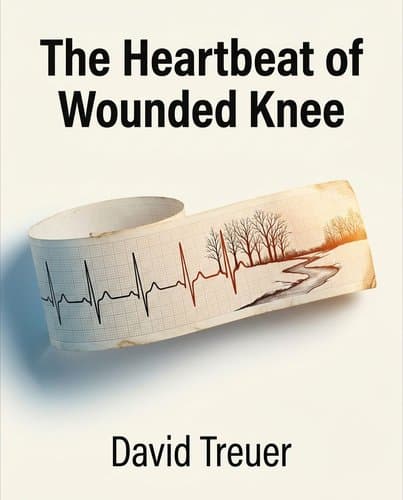
41574287_the-heartbeat-of-wounded-knee
by David Treuer
America needed Indians to vanish—so historians, novelists, and politicians manufactured an extinction narrative that buried 130 years of Native survival…
In Brief
The Heartbeat of Wounded Knee (Janu) dismantles the myth that Native American life ended at Wounded Knee in 1890, tracing 125 years of Indigenous survival, adaptation, and resistance that mainstream history erased. Drawing on law, policy, and individual stories, it equips readers to see how the vanishing narrative was constructed — and what persisted despite it.
Key Ideas
Scholars built extinction into history
The extinction narrative was actively manufactured. L. Frank Baum called for Indian extermination, Frederick Jackson Turner built Indian disappearance into the academic origin story of America, and Dee Brown's sympathetic 1970 bestseller still described reservation life as nothing but 'poverty and hopelessness.' Recognizing the architects is the first step to seeing past the myth.
Assimilation never prevented forced removal
The Cherokee adopted farming, built a legislature and courts, published a bilingual newspaper, and won at the Supreme Court — then Andrew Jackson removed them anyway. Assimilation has never been a reliable protection; the republic's terms kept changing to justify dispossession.
Refusing to leave secured personhood
Standing Bear v. Crook (1879) was the first federal ruling that an Indian is legally a 'person' under U.S. law. It was secured by one Ponca chief carrying his dead son's bones north for burial — not by treaty, not by war, but by showing up in a Nebraska courtroom and refusing to leave.
Individual survival takes unrecognized forms
Bobby Matthews — former safecracker, Leech Lake Reservation — runs 2,000 leech traps, tracks five-year pinecone cycles in black notebooks, and employs a dozen people without ever beating a man for wages. Individual survival that looks nothing like resistance is still survival. The book puts him next to AIM's armed occupations without declaring a winner.
Single refusal built tribal wealth
Helen Bryan's refusal to pay a $147.95 trailer tax bill in 1972 became Bryan v. Itasca County — the Supreme Court ruling that is the legal foundation of all Indian gaming, which generated $26 billion annually by 2009. One specific act of stubbornness by one specific poor mother changed tribal economic history.
Economic freedom corrupts tribal instruments
Blood quantum was a colonial instrument (Virginia, 1705) designed to shrink the Indian population on paper. Tribes with casino revenues are now using it to disenroll their own members. The same legal power that liberated tribes economically is being turned inward to atomize them.
Who Should Read This
History readers interested in World History and Social Issues who want a deeper understanding of how we got here.
The Heartbeat of Wounded Knee
By David Treuer
10 min read
Why does it matter? Because the story of Indian extinction was designed — and the designers had names.
The story most people carry goes like this: 1890, Wounded Knee, end of story. After the cavalry's Hotchkiss guns, after the frozen ground and the 150 dead, the narrative closes. The eulogies followed fast, from newspaper pages, academic halls, and bestselling shelves, all confirming the frontier was closed and Indians went with it. But nobody asked the obvious question: who gave these men the authority to write the ending? The two hundred Lakota who walked away from Wounded Knee went home, had children, made history. David Treuer went looking for what came next.
The 'Dead Indian' Story Had Named Authors — and They Had Reasons
Two weeks after soldiers mowed down at least 150 Lakota men, women, and children along a frozen South Dakota creek — including a woman shot while carrying a flag of truce, and children chased down two miles from the initial scene — a newspaper editor in Aberdeen, South Dakota published an editorial calling for the "total extermination" of all Native Americans. His name was L. Frank Baum. He would go on to write The Wonderful Wizard of Oz.
The man who gave America its most beloved fantasy of home and safety was simultaneously calling for genocide. Baum was the most visible among several people who shaped the story that Wounded Knee had ended Indian life. Each of them needed that story to be true for reasons of their own.
Three years after the massacre, historian Frederick Jackson Turner delivered his "Frontier Thesis" at the World's Columbian Exposition in Chicago, a fair built to celebrate the very arc he was describing. American history, Turner argued, begins with Indians and ends with Americans, a neat sequence of civilizational stages in which one people give way to a more advanced one. Turner didn't call for extermination. He declared it already accomplished, and gave the whole enterprise an academic framework that went largely unchallenged for decades. Wounded Knee was the period at the end of his sentence.
Eighty years later, in 1970, historian Dee Brown published Bury My Heart at Wounded Knee. Written in outrage at American violence, it sold four million copies in seventeen languages and has never gone out of print. Brown's sympathies ran entirely opposite to Baum's. And yet when he described present-day Indian life, he could only offer "poverty, hopelessness, and squalor." Contempt and sympathy arrived at the same destination: an Indian past, and nothing after it.
The extinction narrative endures because it doesn't require malice, just a story frame with room for Indian suffering and none for Indian life.
Over 200 Lakota survived Wounded Knee. They got married and had children and moved to cities and made their own decisions about faith and community. An infant named Zintkala Nuni was found four days after the massacre, alive and frostbitten beneath her dead mother's body in the snow. She lived thirty more years, years the story had already declared she wouldn't have. The story needed a closing image. The survivors kept walking out of it.
The Conquest Wasn't Inevitable — Someone Chose It, Over and Over
The conquest of Native America was not a force of nature. It was a policy, written down, signed, and executed by specific people who knew exactly what they were doing.
In 1803, while serving as president, Thomas Jefferson sent secret memos to William Henry Harrison laying out a strategy to acquire Indian lands in the Southeast. The method: extend credit to influential tribal members, let debts accumulate beyond what they could pay, then accept land cessions in settlement. Jefferson spelled it out plainly — push the trading houses, let the debts grow, and when they became unpayable, "they become willing to lop them off by a cession of lands." If a tribe resisted, seize the whole country and drive them across the Mississippi. He described all of this as humanity.
The Cherokee tested every premise of that logic. By the 1820s, the eastern Cherokee had built a legislature, an independent judiciary, and a bilingual newspaper. They grew cotton on plantations. They did, by every standard the republic claimed to value, exactly what was asked of them. When Andrew Jackson moved to remove them from Georgia, they took the case to the Supreme Court and won — a series of Supreme Court rulings known as the Marshall Trilogy ruled removal unlawful. Jackson removed them anyway. Between 1830 and 1850, more than 125,000 southeastern Indians were marched west on foot, in winter; at least 5,000 Cherokee died. Adaptation had not been a path to survival. It had demonstrated that their land was productive — which made taking it more appealing, not less.
The engineering continued after the wars ended. The Dawes Act of 1887 broke reservation land into individual parcels so it could be taxed into white ownership — Indian landholdings fell from 138 million to 48 million acres by 1934. Boarding schools did the same to culture that the Dawes Act did to land. At the Carlisle Indian Industrial School in Pennsylvania, children were taken from their families, forbidden to speak their languages, and punished with lye soap and beatings for the slip of a word. Richard Henry Pratt, who founded Carlisle, called the program "Kill the Indian, save the man." He meant it as mercy.
Jefferson called it humanity. The boarding school administrators called it salvation. The machinery was never hidden. The tools changed every generation. The goal did not.
Indians Won Their First Legal Rights by Fighting with the Colonizer's Own Tools
In a Nebraska courtroom in 1879, a Ponca chief named Standing Bear raised his right hand before the judge and held it motionless in the air until the room went silent. Then he made a simple argument: prick that hand, and it bleeds red — the same color as any white man's. He was made by God. He was a man.
Standing Bear was there because he had tried to bury his son. The boy had died on the Oklahoma reservation where the U.S. government had forcibly relocated the Ponca — land so unsuitable that a third of the tribe starved in their first year there. His son's dying wish was to be buried along the Niobrara River in Nebraska, on the family's ancestral land. Standing Bear set out on foot with a small band and the boy's bones in a box. The army arrested them.
What followed required a soldier with a conscience, a journalist with fury, and two attorneys willing to file a habeas corpus petition — a legal challenge demanding the government justify an imprisonment — on behalf of people the law didn't formally recognize as people. General George Crook — an Indian fighter who had spent his career doing what his orders required — quietly contacted a local newspaper editor: make noise. The editor did. The lawyers filed. And a Ponca chief was allowed to address a federal court.
In court, Standing Bear described standing on a riverbank with his daughter beside him, floodwaters rising to their knees. He described a trail cut through rocks by his own family's blood. At the end of that trail, one man stood blocking the way. He turned to Judge Elmer Dundy and said: you are that man. Tears ran down the judge's face. Crook covered his with his hands.
Dundy's ruling ran eleven pages. An Indian, he wrote, was a "person" within the meaning of U.S. law — which meant an Indian could sue, could challenge imprisonment, held the same inalienable right to liberty as any other human being. The legal apparatus built to strip tribal sovereignty had just produced the first formal recognition of Indian personhood. The tools had turned.
Standing Bear's ruling established that Indians were persons under federal law, with the right to invoke federal courts — and that instrument is what later generations would pick up and turn against the agencies that had tried to erase them. Nearly a century later, a Chickasaw lawyer named Kevin Washburn became one of the few Indians to run the Bureau of Indian Affairs from the inside. Tribes told him they couldn't prove historical continuity through public records — they had deliberately disappeared after Wounded Knee, trying not to be found. So he rewrote the federal acknowledgment rules. The institution once famous for bossing Indians around became, under Indian leadership, an instrument for confirming that Indian communities had survived.
The Most Authentic Indian Survival Was Almost Never Visible as Resistance
Think about what a magazine photographer would have pointed a camera at in Indian country in 1975: AIM — the American Indian Movement — in face paint, armed occupations, the warrior aesthetic the movement deliberately crafted for the press. What the camera would have missed, on the same reservation, in the same generation, was Bobby Matthews calculating whether he could earn more from fluorescent pink leech traps than from the trunkful of marijuana he was still running north from the Cities. The answer turned out to be yes.
Treuer places Bobby, an Ojibwe former safecracker turned northwoods entrepreneur, in the same generation as Dennis Banks, AIM's co-founder. Both are Ojibwe from the Leech Lake Reservation. Both came of age while federal termination and relocation programs were systematically dismantling reservation communities. Their responses look almost nothing alike, and Treuer refuses to declare a winner between them. That refusal is the most honest thing in the book.
AIM produced real gains. The Indian Education Act of 1972 pushed $43.6 million into programs serving Native students in public schools, the first time the federal government treated Indian education as a national concern rather than a Bureau of Indian Affairs problem. The Native American Graves Protection and Repatriation Act, passed in 1990, has since returned the remains of more than 57,000 Native people to their tribes. The American Indian Religious Freedom Act of 1978 ended a century in which practicing traditional ceremony was technically illegal.
But AIM also produced the Jumping Bull firefight of 1975, where FBI agents Coler and Williams were executed at close range after being shot and incapacitated in a pasture, and Leonard Peltier received two consecutive life sentences. And it produced Anna Mae Aquash, a Mi'kmaq woman who left her two daughters with her sister in Boston to join the movement, who was accused without evidence of being an FBI informant, and who was found dead in a South Dakota ditch: raped and shot in the back of the head, by the organization she'd given everything to. When asked about her death decades later, Banks compared it to a burning house: no one gives the order, he said, someone just does it.
Bobby, meanwhile, owns his house outright, employs a dozen people, and has never beaten a man for wages. He runs 2,000 leech traps with pink floats, pink because when rivals crowded his territory, he swamped them ten-to-one until the color became a warning. He tracks five-year pinecone cycles in black notebooks going back fifteen years, studies university dissertations on leech biology, ships dried cranberry bark to North Carolina, and reads beaver behavior to predict the weather. He does all of this because he intends to still be in business next spring, and the spring after that.
Pink floats and black notebooks: that's what continuity looks like when it's happening rather than when it's being photographed. Not a symbol of resistance. An efficient solution to a competitive problem, developed by someone who planned past the current season. They're the record of that planning, unglamorous and specific, and in Treuer's account, just as much a form of Indian survival as anything that ever made the news.
A $148 Tax Bill Built Indian Gaming — and Indian Gaming Is Now Eating Its Own
In the spring of 1972, a man drove up to Helen Bryan's trailer on the Leech Lake Reservation in Minnesota, measured the exterior without knocking, took photographs, and drove away. Weeks later, a tax bill arrived: $29.85 for the remainder of 1971. Helen, a minimum-wage Head Start worker raising six kids with no running water, knew the bill was wrong. Her husband said pay it and move on. Helen said no.
By the time she was done saying no, the bill had grown to $147.95, her case had reached the U.S. Supreme Court, and the question before the justices was whether states had civil regulatory power over tribal members living on reservations. Her lawyers argued that Public Law 280 (the 1953 legislation states had long cited for that authority) was written as "law and order" legislation only, not a blanket transfer of civil power. On June 14, 1976, the Court ruled unanimously for Helen. States had no general regulatory reach into Indian country.
Within years, the Seminole Tribe in Florida opened a high-stakes bingo hall over the county sheriff's explicit objection and won in federal court. The Cabazon Band in Southern California opened a poker room, got raided, and also won. By 1987, California v. Cabazon had settled it: tribes could operate gambling enterprises that were legal somewhere in their state, regardless of how much the state disliked it. Congress codified the arrangement in 1988 with the Indian Gaming Regulatory Act. Revenue climbed from $100 million that year to $26 billion by 2009 — more than Las Vegas and Atlantic City combined.
That same legal power is now being used by some tribes against their own members. More than fifty tribes have disenrolled at least 8,000 people over the past two decades; 73 percent of those actively kicking out members have gaming operations. On the Nooksack Reservation in Washington, tribal chairman Bob Kelly moved to disenroll 306 people (15 percent of the tribe) because their common ancestor didn't appear on a 1942 federal census widely known to be wildly inaccurate. Blood quantum, a Virginia colonial instrument from 1705 designed to shrink the Indian population on paper, is now being used by tribes to concentrate casino revenue in fewer hands.
The logic is straightforward capitalism: smaller enrollment, bigger per-capita shares. Treuer's counter is sharper. Culture isn't carried in blood — it travels through language, ceremony, place, and obligation. When you measure blood to determine who belongs, you've already conceded the community has gone thin. Helen Bryan spent her life poor after winning the case that made Indian gaming possible. The people getting rich on that case are now using it to decide she wouldn't have qualified anyway.
The Heart That Keeps Beating
Cultural theorist Walter Benjamin wrote that the task of every generation is to seize hold of a memory as it flashes up at a moment of danger — to rescue it from the enemy. The enemy Treuer is fighting isn't ignorance exactly. It's a story so well-made it feels like truth: that a people ended at Wounded Knee, that what came after is only aftermath. Every time you repeat that story, you hand the enemy something. You make the past into a closed door.
The wager here is simple and not small: the history you carry determines the future you can picture. Zintkala Nuni lived thirty more years after soldiers left her for dead in the snow. Helen Bryan said no to a $148 bill and changed the law. Bobby Matthews is still checking his traps. The question Treuer leaves you with isn't what happened. It's what you do now with the knowledge that none of it was ever finished.
Notable Quotes
“Standing Bear arose. Half facing the audience, he held out his right hand, and stood motionless so long that the stillness of death which had settled down on the audience, became almost unbearable. At last, looking up at the judge, he said:”
“Still standing half facing the audience, he looked past the judge, out of the window, as if gazing upon something far in the distance, and continued:”
“The old chief became silent again, and, after an appreciable pause, he turned toward the judge with such a look of pathos and suffering on his face that none who saw it will forget it, and said:”
Frequently Asked Questions
- What is The Heartbeat of Wounded Knee about?
- The Heartbeat of Wounded Knee dismantles the myth that Native American life ended at Wounded Knee in 1890. David Treuer traces 125 years of Indigenous survival, adaptation, and resistance that mainstream history erased. Drawing on law, policy, and individual stories, the book equips readers to see how the vanishing narrative was constructed and what persisted despite it. Treuer demonstrates that Native American history did not stop at Wounded Knee but continued through legal battles, economic adaptation, and everyday survival strategies that resist the dominant extinction narrative.
- What figures shaped the extinction narrative about Native Americans?
- Treuer identifies the architects of the vanishing Indian myth. L. Frank Baum called for Indian extermination, Frederick Jackson Turner built Indian disappearance into America's academic origin story, and Dee Brown's sympathetic 1970 bestseller still described reservation life as nothing but 'poverty and hopelessness.' By recognizing these figures and their influence, readers can understand how the extinction narrative was deliberately constructed. This recognition is the first step to seeing past the myth and recognizing the survival that persisted despite deliberate erasure.
- What legal victories does Treuer highlight in the book?
- Treuer highlights two pivotal Supreme Court cases that transformed Native American legal status. Standing Bear v. Crook (1879) established that an Indian is legally a 'person' under U.S. law—secured by a Ponca chief carrying his dead son's bones to Nebraska and refusing to leave the courtroom. Decades later, Helen Bryan's refusal to pay a $147.95 trailer tax bill in 1972 became Bryan v. Itasca County, the Supreme Court ruling that became the legal foundation for all Indian gaming, which generated $26 billion annually by 2009. Both cases show how individual acts created lasting systemic change.
- What counts as Native American resistance according to Treuer?
- Treuer expands our understanding of Native American survival beyond armed resistance and formal activism. He profiles Bobby Matthews, a former safecracker from Leech Lake Reservation, who runs 2,000 leech traps, tracks five-year pinecone cycles in black notebooks, and employs a dozen people without beating workers for wages. By presenting Bobby Matthews alongside AIM's armed occupations without hierarchizing one approach over the other, Treuer argues that everyday economic adaptation, stewardship, and community employment constitute equally valid forms of Indigenous persistence and survival. Resistance takes many forms.
Related Book Summaries

Read the full summary of 41574287_the-heartbeat-of-wounded-knee on InShort