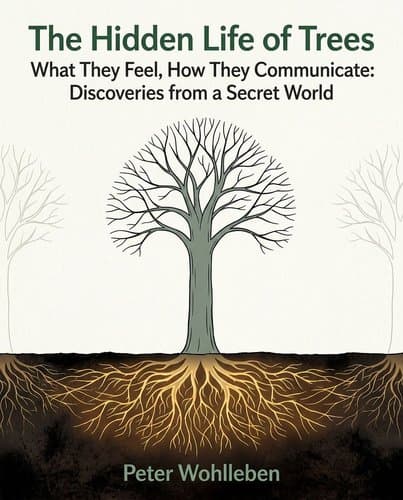
28256439_the-hidden-life-of-trees
by Peter Wohlleben
Trees form genuine partnerships, warn each other of danger, and nurse their sick—and a working forester's decades of observation proves it.
In Brief
Trees form genuine partnerships, warn each other of danger, and nurse their sick—and a working forester's decades of observation proves it. Wohlleben reveals the hidden social world beneath the canopy, forever changing how you'll see a walk in the woods.
Key Ideas
Partner trees deliberately space crowns for coexistence
You can see tree partnerships from below: look up into a forest canopy and find pairs that leave deliberate gaps between their crowns, growing strong branches only outward. These are genuine partners. Trees that crowd each other with competing branches are rivals — the difference is visible to anyone who knows to look.
Slow growth produces stronger disease-resistant timber
Slow-growing trees in a natural forest are healthy, not stunted. Dense wood from low-light childhood resists fungi, seals wounds faster, and produces trees capable of living for centuries. Fast-grown trees — from plantation conditions, extra light, or over-irrigation — develop large, air-filled cells that rot quickly once disease enters.
Harvesting removes trees at peak productivity
Old trees with trunk diameters over 3 feet generate three times the biomass of trees half as wide, and trunk rot from fungi doesn't reduce this productivity. Harvesting forests at 60–120 years removes their most productive carbon-capture members — at precisely the worst moment for climate stability.
Deadwood debris essential for forest biodiversity
A cleaned-up forest floor is an ecological red flag, not evidence of good management. At least 20% of all animal and plant species depend on dead wood. Standing deadwood, fallen trunks, and decaying stumps are the forest's slow-release nutrient system and its most biodiverse habitat — removing them impoverishes the ecosystem for generations.
Soil communities move too slowly for restoration
Soil communities move at the speed of a walk: some forest-floor insects can travel only 30 feet per year. When a forest is cleared and replanted, the organisms that make it function ecologically cannot simply return. 'Restored' forests on old farmland still show broken nutrient cycles and reduced drought resistance a century later.
Urban trees isolated from forest's fungal network
Urban and park trees are missing the underground mutual aid network that makes forest trees resilient. Isolated trees in compacted soil — without community root connections or established fungal partners — are ecologically closer to potted plants than to forest members. Urban greening programs that ignore this are building beautiful but fragile infrastructure.
Who Should Read This
Science-curious readers interested in Ecology and Biology who want to go beyond the headlines.
The Hidden Life of Trees: What They Feel, How They Communicate: Discoveries from a Secret World
By Peter Wohlleben & Tim Flannery & Jane Billinghurst & Suzanne Simard
8 min read
Why does it matter? Because the forest outside your window is running a society you've never been told about.
Walk into a forest and your brain tells you the same thing it always does: here is scenery. Beautiful, quiet, inert. Trees stand there doing nothing in particular, waiting for you to finish admiring them.
What this book argues — methodically, with chemistry and electrical signals and radioactive isotope tracers — is that your brain is wrong. Every tree around you is embedded in a social network older than any city, exchanging food, warning neighbors of danger, raising offspring in deliberate slow motion, and doing all of it through underground channels that science barely mapped until the 1990s. Peter Wohlleben spent twenty years as a professional forester — marking trees for harvest, counting board-feet, ordering felling crews — before any of this broke through. By the time it did, he'd already killed hundreds of them, and he knew exactly which ones. What converted him is the question this summary traces. It starts with a stump, cut long before he arrived, whose roots were still green with chlorophyll, still drawing sugar from the trees around it.
Trees Don't Just React to Their Environment — They Send Warnings, Summon Allies, and Identify Enemies by Taste
Trees are not backdrop. The moment something starts eating one, it launches a targeted counteroffensive that most people find hard to believe.
When a caterpillar bites into an elm or pine leaf, the tree reads the chemical signature of that caterpillar's saliva with enough precision to distinguish one insect species from another. It then releases a specific set of pheromones into the air — a recruitment call for the particular parasitic wasp known to prey on that exact species. The wasps arrive, inject their eggs into the living caterpillar, and the larvae devour it from the inside out. The tree, meanwhile, keeps growing. Wohlleben draws the logical conclusion directly: if a tree can identify saliva, it must be tasting.
Those same pheromones carry a second signal. Trees downwind pick up the broadcast and begin loading defensive compounds into their own leaves before any caterpillar reaches them. The threat hasn't arrived. They're already preparing.
What makes this hard to absorb is that it doesn't fit the model most of us carry — trees as passive, unaware, responsive only the way a thermostat is responsive. The saliva evidence describes something categorically different: a tree that distinguishes between attackers, matches a chemical signature to a species, and calibrates its response. You can call that instinct, or chemistry, or programming. What you can't call it is passive.
The reason we miss it is timing. Electrical distress signals move through leaf tissue at roughly a third of an inch per minute — against the milliseconds our own nerves take. An hour passes before defensive compounds reach the damage site. You look at a tree standing still and conclude nothing is happening. But nothing and slower than you can see are not the same thing.
The Forest Keeps Its Dead Alive — And This Rewrites What 'Survival of the Fittest' Means
Walking his beech forest one day, Wohlleben stopped at something he'd passed dozens of times without registering — a cluster of mossy humps arranged in a rough circle about five feet across. He assumed they were stones. He bent down, lifted the moss, and found bark. He scraped away the bark with his pocketknife and found something he didn't expect: a thin layer of green.
That green was chlorophyll. The living pigment trees use to photosynthesize. The stuff that requires sunlight, leaves, and an intact metabolism. The "stones" were the rim of a stump from a beech felled roughly 400 to 500 years ago. The interior had long since rotted to soil, but the outermost edge was still alive. Not dormant. Alive.
This should be impossible. A stump has no leaves, and without leaves it cannot capture sunlight, and without sunlight it cannot make sugar. Every living cell in that stump needed to eat, and had been eating, continuously, for roughly five centuries. The only explanation was that the surrounding beeches were feeding it. Through root connections and fungal filaments laced between them, neighboring trees had been pumping sugar into the stump long after any reasonable definition of "survival" would have written it off.
Wohlleben calls this friendship, a word most scientists would flinch at. But what he's describing is precise and verifiable. Researchers in Germany's Harz mountains have confirmed that trees of the same species growing together are almost always connected root-to-root, nutrients flowing between them as a standard operating condition, not an occasional accident. Massimo Maffei at the University of Turin found that trees can distinguish their own roots from those of strangers, routing the network toward kin.
A team at Germany's RWTH Aachen University put numbers to it. Rocky soil beside deep loam, wet ground beside dry, nutrient-rich patches beside barren ones — every tree in an undisturbed beech stand produced the same amount of sugar per leaf. Not approximately the same. The same. The underground network was moving surplus from strong trees to weak ones, equalizing output across the entire community. Wohlleben's comparison to a social security system isn't a soft analogy. It's the mechanics.
One Teaspoon of Forest Soil Contains Miles of Fungal Threads — And They're Running Their Own Agenda
The fungi beneath your feet are not support infrastructure for the trees. The trees are support infrastructure for the fungi.
Scale makes this visible. A honey fungus in Oregon covers 2,000 acres, weighs 660 tons, and is roughly 2,400 years old — the largest known living organism on earth. The trees it connects are smaller and younger than the network threading between them. One teaspoon of forest soil holds many miles of fungal filaments. When you look at a forest, you're seeing the tips of something much larger.
In the early 1990s, forest ecologist Suzanne Simard was puzzled by a recurring pattern: wherever paper birches were cleared from plantation rows, neighboring Douglas firs declined in clusters. She suspected something was moving between them underground. To find out, she spiked birches with radioactive carbon and waited. The isotopes moved through the soil and into the firs, a competing species that fought the birches for light and canopy space. But the transfer wasn't incidental leakage. The firs were net receivers, pulling more carbon from the birches than they returned, especially when shaded. And the flow reversed by season: each species took turns subsidizing the other depending on who needed help. When the paper appeared in Nature in 1997, the popular press named it the wood wide web, and the name stuck.
What the experiment revealed, and what Wohlleben makes explicit, is that the fungi threading between these species have their own stake in the outcome. Consider what happens if beeches outcompete everything else in a Central European forest: one pathogen, one severe drought, and the canopy collapses, taking the fungal network down with it. Fungi that have spent centuries building stable connections have everything to lose from monoculture. So they route carbon toward weaker, competing species, keeping them alive, maintaining the diversity that protects the whole system. What looks like generosity, from the trees' perspective, is risk management from the fungi's.
The forest runs on this infrastructure. The fungi built it, maintain it, and defend it: the network runs redundant paths, routing around damaged nodes the way the internet routes around failed routers. No single point of failure. For reasons that have nothing to do with altruism and everything to do with keeping a system alive that they depend on as much as the trees do.
Good Mother Trees Keep Their Children in Near-Darkness for Eight Decades. This Is Not Neglect.
Imagine you're a doctor examining a child who hasn't grown in ten years. In a beech forest, the same finding would mark a tree on track for a life of several centuries.
Wohlleben found beeches in his forest that looked, at a glance, about ten years old — barely twenty inches tall, trunks no wider than a finger. When he counted the tiny annual swellings on their branches, one formed per year, the tally on a single eight-inch twig reached twenty-five. These saplings were eighty years old. Being raised.
Mother trees close their canopies so thoroughly that only 3% of available sunlight reaches the floor below. At 3%, a sapling can barely keep its cells alive — no surplus energy for vertical growth. Foresters have called this "upbringing" for generations, and the word earns its place: the light restriction is a developmental technology.
A tree growing slowly in near-darkness builds cells that are tiny and dense, packed almost without air. Those cells flex in storms without snapping. Fungi — the primary cause of tree death — can barely penetrate them. When wounds open, the dense wood seals over before rot can establish a foothold. A fast-grown tree produces large, air-filled cells: an easy path for pathogens. Commercial plantations cut their trees at 80 to 120 years because the trees can't last longer. In a natural forest, a tree that age is still pencil-thick, still waiting, still building structure that will let it stand for four centuries.
During the wait, the mother does more than control light. Through the fungal root network she passes sugar and nutrients to saplings that can't yet produce enough on their own — slowing them while keeping them alive. When she eventually dies — a summer storm, a brittle trunk giving way under tons of crown — full sunlight floods the forest floor. The children race. Only those that shoot straight upward stay in contention; slower ones fall into the shade cast by faster siblings and dissolve back into soil. One of 1.8 million beechnuts will become a tree. The eighty years were preparation for that lottery.
Harvesting Old Trees Is the Most Expensive Ecological Mistake We Keep Making
Commercial forestry's harvest window is 60 to 120 years. Walk into a managed German forest and almost everything you see is under a century old. The reason given is growth efficiency: energy peaks early, the doctrine says, then wanes, so harvest the elders and replant with vigorous saplings. Forest-owner associations still teach this as settled science. Wohlleben, who trained inside the system, absorbed it without question for years.
An international team studied roughly 700,000 trees on every continent and found the doctrine precisely backwards. Older trees don't slow; they accelerate. Trees with three-foot-diameter trunks were producing three times the new biomass of trees half as wide. Trunk rot — the standard sign of a "declining" elder, the justification most commonly cited for harvest — had no measurable effect on growth rates at all. The rot is real. The slowdown is commercial fiction.
The climate consequences follow directly. Carbon capture scales with biomass production, which means the oldest trees are the forest's heaviest carbon-pulling machinery. Harvest them at the peak of their productivity, and a second loss begins: sunlight floods the now-open forest floor, and the organisms living there immediately accelerate, consuming humus layers that had been quietly locking away carbon for decades or centuries underground. The carbon released from the soil roughly equals the carbon in the timber removed. Every log taken doubles its own damage.
Wohlleben describes the industry's name for this cycle ('rejuvenation') as misleading at best. His sharper point: a tree harvested at 120 years has, from the forest's perspective, barely left adolescence. What gets planted in its place grows fast, stays structurally weak, and is cut again before it can ever become what it replaced. The forest isn't being renewed. The most productive part of it is being stripped away on a schedule built around the economics of lumber, not the capacity of a living system to hold a climate together.
Planting Trees Doesn't Restore a Forest — What You Actually Need Can't Walk Back on Its Own
When you plant a thousand trees in a cleared field, what have you made?
Something like a forest, the argument goes, or at least the beginning of one. Give it decades. The canopy closes, the undergrowth fills in. Nature does the rest.
But what fills in the rest, and how fast it can travel, is what the picture leaves out.
Consider the forest-floor weevils that have been living inside old deciduous forests for so long they can no longer fly. Some species travel thirty feet a year. Not per day — per year. If a forest was cleared in the Middle Ages and later replanted, which describes most of what we call forest across Europe, those weevils simply cannot walk back. The distance is too far. Their presence in soil is a biological timestamp: find them, and you're standing in ground that has been uninterrupted forest for centuries. No weevils means the break happened, and the break hasn't healed.
Planting misses all of this. A forest is trees plus the soil community that makes those trees function: the specialist mites, the springtails, the fungal networks, the thousands of species that decompose, recycle, and supply. Most of them move slower than you walk on a slow day. None of them can be planted.
The Lüneburg Heath, a historic heathland in northern Germany, shows what that gap costs. Oak forests planted there more than a century ago on former farmland look mature. They grow faster than oaks on ancient soil. Leftover agricultural nitrogen and full sun see to that. But the soil shows gaping holes in the species inventory, broken nutrient cycles, and nitrogen from old fertilizers still accumulating in the earth. When drought comes, these oaks fare noticeably worse than oaks rooted in ground that was never broken. The speed came at the price of resilience. A hundred years in, and it still isn't enough.
That gap is what "restoration" never accounts for. You can restore what's visible: the trees, the canopy, the green from a distance. But what makes a forest survive drought, resist disease, and parent the next generation is underground, mostly invisible, and largely immobile. We disrupted it over centuries. Its return, where return is even possible, will take centuries more. The forest we call restored is, by its own reckoning, still waiting to begin.
What You Cannot Un-See
The stump fed for five centuries by neighbors with no obvious reason to bother. The beech that reads saliva, identifies the species eating its leaves, and sends a chemical call for the exact predator equipped to handle that intruder. The elder tree — the one a forester marks for harvest — generating three times the biomass of anything planted to replace it. These aren't metaphors. They're what was measured.
The forest you walk through after this is not the same object you walked into before it. If a forest is a social system that can't be rushed into existence and can't be meaningfully restored in a human lifetime, the question is what we're prepared to stop taking from it: the old-growth trees that are the forest's heaviest carbon machinery, the soil communities that take centuries to reassemble after a clearcut. And how long we're willing to wait for what we've already taken.
Notable Quotes
“I've just described. What's the difference? Do tree societies have second-class citizens just like human societies? It seems they do, though the idea of”
“A chain is only as strong as its weakest link.”
“Just wait a couple of hundred years,”
Frequently Asked Questions
- What is the main premise of The Hidden Life of Trees?
- The Hidden Life of Trees reveals that trees are social organisms communicating through fungal networks, supporting injured neighbors, and raising offspring in the shade. Forester Peter Wohlleben's decades of observation demonstrate forests are complex communities rather than timber inventory. Trees form genuine partnerships visible in the canopy—partnered trees deliberately leave gaps between crowns and grow branches only outward. These partnerships, enabled by underground fungal networks connecting root systems, allow trees to share nutrients, support sick members, and collectively resist disease. Understanding this interconnected nature of forests is essential for recognizing what industrial forestry and urban planting practices destroy when they ignore these ecological relationships.
- How do trees communicate and share resources through underground networks?
- Trees communicate through fungal networks connecting root systems across the forest floor, forming a sophisticated system that transfers nutrients, water, and chemical signals between individuals. Strong, mature trees send resources to smaller trees raising offspring in the shade, essentially parenting the next generation. Sick or weakened trees receive priority support from healthy neighbors, functioning as a genuine community. The book demonstrates that trees form visible partnerships in the canopy—pairs that deliberately leave gaps between crowns. This underground mutual aid system shows that forests operate as interconnected organisms where individual trees respond to and support members' needs, making isolated trees far more vulnerable than those embedded in fungal networks.
- Why does harvesting forests at 60-120 years harm climate stability?
- Old trees with trunk diameters over 3 feet generate three times the biomass of trees half as wide and are the most productive carbon-capture members of forests. Harvesting at 60–120 years removes these peak-productivity trees at precisely the moment when their carbon-capture capacity is most needed. Trunk rot from fungi doesn't reduce their productivity—old, thick trees remain highly functional. Fast-grown replacement trees from plantation conditions develop large, air-filled cells that rot quickly once disease enters, offering poor long-term carbon storage. This practice removes a forest's most productive climate-mitigation assets while replacing them with inherently fragile trees, undermining global carbon-capture efforts.
- Why are urban trees less resilient than forest trees?
- Urban and park trees are missing the underground mutual aid network that makes forest trees resilient. Isolated trees in compacted soil lack community root connections and established fungal partners, making them ecologically closer to potted plants than forest members. Forest trees depend on interconnected fungal networks to share nutrients, water, and support during stress—benefits entirely unavailable to urban trees. Additionally, at least 20% of forest animal and plant species depend on dead wood; urban landscapes eliminate this entirely. Urban greening programs ignoring these biological needs create beautiful but fragile infrastructure vulnerable to drought, disease, and pests that connected forest trees would withstand collectively.
Related Book Summaries
Read the full summary of 28256439_the-hidden-life-of-trees on InShort