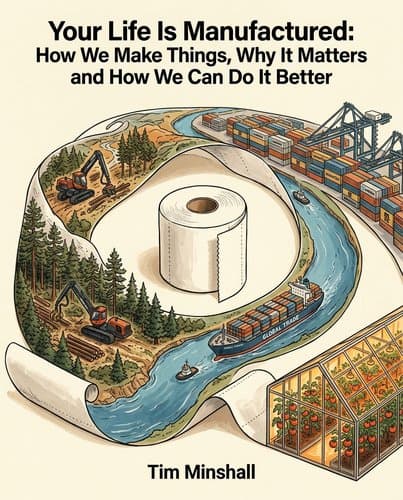
221193153_your-life-is-manufactured
by Tim Minshall
Every object around you — your phone, your coffee cup, your chair — hides a global web of mines, factories, and supply chains you've never had to think about.
In Brief
Every object around you — your phone, your coffee cup, your chair — hides a global web of mines, factories, and supply chains you've never had to think about. Tim Minshall reveals the hidden logic of manufacturing that determines what you can buy, what it costs, and why the modern world is far more fragile than it appears.
Key Ideas
Illusion of Explanatory Depth Reveals Knowledge Gaps
The 'illusion of explanatory depth' applies to almost every object you own — you believe you understand where it comes from until you try to explain it, and that gap is worth taking seriously
Efficiency and Fragility Are Supply Chain Tradeoffs
Lean manufacturing's elimination of 'waste' made supply chains hyper-efficient and hyper-fragile simultaneously — the same logic that delivers cheap goods means there is no 'Plan B' when a single node fails
Factory Archetypes Drive Cost and Scalability
The five factory archetypes (project, job shop, batch, mass production, continuous flow) determine everything about how a product is made — understanding which type made something tells you why it costs what it costs and why it can or can't scale
Digital World Depends on Physical Geographic Concentration
The digital world is physically located — in specific quartz mines, specific chip foundries, specific undersea cables — and is far more fragile and geographically concentrated than most people assume
Scope 3 Emissions Reveal True Environmental Impact
Scope 3 emissions (70% of a manufacturer's carbon footprint, buried in supply chains) are the number to watch when evaluating any company's environmental claims — headline factory efficiency improvements can be dwarfed by upstream and downstream impact
Circular Economy Already Works, Scaling Is the Challenge
The circular economy already exists in working form — British Sugar's Wissington factory is not a future vision, it's a current operating model — which means the question is not whether regenerative manufacturing is possible, but whether it will scale fast enough
Who Should Read This
Science-curious readers interested in Sustainability and Innovation who want to go beyond the headlines.
Your Life Is Manufactured: How We Make Things, Why It Matters and How We Can Do It Better
By Tim Minshall
12 min read
Why does it matter? Because every object you own is the final frame of a globe-spanning story you've never been told.
You probably think you know where your toilet paper comes from. Trees, roughly. Some factory somewhere. Fair enough. But
You Think You Understand Everyday Objects. The Toilet Roll Proves You Don't.
How well do you actually understand how a roll of toilet paper gets made? Most of us would say: trees, some kind of factory, a truck. That answer feels complete right up until the moment you try to fill in a single step.
Start in the Scottish Highlands, where industrial forestry machines with names like the Komatsu 931XC-2020 work through densely planted conifers that took four decades to grow. The machine clamps its jaws around a trunk, a built-in chainsaw drops it in seconds, and onboard sensors immediately calculate the optimal way to section that specific tree before spinning blades strip and slice it — all before the branches have stopped shaking. Decades of growth, processed in under a minute. The usable wood gets chipped and chemically tortured at a pulp mill to liberate the cellulose fibres buried inside. Those fibres are dried into bale-sized sheets and shipped — often across an ocean — to a rolling mill, where they're rehydrated and sprayed in layers onto a five-metre-wide wire mesh moving at sixty kilometres per hour. What comes off the end gets wound onto a steel drum the size of a small car, then sliced, embossed, glued into ply, and cut to the width of the sheet sitting in your bathroom. One mill produces fourteen thousand rolls an hour.
That's exactly what happened in 2020. When lockdowns hit, toilet paper sold at seven times its normal rate. But the shortage wasn't simply about panicked shoppers clearing shelves. It was about two entirely separate manufacturing systems — one producing small, soft, branded rolls for households, another making thick, recycled-fibre rolls in bulk for offices and public buildings — that cannot swap customers on short notice. Retooling a factory to serve a different market means different machinery, different suppliers, different packaging lines. It takes months and costs serious money, and the moment normal life resumed, you'd face the same problem in reverse. The factories weren't broken. They just weren't designed to flex.
Ask someone how toilet paper gets made and they'll say: trees, factory, truck. Ask them to explain a single step and the answer starts to dissolve. The gap between how well we think we understand something and how well we actually do turns out to be enormous.
The Real Scale of Making Things Will Rearrange Something in Your Brain
Dave won't let Tim Minshall touch the controls. Fair enough — the crane costs £12 million and hangs above a ship stacked with containers, each weighing up to fifty tonnes. Minshall sits in the operator's cab high above the quay at Felixstowe, safety gloves sweating, joysticks just out of reach, and looks down at what amounts to a living diagram of global manufacturing: thirty-three cranes stretched across nearly four kilometres of dockside, handling four million shipping containers every year, with up to 150,000 sitting in the yard at any one time. The software tracking their contents, positions, and collection windows is playing three-dimensional Tetris — except every wrong move means a fifty-tonne box blocking the wrong ship at the wrong tide.
Then Dave mentions, almost as an aside, that Felixstowe — the UK's busiest container port, handling nearly a third of everything the country imports and exports by sea — doesn't appear anywhere on the list of the world's fifty busiest ports. Shanghai moves fifteen times the volume.
That's the number that rearranges something. You already knew global trade was large. But there's a difference between knowing that and standing on a crane walkway watching what looks like a city made entirely of steel boxes, being told this is a minor operation by world standards. The manufacturing world isn't a bigger version of the world you can see. It's a parallel infrastructure, running constantly beneath everyday life, at a scale that human intuition isn't built to hold.
And Felixstowe is just one node in a chain that reaches back through container ships crossing the Indian Ocean, through factories assembling components shipped in from a dozen other countries, through chemical plants and smelters and forests. An iPhone travels roughly 250,000 kilometres before it reaches a pocket — more than six times around the Earth — because no single company possesses every specialised skill the device requires. Each subsystem gets made where the expertise exists, shipped somewhere else for the next stage, shipped again. The physical distance is a side effect of the knowledge being scattered — and the knowledge is scattered because each of those skills took decades, sometimes generations, to accumulate in one place.
Once you see it, the supermarket shelf looks different. All those products just being there, every morning, isn't convenience. It's the visible tip of something vast.
The Efficiency That Makes Everything Cheap Also Makes Everything Fragile
The efficiency that makes everyday objects cheap also guarantees that when something goes wrong, it goes wrong catastrophically. This isn't a side effect of global manufacturing — it's baked into the logic of how the system was designed.
The philosophy is called lean manufacturing, and its intellectual godfather is Taiichi Ohno, the Toyota engineer who spent his career hunting down waste wherever it hid inside a production system. Excess inventory sitting in a warehouse? Waste. A backup supplier standing by in case your primary one fails? Waste. Every other form of slack — idle machines, redundant routes, safety stock — was waste to be eliminated. The goal is to have exactly what you need arriving exactly when you need it, with nothing sitting idle anywhere in the system. Applied with discipline, this philosophy genuinely delivered: lower costs, faster throughput, products that consumers in the 1990s and 2000s could suddenly afford that previous generations couldn't.
But eliminated redundancy means eliminated buffers. And buffers are what a system falls back on when something unexpected happens.
In March 2021, a 200,000-tonne container ship called the Ever Given ran aground and wedged itself across the Suez Canal — a channel so narrow that traffic can only move in one direction at a time. Around 30 percent of the world's shipping containers pass through it. For the week it took to free the vessel, roughly $10 billion worth of trade stopped moving every single day. Ships rerouted around the southern tip of Africa, adding five thousand kilometres and around ten days to their journeys. A lean system with no inventory cushion, no alternative routing built in, no Plan B — experienced this as seizure.
The canal cleared. The system resumed. But the fragility it revealed hasn't gone away, because it isn't situational — it's structural. Cut the redundancy out of a network of interdependent nodes and you don't just make it efficient. You make it brittle. Every optimisation that brings the price down is also a buffer removed. Those two things are the same decision.
Modern Manufacturing Was Born the Day a Gunsmith Needed Bodyguards
Paris, 1785. A gunsmith named Honoré Blanc arranges a table of musket components in front of sceptical French military generals and seething fellow craftsmen, then scrambles the parts together and reassembles several working weapons from the mixed pile. The demonstration takes minutes. The consequences take centuries to unfold.
What Blanc was proposing sounds almost trivially obvious now: make every part to such consistent dimensions that any trigger fits any lock, any barrel fits any stock. Before this, every gun was bespoke. A broken component meant finding an armourer who would grudgingly hand-file a replacement to fit that specific weapon. In the field, this required dragging a mobile blacksmithing operation to the front line. Interchangeable parts would make spare components as simple to carry as ammunition. But the craftsmen in that room understood immediately what it meant for them: if anyone could follow a jig and stamp out a standard part, the painstaking skill that commanded their wages was worthless overnight. The hostility was intense enough that the French government moved Blanc and his workers into the basement of the Château de Vincennes for their physical safety. One of the more attentive audience members at the original demonstration was Thomas Jefferson, then serving as US Minister to France, who carried the idea back across the Atlantic where it became the foundation of American industrial production.
Interchangeable parts required two supporting innovations that rarely get equal billing: precision measurement tools capable of detecting whether a part met its specified tolerances, and machine tools — cutting and grinding devices that could produce accurate parts repeatedly, in volume, without relying on a craftsman's trained eye. Once those three things existed together, the logic of mass production became hard to resist. A century later, Henry Ford observed the efficiency of slaughterhouse disassembly lines, where each worker performed one cut as carcasses moved past on a powered conveyor, and ran the concept in reverse — things being assembled rather than taken apart, each worker repeating one action as the product came to them. Throughput exploded. But quality collapsed into a rearguard action of inspectors catching defects after the fact, until W. Edwards Deming, an American statistician who would later transform Japanese manufacturing, and Toyota's engineers realised the inspection model was backward: the person making the mistake should stop the line immediately, not pass the problem downstream. That single inversion — responsibility to the worker, not the auditor — is why the car you drive probably starts every morning.
Three contested ideas, each fought over by people whose livelihoods hung on the outcome. None of it was ordained. Every step was argued into existence by people with something to lose if they were wrong — and opposed by people with something to lose if they were right.
92 Billion Transistors on a Fingernail, and the Factory That Makes It Possible
Think of the internet as pure thought — invisible, weightless, existing somehow above the messy physical world of steel mills and shipping containers. That intuition is wrong, and one Dutch machine is enough to demolish it.
To make the chips that power every smartphone, laptop, and data centre on earth, manufacturers need to etch billions of microscopic transistors onto a wafer of silicon. The only equipment capable of doing this at the required precision is built by a single company in Eindhoven: ASML. Their TWINSCAN machine is the size of a city bus, has 100,000 individual components — including two kilometres of internal cabling — costs $150 million per unit, and requires forty shipping containers to deliver and install. One machine. Forty containers. There is no substitute, and no second source.
Now consider what that machine actually produces. The Intel 4004 microprocessor, released in 1971, packed 2,250 transistors onto a chip roughly the size of your fingernail. That was remarkable enough to be called a revolution. The 2024 Apple M3 Max fits 92 billion transistors into the same space. Worth checking twice: the physical chip hasn't grown. The density has increased by a factor of roughly forty million in fifty years.
Making that chip isn't a single act of engineering — it's a globally distributed relay race. The silicon likely began as quartz pulled from a mine in North Carolina's Blue Ridge Mountains, chosen because the geology there produces unusually pure rock. The circuit layout was probably designed by ARM in Cambridge. The actual fabrication almost certainly happened in Taiwan, inside a TSMC foundry, using those ASML machines shipped from the Netherlands. Four countries, one component — and if any leg of that relay breaks, the consequences aren't local. A single factory fire in Taiwan, a blockade in the Taiwan Strait, a trade dispute with the Netherlands: any one of them can starve the electronics industries of entire continents within months. The supply chain isn't just geographically concentrated. It's geographically fragile.
The digital world doesn't float above physical manufacturing. It depends on it more completely than almost anything else we make.
Manufacturing Is Causing the Climate Crisis — and It's the Only Thing That Can Fix It
Here is a claim worth sitting with: manufacturing is the primary cause of the environmental crisis, and it is also the only mechanism capable of resolving it. There is no version of this story where we stop making things. The question is whether the industrial capacity we have built does damage or repairs it.
The damage is not abstract. Cement alone — the material holding together every highway, hospital, and apartment block — generates around 8 percent of all global carbon dioxide emissions. That is four times the combined output of every commercial flight on earth. Cement isn't a niche industrial process. It is the second most consumed material on the planet after water, and demand is rising. Fashion produces more greenhouse gases annually than international aviation and maritime shipping combined, and recycles just 1 percent of the clothes it makes. The global food system wastes 40 percent of everything it produces — 2.5 billion tonnes every year — which means roughly 10 percent of all food-related emissions are generated growing, processing, and shipping food that nobody ever eats. These aren't distant projections. They are current operating figures for the system that makes everyday life possible.
The same system is also where the solutions are being built. The British Sugar factory outside the village of Wissington in Norfolk is one of the more instructive examples. Every year, millions of tonnes of sugar beet arrive by truck convoy from over a thousand farms. The operation produces 400,000 tonnes of sugar — and used to produce enormous amounts of waste alongside it. Then a team led by a plant manager named Gary decided to treat every by-product as a raw material for something else. The mud caked on incoming beet, previously washed away, became 150,000 tonnes of topsoil sold for landscaping. Stone removed in the same process became aggregate. Leftover liquid from sugar extraction became bioethanol, now blended into petrol at forecourts across the country. The factory's surplus heat and carbon dioxide, formerly vented into the atmosphere, were piped into eighteen hectares of glasshouses to grow tomatoes. The factory also generates enough surplus electricity to supply around 120,000 homes. None of this required new science. It required someone deciding that 'waste' was just a failure of imagination about what a material could become.
That shift — redesigning the system so that waste loses its meaning, rather than asking consumers to recycle more diligently — is what actually changes the numbers. Manufacturing caused this crisis through a century of treating the natural world as a one-way input. Reversing it runs through exactly the same factories, the same engineers, the same industrial logic — just aimed at a different destination.
When Crisis Hits, Manufacturing Is the Infrastructure That Saves Lives — If It's Resilient Enough
Early 2020, and the UK had eight thousand ventilators. Scientists modelling the pandemic's trajectory said it might need ninety thousand. There were almost none available to buy anywhere in the world — every country was scrambling at once. So the government did something that sounds absurd: it asked the firms that build fighter jets and Formula 1 cars to design a medical device capable of keeping critically ill patients alive, build it at scale, and do it fast.
What followed is one of the more arresting demonstrations of what industrial capacity actually means when lives are on the line. More than fifty manufacturers — most of whom had never made a medical device — took on the challenge. They set up seven new production facilities inside factories normally devoted to aerospace and motorsport. In a week and a half, new supply chains were assembled to source forty-two million components. Three thousand five hundred workers who had never seen a ventilator outside a television drama were trained to build them. Before the pandemic, the UK produced five ventilators a day. At peak, those converted factories were turning out four hundred. Within three months, fourteen thousand additional units reached hospitals.
The ventilators didn't save lives because someone had a clever idea in a crisis. They saved lives because the industrial capability — the machine tools, the skilled engineers, the manufacturing knowledge — already existed and could be redirected. Countries without a domestic manufacturing base of that kind had no equivalent fallback.
Manufacturing resilience is infrastructure in the same sense that a hospital building is infrastructure. When it's absent, or when decades of offshoring and lean optimisation have stripped out every spare ounce of flexibility, the cost isn't measured in percentage points. It's measured in who gets a ventilator and who doesn't.
You're Not a Passive Consumer. You're a Participant in the System.
What would it mean to actually understand the system that makes everything you own? Not to feel guilty about it, or optimistic about it, but to see it clearly enough to act differently within it.
Minshall offers a frame that stays with you. Two worlds run simultaneously: the regular world of homes and shops and offices, and the manufacturing world of mines, forests, factories, and container ports. Most of us live entirely in the first and treat the second as background noise — something that produces the things we buy, too large and complex to influence. That assumption is what this book is designed to dismantle.
Visibility is the first form of agency. Once you've traced the toilet roll from Scottish forest to bathroom shelf, or watched a cement plant's worth of emissions get quietly reassigned to a foreign country while domestic figures look clean, you're no longer a passive recipient of the system's outputs. You're a participant with some capacity to influence it. What you buy, how long you keep it, whether you repair it — even one of those, done with the system in mind, is different from doing it blind.
Minshall is candid about his own position inside this. In 1997, he interviewed skilled UK manufacturing workers specifically to document their expertise — so that their jobs could be moved to China or Mexico. He names this plainly, without self-exoneration. Individual people, acting within the logic of a system, make that system what it is. That's not a reason for paralysis. It's a reason for paying attention.
The Object in Your Hand Is a Question Worth Asking
Pick up whatever's closest to you right now. A mug, a pen, your phone. Hold it for a moment and ask three questions: where did this actually come from, who made it, and what did the world absorb so it could exist here in your hand? You probably can't answer any of them fully — and that gap, that honest incomprehension, is exactly where Minshall wants you to start. Not because ignorance should produce guilt, but because the moment you notice the gap, something shifts. You've stepped out of the consumer's passive role — objects just appearing, prices just being what they are — and into the manufacturing world, where every choice has an upstream cause and a downstream consequence. That's not a burden. It's the beginning of something. The people inside the system designed it, argued over it, broke it in specific ways, and kept going. Which means people can change it — starting with anyone willing to ask where things come from.
Frequently Asked Questions
- What is "Your Life Is Manufactured" about?
- The book exposes the hidden systems behind every physical object you own, from supply chains to digital infrastructure. It explains why manufacturing decisions shape cost, sustainability, and resilience. Tim Minshall provides conceptual tools to evaluate how things are made, understand environmental claims, and identify opportunities for a circular economy. He highlights the "illusion of explanatory depth" that applies to almost every object you own — you believe you understand where it comes from until you try to explain it, and that gap is worth taking seriously.
- How did lean manufacturing create fragile supply chains?
- Lean manufacturing's elimination of 'waste' made supply chains hyper-efficient and hyper-fragile simultaneously. The same logic that delivers cheap goods means there is no 'Plan B' when a single node fails. This efficiency comes at the cost of redundancy and flexibility. When manufacturers removed buffer stock, duplicate suppliers, and safety margins to reduce costs, they created systems where disruption at any point cascades through the entire supply chain. This tension between efficiency and resilience has become critical in a world facing increasing shocks.
- What are the five factory archetypes and why do they matter?
- The five factory archetypes—project, job shop, batch, mass production, and continuous flow—determine everything about how a product is made. Understanding which type made something tells you why it costs what it costs and why it can or can't scale. Each archetype differs in how it processes diverse versus standardized products and at what volumes. Project factories build custom one-offs; job shops handle varied custom work; batch production manages moderate volumes of different products; mass production optimizes high-volume standardized goods; continuous flow maximizes efficiency for commodity products. This framework is fundamental to understanding manufacturing.
- What role do Scope 3 emissions play in evaluating environmental claims?
- Scope 3 emissions—accounting for 70% of a manufacturer's carbon footprint and buried in supply chains—are the number to watch when evaluating any company's environmental claims. Headline factory efficiency improvements can be dwarfed by upstream and downstream impact. Many manufacturers tout reductions in their own operations while outsourcing emissions-intensive activities, creating a misleading sustainability picture. Understanding the full lifecycle of a product, from raw material extraction through end-of-life disposal, is essential for assessing genuine environmental progress versus strategic carbon accounting that hides true impact.
Related Book Summaries



Read the full summary of 221193153_your-life-is-manufactured on InShort